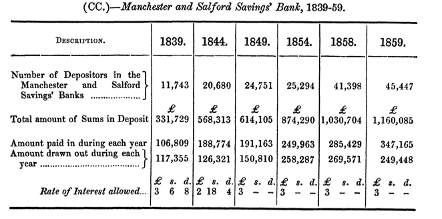
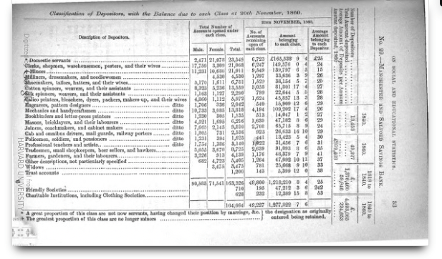
20.18. Infant Mortality.

Manchester, Salford, Chorlton

 BirthsBurialsUnder 1 Year1 to 4 YearsPer 1000 BirthsPer 1000 Births
       
1838-1839 (+)10,7009,2762,0452,214191207
1839-1840 (+)10,1928,6672,1162,442207240
184114,05110,3782,6512,546188181
184213,85710,7483,0292,566218185
184314,10911,057N/AN/A  
184415,19410,470N/AN/A  
184515,80210,8982,9442,470186156
184616,75814,095 Typhus+ Irish4,2253,508252209
184715,48215,114 Typhus+ Irish3,4133,441222222
184814,94913,8413,2813,585219240
184916,68614,4263,6312,876217172
185014,40311,3833,3642,463233171
185117,57011,8553,4182,173194123

(+) Only Manchester plus Salford

Figures from Annual Reports of the Registrar-General, 1838-1839 to 1851.
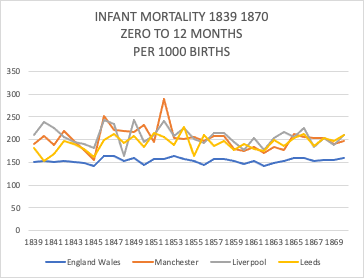
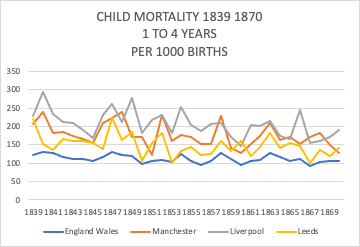
Graphical Representation of data from the previous page, continued with data extracted from Annual Reports of the Registrar-General up to 1870

The figures of infant mortality (zero to twelve months at death) in England as an average were lower than in other countries during the 19th century. The figures for Manchester and Liverpool, i. e. the worst cases in England, were on average 210 in 1841-1851, and decreased to about 175 in 1900. This means that the average in Germany was equal to Manchester and Liverpool from 1825 to 1845, and then was more throughout the rest of the nineteenth century. The data shown for each country include rural and urban areas; since industrialization did not start until 1830 on the European mainland, we can suppose that the figures correspond in a large proportion to agricultural communities and small towns. Thus the high figures (from our point of view) from industrial towns in England, are close to those from agricultural areas in all the other countries. 2.21
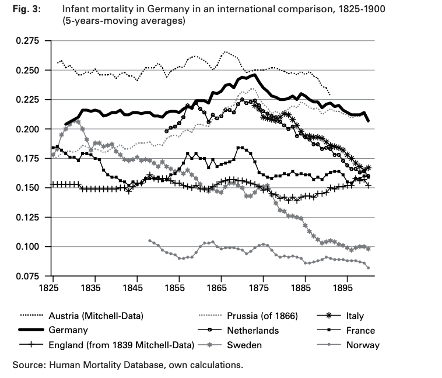
For the whole period 1830 to 1900, Bavaria and Baden were over 250/1000.

2.21 Gehrmann, Rolf, “Infant Mortality in Germany in the 19th Century”, Comparative Population Studies, 2011, pp. 839-869.

Taux de mortalité infantile depuis 1745

(Rate of infant mortality after 1745)
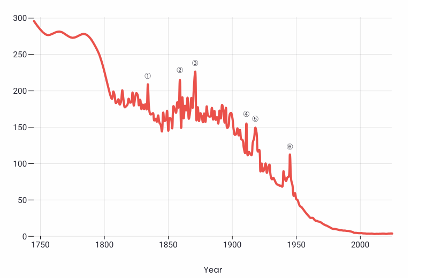
INED: Institut National d’Études Démographes, la mortalité en France en Chiffres: décès avant l’âge d’un an (Publié le 2/12/2015).

(INED: National Institute of Demographic Studies; Mortality in France in figures, death before the age of one year: Published 2/12/2015)

Chadwick informs us of extreme sanitary problems and high infant mortality in New York and Philadelphia. 2.22.

2.22 Edwin Chadwick, “On the Best Modes of Representing Accurately, by Statistical Returns, the Duration of Life, and the Pressure and Progress of the Causes of Mortality Amongst Different Classes of the Community, and Amongst the Populations of Different Districts and Countries”, Statistical Society of London, Vol VII, April 1844, pp. 1-40

https://www.jstor.com/stable/2337744

Mulhouse

In 1835, the Academy of Moral Sciences requested a doctor with a knowledge of statistics, Dr. Louis René Villermé, to conduct an investigation into the conditions of labour in the cotton, wool, and silk industries in France. Dr. Villermé finished his work (“Tableau de l’État Physique et Moral des Ouvriers dans les manufactures de coton, de laine y de la soie”) after some years (the on-the-spot investigation in Mulhouse was in June and July 1835 and September 1836), and published it in 1840. The conclusions with respect to some of the towns were very negative, and the worst case was Mulhouse.

The reaction of the French population was of anger, and in less than 12 months, a Law on the Employment of Children was passed. There was to be no employment of children under the age of 8 years old; the maxima of the working day were to be 8 hours for children of 8 to 12 years, and 12 hours for children of 12 to 16 years; no night work for children of under 13; children under 12 years had to attend school.

“As to the workers in spinning and weaving, who offer in all the stages of life the highest mortality, … one has forgotten without doubt how much they are wretched, pale, worn out by scarcities and fatigue. I use the word “scarcity”, as it is obvious that they are far from obtaining, in exchange for their work, good food and in sufficient quantity. It is therefore not surprising they succumb at all ages, in a higher proportion than all the others.

…..

The excessive mortality which reap the families of the workers employed in the spinning and weaving of the cotton in Mulhouse, has an effect particularly on the earliest periods of life. Exactly, while the half of the infants born in the class of manufacturers, of businessmen and directors of factories, will reach their twenty-ninth year, the half of the children of the weavers and the simple workers in spinning would have terminated their existence, one hardly dares to believe [“on ose à peine le croire”], before the age of two completed years.” 2.23

[Literally, the children of the poorest category of workers had an average life expectation of less than 24 months. Figures extracted from the Civil Register by Dr. Villermé, and accepted in a parallel investigation, carried out by a representative of the owners]

“It is necessary to observe them, arriving in the morning, and departing in the evening. There are, among them, a multitude of pale women, thin, walking barefoot in the mud, and who, as they do not have an umbrella, have upside-down on their heads, when it rains, an apron or an outside petticoat, to cover the body or the neck, with a considerable number of small children, not any less dirty, not any less haggard, covered with rags impregnated with the oil of the looms, which falls on them while they work. These last, better preserved from the rain by the impermeability of their clothing, have in their arms not even – as do the women of whom I have just been speaking – a basket with the provisions of the journey; but they have in their hands, or hidden in their jacket, as well as they can, the piece of bread which has to feed them until their return to the house.” 2.24

2.23 Villermé, Dr. Luis René, “Tableau de l’État Physique et Moral des Ouvriers dans les manufactures de coton, de laine y de lasoie”, 1840, Tome II, pp. 253-255

2.24 Villermé, Ibidem, Tome I, p. 26

Infant Mortality (causes)

The deaths in infancy in industrial regions of England were high, but this was not due to the very insanitary surroundings in which the small children were “brought up”, but rather to the very low level of care by the mothers, who did not have the time to look after them.

“The great mortality among children under 2 years of age is not directly chargeable to the factory system. The mortality between 1 and 2 is greater in Birmingham than in Manchester, for those are the two places especially contrasted. To what cause, therefore, may it be attributed? To no one in particular. The manners and habits of the people have much to do with it. That some localities are less healthy than others there can be no doubt. The most plausible reason which I can find is, not that the youths die in factories, but that the very young children are, under the existing system, not sufficiently taken care of by the mothers – both as regards themselves during gestation, and their offspring during childbirth. The women, during pregnancy, continue as long as possible at their work, and after child-birth return to it sooner than they ought, leaving their infants to the care of ill-paid and unsuitable persons. Nor ought we to omit, that soothing drugs, such as the well-known nostrum, Godfrey’s Cordial, are often had recourse to, with a view to ease the pains and to quiet the restlessness of infants; and it is perhaps to this improper use of narcotics that the frequent deaths from convulsions may be attributed. However desirable it may be, on other grounds, to regulate the labour of youths in factories, it is still more expedient, that mothers should not, if possible, be abstracted from attention to their helpless infants, particularly during the periods of lactation and teething.” 2.25

2.25 Johns, William (Registrar for Manchester), Report upon the Working of the Registration and Marriage Acts, during the Two Years 1837-38 and 1838-39, in the Registration District of Manchester
Journal of the Statistical Society of London, Vol. 3, No. 2 (Jul., 1840), pp. 191-205; Here: pp. 195-6.
https://www.jstor.org/stable/2337734

“From enquiries made by Dr. Willis from cellar to garret, and from house to house in Dublin, he found the average age at death of the working classes to be 18 years, decimal 65, which it will be seen, is about the same age as that in one of the lowest districts in London, Bethnal Green; it being in the best districts in London about 30. The average age at death of those of the working classes in Dublin who had attained 21, was no more than 34.70; whilst even in Bethnal Green it is not less, apparently, than 46.

Speaking of the deaths of children he [Dr. Willis] states, “the deaths up to 5th year are rather under those of Manchester, Leeds, &c.; above 5 and up to 10, the mortality is very great, and more than in any of your manufacturing districts. I wish to avoid all theory, yet I cannot resist endeavouring to account for this excess of mortality at the ages of 6 to 10.

The mothers with us have no employment, and, therefore, even in their wretchedness they bring up a greater proportion of infants, say up to 5th or 6th years; from this to the 10th year, very many of our poor children have not the same comforts as your factory children, and therefore furnish a larger proportion of deaths.

“The average number of children baptized to each marriage, is 5.70; average number now living to each marriage, 2.67. Of mothers who have had eight or more children, only 1 in 718 never lost a child; of mothers who have had six or more children, only 1 in 215 have never lost a child!”” 2.26

2.26 Chadwick, Edwin, “On the best Mode of representing accurately by Statistical Returns, the Duration of Life, and the Pressure and Progress of the Causes of Mortality amongst different Classes of the Community, and amongst the Populations of different Districts and Countries”, Journal of the Statistical Society of London, Vol. VII, 1844, pp. 1-39 (here, pp. 20-21)

“I now return to the dismal topic of infant mortality, the undue proportion of which arises from the neglect of mothers who are compelled to leave their young children at home while they labour in the mill. This I believe to be the blackest blot on the factory system. Whether it can be remedied is a question which I shall not attempt to answer. “Pregnant women” says Dr. Johns, “frequently continue their work up to the very last moment, and return to it as soon as ever they can move about.” “In Ashton-under-Lyne,” says Dr. Coulthard, “it is no unfrequent occurrence for mothers of the tenderest age to return to their work in the factories on the second or third week after confinement, and to leave their helpless offspring in the charge of mere girls or superannuated old women.” 2.27

2.27 Reach, Angus Bethune (reporter, 19th century, for Lancashire). Included in: Routledge Library Editions, The History of Social Welfare, Edited by J. Ginswick.“Vol. 3, Labour and the Poor in England and Wales 1849-1851, The Letters to the Morning Chronicle from Correspondents in the Manufacturing  and Mining Districts the Towns of Liverpool and Birmingham, and the Rural Districts, Vol. 1, Lancashire, Cheshire, Yorkshire”. Here: p. 47.

“As in Coventry and Nottingham, so in Manchester, the large diarrhoeal mortality of children is partly attributed by the medical men to the neglect arising from the employment of women in factories. Infants, it is said, are frequently left by their mothers, at the age of three or four weeks, for the greater portion of the day, during which they are fed upon bread and water, and more rarely upon arrow-root and milk. Coffee, meat, and “little drops” of gin are also sometimes given to infants; and the system of drugging with Godfrey’s Cordial is so common, that one druggist is reputed to sell thirty gallons per week of this narcotic. Mr. Leigh, one of the sub-registrars, and likewise a medical practitioner, who has devoted much attention to the sanitary state of Manchester, attributes the frequency of atrophy in young children to this system of drugging them with opiates, and the large mortality among children from diarrhoea, to neglect; …..” 2.28

2.28 Dr. Heedlam Greenhow, “Report on Diarrhoea in Manchester”, Addressed to the Public Health Department of the Privy Council, presented to both Houses of Parliament in 1859.

Quoted in:

Kay-Shuttleworth, Sir James, Four Periods of Public Education, 1862, Sketch of the Progress of Manchester in thirty Years, from 1832 to 1862; pp. 87 to 170, here p. 164.
20.17. Infant Mortality and Non-infant Mortality

We are conscious of the fact that, in the industrial towns of England in the first half of the Nineteenth Century, half of the babies died before their 60th month of life; further, that of the absolute number of deaths in a given year, and in a given town, 50 % were of children under the age of 5 years.

So that the other persons died at some age of above 5 years. The question is, what was their velocity of dying?

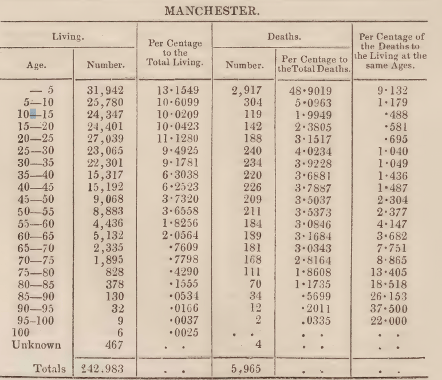
We have the answer below, for Manchester in the year 1841, combining the Age of the Living from the Census, with the Mortality data from the Annual Report of the Registrar-General, by age cohorts. 2.20

We see that for the persons of 5 to 44 years old in Manchester, the probability in 1841 of dying in the following 12 months was some figure between 0.5 % and 1.5 %.

This is not really a difficult health situation.

2.20 Neison, F. G. P.

On a Method recently proposed for conducting Inquiries into the Comparative Sanatory Condition of various Districts, with Illustrations, derived from numerous places in Great Britain at the period of the last Census.

Journal of the Statistical Society of London, Vol. VII, 1844, pp. 40-68 (here, p. 58)

[Data taken by Mr. Neison from the Census of 1841 and from the Annual Report of the Registrar-General for 1841]

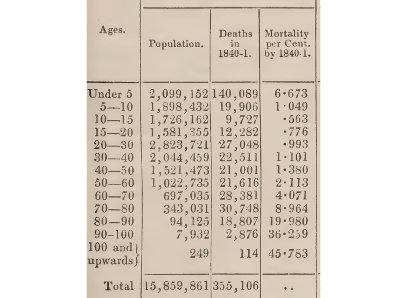
Mortality in England by “cohorts” for the Year 1841.

Result: for persons of from 5 to 50 years old in England in 1841, the probability of dying in the following 12 months is from 1.1 % to 1.4 %.

Neison, 1844, op. cit, p. 47

[Unfortunately, the figure for the Total of the Living, as shown, is not at all close to the population of the three Registration Districts of the conurbation of Manchester according to the Census of 1841. Very probably the calculation was made without including Salford.     It is not possible to adjust the calculation to add Salford, because there are differences in the definitions of the regions. We therefore pass to a calculation for the total of Manchester conurbation in 1851]

Calculation for Manchester 1851, Both Sexes

AgeNumber LivingPercentage to Total LivingDeaths
Number
Percentage to Total DeathsPercentage Deaths To Living same Age
      
0 – 451,73612.89 %5,51046.81 %10.65 %
5 – 942,79610.66 %5224.43 %1.22 %
10 – 1441,09310.24 %2341.99 %0.57 %
15 – 2482,26520.50 %7776.60 %0.94 %
25 – 3471,28617.76 %9117.74 %1.28 %
35 – 4450,43112.57 %8927.58 %1.77 %
45 – 5433,0338.22 %9648.19 %2.92 %
55 – 6419,0544.75 %8066.85 %4.23 %
65 – 747,3401.83 %7196.11 %9.80 %
75 – 842,0700.52 %3743.18 %18.07 %
85 – 1002470.06 %630.54 %25.51 %
      
All Ages401,231 11,772 2.93 %
      

Calculation by this author

Sources:

“Number Living” from Census 1851

“Deaths Number” from Annual Report of Registrar-General 1851.

Result:

For persons of from 5 to 44 years old in Manchester in 1851, the probability of dying in the following 12 months is from 1.0 % to 1.8 %.

England 1851:

  Males 1851Females 1851 Both Sexes 1851
     
0 – 47.2986.299 6.799
5 – 90.8690.866 0.867
10 – 140.4910.527 0.509
15 – 240.7760.818 0.797
25 – 340.9881.005 0.996
35 – 441.2361.193 1.214
45 – 541.7871.519 1.653
55 – 643.0312.679 2.855
65 – 746.2965.854 6.075
75 – 8414.95512.818 13.886
85 – 9428.24526.337 27.291
95 and up41.93745.017 43.477

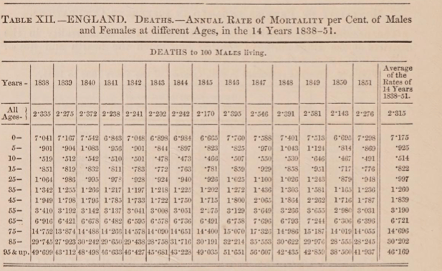
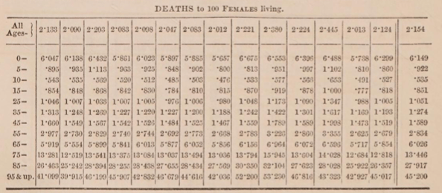
(see last right-hand column of the tables above)

For persons of from 5 to 44 years old in England in 1851, the probability of dying in the following 12 months is from 0.5 % to 1.2 %.

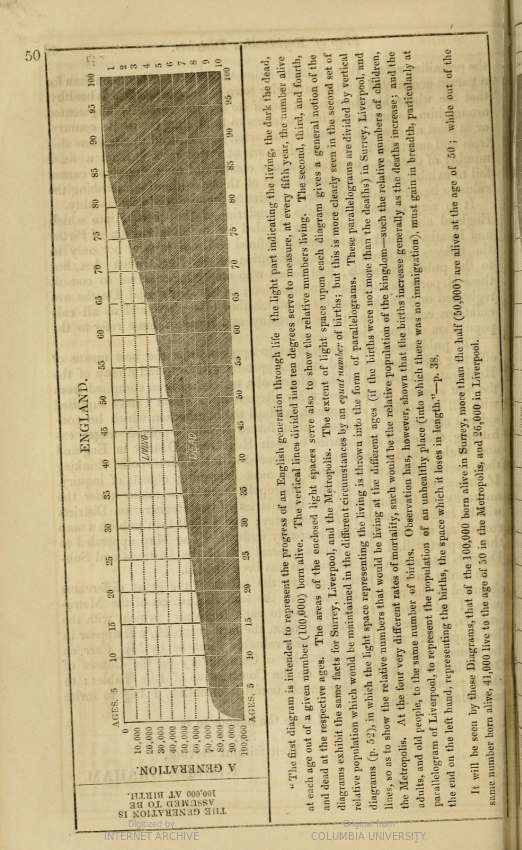
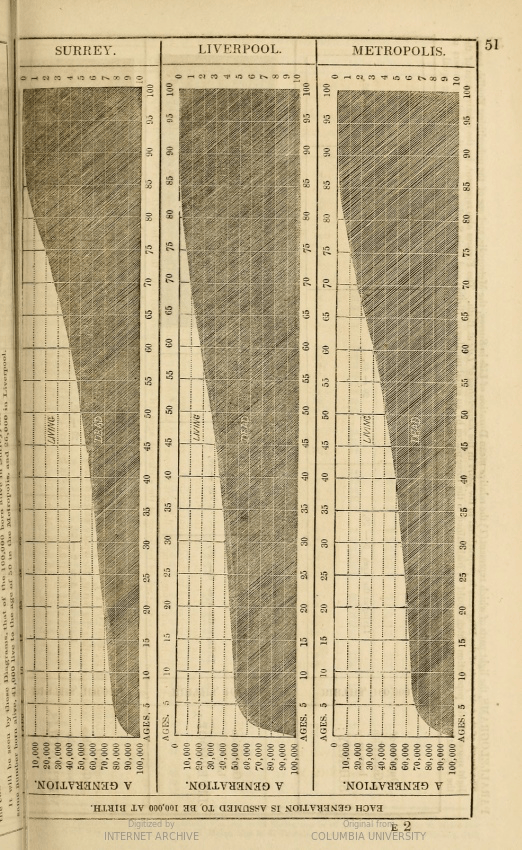
Dr. Farr gives us a graphical demonstration of the advance of the proportion of deaths in each of the cases. Note that the “gradient of deaths”, i.e. the increase of cumulative deaths for persons in each “cohort” above the age of 5, is very similar in the cases of: England, rural Surrey, Liverpool, and the Metropolis.

Fifth Annual Report of the Registrar-General, Report 1841, pp. 50-51.

SO THAT WE SEE THAT THE STRESS ON THE BODY OF THE ADULT PERSON, FROM LIVING IN MANCHESTER, IS ONLY SLIGHTLY MORE THAN IS THE CASE IN THE AVERAGE OF ENGLAND.

20.16. Poor Areas of the Town.

M. Faucher in 1844 mentioned “the poor quarters of the town – Angel Meadow, Garden-Street, Newtown, St. George’s Road, Oldham Roads, Ancoats, and Little Ireland. …” 2.11

Herr Johann Georg Kohl made visits to several parts of Manchester, including the poor parts near the rivers Irk and Irwell. “Sometimes the work-people of each manufactory form a little community by themselves, living together in a neighbourhood in a little town of their own [probably he means Ancoats]; but in general they occupy particular quarters of the town, which contain nothing but long unbroken rows of small low dirty houses, each exactly like the other. These quarters are the most melancholy and disagreeable parts of the town, squalid, filthy and miserable, to a deplorable degree.” 2.12

Mr. Nassau Senior, a politician who was a firm proponent of the New Poor Law, visited Manchester on a fact-finding trip. He was steered in the right direction: “The difference in appearance when you come to the Manchester operatives is striking: they are sallow and thinner. But when I went through their habitations in Irish Town, and Ancoats, in Little Ireland, my only wonder was that tolerable health could be maintained by the inmates of such houses.” 2.13

2.11 Faucher, Léon, “Manchester in 1844, its present condition and future prospects,” 1844, p. 27

2.12 Kohl, J. G., “England, Wales and Scotland”, 1844, p. 133

2.13 Senior, Nassau W., “Letters on the Factory Act, as it affects the Cotton Manufacturer; Addressed to the Right Honourable The President of the Board of Trade”; 1837, p. 16

“Several of the habitations of the Manchester poor are low, damp, ill-ventilated, and surrounded with filth. This is especially the case in Little Ireland, and the neighbouring district, which is chiefly inhabited by Irish. This, however, the most destitute part of the population, does not in general work in factories; but it would be a great improvement in their condition if they did, as the worst room in a factory is a palace of health and comfort in comparison with their miserable dwellings. The factory workmen are usually in a very comfortable condition, many of their houses displaying neatness, and even elegance in their arrangements; and when I visited them at dinner-time, the occupants were generally eating fresh meat and potatoes.” 2.14

The rapporteur for Manchester to the Poor Law Commissioners in 1842, Dr. Howard (Physician to the Ardwick and Ancoats Dispensary), made it clear that, although there were really horrible districts in Manchester, these were confined to a small number of regions.

“That the filthy and disgraceful state of many of the streets in those densely populated and neglected parts of the town where the indigent poor chiefly reside, cannot fail to exercise a most baneful effect on their health, is an inference which has fully proved to be well founded; and no fact is better established than that a large proportion of the cases of fever which occur in Manchester originate in these situations.” 2.15

2.14 Factories Inquiry Commission, Supplementary Reports, Part I, 1834; D2 Lancashire District, Report by Mr. Tufnell, p. 204.

2.15 Poor Law Commissioners, Local Reports, 1842, Lancashire, p. 305

“It appears to me to be unnecessary to lengthen this report by specifying the particular localities in which nuisances, productive of malaria, tending injuriously to affect the health of the inhabitants, and to promote the prevalence of contagious diseases, exist; but it may be well to mention a few of the streets which, either from being unpaved, or without drains, or containing collections of refuse, &c., or being over-crowded and ill ventilated, have been remarked to be particularly unhealthy.” (ibid., p. 312)

“These two districts [Ancoats and Angel Meadow] are very densely populated, principally by hand-loom weavers and the workpeople employed in the factories, a large proportion of whom are Irish, living for the most part in a state of extreme indigence, and without the least attention to cleanliness. Altogether they comprehend by far the worst quarters of the town both as regards the wet and filthy state of the streets, the dirty, damp and dilapidated condition of the houses, and the improvidence, poverty, and destitution of the inhabitants; and, as might be anticipated, they furnish the great bulk of our fever patients.”

(ibid., pp. 313-314)

“Thus in the moral topography of Manchester, Angel Meadow, which comprises a number of streets, New Town, Blakely-street, St. George’s-road, Oldham-road, Great Ancoats-street, and Pollard-street, Deansgate, Little Ireland, Pop Gardens, Gaythorn and Knott Mill, are the districts which may be pointed out, as principally occupied by the criminal portion of society; ….” 2.16

2.16 Neale, William Beaver, “Juvenile Delinquency in Manchester: its causes and history, its consequences, and some suggestions concerning its cure”, 1840, p. 8.

After the Cholera Epidemic of 1848-49, a doctor and a registrar made out a report, which they sent to the Registrar-General of England and Wales. 2.17

They make a number of comments as to the sanitary situation and density of drains in the different part of the Manchester Conurbation. The drainage is better than in 1840, but the small back streets have not been totally improved.

“It can scarcely be said now that Manchester is a badly sewered town, large wide sewers with the necessary regard to the due inclination have been laid in most of the streets, and the Corporation has been most active in carrying out the sewering and paving of all streets requiring it, whether old or new, and nothing is wanting but a sufficiency of water for flushing. It is hoped that on the completion of the water water-works, sufficient water will be obtained for this purpose.

It is in the courts and alleys and in the condition of house-drains that the greatest deficiencies exist; these are usually left to be drained by the landlord, are in a most wretched and unwholesome condition.” 2.17

2.17 John Leigh (M. R. C. S. of England) and Ner Gardiner (Superintendent Registrar of Manchester),“History of the Cholera in Manchester, in 1849; as reported to the Registrar General of Births, Deaths, &c.,”, 1850.

https://wellcomecollection.org/works/bc8tk2tn

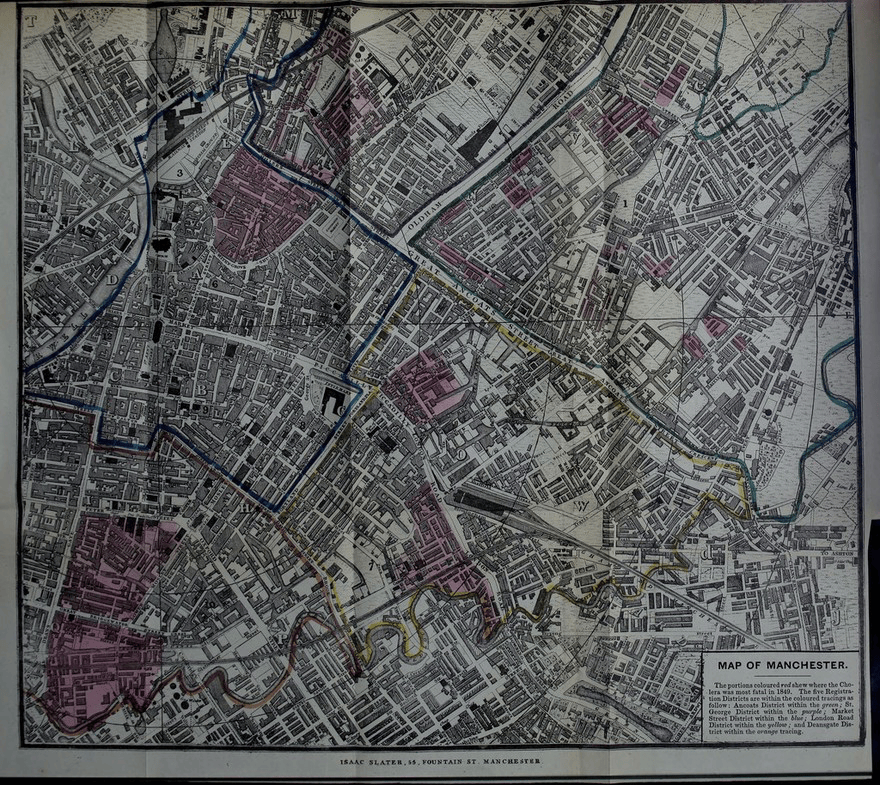
Consult the map of Manchester in 1849, showing the districts most affected by the typhus. (p. 7)

“The artificial drainage of Manchester by sewers has of late years been rendered very complete.”

Ibidem, p. 8

“In the examination of the streets and houses of Manchester, it is impossible to avoid the comparison of the wide, airy, clean and dry streets that are found in most parts of Hulme, Chorlton-upon-Medlock, and Ardwick, with the narrow streets, close-winding alleys, and crowded pent-up courts, to be found in many parts of Manchester. The out-townships, again, have the advantage of a dry, gravelly soil, with considerable elevation, whilst Manchester in built on the clay. The houses in the out-townships are of much more recent erection, and built with greater reference or attention to comforts and conveniences.”

Ibidem, p. 8.

“It is in the dirty back streets, the close-crowded, ill-ventilated, damp and badly-drained dwellings that are to be found in every large manufacturing town, that we are to seek them. … Long Millgate …Angel Meadow … Little Ireland … the great mass or block of streets lying between Great Ancoats-street, Oldham-road, Butler-street, and Every-street.»

Ibidem, p. 9,

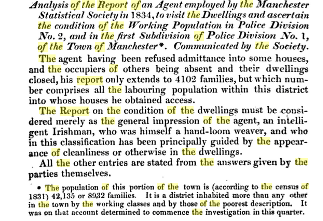
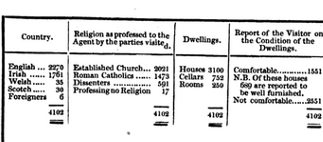
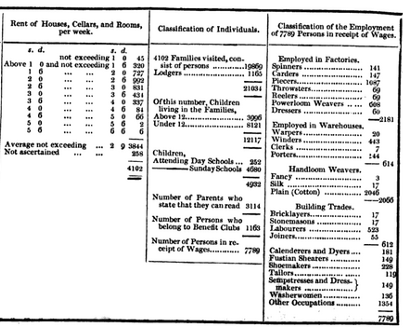
The following report by the Manchester Statistical Society, about the condition of the working population, refers specifically to the “district inhabited more than any other in the town by the working classes and by those of the poorest description”. Geographically the area includes the Ancoats district, and also the Police District with the largest number of lodging houses. 2.18

This report shows that the people in these districts had bad housing (60 % not comfortable; 85 % not well furnished), and did not pay much rent. We assume that they did not have good incomes, that is, the average was about 12 shillings for the total family, and a maximum of 16 shillings. However, 30 % paid a monthly charge to a Benefit Club (self- insurance for illness or death), and one child per family attended Sunday School. Only 0.5 persons per family worked in a factory.

2.18 British Association for the Advancement of Science; Report of the Fourth Meeting, held at Edinburgh in 1834, Report by the Manchester Statistical Society; John Murray, London, 1835; pp. 690-691.

This last point is interesting, because all these people lived near the large cotton mills, which employed perhaps 5,000 workers (men, women and children) in Ancoats.   The assumption must be that the lower income workers lived near the factories, and in bad housing conditions, and the skilled workers lived in better areas, at a distance from the factories.

But the inhabitants of this area did have a certain cultural level:

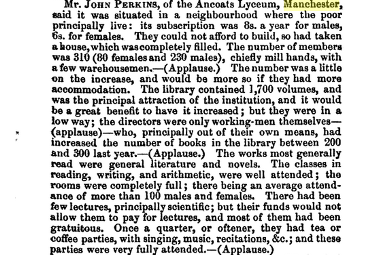
In 1844, a general meeting of the “self-help” organizations in Lancashire was held in the Atheneum, Manchester. The Ancoats Lyceum, situated in one of the poorest areas of Manchester, gave a presentation of their successes in forming a library, and in giving classes.2.19

2.19 Report of the Proceedings … Ancoats Lyceum: From the Manchester Guardian of Saturday, October 5th, 1844, Manchester; p. 7.

20.15. Housing.

We have the impression that all the districts of Manchester (apart from the mansions of the wealthy, on the outskirts of the town), were uniformly poor, dirty, with dirty water and excrement in the streets, and with houses with small rooms and people living in cellars. But the truth is that there was a great differentiation in the housing for the working class.

“Of the first or lowest class, averaging 1s. 3d. per week rent, the occupants are of the poorest description of persons, paying frequently one-fourth of their income for rent; by which the landlords or owners realize about eight per cent net on the outlay; whilst the dwellings are without ovens or boilers, and are often filthy, damp, and unfit for habitation; generally deficient of privies, or drainage; or, in manufacturing towns, one privy to 10 or 15 houses.

The second class of dwellings are occupied by a better class of labourers, paying about one-sixth of their incomes for rent; producing, perhaps, 8 ¾ per cent to the owners as interest on their capital; and although many of them are very defective, as regards drainage and privies, they are still much better provided than the class before described; and many of them have ovens or boilers.

Of the third or best class, the occupants being generally more skilled and a better class of workmen, whose rent amounts to about one-eighth of their income, producing 9 ¾ per cent on the outlay to the owners; and here we find far superior accommodation and comparatively comfortable dwellings, well drained, and provided with privies; frequently gardens, and in most of them ovens or boilers.

These results confirm the lamentable fact, that the lower the poor are reduced in the social scales, the more they are subject to imposition and extortion.

The cottages erected by the manufacturers, and other respectable owners of cottage property, are very superior in every respect to those built or purchased by avaricious speculators, whose sole object is gain, and who enforce the payment of their rents with rigid severity. They are moreover commodious, clean, white-washed, and in many cases have the advantage of school-houses.” 2.01

(These comments refer to the whole region of Lancashire, Cheshire, Derbyshire, and Staffordshire, not just to Manchester)

2.01 Poor Law Commissioners, “Local Reports on the Sanitary Condition of the Population”, 17. Lancashire, Cheshire, Derbyshire and Staffordshire, p. 247.

The houses in Manchester were built by people who used a flimsy form of construction in order to get out a maximum of profit from the property. The houses were built at a minimum cost, without cellars or foundations, and with walls of only half a brick thickness. The rooms were generally from 11 feet square to 14 feet square, one room above the other, ceiling height from 8 to 11 feet.

Following we have a section of a back-to-back house 2.02

PICTURE

This house is more “splendid” than the majority of back-to-backs; normally they had only two stories, and did not always have a cellar room. But in every case, it is clear that there is no movement of air through the house. There is also no individual “privy” for each of these houses.

But the investors were not necessarily rich people, but “building clubs”, whose members were workers with good earnings and tradespeople. There had been possibly 150 of these clubs in Manchester and nearby towns; if each club had 100 “investors” at 100 pounds each, this would correspond to a total of 1,500,000 pounds. At 60 pounds cost of construction each, this would be 25,000 houses which had been built with this scheme.

The members paid 10 shillings per month, thus every 2 months the club had 100 pounds to start a building. This shows us that there were a good number of working-class men who could save 10 shillings a month, and also had taken the decision to use this amount in an “investment”. A person who wanted to build at this moment on a given lot, could take up all the money for the house, and contracted to pay the money in the following months to his co-investors. The payments for the house were assured by a mortgage on the house. 2.03, 2.04

2.02 Hatton, John
“A Lecture on the Sanitary Condition of Chorlton-upon-Medlock, Delivered at the Request
of the Manchester and Salford Sanitary Association”, 1854, Plate before p. 9
https://archive.org/stream/b22337489#page/n1/mode/2up

2.03 Poor Law Commissioners, “Local Reports on the Sanitary Condition of the Population”, 17. Lancashire, Cheshire, Derbyshire and Staffordshire, 1842, pp. 240-241.

2.04 J. T. Slugg, “Reminiscences of Manchester Fifty Years Ago”, J. E. Cornish, Manchester, 1881; Chapter XXV, Building Clubs.

The lodging houses where the indigents could sleep for from 1 penny to 3 pennies a night, were the least sanitary housing units in Manchester. There were probably 5,000 to 8,000 people sleeping in these places each night.

“In some of these houses as many as 6 or 8 beds are contained in a single room; in others, where the rooms are smaller, the number is necessarily less; but it seems to be the invariable practice of these “keepers of fever beds”, as the proprietors were styled by Dr. Ferrar, to cram as many beds into each room as it can possibly be made to hold: and they are often placed so close to each other that there is scarcely room to pass between them. The scene which these places present at night is one of the most lamentable description; the crowded state of the beds, filled promiscuously with men, women, and children; the floor covered over with the filthy and ragged clothing they have just put off, and with their various bundles and packages, containing all of the property they possess, mark the depraved and blunted state of their feelings, and the moral and social disorder that exists. The suffocating stench and the heat of the atmosphere are almost intolerable to a person coming in from the open air, and plainly indicate its insalubrity.” 2.05

Cellars

In 1850, 16,000 persons were living underground in 4,600 cellars. These were not pleasant, but had the advantage that they were usually dry, and had a separate entrance from that of the house above.

2.05 Poor Law Commissioners, “Local Reports on the Sanitary Condition of the Population”, 20. On the Prevalence of Diseases …. Manchester, 1842, pp. 319-320

Sanitation

As is well known, in 1831, Dr. Kay made a “census” of the houses and streets in the Township (really, 30 % of the total) as to their sanitary characteristics.

But it must also be taken into account, that the better classes of Manchester did do something – starting in 1830 – to improve the drainage conditions. “In no place in England can more anxiety be shown to remedy the evils which I have described, or more humane and philanthropic desires evinced to improve the condition of the poor, than those which exist on the part of the wealthier classes in Manchester; and the following statement, made up to the end of October in the past year, of the improvements within the last eight or nine years, since the obtainment of the Manchester Police Act in 1830, will prove that the Commissioners have not been inattentive in their duties, as far as their functions enable them to act: 2.06

Number of streets paved and sewered         181                                                                                    Miles    Yards           
 Length of streets paved and sewered            16          540            
Length of main sewers formed                       15          678            
Length of cross sewers formed                         5        1223
Surface of streets paved, 289,971 square yards”

2.06 Poor Law Commissioners, “Local Reports on the Sanitary Condition of the Population,” 1840, 17. Lancashire, Cheshire, Derbyshire and Staffordshire, Comment by Charles Mott, Assistant Poor Law Commissioner, p. 243.

We have some more detailed information as to the advances in sanitation:

“With these difficulties to encounter, too much praise cannot be given to the committee for the great improvements carried into execution by them. Since 1830, more then 32 miles of sewers have been constructed. The total number of streets sewered and paved, or “on the town’s books”, is 480; but there are still 450 unpaved and unsewered streets of sufficient size to come under the operation of the act.

10. The labours of the committee [“The Paving and Soughing (sewerage) Committee” of the town-council of Manchester] have not by any means been confined to the wealthy parts of the town, the poor districts having attracted a large, if not the largest share of their attention. And their labours have not been in vain; Dr. Howard and Mr. Leigh, who were intimately acquainted with these districts some years since, from the connection with the infirmary, kindly agreed to inspect the worst conditioned localities with a view to report on their present state. They both express their astonishment at the better appearance of the inhabitants, and of the physical condition of these districts since the time they were accustomed to visit them. A few years back they were unpaved and unsewered, “and in winter the streets in the district of Angel Meadow were trod up into a thick mud 12 to 14 inches deep, and were almost impassable; the cellars of the houses were flooded, and influenza, cholera or fever, prevailed in succession the year round”. The wards of the hospital were filled with cases from this district. Within the last few years, however, almost the whole of the streets have been put into thorough repair by paving and sewering; the footways have been well flagged, and the cellars have been well protected from the inundations to which they were formerly subject. But they show that there are still many evils connected with this district. “In one part a chandlery sends forth its disgusting effluvia, pigsties are dotted up and down, and heaps of filth are poured a precipitous clay bank to lie and rot.”           

Dr. Howard and Mr. Leigh visited carefully all the worst districts of the town in which epidemics had formerly prevailed and cholera raged, and they state their general impression as follows: “These localities are those in which the greatest amount of disease was wont to prevail, and the condition of which is yet such as to attract attention. Still, compared with the appearance which they presented seven or eight years ago, their condition would scarcely be censured by those whose recollections of them extended so far back. Within that period they have nearly all been excellently paved and sewered.”

Mr. Bennett, a surgeon and registrar of deaths in the Ancoats district, in alluding to the health of his district not being impaired in late years with severe distress, states that the reason is “because the draining, paving, &c., is so much improved.”’ 2.07

2.07 “Appendix – Part II, to Second Report of the Commissioners for Inquiring into the State of Large Towns and Populous Districts” (1845), pp. 4-5.

Street Sweeping Machines

Before 1842, the access to the side streets was very difficult for pedestrians and wheeled vehicles, as dust and refuse accumulated in them to a certain height, and the manual sweeping was inefficient and sometimes non-existent.

“That the filthy and disgraceful state of many of the streets in these densely populated and neglected parts of the town where the indigent poor reside, cannot fail to exercise a most baneful influence over their health, is an inference which experience has fully proved to be well founded; and no fact is better established than that a large proportion of the causes of fever which occur in Manchester, originate in these situations. Of the 182 patients admitted into the temporary fever hospital in Balloon-street, 135 at least come from unpaved or otherwise filthy streets, or from confined and dirty courts and alleys. Many of the streets in which cases of fever are common are so deep in mire, or so full of hollows and heaps of refuse that the vehicle used for conveying the patients to the House of Recovery often cannot be driven along them, and the patients are obliged to be carried to it from considerable distances. Whole streets in these quarters are unpaved and without drains or main-sewers, are worn into deep ruts and holes, in which water constantly stagnates, and are so covered with refuse and excrementitious matter as to be almost impassible from depth of mud, and intolerable from stench. In the narrow lanes, confined courts and alleys, leading from these, similar nuisances exist, if possible, to a still greater extent; and as ventilation is here more obstructed their effects are still more pernicious.” 2.08

“The surface of these streets is considerably elevated by accumulated ashes and filth, untouched by any scavenger; they form nuclei of disease exhaled from a thousand sources. Here and there stagnant water, and channels so offensive they have been declared to be unbearable, lie under the doorways of the uncomplaining poor; and privies so laden with ashes and excrementitious matter, as to be unusable, prevail, till the streets themselves become offensive from deposits of this description; in short, there is generally pervading these localities a want of the common conveniences of life.”” 2.09

“33. These remarks apply only to the state of Manchester when I first undertook its examination; but since then the whole system has been altered. Arrangements are now made by which the street-cleansing machine sweeps the streets twice as often as formerly, at a diminished cost of 500 l. Much attention paid to the efficiency of this machine enables me to state with confidence, that the streets of Manchester are kept much more cleanly [sic.] than under the old system of hand labour.” 2.10

Water Supply

The water from the rivers that crossed Manchester was not suitable for human consumption; it had to be left standing for some time, until it could be used at least for washing.

The annual report from the Constabulary Force for 1847 gave: 2,955 streets, squares, alleys. There were 46,922 dwelling houses, of which 11,190 received water by installed pipe, 12,776 had access to a tap in the street, 22,956 did not receive water. There were 5,070 dwelling cellars, of which 1,108 had piped water, 1,968 could use a common tap, and 1,994 had no access to a point of supply.

2.08 Poor Law Commissioners, “Local Reports on the Sanitary Condition of the Labouring Population” ,1842, Manchester, Dr. Baron Howard, p. 305.

2.09 Poor Law Commissioners, “Local Reports …,”, Leeds, Mr. Baker, pp. 352-35

2.10 Appendix – Part II, to Second Report of the Commissioners for Inquiring into the State of Large Towns and Populous Districts (1845), p. 12.

20.14. Adult Education.

Friedrich Engels writes to Karl Marx about the educational activities in the Manchester Hall of Science:

“While the Church of England lived in luxury, the Socialists did an incredible amount to educate the working classes in England. At first one cannot get over one’s surprise on hearing in the Hall of Science the most ordinary workers speaking with a clear understanding on political, religious and social affairs; but when one comes across the remarkable popular pamphlets and hears the lecturers of the Socialists, for example Watts in Manchester, one ceases to be surprised. The workers now have good, cheap editions of translations of the French philosophical works of the last century, chiefly Rousseau’s Contrat social, the Système de la Nature and various works by Voltaire, and in addition the exposition of communist principles in penny and twopenny pamphlets and in the journals. The workers also have in their hands cheap editions of the writings of Thomas Paine and Shelley. Furthermore, there are also the Sunday lectures, which are very diligently attended; thus during my stay in Manchester I saw the Communist Hall [actually “Manchester Hall of Science”], which holds about 3,000 people, crowded every Sunday, and I heard there speeches which have a direct effect, which are made from the special viewpoint of the people, and in which witty remarks against the clergy occur. It happens frequently that Christianity is directly attacked and Christians are called “our enemies.”” 1.35

1.35 F. Engels, Letters from London, Schweizerischer Republikaner No. 46, Volume 3, June 9, 1843, Letter III; Marx and Engels Collected Works, digital edition Lawrence & Wishart, 2010, p. 387.

There were Mechanics’ Institutes at Manchester Centre (Cooper Street), Salford, and Lyceums etc. at Chorlton, Salford, Ardwick, and Ancoats. From 1845, women could attend special day classes.

The Institute presented exhibitions on scientific and technological themes in 1837, 1838, 1840, 1842-3, 1844-5; these attracted in total 300,000 visitors. 1.36

“The men had frequently learned to write since they were grown up. They were anxious to read well also, that they might avail themselves of the libraries. The lads were in a great proportion of cases members of night schools.” 1.37

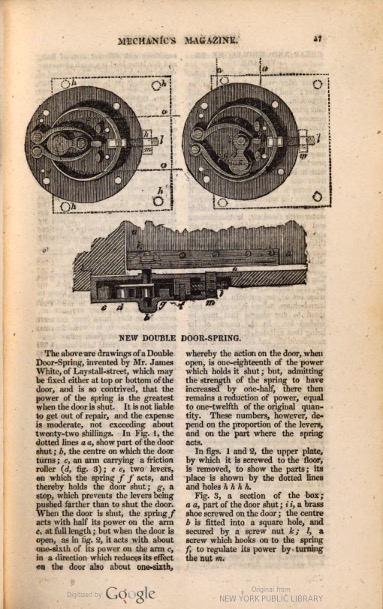
There was a “Mechanics’ Magazine” with a high level of general technical knowledge. It began in 1823, with 32 pages, at 3 pence a week. It had a circulation of 16,000 in 1824, but we can assume that in general, each booklet was read by more than one person.

It is not clear where these 16,000 men obtained the technical education necessary to understand these articles, in the years before 1823; it is also not clear in which industries they worked.

Diagram below from 1.38

1.36 Beauchamp, Dr. Ken, “Exhibiting Electricity”, pp. 40-46.

1.37 Reach, Letters to the Morning Chronicle, p. 59

1.38 “Mechanics’ Magazine”, No. 1, August 30, 1823, p. 47.

“No county buys so many books as Lancashire. Chamber’s Edinburgh Journal, which circulates to the extent of 85,000 per week, is read principally in the manufacturing districts, and Lancashire alone takes 20,000 of them.” 1.39

Evening Schools

In Manchester, according to the 1851 Educational Census, there were 1,478 working-class persons who were taking evening classes. We do not have a detail for Manchester, per occupation, nor per subject. For the total of Lancashire, there were 9,078 such persons of whom Factory Hands were 2,705, Artizans were 3,440, Agricultural Labourers were 565, and 124 were Domestic Servants. As to the subjects given, of 314 schools giving evening classes, 272 had reading, 305 writing, 282 arithmetic, 94 English grammar, 75 geography, 37 mathematics, 29 history, 13 music and singing, and 10 bookkeeping.

Great Britain, Educational Census 1851, Table V p. ccx, Table W p. ccxii.

1.39 Faucher, Léon, Manchester 1844, Its Present Condition and Future Prospects”, 1844, p. 122

20.13. Children’s Education

Dr. Kay-Shuttleworth (who from 1840, was more interested in Education, than in conditions of Poverty), gives us a description of the early lives of children who came from the poorer parts of the countryside, or who worked in difficult jobs. He demonstrates that these children needed “civilizing” before they could have normal lives in the town, and normal levels of attention in the classroom.

“The manufacturing districts of Lancashire and Yorkshire have been fed by a constant immigration from the wolds of North Yorkshire and the border, and from the moors of Cumberland, Westmoreland, Derbyshire, the Pennine Chain, and Wales. A family enters a manufacturing village; the children are at various school ages, from seven to eleven. They probably have never lived but in a hovel; have never been in the street of a village or town; are unacquainted with common usages of social life; perhaps, never saw a book; are bewildered by the rapid motion of crowds; confused in an assemblage of scholars. They have to be taught to stand upright,– to walk without a slouching gait,- and sit without crouching like a sheep dog. They have to learn some decency in their skin, hair and dress. They are commonly either cowed and sullen, or wild, fierce, and obstinate. In the street they are often in a tumult of rude agitation. In the school they are probably classed with children some years younger than themselves. They have no habits of attention, and are distracted by the babel of sounds about them. The effort of abstraction required to connect a sound with a letter is at first impossible to them. Their parents are almost equally brutish. They have lived solitary lives in some wild region, where the husband has been a shepherd, or hind, or quarryman, or miner, or turf cutter, or has won a precarious livelihood as a carrier, driver of loaded lime ponies, or poacher. The pressing wants of a growing family have induced them to acept the offer of some agent from a mill. From personal experience of many years, I know that such children as these form a large portion of the scholars which the schools of the cotton and woollen districts have to civilise and Christianise. A large part of that better work has often been accomplished, and the benumbed brain has been awakened from torpidity, and fitted for the reception of knowledge which there has not been time to give. The half-time system in factories, and the rule that no child under eight shall be employed in them, have been in operation little more than twenty years. Before this time the factory children of settled families were as brutish as they still are in the mining districts. The children employed in bleach and print works have had only a limited and almost worthless protection from too early and excessive labour.            A different kind of brutishness is shown by a large class of scholars in the most degraded parts of great cities. A London child, living in a street of brothels and thieves’ dens, with parents leading abandoned lives, spends his day in the kennel among sharp-witted, restless little creatures like himself. He is his own master. His powers of observation are singularly acute; his powers of decision rapid; his will energetic. He is known as the “Arab of the streets”. He learns a great deal of evil. Perhaps, he is an accomplished thief or beggar, or picks up a precarious living by holding horses, sweeping a crossing, or costermongering. Such children have of late years been netted in shoals, – got into schools, have been won, tamed, and, in some degree, taught. But is it not a mischevious folly to say that the work done is to be measured by the proficiency of such children in reading, writing and arithmetic? All that has been done has been against wind and tide. At home – misery, drunkenness, sullen despair, or the irritability of a dissolute life, drive the child into the street. Bad example at home lends its corruption to the foulness of the street of stews, and hiding holes. Are twenty scattered weeks, even if repeated in three successive years, enough to get rid of the wild, untamed barbarism of such children, and to graft on this civilization that amount of knowledge of reading, writing, and arithmetic which the Comissioners say is easy? What has to be done in the case of the children who have hitherto worked, without protection and without instruction, in mines? From eight years of age they have sat eight years daily in the black darkness, with their feet in the mud or running water, and the dripping roof of the mine overhead – opening and shutting the ventilating door – or as they grow older dragging the corves or waggons?Take Mr. Norris’s account of the life of a potter’s child, up to the age of apprenticeship (p. 184 Commissioner’s Report) – “At eighteen months or two years old he is sent to one of the dames who gain a livelihood by taking care of young children whose mothers are at the factory. There, from seven in the morning to eight or nine at night, he is stowed away in a small room, without exercise or change of air, predisposing the constitution to consumption, which is a common malady in the pottery towns. This continues, on average, for four years. He is then, at five and a half or six years old, sent perhaps to the National School, where he stays one or two, or at most three years; but during the latter part of the time he is sure to be kept away very much, to act as an occasional substitute for some other boy who is at work. At eight or nine (‘earlier if his parents are drunken or improvident, often at six or seven’) he begins to work regularly for a journeyman potter, turning his jigger (the potter’s wheel, to which steam seems never to have been applied), and earning from 1s. to 2s. a week. In a year or so a quick boy will begin ‘handling’ (making handles for cups, &c.) or ‘figuring’, and earning from 2s. to 4s. But by this time a great change has come over him,- he has been kept at work twelve or thirteen hours each day, and so, even if disposed to continue his school studies, has little time to do so; consequently he now reads badly, and writes worse; and, in short, nearly all he acquired at school is forgotten.” 1.27

1.27 Kay Shuttleworth, Dr. James P., “Letter to Earl Granville on the Revised Code of Regulations ….”, November 4, 1861, footnote inserted in pages pp. 15-17.

The Sunday School Movement

The movement started in 1783, almost simultaneously in various towns in England. The idea was to take children off the streets, where they were causing a lot of trouble (this was their only day free from work), and give them schooling of catechism and reading. By 1788 there at least 6,598 scholars of this type in Salford Hundred (which did not include the town of Manchester).

The Manchester Sunday School Movement was launched on 10th August 1784. By 21st September there were 25 schools with 1,800 children. These were Anglican and Dissenting groups.

The schools were financed from annual subsriptions and from church collections.

From 1800 onwards, the teacher with payment slowly disappeared, and was replaced by persons who gave the classes gratuitously. But by 1816, there was not much success in the education levels of the children. According to evidence to the Select Committee on Childfren in Manufactories, only one-quarter of the children in Manchester and Salford could read and write, one-sixth were learning the alphabet, a third were learning to spell, one.sixth could read the Testament, one-twelfth could read the Bible.

A survey of 1821 showed 2,500 boys and girls in day schools, but 23,000 in Sunday schools. In 1834-35 a report of the Manchester Statistical Society gave 10,000 in day and evening schools only, 10,000 day and Sunday schools, 23,000 Sunday schools only, and 17,000 did not attend any school. 1.28

1.28 Extracted from: A. P. Wadsworth, “The First Manchester Sunday Schools”, A lecture delivered in the John Rylands Library on the 13th December 1950.

Mr. Reach gives us an overview of the principles and success of the Movement:

“The Sunday Schools of the industrial north form not only a vast moral and educational engine but a curious and characteristic fact. The system, originated by Mr. Raikes some seventy years ago, took deep root in Lancashire, and grew with the growth of manufacturing industry. The serious cut of the Lancashire, its earnestness and zeal, acting upon the facilities afforded by the order and discipline which it is the very nature to instil, formed a soil in which the Sunday School System too very deep root, and bore very rich harvests. I rather understate than overstate the numbers, when I say that in the Sunday Schools of Manchester may be found from 40,000 to 50,000 scholars and from 4,000 to 5,000 teachers, inspectors and visitors. In 1852, the fiftieth anniversary of the introduction of the system was celebrated by a day of jubilee, and upon that occasion no less than 32,000 medals were disposed of, to be worn by members of the Sunday scholars’ procession which defiled through the streets of Manchester.” 1.29

.1.29 Reach, “Letters to the Morning Chronicle”, p. 67

And a description of one of the schools:

Union Street

“Close to this dreary but characteristic street are the Lyceum Factory Schools. The establishment boasts of a newsroom and a library. In the former, a quiet comfortable room, a fair assortment of the London and local journals are taken. The library is one of three thousand volumes. In the day-time the children from the neighbouring mills receive there, their three hours modicum of instruction; at night, adult classes meet in the same rooms. The children are charged threepence and fourpence a week, according as they remain half a day or a whole day in the school.” 1.30

1.30 Reach, “Letters to the Morning Chronicle”, p. 60

Statistics of Schools and Pupils

1834-1835

Population Conurbation 255,000

Day Schools 701, Pupils 24,365 (Richson, quoting Manchester Statistical Society pamphlet) 1.31
Dame Schools            295 / 6,265, 
Common boys’ and girls’ schools     221/ 8,604, 
Superior private and boarding schools 143 / 3,816, 
Other charity schools 42 / 5,991

Ratio pupils / population conurbation, for Day Schools = 1 to 10.27.

For Day Schools, there is no individual listing of the Schools for 1834-1835.

Sunday Schools 117, Pupils 42,950 
Church of England 13,025,
Dissenters 25,432, 
Roman Catholic 4,493 
(Richson, quoting Manchester Statistical Society pamphlet, and A. P. Wadsworth, The First Manchester Sunday Schools)

Ratio pupils / population conurbation, for Sunday Schools = 1 to 8.16

1.31 Rev. C. Richson, Educational Facts and Statistics of Manchester and Salford, being a Summary of some of the most important Statistical Tables, presented in evidence before a Committee of the House of Commons on Manchester and Salford Education, May and June 1852, p. 12.

1834-1835, Sunday Schools, Manchester and Salford, pamphlet Manchester Statistical Society.

Religious DenominationSchools ManchesterSchools
Salford
Schools
Total
    
Church Establishment25934
Wesleyan Methodist18523
Catholic9211
Independent9413
Methodist New Conexion527
Baptist3 3
General Baptist2 2
Primitive Methodist213
Bible Christian213
Welch Independent314
Scotch Church1 1
Scotch Secession Church1 1
New Jerusalem Church112
Unitarian1 1
Independent Methodist112
Arminian Methodist1 1
Welch Baptist1 1
Welch Methodist1 1
United Christian 11
Unconnected with any religious body 11
    
Total8631117

1834-1835, Scholars in Sunday Schools, Manchester and Salford, pamphlet Manchester Statistical Society

Religious DenominationScholars
Manchester
Scholars
Salford
Scholars 
Total
    
Church Establishment10,2842,68212,966
Wesleyan Methodist9,0662,63011,696
Catholic3,8805394,419
Independent4,0591,4875,546
Methodist New Conexion1,4535532,006
Baptist1,183 1,183
General Baptist350 350
Primitive Methodist3207021,022
Bible Christian40198499
Welch Independent779176955
Scotch Church115 115
Scotch Secession Church188 188
New Jerusalem Church15090240
Unitarian283 283
Independent Methodist32065385
Arminian Methodist79 79
Welch Baptist30 30
Welch Methodist175 175
United Christian 1515
Unconnected with any religious body 150150
    
Total33,1969,75442,950

Wheeler, “Manchester, Its Political, Social and Commercial History”, 1836, p. 386 and p. 388.

Additional 1834-1835 
Factory Schools. 29 / 1,820. 
Infant Schools 2,000 
Juvenile Infant Schools 1,800 
Royal Lancasterian School. 1,000 children of the poor

According to Mr. James Wheeler (p. 392), it had been estimated that one-half of the scholars in Manchester who attended Day Schools, also attended Sunday Schools. Therefore, the sum of these two quantities, does not give us a useful datum, which could be compared with the total child population of the Manchester Conurbation. On the other hand, the information on Day Schools and Sunday Schools, summed, and with the application of a multiplication amount, could tell us what was the total number of “pupil-hours” per year. We should applaud those children, who studied in Day Schools on weekdays, and additionally studied on Sundays.

1851 Census

Population Conurbation  387,000

Day Schools 548 / 38,211

Public Day Schools 132 / 23,852

Private Day Schools 416 / 14,359

Sunday Schools 201 / 63,653

Ratio pupils / population conurbation, for Day Schools = 1 to 13.30, which is 30 % worse than in 1834-1835

Ratio pupils / population conurbation, for Sunday Schools = 1 to 7.53, which is a small improvement.

Day Schools, Private Day Schools, Public Day Schools, Sunday Schools, for Chorlton, Salford, Manchester, according to the Census 1851

  CHORLTON SALFORD MANCHESTER
 SCHOOLSSCHOOLSSCHOOLS
    
DAY SCHOOLS229112207
    
PRIVATE DAY SCHOOLS19487135
    
PUBLIC DAY SCHOOLS352572
    
CLASS I   
Workhouse Schools11 
CLASS II   
Collegiate and Grammar Schools1 1
Other Endowed Schools2 3
CLASS III   
Church of England – National6413
Church of England – Others10815
Free Church of England  1
Presbyterians not defined 11
Independents – British   
Independents – Others333
Society of Friends – British  2
Unitarians  2
Wesleyan Methodists – British1 1
Wesleyan Methodists – Others521
Methodists New Conexion   
Wesleyan Association  1
New Church 22
Roman Catholics3 8
Undenominational – British116
CLASS IV   
Industrial School  1
Odd Fellows’ Orphan School  1
Factory Schools   
Blind Asylum   
Deaf and Dumb School   
Mechanics’ Institution School1  
Penitentionary School1  
Subscription Schools 35
    
SUNDAY SCHOOLS5840103
    
Church of England171329
Presbyterian Church England3 4
Independents7610
Baptists424
Society of Friends  1
Unitarians113
Wesleyan Methodists14718
Methodists New Conexion115
Primitive Methodists311
Bible Christians 1 
Wesleyan Association333
Independent Methodists 1 
Welsh Calvinistic Methodists 11
New Church1 2
Undef. Protestant Congreg.3 5
Roman Catholics127
Latter Day Saints 1 
    
 CHORLTONSALFORDMANCHESTER
 SCHOLARSSCHOLARSSCHOLARS
    
DAY SCHOOLS10,9477,52319,741
    
PRIVATE DAY SCHOOLS5,6332,8085,918
    
PUBLIC DAY SCHOOLS5,3144,71513,823
    
CLASS I   
Workhouse Schools97105 
CLASS II   
Collegiate and GrammarSchools20 402
Other Endowed Schools260 366
CLASS III   
Church of England – National1,4088052,707
Church of England – Others1,6572,1183,157
Free Church of England  122
Presbyterians not defined 152161
Independents – British   
Independents – Others534329323
Society of Friends – British  286
Unitarians  648
Wesleyan Methodists – British55 104
Wesleyan Methodists – Others882325151
Methodists New Conexion   
Wesleyan Association  70
New Church 258429
Roman Catholics106 2,073
Undenominational – British1021401,662
CLASS IV   
Industrial School  96
Odd Fellows’ Orphan School  89
Factory Schools   
Blind Asylum   
Deaf and Dumb School   
Mechanics’ Institution School143  
Penitentionary School50  
Subscription Schools 371530
    
SUNDAY SCHOOLS18,23013,26432,159
    
Church of England5,1084,42312,537
Presbyterian Church England545 700
Independents3,8823,5444,017
Baptists917423620
Society of Friends  204
Unitarians66140964
Wesleyan Methodists4,5332,5984,685
Methodists New Conexion1892551,375
Primitive Methodists59625360
Bible Christians 121 
Wesleyan Association7706802,590
Independent Methodists 85 
Welsh Calvinistic Methodists 212125
New Church313 372
Undef. Protestant Congreg.896 1,271
Roman Catholics5055042,011
Latter Day Saints 26 
    

Census of Great Britain, 1851. Education. England and Wales.  Lancashire: RD 471 Chorlton, RD 472 Salford, RD 473 Manchester, pp. 172-174.

 MANCHESTER
CONURBATION
 SCHOOLSSCHOLARS
  
DAY SCHOOLS54838,211
  
PRIVATE DAY SCHOOLS41614,359
  
PUBLIC DAY SCHOOLS13223,852
  
CLASS I 
Workhouse Schools2202
CLASS II 
Collegiate and Grammar Schools2422
Other Endowed Schools5626
CLASS III 
Church of England – National234,920
Church of England – Others336,932
Free Church of England1122
Presbyterians not defined2312
Independents – British 
Independents – Others91,186
Society of Friends – British2286
Unitarians2648
Wesleyan Methodists – British2159
Wesleyan Methodists – Others81,358
Methodists New Conexion 
Wesleyan Association170
New Church4687
Roman Catholics112,179
Undenominational – British81,904
CLASS IV 
Industrial School196
Odd Fellows’ Orphan School189
Factory Schools 
Blind Asylum 
Deaf and Dumb School 
Mechanics’ Institution School1143
Penitentionary School150
Subscription Schools8901
  
SUNDAY SCHOOLS20163,653
  
Church of England5922,068
Presbyterian Church England71,245
Independents2311,443
Baptists101,960
Society of Friends1204
Unitarians51,170
Wesleyan Methodists3911,186
Methodists New Conexion7504
Primitive Methodists5909
Bible Christians1121
Wesleyan Association94,040
Independent Methodists185
Welsh Calvinistic Methodists2337
New Church3685
Undef. Protestant Congreg.82,167
Roman Catholics103,020
Latter Day Saints126
  

Total of the preceding data of the three Registration Districts

One great problem of education in Manchester, was that a large number of children were not attending any sort of school. It appeared that the parents just did not want their children to go to school.

“It has been stated in evidence that about “54,670 children, belonging to the labouring classes, whether employed or not, are not attending day schools”, and that no reason has been alleged, that ought to be considerd satisfactory, why “one half, at least” of that number ought not “to be in some school receiving educatiion”. It is indeed highly probable that, at the present time, there are not fewer than 20,000 or 30,000 children of the labouring classes kept from day school, without being in employment or detained at home through sickness, domestic need, or any other sufficient cause; and who ought therefore to be gathered into school.” 1.33

1.33 Richson, p. 10

Love, 1842, p. 173

Industrial and Training School, Swinton, Manchester Poor Law Union

This was a large and effective (but also high-cost) institution for pauper children.

“The two great cities of Lancashire support two great pauper educational establishments. Manchester has its Swinton and Liverpool its Kirkdale. In the Infant School attached to the former establishment, the children could point to Washington and Iceland on the map. They could name the Books of the Testament and understood what a thermometer was. In the girls’ school, five-sevenths of the pupils could read the New Testament. They were also taught to sew, knit, cut out, wash, iron and mangle. In the boys’ school, the reading was “fair” and “a certain standard of education was attained by many”; so that “material progress may be expected”. The industrial training consisted of tailors’ and shoemakers’ work, and clogging, and the general dscipline was “excellent”. At the Kirkdale establishment, the boys’ school was efficient; but the infant and girls’ schools were less satisfactory, and the progress of the learners slow. The girls sew and do household work, being out of school one week in three.” 1.34

1.34 Reach, “Letters to the Morning Chronicle”, p. 66

Differently from all the institutions commented above, this was founded by the Manchester Poor Law Union (opened in 1843). Swinton was on the road from Manchester to Liverpool; the building was on the site of the present Salford Town Hall. The installations were sufficient for 1000 to 1450 children (paupers), although the real figures were from 700 to 1000, and 50 staff. It had a gymnasium, a swimming pool, a Roman Catholic chapel, and Church of England chapel. There was also a farm attached, as the children had to help with the production of the food consumed there.

[For photographs of the outside of the building, see Google = “workhouses.org.uk Swinton Industrial School»]

20.12. Working Conditions.

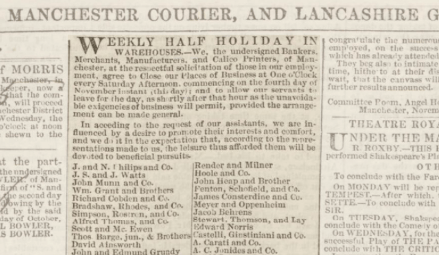
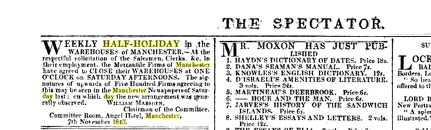
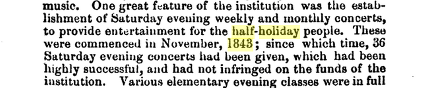
In 1843, a number of young men in the Manchester Athenaeum, led by William Marsden and Robert Lowes, embarked on a campaign to convince the owners of shops, warehouses and factories to reduce the working day on Saturdays, from a whole day, to a half-day ending at 1 pm. This was done without reduction of weekly earnings. They were successful, and a joint document was signed by 440 business owners in September 1843.

Manchester Courier, and Lancashire General Advertiser, Saturday, November 4th, 1843

http://www.genesreunited.co.za/searchbna/viewrecord/bl/0000206/18431104/054/0005

British Newspaper Archive

The effect was to give the working people more time for leisure activities on Saturdays, including concerts: 1.24

[The above document included a report of the short verbal presentations by each of the self-help organizations present, as to their membership, libraries and lectures given]

“A soirée held in the Town Hall, to celebrate the Saturday half-holiday granted by the merchants, &c., of Manchester, to the persons in their employment.” 1.25

1.24 “Report of the Proceedings Connected with the Grand Soirée of the Manchester Athenæum, Held on Thursday, October 3rd, 1844”: From the Manchester Guardian of Saturday, October 5th, 1844, Printed by Cave & Sever, Manchester, 1844; p. 6.

.25 Axon, William Edward Armytage, “Annals of Manchester”, November 1844, p. 244.

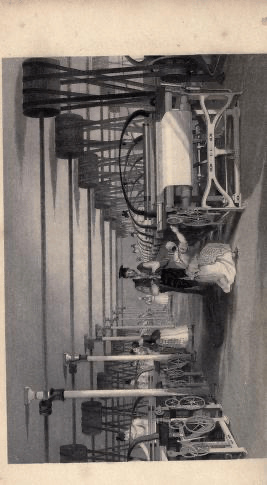
“The first thing, then, which strikes the observer as an essential and fundamental part of the factory system, is the comparative lightness of the actual labour – the comparatively small amount of physical strength required in any of the processes. In truth, the engine is the worker. The operative is the superintendent of the engine’s labours.” 1.26

[This statement was true in 1849, and earlier dates, but not true before 1835]

1.26 Reach, “Letters to the Morning Chronicle”, p. 9.

20.11. The Physical Appearance of the Factory Workers.

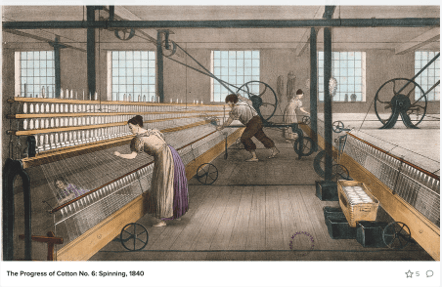
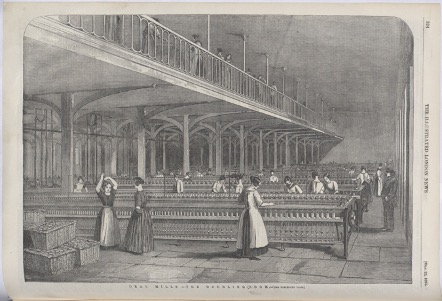
There are a number of descriptions of the Lancashire cotton workers, referring to their sallow skin, low stature and thin body, sharp features of the face, and the skin being tight on the muscles and bones:

“These artizans are frequently subject to a disease, in which the sensibility of the stomach and bowels is morbidly excited; the alvine secretions [solid excrements] are deranged, and the appetite impaired. Whilst this state continues, the patient loses flesh, his features are sharpened, the skin becomes pale, leaden coloured, or of the yellow hue which is observed in those who have suffered from the influence of tropical climates.” 1.20

“It is perfectly true that the Manchester people have a sickly, pallid appearance; but this is certainly not attributable to factory labour, for two reasons; first, because those who do not work in factories are equally pallid and unhealthy-looking with those that do, and the sick society returns show that the physical condition of the latter is not inferior:- secondly, because the health of those engaged in country cotton factories, which generally work longer than town ones, is not injured even in appearance. … Mr. Wolstenholme, surgeon at Bolton, says that “the health of factory people is much better than their pallid appearance would indicate to any person not intimately acquainted with them”.” 1.21

1.20 Kay, Dr., 1832, pp. 11-12

1.21 Factories Inquiry Commission, “Supplementary Report …  as to the Employment of Children in Factories, 1834, Part I,”, Mr. Tufnell’s Report from Lancashire, p. 198

“Of course the air in which they work exercises a marked effect upon the appearance of the people. This is a subject which I shall treat of at length later; but I may be here permitted to remark upon the more obvious physical characteristics of carders, spinners and weavers. In the first place I do not remember seeing one male or female adult to whom I would apply the epithet of a “stout” man or woman. There is certainly no superfluity of flesh in the factories. When I say this I do not by any means intend to insinuate that the people are unhealthy or unnaturally lean; they are generally thin and spare but not emaciated. By such occupation as is afforded in the various branches of cotton spinning, much muscle cannot be expected to be developed. There is no demand for it – the toil does not require it – it would be useless if it existed. I cannot therefore term the appearance of the people “robust”. They present no indication of what is called “rude” health. They are spare, and generally – so far as I can judge – rather undersized. At the same time their appearance cannot rightly be called sickly. Their movements are quick and easy, with nothing at all of langour expressed either in face or limbs. The hue of the skin is the least favourable characteristic. It is a tallowy-yellow. The faces which surround you in a factory are, for the most part lively in character, but cadaverous and overspread by a sort of unpleasant greasy pallor.” 1.22

1.22 Reach, Angus Bethune (reporter, 19th century, for Lancashire)

Included in: Routledge Library Editions, The History of Social Welfare, Edited by J. Ginswick., “Vol. 3, Labour and the Poor in England and Wales 1849-1851, The Letters to the Morning Chronicle from Correspondents in the Manufacturing  and Mining Districts the Towns of Liverpool and Birmingham, and the Rural Districts, Vol. 1, Lancashire, Cheshire, Yorkshire”, pp. 15-16.

Angus Reach, of the Morning Chronicle, reports on the clothing of the workers in the factory, and then in their leisure time:

“The men wear blue striped shirts, trousers and slippers; the women generally envelop themselves in coarse pinafores and loose jackets tying round the throat.”.

“The outdoor dress of the men is comfortable and respectable. Velveteen jackets and shooting coats seem to be in great favour, with waistcoats and trousers of dark fustian cloth. The people are uniformly well shod, and their general appearance is one of unostentatious comfort.” 1.23

1.23 Reach, Letters to the Morning Chronicle, p. 15, p. 17

Edward Baines, jun., History of the Cotton Manufacture, 1835, p. 239, View of Power-Loom Weaving

James Richard Barfoot, The Progress of Cotton: a Series of Twelve Engravings, Darton, 1840, Yale University Art Gallery

Dean Mills: The Doubling Room, Illustrated London News, October 25th, 1851

PICTURE

(Earliest photograph of English workers)

James Cox, centre of the front row, surrounded by some of the men he worked with. The photograph was taken circa 1848. James Cox came to Manchester from Ireland in 1846 during the famine years. He first lived near Oxford Road Station, Mary Street, an area known as “Little Ireland”. He also worked on the Manchester Ship Canal in the later years of the 19th century. Mr. Cox, although he lived in the worst slum in Manchester, “Little Ireland”, does not appear to be poor or to have suffered hunger!

Group of Manchester workers 1848

The workers may appear a little shorter than average, but this may be due to the fact that they are from Manchester.

20.10. Consumption of Meat.

Reports of Animals deposited, sold, or slaughtered in Manchester

Note that the amount per person is fairly constant in these data, although types of transaction investigated are different from year to year.

The detailed calculations and the sources are to be found in the external file “Manchester Meat Market Reports”

Years: 1801 – 1810
Yearly Average Animals: Cattle 10,988; Calves 12,252; Sheep 58,679.
Evidence: Inspections of Hides and Skins
Select Committee on the Distressed State of Agriculture, 1821
Consumption “on the bone”.  Pounds / person /week.       2.10                          Consumption edible meat.     Pounds / person / week.     1.26                              Consumption edible meat.     McDonalds quarter pounders / person /week  5.04
Inspections of Hides and Skins, Select Committee on the Distressed State of Agriculture, 1821
Years: 1811 – 1820
Yearly Average Animals: Cattle 14,252; Calves 14,692; Sheep 73,682. 
Evidence: Inspections of Hides and Skins
Select Committee on the Distressed State of Agriculture, 1821
Consumption “on the bone”.  Pounds / person /week.            2.05                        Consumption edible meat.      Pounds / person / week.                      1.23             Consumption edible meat.      McDonalds quarter pounders / person /week  4.93
Inspections of Hides and Skins, Select Committee on the Distressed State of Agriculture, 1821
Years: 1815 – 1820 incl.
Yearly Average Animals: Cattle 37,133; Calves 43,326; Sheep 24,553 
(Total Liverpool, Manchester, Leeds, Sheffield)
Evidence: Inspections of Hides and Skins
Select Committee on the Distressed State of Agriculture, 1821
Consumption “on the bone”.  Pounds / person /week.                       2.36           Consumption edible meat.     Pounds / person / week.                        1.41          Consumption edible meat.     McDonalds quarter pounders / person /week  5.64
Manchester Statistical Society
Year: 1836
Year Total Animals: Cattle 40,820; Calves 11,791; Sheep 105,040; Lambs 96,968 Evidence: Reports from Toll Offices
Consumption “on the bone”.  Pounds / person /week.                                1.94   Consumption edible meat.     Pounds / person / week.                                1.17   Consumption edible meat.     McDonalds quarter pounders / person /week  4.66
Manchester Smithfield Market, Weekly Reports, Sales, 1834
Sales Week of May 7, 1834
Week Total Animals: Cattle 652; Calves 68; Sheep 2,646; Lambs 662; Pigs 658.
Evidence: Weekly Reports, Manchester Times
Consumption “on the bone”.  Pounds / person /week.                        1.86            Consumption edible meat.      Pounds / person / week.                           1.12       Consumption edible meat.     McDonalds quarter pounders / person /week  4.47
Animals slaughtered in Manchester
Years: 1849, 1850, 1851
Yearly Average Animals: Cattle 67,484; Calves 12,434; Sheep 287,880; Pigs 30,133 Returns from Abattoirs and Market Inspectors. 
Braithwaite Poole, Statistics of British Commerce
Consumption “on the bone”. Pounds / person /week.                               2.95     Consumption edible meat.     Pounds / person / week.                                  1.77 Consumption edible meat.     McDonalds quarter pounders / person /week  7.08
Salford Market Cross Lane, Weekly Reports, Sales, 
Reports: 6 Individual Weekly Reports, 1849-1855
Average of 6 Weekly Reports: Cattle 1,320; Calves 121; Sheep 6,084.
Consumption “on the bone”.  Pounds / person /week.                                 2.59  Consumption edible meat.      Pounds / person / week.                                 1.55 Consumption edible meat.     McDonalds quarter pounders / person /week  6.21

Copy of Weekly Market Report:

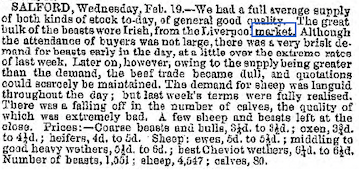
Salford Market Cross Lane, Weekly Market Report, February 19, 1851 (extract)

Number of beasts, 1,551; sheep, 4,547; calves, 80.

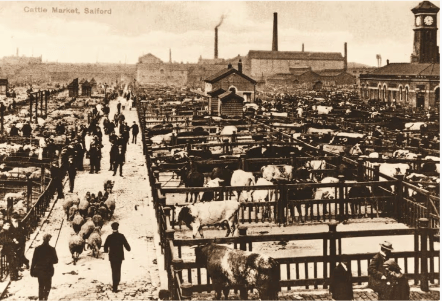
Cross Lane Market, Salford, Manchester

(The only meat market in the Manchester Conurbation from 1837; the second largest meat market in the country after Smithfield in London)

From 1837, the animals were bought and sold at Cross Lane Market. The majority were walked from the nearby train station to the shop of the butcher, where they were killed and cut up into joints. A further quantity of animals was walked to the abattoirs where they were killed and cut up, and the pieces were transported to butcher’s shops. A last segment was killed, and transported to surrounding towns.

There were 550 butcher’s shops in the Manchester Conurbation in 1841, according to Pigot’s Directory 1.14 (see external files, Manchester Supplements Butchers A / B / C; with names and addresses).

1.14 Pigot & Co.’s ….. Directory of Yorks, Leics, …Great Manufacturing Towns of Manchester and Salford, 1841, pp. 733-735.

The calculation of the meat actually eaten, requires the percentage of flesh in the carcasses:

“The amount of edible flesh carried by such carcasses has also been analysed (*), and it too varies according to the type of carcass 1.15

Type of Carcass

Lean.  Average    Fat

Lean Meat                              66%    59%         50%

Edible Fat                               13%    21%         32%

Tallow Fat                                3%      4%           5%

Bone                                       18%    16%         13%”

(*) Quoted source not findable

The report about unskilled and semi-skilled workers in Manchester and Dukinfield in 1836, shows a consumption in Manchester of 1.0 to 2.0 pounds per person per week, and in Dukinfield of 0.5 to 1.0 pounds per person per week.

1.15 Gibson, A. G. S., “The Size and Weight of Cattle and Sheep in Early Modern Scotland”,

Agricultural History Review, Vol. 36, pp. 162-171, 1988

The rapporteur to the Poor Law Commissioners in Lancashire in 1834, Mr. Tufnell, gave the following information as to the amount of food eaten by the better class of workers:

“The mode of living of the factory workmen will be seen from the following extracts:-

“What do the factory operatives usually live on?” “They won’t take anything but the best of flour, potatoes, and mutton. I hardly go into one house but what I see they have beer; and they have five meals a day; breakfast at eight, lunch at eleven, dinner betwixt twelve and one, their bagging at four, and supper about seven.”

“For how many of these meals do they leave the mill?” “Breakfast, dinner, bagging, and supper; they only lunch in the mill, on beer, and bread and cheese.”

“Do they eat meat every day for dinner?” “I think generally they do; they live full as well as most labouring people; better than farmers in general; they would not eat the same flour as is eaten in farm-houses.”

“Do they live better than the hatters and hand-loom weavers?” “Yes, they do; the hand-loom weavers are the most miserable part of the population; they scarcely eat meat once a week.”

Mr. Butcher, overseer [Poor Law administrator] of Salford, Hulme, and part of Manchester, says that the factory operatives “in a general way have fresh meat about twice a week, fried bacon two days a week, and liver and a little bacon generally on a Friday, and the other two days bread and cheese, bread and butter, and water-gruel”. The overseer of the township of Heap, in answer to my question concerning the usual diet of the factory operatives, says, they have either tea or coffee for breakfast, and fresh meat for dinner, and tea in the afternoon; and for supper, porridge, which some of the poorer classes have in the morning. The same witness also states, that the factory operatives are better off than any other class, except perhaps general mechanics, and that he has not had to relieve one spinner since he came into office.”” 1.16

The sampled workers in Manchester and Dukinfield ate from 5 to 7 lbs. of bread per person per week (including in some cases, oatcakes): this was the normal consumption in England.

Dr. Kay informs us of a great improvement in food quantities from 1832 to 1862:

“The diet and household management of the factory operatives have undergone a great change since this was written. Tea, coffee, wheaten bread, and animal food, are now much more consumed.- J. P. K. S. 1862”. 1.17

1.16 Factories Enquiry Commission, “Supplementary Report”, Part I, D2 Lancashire District, 1834; Report by Mr. Tufnell, pp. 203-4

1.17 Kay-Shuttleworth, Dr., “Four Periods of Public Education”, 1862, note on page 8, updating his original report of 1832.

The weekly provisions for prisoners in the Manchester New Bailey in 1844 were as follows: 1.18

 s. d.
Seven loaves of twenty ounces each, costing1   1
Thirty-one ounces of flour0   4
Five pounds of potatoes0   1
One pint of pease0   1
Three ounces and a half of salt0   0
One pound of beef0   4
One quart of beer0   0
Total1 11

These data show consumption of 2 and 3 pounds of meat per person per week 1.19

1.18 Kohl, 1844, p. 111

1.19 “Factories Inquiry Commission, Supplementary Report, Vol. I”, 1833, D. I. Lancashire District, Bolton, Evidence Thomas Yates, p. 170

20.9. Wages.

THE EXPRESSION “THE HUNGRY FORTIES” WAS NOT USED IN WRITING IN THE NINETEENTH CENTURY. ACCORDING TO THE OXFORD ENGLISH DICTIONARY, THE FIRST USAGE WAS IN 1903; THE FIRST EDITION IN WHICH THE O. E. D. GAVE AN INFORMATION ABOUT THE PHRASE, WAS OF 1930.

THE TERM COMES FROM THE TITLE OF A BOOK PUBLISHED IN 1904.

SEE THE EXTERNAL FILE “THE HUNGRY FORTIES”

Herewith, a list of the types of “operatives” in the cotton industry in the Manchester area in 1833:

There are no comments by contemporary persons, that the cotton workers had poor wages:

“The wages obtained by the operatives in the various branches of the cotton manufacture are, in general, such, as with the exercise of that economy without which wealth itself is wasted, would be sufficient to provide them with the decent comforts of life – the average wages of all persons employed (young and old) being from nine to twelve shillings per week. Their means are consumed by vice and improvidence. But the wages of certain classes are exceedingly meagre.”1.03

1.03 Kay, Dr., 1832, pp. 26-27

The most complete collection of wage data for our period, in Lancashire, is the following document:

Chadwick, David, On the Rate of Wages in Manchester and Salford, and the Manufacturing Districts of Lancashire, 1839-59 1.04

Mr. Chadwick says that he revised the individual data with representatives of the business owners, and with representatives of the workers, and that the figures were in general accepted.

The document is long, so that here we shall present only some of the most interesting points. We note that the list gives a number of types of employment outside of the cotton industry.

1.04 Chadwick, David, On the Rate of Wages in Manchester and Salford, and the Manufacturing Districts of Lancashire, 1839-59; Journal of the Statistical Society of London, Vol. 23,

No. 1 (Mar., 1860), pp. 1-36.

https://www.jstor.org/stable/2338478

The wages in 1839, 1849, 1859, for a number of tasks in the cotton industry were the following 1.05:

  183918491859
  s. d.s. d.s. d.
Spinners
Self-acting mules
Men16 018 020 0
Spinners
Throstles
Women 7 0 7 6 9 0
WarpersMen22 022 023 0
DoublersWomen 7 0 7 6 9 0
Piecers 14 to 18 yrs.Boys 5 6 5 66 0
Spinners
Hand-mules
Men25 021 025 0
Weavers
Power-looms
(2 looms)
Women 9 0 9 010 0
Weavers
Power-looms
(4 looms)
Women17 016 018 0
Hand-loom weavers
Fancy fabrics (working at their own house)
Men16 015 016 0

(In all cases, the hours were 69, 60, 60)

1.05 Chadwick, 1860, Tables (N), (O), (P), pp. 23-25

The reduction of the number of hours given for 1849 and for 1859, against 1839, is due to the Ten Hours Act of 1847.

The number of places in a typical cotton mill was as follows (but note the distribution of the sexes) 1.06

1.06 Chadwick, 1860, Table (A), p. 5

We note that the work of spinning is done by a “self-acting mule” or by a “throstle”, and that the work of weaving is done by “power loom”, such that the workers do not have to expend much physical effort. As Mr. Chadwick says, “it cannot be considered very laborious work for even women or children.”

Here we have a typical list of food and other expenses for a family which has a total income of 30 shillings a week, in 1859, 1849, 1839 1.07

1.07 Chadwick, 1860, Table (DD), p. 24

Herr Kohl, a well-known writer of travel guides, informs us about the highest level of wages for working-class men (highly qualified mechanics):

“I had the pleasure of visiting one of the greatest machine-making establishments in the world; namely, the so-called Atlas-Works of Messrs. Sharp and Roberts. These gentlemen have two manufactories, one for general machine-making, the other for the manufacture of locomotive engines, and of those enormous tools used in the making of machines. …..”

“Mr. Sharp died a short time ago, and his funeral was attended by all his mechanics and work-people, 800 in number. As not one of these workmen had weekly wages less than twenty-five shillings, and many earned four or five pounds, a week, the amount of capital necessary to carry on such a business must be enormous.” 1.08

1.08 Kohl, J. G., “Ireland, Scotland and England”, England and Wales, 1844, p. 125

On the other hand, we see that the persons in the poor-house had enough food to live on:

“I yesterday visited the poor-house, and send some particulars from the last year’s report for your information. There were in the house 233 men, 83 boys, and 77 girls; 9 of the men, and 39 of the women, were between 80 and 90 years of age. The weekly expenses for every person is –

s.  d.

Food                           2  0 ¾

Clothing                      0  5 ½

Total                2  6 ¼

Their breakfast consists of rice and milk, oatmeal porridge; their dinner, two days in the week, of meat and vegetables; and the remaining five days they have soup, or potato soup, with a sufficient quantity of bread.” 1.09

1.09 F. von Raumer, “England in 1835: being a series of letters written to friends in Germany, during a residence in London and excursions into the provinces”, 1835, Vol. 3, p. 225.

In 1841, Mr. Nield, mayor of Manchester, decided to make a comparison of wages and expenses, for 12 families of Manchester and 7 families from Dukinfield, between the year 1836 and the year 1841. The “background” to this was the catastrophic depression in the North of England, which had started in 1838, and would end in 1842. Thus the data for 1836 refer to a “normal” economic situation, and the data for 1841 refer to a “very abnormal” situation. 1.10

The families chosen for the report were as follows (note that they are – almost all – unskilled or semi-skilled occupations).

 Job DescriptionNumber
Persons
Income Family
1836 (shillings)
Expense Meat
Family
1836 (shillings)
     
1Machine Printer 987 9
2Millwright1090 7
3Watchman 215 1
4Stoveman 8576
5Washer 2141
6Overlooker 6343
7Labourer 4221
8Labourer 4213
9Dyer10402
10Blue Dipper 5200
11Watchman 7210
12Dyer 9232
13Power Loom Weaver 3211
14Dresser 6372
15Labourer 6282
16Card Room Hand 3131
17Spinner 5211
18Warehouse
Man
4161
19Mechanic’s Assistent 7231

1 TO 12: MANCHESTER, 13 TO 19: DUKINFIELD

See the external file: “Income Expenditure Manchester Dukinfield 1836”

A number of the workers have large families. But they do have good incomes. Generally, they do not eat much meat (1 shilling buys 2 pounds weight). The rent is from 8 % to 16 % of the Total Family Income.

1.10 Nield, William, “Comparative Statement of the Income and Expenditure of certain Families of the Working Classes in Manchester and Dukinfield, in the Years 1836 and 1841«, Journal of the Statistical Society of London, Vol. 4, No. 4, January 1842, pp. 320-334.

www.jstor.org/stable/2337693

To see if the generality of the working-class families had an excess of income over expenses, we can inspect the amounts of the deposits in the Savings Banks.

The Government Savings Banks were institutions under the supervision of the central government. They were only open to deposits by the labouring classes, with maxima of monthly deposits, and maxima of total balance. Husbands and wives could have separate accounts. The interest rate was around 3 % p. a.

The total population in the Manchester Conurbation in 1849 was close to 420,000, thus the number of working-class families was about 55,000. Approximately 45 % of working-class families had an account. The average investment was 25 Pounds per family. 1.11

1.11 Chadwick, 1860, Table (CC), p. 34

The number of accounts per type of occupation in 1860, was as follows 1.12

1.12 Chadwick, David; “Social and Educational Statistics of Manchester and Salford, 1860”.

Classification of Depositors, with the Balance due to each Class at 30th November 1860,

Manchester Statistical Society, November 1861, p. 33