The Fords Farm, Twyford. 1797. Vignette, naive in style, of farm work in north-west Shropshire. The harvest is being got in, cart-horses watered, pigs fed, and a cow milked. The Fords (120 a.), had belonged to the Lloyds, a yeoman or minor gentry family, for generations; Samuel Lloyd owned it in 1797. The drawing is on the edge of a map.
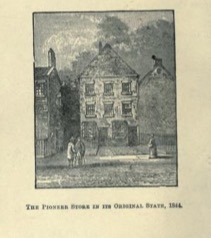
In 1844, 28 hand-loom weavers in Rochdale, who had only intermittent employment, decided to set up a co-operative shop, where there would be no profit to third parties. They gave it the legal name of “The Rochdale Society of Equitable Pioneers”. They needed 3 months to save up one Pound each, to subscribe the capital, and begin buying some groceries. They rented the ground floor of a warehouse at 31 Toad Lane, and on 21st October 1844, they started sales through a window; the wares were small quantities of flour, butter, sugar and oatmeal.
For the first years they sold only groceries. In 1846, they started selling butcher’s meat; in 1847, they opened a drapery business; from 1852, they offered services of shoemaking, clogging, and tailoring. They also introduced a drawback from profits to finance an educational fund. The co-operative stores had fixed principles of honest dealing, good quality, “full weight”, cash payments only (no risk of a client getting into problems with his debt). By 1851 there were 130 similar shops. By 1861 the yearly sales volume in the country was 176,000 pounds. The co-operative system in Britain increased in size during the rest of the nineteenth century.
(Holyoake, 1893, p. xvi)
We have a description of a typical day’s business around 1855:
“At seven o’clock there are five persons serving busily at the counter, others are weighing up goods ready for delivery. A boy is drawing treacle. Two youths are weighing up minor articles and refilling the shelves. There are two sides of counters in the grocer’s shop, twelve yards long. Members’ wives, children of members, as many as the shop will hold, are being served; others are waiting at the door, in social conversation, waiting to go in. On the opposite side of the Lane, three men are serving in the drapery department, and nine or ten customers, mostly females, are selecting articles. In the large shop, on the same side of the street, three men are chopping and serving in the butcher’s department, with from twelve to fifteen customers waiting. Two other officers are weighing flour, potatoes, preparing butter, etc., for other groups of claimants. In other premises adjoining, shoemakers, cloggers, and tailors are at work, or attending other customers in their respective departments. The clerk is in his office, attending to members’ individual accounts, or to general business of the Society. The news-room over the grocery has twenty or more men and youths perusing the newspapers and periodicals. Adjoining, the watch club, which has fifty-eight members, is collecting its weekly payments, and drawing lots as to who shall have the repeaters (manufactured by Charles Freeman, of Coventry), which the night’s subscription will pay for. The library is open, and the librarian has his hands full in exchanging, renewing, and delivering books to about fifty members, among whom are sons, wives, and daughters of members. The premises are closed at ten o’clock, when there has been received during the day for goods £ 420, and the librarian has lent out two hundred books. In opposite districts of the town, the Society has now open four Branch Stores for the convenience of outlying members, where, on a lesser scales, the same features of sale are being repeated.”
(Holyoake, 1893, p. 39; this chapter was first published in 1857)
These paragraphs are inserted to show that in some circumstances, the inflationary increases in prices actually paid by the working classes for their necessary articles, could be less than the increases in the wholesale prices. It was possible to reduce the sales margins, to the benefit of the workers.
The information about the Co-Operative Movement shows that the workers in the industrial towns were not just passive wage-earners, but were capable of initiative and business organization. We also see that the “sons, wives, and daughters of members” are interested in reading books; this was in general not the case of their grandparents, 50 years earlier.
The poor in the countryside were often exploited as to the prices that they paid for their wheat, or the other articles in the small shops in the village.
David Davies reports that the wheat passed through several transactions until it arrived in the peasant’s cottage:
“ ….. The great farmer deals in wholesale way with the miller; the miller with the mealman; and the mealman with the shopkeeper, of which last the poor man buys his flour by the bushel. For neither the miller, nor the mealman, will sell the labourer a less quantity than a sack of flour under the retail price at shops; and the poor man’s pocket will seldom allow of his buying a whole sack at once. Formerly the wife saved the profits of the mealman and shopkeeper, who now, without adding to the value if the manufacture, do each receive a profit out of the poor man’s earnings. It has been asserted by a good judge of these matters, that this is a disadvantage to the poor of at least ten per cent, upon this prime necessary of life. (See Mr. Kent’s Hints to Gentlemen of Landed Property, p. 277) In short, the poor man buys every thing at the highest price; at a higher price than the rich do. He cannot help this; but must submit to the established order. It is not possible for him, nor is it easy for his superiors, to effect a change, where things have gone on for a long time in a certain train.”
(Davies, 1795, p. 34)
Mr. Vaughan, the Assistant Commissioner in the Report on the Employment of Women and Children in Agriculture, 1843, gives a long commentary on the same sort of monetary disadvantages which the farm labourers have in their purchases in the village shops. He says that “a general conviction prevails that the charges in the villages shops are very high, and the articles very often inferior”. He then quotes the Rev. Thomas Corvey of Cowden in Kent:
“One great and oppressive misfortune to the laborer is the difficulty of expending his earnings to any advantage. Confined to the limits of his small circle, and perhaps only late in the evening receiving his wages, he deals solely with the village shop. In these shops are sold articles of but moderate quality, at very high prices. There are numerous instances of large fortunes being made in the places where the farmers and labourers are the only customers – such fortunes as could only be accumulated by excessive profits and want of competition. A labourer (it is considered) is allowed credit for a small amount, and then obliged to deal under a fear of having his debt called for, and thus of being destitute for the time. It may be true that the shopkeeper, by deaths and other causes, loses money; but with such large profits the effect is slight; and as he knows everybody he has generally good tact, and avoids a bad creditor. Millers commonly pursue the same system. The labourer in consequence, finds himself ill off, and complains that he cannot live on his earnings, when, in fact, he cannot lay them out to advantage. Averages and quotations serve little purpose. Deal here, or pay your debt, is the practical argument. I believe one great cause of the bad condition of the poor is to be found in this.”
Mr. Vaughan says that “it is not an uncommon thing for the families who are in a condition to do so, to purchase six or eight miles from their own homes, rather than at the village shop”. He quotes in this respect, a witness, Mr. Duppa:
“There is just cause for the statement about the dearness of village shops. I can hardly give a better idea of my opinion on the subject than by stating an alteration which I made about a year ago in my hour of paying the workmen. My former hour of payment was seven o’clock on Saturday evening, which I have changed to nine o’clock on Saturday morning. My people are enabled to purchase their goods at the market town in consequence, at the distance of six miles. They have all quitted the village shops for the better and cheaper shops of Maidstone. My opinion is not ruled solely by this circumstance. I am certain there is great foundation for the complaint.”
Mr. Vaughan says that the shops are generally supposed to be 25, 20, or 10 per cent dearer than the town shops, that the articles are inferior, and that the practice of giving credit is used as a method to pressure the people.
Further, in some cases in Sussex at least, the farmers do not pay their workers in cash, but with vouchers cashable in purchases from the shopkeeper or the miller.
“”The cause of articles in this neighbourhood,” says the rector of Brede, in Sussex, “being dearer at the village shops, arises from the infamous system of giving checks upon shopkeepers, instead of paying the labourers in money, as adopted by farmers, I fear, too generally. The hardship in this parish has been excessive through the prevalence of the above system, which, by making the petty shopkeeper the farmers’ banker, at one exposes the labouring poor to whatever exactions their paymaster may think proper to impose upon them; for, under such a system, they have no alternative but to take his goods at his own price or starve.””
(Reports of Special Assistant Poor Law Commissioners on the Employment of Women and Children, 1843, pp. 140-142, Mr. Vaughan, Kent, Surrey and Sussex)
The “truck system” and the “tommy shops” were also used in the industrial areas (colleries, iron works, Black Country), and consisted of forcing the worker to buy the goods in a shop controlled by the owner of the company, or paying him with vouchers which could only be utilized in a shop owned by a business associate. Obviously the owner made a profit from this. William Cobbett gives a clear example from the iron-working district:
“The manner of carrying on the tommy system is this: suppose there to be a master who employs a hundred men. That hundred men, let us suppose, to earn a pound a week each. This is not the case in the iron-works; but no matter, we can illustrate our meaning by one sum as well as by another. These men lay out weekly the whole of the hundred pounds in victuals, drink, clothing, bedding, fuel, and house-rent. Now, the master finding the profits of his trade fall off very much, and being at the same time in want of money to pay the hundred pounds weekly, and perceiving that these hundred pounds are carried away at once, and given to shopkeepers of various descriptions; to butchers, bakers, drapers, hatters, shoemakers, and the rest; and knowing that, on an average, these shopkeepers must all have a profit of thirty per cent., or more, he determines to keep this thirty per cent. to himself; and this is thirty pounds a week gained as a shop-keeper, which amounts to 1,560l. a year. He, therefore, sets up a tommy shop: a long place containing every commodity that the workman can want, liquor and house-room excepted.”
(Cobbett, Rural Rides, Midland Tour, Wolverhampton and Shrewsbury; 18th May 1830)
These systems were made illegal by the Truck Act of 1831, which required that all payments of wages should be made in coin.
As a result of the disappearance of these abuses, the poorer classes paid a lower price level for their food and other necessities. This means that the retail prices did not increase so fast as the wholesale prices.
We will see in other sections, that the prices for food and other articles fell from 1825 to 1860. This was not due to a general decrement in prices, or from government policies, but because the costs of production went down. This was demonstrably due to the Industrial Revolution. We have here an “industrializing dividend”, similar to the “peace dividend” after the collapse of the Soviet Empire in 1989-1991.
These were the changes in manufacture:
machines with fast, repetitive movements to produce large quantities of articles, with high quality;
enough purchasing power in the working classes and professional classes to buy these articles;
reduction in transport costs, with the introduction of the steam train and the steam boat;
reduction in energy costs in industry and in agriculture, due to the introduction of the stationary steam engine, and continual increases in its efficiency;
continuous improvements in technology, with a large number of trained mechanics;
assembly line organization;
an economic environment, which gave more sales and at better prices, to companies which brought better products to market;
use of management accounting, to identify costs savings, and to give input for deciding prices;
use of iron and steel, instead of wood.
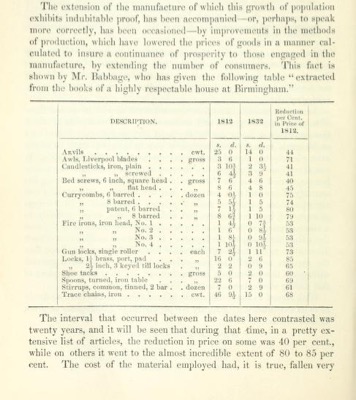
The costs of manufacture of mechanical goods in Birmingham decreased by 40 % to 70 % in 20 years:
These were gas lighting, postage stamps, transport by rail, and easier working conditions.
The most obvious improvement for the people from the Industrial Revolution was gas lighting in the streets, the interior of public buildings, and in the factories.
Gas lighting was first implemented in streets in London in 1810, and in the majority of towns and cities by 1825; as to factories, it began in the North from 1808.
The great advantage of street lighting was the general possibility to move around the towns in the evenings, and the reduction in the activities of thieves and violent gangs. Its use in buildings particularly gave the people more hours for reading, and thus increased the level of general knowledge and of literacy.
The financial arrangement for the supply of street lighting was the formation of a public subscription company, which used the money from the subscribers to construct and operate the gas company. The company was paid by the local authority, and thus could pay dividends to the subscribers; the local authority made the payments out of funds collected from the rates. Thus street lighting was a practical improvement for the whole population, paid for by house owners.
Gas lighting for the factories in Lancashire and Yorkshire was used to illuminate the working areas of the mills, in the early morning and the evening in the winter months. Thus the mills could be run for longer hours, which meant that the companies could produce more cotton or woollen cloth, and that the workers could earn their wages during more hours.
“This [Bradford] is one of the many towns which, when approached just after dark on a winter’s evening, present that curious species of illumination resulting from the countless windows of large factories. Five, six, seven stories of such windows are to be seen, extending to great width, and each throwing out its glare from the gas-lights within the long rooms or galleries of the factory. Those who, by residing in an agricultural county, or even in London, are not accustomed to such a sight, can scarcely form an idea of the singular effect which these symmetric specks of light produce when viewed in the aggregate from a distance.”
(Knight, 1844, Worsted factories, p. 35)
Postage stamps for letters were introduced in 1840. These made the communication between family members in different towns much easier. In 1849, 268 million letters were sent with stamps; that is, about 15 letters per family.
Personal travel was 0.21 shillings (1700 price level) per passenger mile by stagecoach in 1800, but with third class railway fares in 1865 was 0.05 shillings per passenger mile; the journey speed instead of 7.76 miles per hour in 1820 was 23.2 miles per hour in 1870. With reference to freight, the costs by road in 1800 were 0.7 shillings per ton mile (price level 1700) and by canal were 0.25 shillings; in 1865 the costs by rail were 0.06 shillings per ton mile
(Bogart, 2013, p. 14, p. 16)
That is, the passenger ticket cost went down to 25 %, the journey time to 30 %, and the freight rate to 10 % resp. 25 %.
In 1844, Parliament enacted a law, requiring the railway companies to run trains (generally known as “Parliamentary trains”!) with cheap tickets for the lower classes. All companies had to provide one train daily, with carriages for third-class passengers, on each track, in both directions, and stopping at all the stations, with the following conditions:
the fare should be 1 penny per mile;
the average speed should be not less than 12 miles per hour;
third class passengers should be protected from the weather, and be provided with seats.
(Wikipedia, “Railway Regulation Act 1844”)
The number of rail passenger journeys increased from 33,700,000 in 1845 to 60,400,000 in 1849. As to the “parliamentary trains”, there were 1,060,000 pounds paid for tickets, which corresponded to 250,000,000 passenger miles. With about 2,000,000 working-class families, that would be 25 miles per person per year (Porter, 1851, p. 330). In 1840, there were groups of three or four weavers in Manchester, who paid for a ticket for one of their number to take their cloths to Liverpool by train.
Transport by rail was very important for the supply of food. Cattle could be killed in the town near the farm, and the carcasses moved by rail to the cities; before the railways, the cattle were walked to the city, and lost an average of 20 pounds weight each. By 1849, one million animals (killed) were reaching London each year.
In the case of fruit and vegetables, these could be brought to the cities at lower cost than in horse vehicles; the short time in transport meant that these articles arrived practically without physical damage or over-ripening. Market gardening around London increased greatly in the 1840’s; farms in Kent were selling large amounts of cherries to Yorkshire. Manchester had a complex railway network to bring large quantities of potatoes, cabbages, turnips and carrots from the agricultural areas of Lancashire, Chester, Yorkshire, plus imports from Ireland through Liverpool.
The easier conditions in agriculture and mines are noted in the appropriate chapters. In the mines, underground work for small children and women (which had always existed) was abolished. Cotton manufacture in the mills did not require much physical effort after the introduction of the power-loom in 1830-1850. Note: this does not only mean that the weaving work in the factory in 1850 was lighter than in the factory in 1815; it also means that the weaving work in the factory in 1850 was lighter than in the cottages in 1770, as even then the weavers had to work 10 hours a day in a difficult position.
“I can only allude to a class of subjects so vast and so interesting that a good volume might be written on them. I refer to the thousand and one scientific inventions of the past half century [1831-1881] which have been applied in so many ways to the improvement and the manufacture of articles in use in every-day life, tending to lighten labour, make life more comfortable, and in various ways minister to our happiness. Take one very simple instance as an illustration – that of a trifling and insignificant article which, though in daily use, is thought but little of. Few people stop to bestow a moment’s thought to the great convenience promoted by its use as compared with the inconvenience which attended the striking of a light fifty years ago. People who only know the lucifer match have no idea of the trouble and inconvenience of the tinder-box and flint and steel in use fifty years ago. …..”
(J. T. Slugg, Reminiscences of Manchester Fifty Years Ago, pp. 319-320)
A final consideration for the whole of the working classes was that they could be clothed in cotton. This was lighter than wool or flannel, was durable, could be presented in many colourful designs, and was easily washed and thus more hygienic.
The male workers also had the time, energy, and money to frequent prostitutes. Quantitative and descriptive data come from a book written by a Mr. William Logan, a “City Missionary”, i.e. a Christian social worker, in his book “An Exposure from Personal Observation of Female Prostitution in London, Leeds and Rochdale and especially in the City of Glasgow” (1843).
Mr. Logan gives his estimate of the size of the “industry” in Leeds and Glasgow (“only the third-class houses”):
Leeds
Glasgow
Population of the city
160,000
250,000
Number of houses of ill fame
175
450
Number of prostitutes
700
1,800
Number of visits by men, weekly
14,000
36,000
Average girl’s weekly income
Shillings
30
20
Payments to girls, weekly
Pounds
1,050
1,800
Robberies, weekly
Pounds
1,750
4,500
Spent on drink, weekly
Pounds
1,400
3,600
Total expenses of the clients, week
Pounds
4,200
9,900
Total expenses of the clients, year
Pounds
218,400
514,800
Prostitutes who die each year
120
300
(taken from: Logan, 1843, p. 9, p. 20)
But we must not forget the other side of the equation. Many of the women in prostitution had miserable lives. Some were prostitutes by choice, but many were workers in badly-paid jobs, or in times of reduced work possibilities, and who had to “go on the street” in order to eat.
“The police report, for the year ending December 31, 1843, states that the number of brothels in Manchester (within the police limits, containing a population of 235,139), is 330. The number of bedrooms is 722, and these contain 973 beds. The number of prostitutes living in these brothels is 701. But these numbers give a very inadequate idea of the extent of prostitution, for there is certainly a large number of females who work in factories, and also, of dress-makers, umbrella-stichers, stock, cravat, and shirt sempstresses, &c., who resort to this practice, to eke out the deficiencies of their ill-remunerated labour. If we suppose that these are only as numerous as the professed prostitutes – the result would be 1,444 – a number, which, accords very nearly with Mr. Logan’s estimate. From information, which he states he had derived from the Manchester Town Missionaries, and which was corroborated by a medical gentleman who had paid particular attention to the subject, he gives 1,500 as the number of prostitutes in Manchester, at a probable cost to our town of £470,000 per annum! (*) And, out of this number, he estimates that at least 250 are annually cut off by intemperance and disease. He affirms the average duration of a life of prostitution is not more than six years. In London, Mr. Logan thinks, there may be about 15,000 of this unfortunate class – in Liverpool, 2,000; in Hull, 300; and in Paisley, 250.”
(*) £ 7 per adult male per annum!
(Faucher, 1844, p. 42, footnote 18, added by the translator, a native of Manchester)
“But Mr. Logan has omitted one feature, which I am convinced, is a powerful cause in extending prostitution. I mean seasons of commercial distress, when trade becomes paralysed – the mills closed – and honest labour denied an honest livelihood. During the last panic, the increase of prostitutes was enormous; and it was impossible for a resident to be ignorant that this increase was owing to the awful destitution which then existed. In seasons of prosperity, this class is contracted to the professed prostitutes, whose dress and demeanour declare all too plainly their vocation; but in seasons of distress, the homely garb and timorous deportment of a large number of females, tell, in language not to be mistaken, that the increase consists of females who are driven to walk the pavement for a livelihood.”(op. cit., p. 43, continuation of footnote 18)
The lower classes of the workers in Manchester found time and money enough, to go to drinking saloons, beer-shops and “dram-shops” (gin-palaces). Benjamin Love reports that in 1840, from own investigation and from a report published by an academic institution, “in all our large towns, the principal taverns and gin palaces have now attached to them spacious saloons, in which, four or five evenings a week, and principally on the Sunday, the operatives assemble in crowds to listen to vocal and instrumental music, generally speaking, of superior character. Those who spend a certain amount in liquor have admission free, so that the expenses, which are large, must, of course, be amply covered by increased custom, i.e. from those who go there for the music and not for the drink. The number of such places of resort in Manchester and Salford is upwards of fifty, which display themselves in all directions at an average of not more than a quarter of a mile’s distance from each other. Reckoning one hundred persons at a time in each place, would give five thousand, principally young people of both sexes, nightly exposed to these contaminating influences. The nature of the scenes sometimes enacted, and the effects upon the character of those who frequent them, may be readily imagined”.
(Love, 1842, pp. 144-146).
These expenses often impacted the family budget: “Beer shots are considered debts of honour.” The operative paid these first, before giving the rest of his salary to his wife, to cover the weekly expenses. One of the mills made the Saturday payment of the week’s salary to the workers in large amounts of small change, so that the worker would not have the excuse to go to the nearest public house “to change the large coins”.
There were a large number of drinking establishments in Manchester:
(Kay, 1832, pp. 34-35)
Mr. George Porter, at the time Secretary of the Board of Trade, gave a presentation to the British Association in 1850, with figures as to the annual consumption in the United Kingdom of spirits, beer, and tobacco; the figures were calculated, taking the taxes collected for each position. The total retail sales amounts were: spirits 20,800,000 pounds, brandy 3,300,000 pounds, beer 25,400,000 pounds, tobacco 7,600,000 pounds.
We may suppose that the beer was consumed exclusively by the working classes, which were about 19,000,000 persons or 4,200,000 families in the whole United Kingdom. This gives 1.3 pounds per person per year, or 2.3 shillings per family per week. The average income per principal wage-earner was about 14 shillings, so that 16 % of the income went on beer. The physical quantity of beer was 435,000,000 gallons, or 15 pints per family per week.
This means that, either, the average of the families were able to spend an important part of their income on beer (and some additional amount on gin, brandy, and tobacco), and thus were in very good financial circumstances, or, that the total weekly incomes of the families were higher than are generally supposed. It also means that the “family budgets” that we have are not complete.
(Porter, 1850, On the self-imposed Taxation of the Working Classes in the United Kingdom)
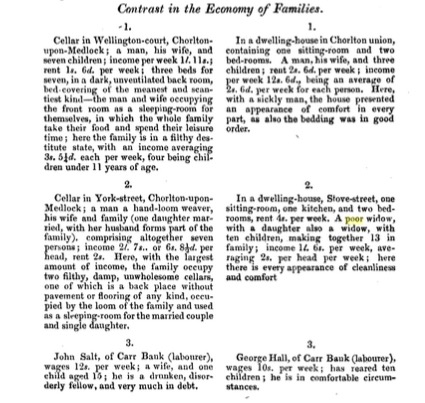
The mill-owners, the Government inspectors, and the local doctors in the textile areas were all convinced that it was a bad idea that a worker had a high income, because he would spend a large amount on drink. Many workers with a median income lived better than the highly paid men, exactly for this reason. There were cases of spinners with a family income of 40 shillings, but who lived in a cellar, because they could not pay a normal level of rent and food. The Poor Law Commissioners (1842) give us a comparative vision of some families, who have the same income, but those in the left column live very badly, and those in the right column live decently.
(Poor Law Commissioners, Local Reports, 1842, pp. 238-239)
This means that the image that we have of the difficult home circumstances in many cases of the workers, is not necessarily because they were poor, but because they were well-paid.
Mr. Edwin Chadwick, in an earlier official position as Assistant Commissioner to inform on the usages of the Poor Laws, specifically in London and Berkshire, made a number of investigations into the habits and financial possibilities of those persons who were receiving subsidies, and also as to the minimum amounts on which a poor person could live. There is a lot of fraud by the applicants. It is also shown that the poor could live on less money than they are receiving. It is very interesting to read the whole section.
(Extracts from the Information received by His Majesty’s Commissioners as to the Administration and Operation of the Poor Laws; See: Report from E. Chadwick, Esq., Assistant Commissioner, on London and Berkshire, pp. 234-339)
The better members of the factory classes and the men working in engineering workshops, as well as clerical staff in the factories, and small tradesmen, went to study in Mechanics’ Institutes in the evening. These gave classes on technical subjects, physics and chemistry; some gave classes of German and French. The concept started in the 1820’s, and by 1850 there were 700 institutes in the United Kingdom with 120,000 members. Many of the workers who improved themselves in these classes went on to be engineers, plant supervisors, or designers. The institutions were often partially subsidized by the better classes, who also donated books for libraries. On occasion, starting from 1840, the members went on educational train journeys to other cities, and to meet the members of other institutes.
(Tylecote, 1957, Ch. III. Origins and Development in Lancashire and Yorkshire)
In Nottingham the cost was one shilling per quarter. The subjects taught were science, French, engineering drawing and architectural drawing. For those with lesser formal education, there were classes in English grammar and advanced arithmetic. Individual lectures were given on, for example, physiology, astronomy, railways and silk manufacture.
At South Shields, the first year’s courses were: history of chemistry, attraction of gravitation, chemical affinity, heat, light, electricity, and electro-negative bodies. All were attended by eighty to one hundred listeners.
There were large institutes in Manchester and Salford (Report of a Committee of the Manchester Statistical Society on the State of Education in the Borough of Manchester, 1834, pp. 17-18, pp. 30-32), and Ancoats – the area of Manchester with the most important mills and lower working-class housing – had its “Lyceum” (Love, 1842, pp. 177-184).
The Institutes held a number of exhibitions for the public, to improve their general technical knowledge. The first large exhibition was presented by the Manchester Mechanics’ Institute in 1837. Exhibits included 31 model steam engines, 79 models of “useful machines and ingenious mechanical contrivances”, 12 models of public buildings, 90 scientific instruments, 140 India ink and coloured designs and drawings, 28 specimens of glass, painted and stained glass, and 10,000 insects. Other exhibitions were organized at Bradford, Halifax, Todmorden, Leeds, Huddersfield (*), and Birmingham; these included arts, and scientific experiments in front of the visitors. Without doubt, these exhibitions paved the way for the Great Exhibition of 1851; Prince Albert specifically requested the inclusion of working men on the Committee.
(Walker, 2010, Chapter Three “The Great Exhibition and the Mechanics’ Institute Movement”)
(*) There was an independent “Huddersfield Female Institution” from 1849, with 100-200 members, and with women teachers.
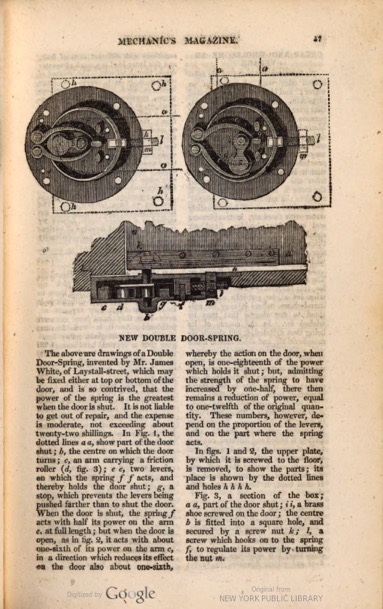
There was also a “Mechanics’ Magazine” with a high level of general technical knowledge. It began in 1823, with 32 pages, at 3 pence a week. It had a circulation of 16,000 in 1824, but we can assume that in general, each booklet was read by more than one person.
(“Mechanics’ Magazine”, No. 1, August 30, 1823,p. 47)
It is not clear where these 16,000 men obtained the technical education necessary to understand these articles, in the years before 1823; it is also not clear in which industries they worked.
Thus we see that a certain proportion of the workers were interested in improving themselves, and could give up their time and money for this purpose.
Mr. Zacharias Allen, a visitor from the United States in 1825, was shown round the largest flax mill in the country by the owner, Mr. Marshall:
“The proprietor, Mr. Marshall, showed us the library formed for the use of the workers of the establishment. This library is sustained by a small periodical payment by those who use the books, for the reception of which a room is appropriated. The volumes bear evident marks of having been well thumbed. These mill-libraries, if the term be allowed, are of late established by many of the propietors of large manufactories in England, and are very creditable evidences of their liberality and personal exertions, to render the men who are engaged in their employments both more intelligent and virtuous. For this excellent purpose, numerous mechanic’s libraries have also been established throughout England; ….”
(Allen, 1832, report of visit of 1825, pp. 208-209)
Of the male workers in English factories in 1833, 86 % could read, and 43 % could write:
(Factories Inquiry Commission: Supplementary Report of the Central Board, Part 1, Ordered by the House of Commons to be Printed, 25 March 1834; p. 42)
“The workshop depraves, but it throws open to the minds of the operatives a whole world of ideas. Spurred on now by destitution – now by high wages – they are continually struggling to attain a higher position, and feel the necessity of cultivating their minds. No county buys so many books as Lancashire. Chamber’s Edinburgh Journal, which circulates to the extent of 85,000 per week, is read principally in the manufacturing districts; and Lancashire alone takes 20,000 of them. There is no portion of society which struggles with greater avidity for a better Future.”
(Faucher, 1844, p. 122)
According to the Select Committee on Public Libraries, 1849, the Mechanics’ Institutes in Lancashire and Cheshire, had 29 libraries with a total of 56,000 volumes:
In Yorkshire, the Mechanics’ Institutes libraries had about 60,000 books, on average 900 books per library (Ibid., p. 124).
The Religious Tracts Society informed the Committee, that since 1823 they had formed 5,410 libraries in Great Britain and Ireland, with, on average, 100 books each (Ibid., p. 168).
“Having been so long associated as you have been with the working classes, can you give the Committee any information respecting their tastes and habits, and can you state how far, in your judgement, the establishment of public libraries is likely to be appreciated by them?” “I have witnessed a very decided improvement intellectually and socially among them, especially among the working classes of London, during the last 28 years of my residence here.”
“Can you give the Committee any instance of the improvement of their habits which you have observed?” “In the first place, they are not so drunken and dissipated in their habits as they were at that period; which beneficial change I attribute principally to the great increase of coffee-houses and reading-rooms; for at the period I refer to, the working classes generally took their meals at public-houses, which led to the formation of habits which I know to be the ruin of great numbers; the same persons now generally take their meals at coffee-houses and reading-rooms.”
“Can you give the Committee any idea of the increase of late years in the number of coffee-houses?” “I have no statistical information to give, but I should say they have increased five-fold within the last 17 or 18 years.”
“You possibly recollect the time when there was scarcely a coffee-house in London?” “I recollect when there were very few indeed, and unattractive, and these having few publications, owing to the high price they had to pay for newspapers. There was no cheap literature at that time, or very few cheap publications; there was the “Mirror”, one little publication, taken in by them, but I do not know any other at that period; and the consequence was that the working classes used to have their meals at a public-house.”
“The first of what may be called the modern coffee-houses was established in 1811, was not it?” “That was before my coming to London.”
“And they now amount to probably 2,000?” “I have been told 2,000.”
“Are not those coffee-houses the resort of the sober part of the working population?” “I should say so.”
“In fact, they have not there the means of indulging in dissipated or drunken habits?” “Not at all; you may go into those places, and see a great number of the working classes reading; I am told that somewhere about 500 of them have libraries connected with them; some of these libraries have as many as 2,000 volumes; there is one especially in Long Acre, “Potter’s Coffee-house”, I think it is called, where they have 2,000 volumes, it is said; and there are other parts of London where they also have large libraries.”
“Is that a mere coffee-house?” “Yes.”
“They do not sell spirits?” “Nothing but tea and coffee.”
“These houses are strictly for the sale of tea and coffee?” “Yes, except that in many of them they cook meat; which persons can be supplied with as well and tea and coffee.”
“They are not spirit-shops as well?” “Not at all.”
“Do the working classes take their meals in coffee-houses, rather than go home?” “I am speaking of the young men of London, and also of the married men who have to work at some distance from their houses. In London they have to go sometimes two or three miles away; their work calls them into different parts of the town.”
“Do not some of the proprietors of some of those coffee-houses expend hundreds of pounds a year in the purchase of periodicals, newspapers and books?” “They do; a gentleman, the proprietor of one of those places, told me that his average expenditure was about 5l. a week.”
“Are not some of those coffee-houses so much frequented that perhaps 1,500 persons pass through one of them in the course of a day?” “As to the exact number I cannot say; but you can seldom go into some of the large ones but you find them crowded with people mostly of the working classes.”
(Ibid., p. 177, Mr. W. Lovett, manager of the National Hall in High Holborn, and superintendent of the schools)
We do know how much money “the people” had saved up. In 1849 in the savings banks there were 1,100,000 depositors from all the United Kingdom with a total amount of 28.5 million pounds. The number of depositors increased from 370,000 in 1830 to 1,100,000 in 1849. With a total population of 18,000,000 and 5 persons per family, this means that 30 % of the families in the United Kingdom had money in excess of their expenses, of about 26 pounds or 520 shillings each accumulated, when the average weekly income for a working-class family in good circumstances was 25 shillings.
(John Tidd Pratt, The History of Savings Banks in England, Wales, Ireland, and Scotland, 1842, p. 79)
In South Devon, 2,000 agricultural labourers and 2,400 artisans had savings accounts:
(Extracts from the Information received by His Majesty’s Commissioners, 1834, Ability of the Labourers to Save, p. 231)
By law, the investors in the savings banks could only be from the working class, as we can see from the data of the Manchester and Salford Bank for Savings in 1842. The list includes domestic servants, although here it is probable that what really happened, is that the lady of the house deposited the weekly salary of the servant, so that she could not make a bad use of the money!
(Porter, 1847, pp. 618-623)
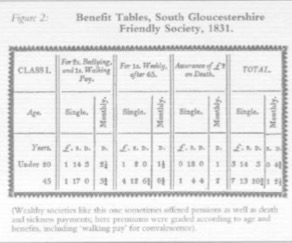
The Benefit Societies were associations, to which the members paid a certain amount each week, to be covered against costs from illness, or loss of work (there were also contributions to trades’ unions to cover these costs). The Friendly and Benefit Societies had 2 million depositors with 9 million pounds. (Hartwell, 1961, p. 404)
“But there are also in Liverpool a number of clubs or benefit societies, to each of which there is usually a surgeon attached and the members of which (who are principally mechanics or labourers in receipt of good wages) are not received as patients by the dispensaries. The largest of these clubs consists of 8000 members, and it is probable that in the aggregate they amount to more than 20,000.”
(Poor Law Commissioners, Local Reports on the Sanitary Condition…,1842, p. 283)
In Sheffield there were at least 50 benefit societies, with from 100 to 900 members each, and from 1000 to 6000 pounds in the bank account. The monthly contribution was one shilling or fifteen pence. In the case of the member not being able to work because of illness, the fund paid out 10 shillings a week for ten weeks, and from that date on, the half. In the case of death, the family received 8 pounds for funeral expenses.
(Holland, 1843, Chapter XVII, Sick Clubs or Friendly Societies and Secret Orders)
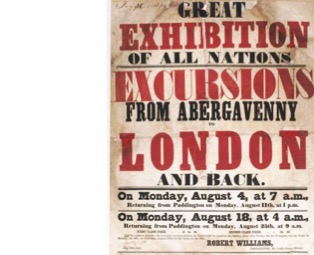
The Great Exhibition of 1851, in the Crystal Palace in Hyde Park, was the largest public event of the nineteenth century in the United Kingdom. It showed all the technical, scientific, artistic and cultural progress of the country in a structure of 1850 feet by 450 feet. It was visited by more than 6,000,000 people in 5 months, with a maximum per day of 110,000. The tickets were of one pound for the decent classes on reserved days, and one shilling for the other classes. 6,000,000 people was about 1 in 3 of the total population of England, and 3 times the population of London, which tells us that many people came from distant towns, and that a large proportion were of the lower working class. There were cases of workers in Yorkshire, who took the night train to London, visited the Exhibition the next day, returned on the next night train, and presented themselves for work the following day.
“Another instance of special purchase of food was that connected with the Great Exhibition in Hyde Park, in 1851, when £75,000 was spent in refreshments, averaging £525 per day for the 144 days during which the exhibition was open, or averaging three-pence per visitor for six million visitors; when nearly two million buns were purchased and eaten, and a hundred thousand pounds weight of patés and biscuits, and a hundred thousand loaves of bread cut up into slices, and four hundred thousand pounds of meat; and when these solids were washed down with a million bottles of aërated beverages, sixty thousand quarts of milk and cream, and the drinks prepared from twenty thousand pounds of coffee, tea, and chocolate.”
(First Class Fare £ 3 2s. 6d., Second Class Fare 18s. 6d.)
Abergavenny is a small town in Monmouth; it has today a population of 10,000. In the nineteenth century it was the major town in the region, and had a small clothing industry, and some agriculture. What we see is that there were enough people with 18 shillings to spare (in First Class, 3 pounds), plus the cost of eating and hotel for 7 days in London, for it to be worthwhile to organize an outing to London. The cost is per person which means that for a family of four, it would be nearly 4 pounds. The same level of price calculations would have been valid for the people who came from, for example, Lancashire or Yorkshire. A large section of the working class apparently had the possibility to save money to spend on leisure activities. This indicates that, approximately, more than half of the population had enough income to lead a satisfactory life.
The investors in the project of the Liverpool and Manchester Railway made their calculations on the basis of mainly freight carriage. But there was exceptional interest by people to use the train. In its first years it sold 400,000 tickets per year, which would be 100,000 trips of a couple, return. The tickets were 4 shillings one way, uncovered, so that a man going and returning with his wife, would spend 16 shillings, which was somewhat more than an agricultural worker’s weekly wages in Lancashire. The following year (1831), the company temporarily refitted freight wagons to be used for people, and these were used for transport to the Newport Horse Races in the summer.
There were other railway excursions in the following years. One of the earliest cases was an Excursion Trip from York to Leeds and Hull, on the Easter Weekend 1841 (3 days) (Major, 2012, p. 68).Another was from London to Bristol, Bath, and Exeter in September 1842, for 800 persons (p.70). There was a trip in 1840 from Wadebridge to Bodmin Jail, to see two murderers hanged; 800 passengers in three trains (p. 71).





 The Industrial Revolution in England was not All Bad