14.6. Carpenters, Joiners, Masons, Bricklayers

From the study by Clark, we give the table for 1780-9 to 1860-9, for skilled building craftsmen:

Building Wages, the Cost of Living and Real Wages by Decade, 1209-2003

DecadeCraftsmen day
wage (pence)
Craftsmen day
wage (1780-9 = 100)
Cost of Living
(1780-9 = 100)
Craftsmen real
wage
(1780-9 = 100)
     
1780-926.3100.0100.0100.0
1790-929.8113.3116.397.5
1800-939.3149.4156.295.9
1810-947.4180.2174.8102.8
1820-944.9170.7143.1119.2
1830-945.2171.8129.7132.7
1840-945.7173.7125.7138.7
1850-947.7181.3119.3152.4
1860-955.1209.5126.4165.3

(extracted from: Clark, 2004, Table 4, p. 54-55; converted to 1780-9 index = 100 by this author)

As in the case of the unskilled workers in the calculations of Clark, we see that the real wages remain stable from 1780-9 to 1810-9, and then increase by 50 % to 1860-9. 

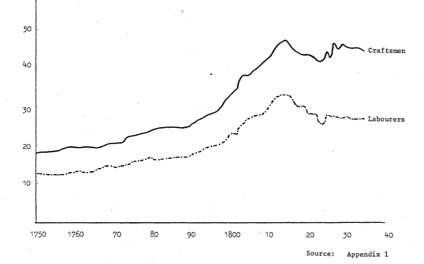
From the  investigation referred to above, by B. Eccleston, we have the following movements for skilled building workers.

Fig. 9, Building Workers, mean wage rates 

(Ecclestone, 1976, Fig. 9, p. 73)

With reference to carpenters and bricklayers, we have continuous data from 1780 to 1860, from the contract prices of Greenwich Hospital. The wages are practically constant for the period 1780 to 1800, they are suddenly doubled in 1800, and then maintain this level until 1860. We might think that that this was due to a change in contractual conditions in the works in Greenwich, and thus not representative of the whole country. However there are similar movements in Macclesfield for joiners and bricklayers of 33 % from 1793 to 1815, and then without changes to 1838. 

The carpenters in London in 1850 had a good standard of living. The better part, who had lived all their lives in London, and had contracts with the masters, had an income of about 30 shillings a week, while the lower class, those who had recently immigrated from the country, and had to look for work with informal builders, had an income of 20 to 25 shillings. The information in 1850 was that the wage level had not changed in 30 or 40 years. 

“The more respectable portion of the carpenters and joiners “will not allow” their wives to do any other work than attend to their domestic and family duties, though some few of the wives of the better class of workmen take in washing or keep small “general shops”. The children of the carpenters are mostly well brought up, the fathers educating them to the best of their ability. They are generally sent to day schools. The cause of the carpenters being so anxious about the education of their children lies in the fact that they themselves find the necessity of a knowledge of arithmetic, geometry, and drawing in the different branches of their business. Many of the more skilful carpenters I am informed, are excellent draughtsmen, and well versed in the higher branches of mathematics. A working carpenter seldom sees his children except on a Sunday, for on the week day he leaves home early in the morning, before they are up, and returns from his work after they are in bed. Carpenters often work miles away from their homes, and seldom or never take a meal in their own houses, except on a Sunday. Either they carry their provisions with them to the shop, or else they resort to the coffee-shops, public-houses, and eating-houses for their meals. In the more respectable firms where they are employed, a “labourer” is kept to boil water for them, and fetch them any necessaries they may require, and the meals are generally taken at the “bench-end”, under which a cupboard is fitted up for them to keep their provisions in. In those shops where the glue is heated by steam the men will sometimes bring a dumpling or pudding and potatoes with them in the morning, and cook these in a glue-pot which they keep for the purpose. In firms where the glue is dissolved by means of hot plates small tins are provided, on which they cook their steaks, rashers of bacon, red herrings, or anything else that they may desire. These arrangements, I am informed, are of great convenience to the men, and in those shops where such things are not allowed they are mostly driven to the public houses for their food.”

The carpenters received their work through “houses of call” (which were in pubs), which had a roll-book of workers, where they would be assigned to a master or architect who required their services. They had common funds, which acted as friendly societies, and paid them in times of sickness or unemployment. 

(Mayhew, 1850, Letters LX, LXI and LXII)            

In Lancashire in the period 1839-1859, the bricklayers had an increase from 27 shillings to 33 shillings, and the bricklayers’ labourers from 18 shillings to 21 shillings (with a reduction in hours worked per week, from 60 to 55 ½). The brickmakers also increased their income, from 42 shillings to 50 shillings weekly.

(Chadwick, 1860, Section V, pp. 12 and 16)

Carpenters, joiners, bricklayers, stonemasons (shillings per week)
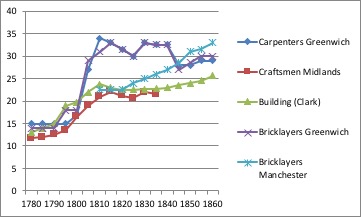
CarpentersCraftsmenBuildingBricklayersBricklayers
GreenwichMidlands(Clark)GreenwichManchester
178015121314
178515121414
179015131514
179515141918
180017172018
180527192229
18103421243123
18153322233323
18203221233223
18253021233024
18303322233325
18353322233326
184033233327
184528242729
185028242931
185529253032
186029263033

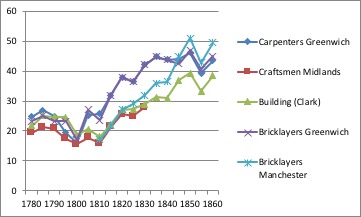
Carpenters, joiners, bricklayers, stonemasons (loaves per week)

CarpentersCraftsmenBuildingBricklayersBricklayers
GreenwichMidlands(Clark)GreenwichManchester
178025192223
178527212525
179025212523
179519172523
180016161917
180525182127
18102616182417
18153221223222
18203826273827
18253625273629
18304228294232
183545314536
184044314436
184540343941
185046394751
185539334143
186044384550

Carpenters, joiners, bricklayers, stonemasons (shillings per week)

Carpenters, joiners, bricklayers, stonemasons (loaves per week)
14.5. Coal Miners

In the following, it is important to note that the high figures for wages usually given for “miners” only refer to the pit-face workers. The totality of the workers in each mining business had an average wage of about the half of the direct miners

.The wage levels of the miners and their working conditions were fixed by collective bargaining and strikes. The collective bargaining took place on each occasion that a new seam was opened, and also at the beginning of the year. The strikes were generally due to changes that the owners wanted to introduce in the general terms of the contracts, or when they really wanted to force down the salary level. 

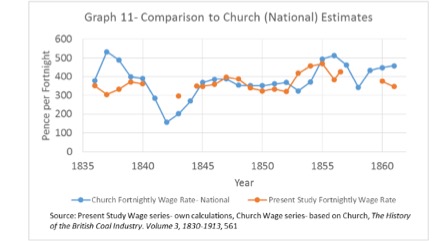
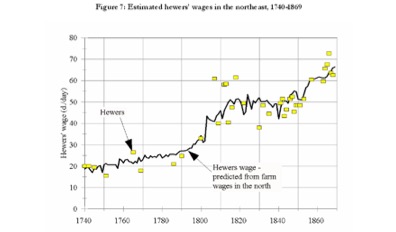
It was generally accepted that the male miners had a high wage level and deserved it, due to the dangerous and physically tiring nature of their work, as well as the exactness with which they had to work. Their wages were about twice those of the agricultural labourers in the same region, additional to which they could take coals home for own use, and in some coalfields the married men could live in cottages rent-free. In the majority of families two sons of from 12 to 18 years old worked in or above the mine, which increased the family income by 100 %. In the long term the wages did reflect the movements in the agricultural wages (see the graph below, for the relationship in the Northumberland and Durham coalfield, which was the largest), although it is not clear if the miners’ wages were moved by the labourers’ wages, or vice versa. 

(Mitchell, 1984, Ch. 6, Wage Bargaining, Ch. 7, Wages) 

(Clark, Gregory; Jacks, David; Coal and the Industrial Revolution, 1700-1869; University of California, Davis; http://gpih.ucdavis.edu/files/Clark_Jacks.pdf; Fig. 7, p. 46.)

It is very difficult to estimate the percentages of increase and decrease of the miners’ wages during the first half of the nineteenth century Great Britain. This is because the wages were negotiated between owners and workers with complicated contractual conditions, and also the negotiations were carried out per individual coalfield, and thus the final figures in each case were a function of the economic conditions of the coal extraction and of the relative strength of the negotiation positions of owners and miners. The principal expert, Church, gives a general estimation that the real wages of the coal-face workers – hewers – “fluctuated greatly” between 1830 and 1842, “but the average trend was stationary or slightly downwards”; from 1842 to the mid-sixties, there was a “general improvement of at least 50 %”. 

(Solomon, 2014, p. 22, pp. 49-55)

Church, The History of the British Coal Industry: Volume 3, 1830-1913, Victorian Preeminence, Clarendon Press, Oxford, 1986; pp. 570-574)

(Solomon, 2014, p. 65)

However, we do have a series of average figures from 1811 to 1838, from the book by J. Symonds, “Arts and Artisans ….”(p. 5), quoting information from William Dixon, owner of a large coal company.

In the important coalfields, the wages (pit-head workers) were: 

Northumberland   1831 21-24s., 1834 15-20s., 1843-6s. 18-24s., 1849 21s., 1861 31s.

Durham  1839 22s., 1846 22s., 1861 31s.

Staffordshire  1831-40 25s., 1844 21s., 1847 30s., 1848 24s., 1849 21s., 1860 24s.

Lancashire 1839 25s., 1849 20s., 1859 25s.

Yorkshire 1844-53 21s., 1853 24s. 

South Wales 1840 25s., 1845 17s., 1849 14s., 1860 18s.

(Bowley, 1900, pp. 108-9)

The main effect of the Industrial Revolution on the economics of the coal industry was to increase the amount of coal required by the country, and thus the number of miners employed. There were however, booms and slumps on the scale of a few years, which could lead to temporary adjustments in numbers employed or in wages.

(Mitchell, 1984, Table 5.3., p. 106)

Cobbett visited the coalfield in the area of Sunderland, in 1832, and found the living conditions very acceptable. “You see nothing here that is pretty; but everything seems to be abundant in value; and one great thing is, the working people live well …. The pitmen have twenty-four shillings a week; they live rent-free, their fuel costs them nothing, and their doctor costs them nothing. Their work is terrible, to be sure; and, perhaps, they do not have what they ought to have; but at any rate they live well, their houses are good and their furniture good; …. Their lives seem to be as good as that of the working part of mankind can reasonably expect.”

(Cobbettt, Rural Rides, II, p. 294; quoted in Thompson, 1963, p. 242)  

(But conditions in the North-East coalfield were better than those in the Black Country or in South Wales.)

The Industrial Revolution also improved the conditions of working life of the miners:

  • steam engines with fans, installed at the base of vertical shafts, to expel poisonous or potentially explosive gases upwards;
  • steam engines with metal cables, to bring up the miners in cages;
  • metal wire rope for bringing up the boxes of coal – before, the women had to walk up steps, with the coal baskets on their heads. 

“Simonin, however, provides a more detailed account of the changes in his book, Underground Life, written in 1869. He maintains that by 1860 the technology had advanced to the extent that in some collieries horses were used to draw the waggons on the underground railways in the main roads while in others the trains or trams were conveyed by locomotive engines or drawn by stationary engines (when working on inclined planes). In addition, some of the waggons, carts and trams used for carrying the coal were made of sheet-iron instead of wood and all types ran on four wheels. Simonin’s description of how the method of working mines had improved by 1869 is particularly enlightening:

“No more square-work or falls; no more narrow, winding, and badly-kept roads; no more conveyance on the backs of men: but a methodical setting off of stalls, or a regular system of working away the mineral by long-work, and a rapid conveyance along good roads on underground railways, either by horses or by engines. With all these improvements the cost of winning and raising the coal has been diminished by one-half, and the lives of the men have been less exposed to risks.”

Advances in the method of «dressing the ores» on the surface of metal mines occurred nearer the end of the nineteenth century. The process of riddling, bucking, cobbing and washing had been mechanized. Belts powered by steam engines moved the metal sieves back and forth to separate the rock and metal (riddling) and raised the hammers and anvils which crushed and pulverized the ore (bucking and cobbing). Water ran continuously with the aid of pumps over the metals to wash away dirt and impurities (washing). Machines performed the tasks which had employed hundreds of the young women and children on the surface of metal mines. The jobs of “riddlers”, “buckers”, “cobbers” and “washers” were becoming obsolete as mines modernized the dressing process.” 

(Tuttle, 1999, p. 233)

To this we can add the liberation of the women and small children from underground work (although on the other hand, this reduced the total family income). 

Miners, pit-face workers (shillings per week)

NationalNortheastStaffordS. WalesLancsWolver-
hampton
Average
178010
178510
179012
179515
180016
180520
18102220
18152023
18201725
18252425
183019242525
183516222525
1840172325212524
1845152321172224
1850152521142023
1855212722162223
1860193024182523

Miners (loaves per week)

NationalNortheastStaffordS. WalesLancsWolver-
hampton
Average
178017
178518
179020
179519 
180015
180519
18101715 
18151922
18202130
18252930
183024313232
183522303434
1840233134283432
1845243633273538
1850254135233338
1855283730223031
1860294536273835

Miners (shillings per week)

Miners (loaves per week)

14.4. Milliners, dressmakers, seamstresses, shirtmakers

These girls and women had a very difficult life (except for a few who worked for fashion houses, or in houses of the richer class). They had to work very long hours – up to 18 hours daily – in the work-rooms; the government inspectors and doctors said that they had never seen in other industries such long hours (“The protracted labour described above is, I believe, quite unparalleled in the history of manufacturing processes”) . They often suffered from extreme exhaustion, curvature of the spine, or partial blindness. Many were only 14 to 18 years old. 

(Ralph Barnes Grindrod, The Slaves of the Needle: An Exposure of the Distressed Condition, Moral and Physical, of Dress-makers, Milliners, Embroiderers, Slop-workers, &c, William Brittain, and Charles Gilpin, London, http://www.bl.uk/collection-items/the-slaves-of-the-needle, 1844)

(Children’s Employment Commission, Second Report, 1843; Millinery and Dress-Making, pp. 114-122) 

Those who were in a workshop had to work two years of apprenticeship without wages (only bed and board), then one year without pay as “improver”, then as “first hand” they received 10 shillings a week; after two more years, if they were very competent, they might be promoted to “second hand” at 20 shillings a week. 

(Dr. William Ord, The Sanitary Circumstances of Dressmakers and other Needlewomen in London”, 6th Report of the Medical Officer of the Privy Council, 1863), quoted in http://www.victorianlondon.org/index-2012.htm, Clothing, Dressmakers)

Those who worked on their own, usually in garrets, had very low incomes, as they were competing against the totality of girls and women in the industry. Many had recourse to prostitution. 

See for a complete description of the working conditions and wages: Mayhew, 1850, Letter VI to XI, and Letter LXXV to LXXVI . There are a number of very distressing situations of poverty.

14.3. Boot and Shoe Makers

These workers in London worked individually in their workshops for masters, and were formed into two unions. 

The wages of the journeymen shoemakers in London remained the same from the strike in 1812, until 1842, when they were reduced by 15 percent, reflecting the lessening of duties on imports, particularly from French production. From 1842 to 1849 they were from 15 to 17 shillings. There was much price competition from Northampton, where there was a sort of “assembly line system” (Mayhew, 1850, Letter XXXII and Letter XXXIII).   

The main region outside London for the boot and shoe industry was the city and the county of Northampton. The structure was of small home workshops of a few people (almost all the establishments were of one to nine adult males, to which would be added wives and children). There was no use of machines before 1850. 

“In Northampton, and some of the neighbouring towns, upwards of a thousand hands are employed, in making shoes for the supply of the army and navy, and the shops in London, and also for exportation to different parts of the world. About 7000 or 8000 pairs are manufactured weekly in time of peace; but at present (July 1794), in consequence of the war, from 10,000 to 12,000 may be manufactured in the same period. The price runs from 3s. 6d. to 5s. and upward the pair. The medium price may be reckoned at 4s. 3d. of which about 1s. 6d. is paid for labour.

The leather is purchased partly in this and the neighbouring counties, but chiefly from the London market. A journeyman earns from 7s. to 14s. the week; but from 9s. to 10s. may be considered as the general average.”

(General View of Agriculture of Northampton, 1794, James Donaldson, p. 10) 

In the 1790’s wages in Northampton were from 10 to 15 shillings a week for the cheap work. The wages fell by 20 to 25 % from 1812 to 1850 (Greenfield, 1998, p. 28); but this would be approximately compensated by the decrease in living costs in the same period. The number of active male shoemakers in Northampton borough changed from 500-600 in 1818 to 1,800 in 1841, and to 4,600 in 1871. 

In 1857-9 there occurred an important change in the industry in Northampton. The manufacturing companies decided that the workers instead of working manually, would have to use sewing machines for “closing”, that is, sewing the parts of the uppers together. Further, the work would be carried out in large factories, instead of in the family workshop.

http://www.mylearning.org/victorian-shoemakers-in-northampton/resources

This was rejected by the workers and their families, and they went on strike. But the strike did not prosper, and as the companies managed to convince the workers that they would not suffer a reduction in wages or lose their jobs, the workers accepted the change. One of the manufacturing companies took out a full-page advertisement in the “Northampton Mercury”, promising the workers good working conditions, reasonable hours, separate work places for men and for women, and noting that they would now not have to use their homes as workplaces.

In 1861, steam engines were introduced in the factories, and in 1865 they were producing 100,000 pairs of shoes a week. By 1864, there were 1500 closing machines in the town.

www.bbc.co.uk/legacies/work/england/northants/article_1.shtml

The average weekly wage of hand closers of less than seven shillings, could be doubled, or even trebled, by working on machine closing. 

(Greenfield, 1998, p. 74, n. 20, quoting the Children’s Employment Commission, Second Report, 1864, XXII, p. 164)

In 1869, in small factories (more exactly, large workshops), the young women working as “machinists”, sewing uppers on the Singer machines, were earning 9s. to 18s. a week; the “fitters” joining up the parts were earning 7s. to 12s. a week. 

(BBC Legacies, Northants, Mechanisation and Northampton’s shoemakers, http://www.bbc.co.uk/legacies/work/england/northants/article_2.shtml)

(Greenfield, 1998, pp. 102-113)

(Magazine “Good Words”, Nov 1st 1869, http://www.familyhistorynorthants.co.uk/1869.html)

This gives us a very important example of the effects of mechanization and the change to factory work. The men and women were able to improve considerably their income, find more employment, and have better working conditions, because the shoemaking industry could increase considerably its sales volume at low prices.

In Lancashire in 1839 to 1859, they had an increase from 26 shillings to 32 shillings (“bootclosers”) and from 22 shillings to 25 shillings (“bootmakers”). This was supposed to be due to the introduction of sewing machines.

(Chadwick, 1860, Section VI, p. 17)

14.2. Labourers

With reference to the 376,000 common labourers, we do not have any detail as to their activities. The administrators of the Census of 1851 did not know. “… who undoubtedly include many agricultural labourers, many road labourers, many bricklayers’ labourers, many dock labourers; and also many who are ready to work in any of the ordinary mechanical employments.” (Registrar-General of Great Britain, 1854, Census of Great Britain 1851, Occupations of the People, p. 72). This title would probably include: building construction, road building, urban infrastructure, excavating canals, opening railway cuttings, and laying railway lines.

The major academic study is from Clark, “The Condition of the Working-Class inEngland, 1209-2003” (2004), which gives the development of daily wages for craftsmen and helpers in the building industry for the given period. It made use of 43,000 quotes of day wages, 85,000 price quotes of 44 commodities, and 20,000 quotes of house rents. The wage data come from all regions of England, and from payments by town governments, estate managers and charitable foundations.

Building Wages, the Cost of Living and Real Wages by Decade, 1209-2003

DecadeHelpers day wage
(pence)
Helpers day wage
(1780-9 = 100)
Cost of Living
(1780-9 = 100)
Helpers real wage
(1780-9 = 100)
     
1780-917.4100.0100.0100.0
1790-920.0114.9116.398.7
1800-926.3151.1156.296.7
1810-932.4186.2174.8106.5
1820-929.1167.2143.1116.8
1830-929.8171.2129.7132.0
1840-930.7176.4125.7140.3
1850-931.4180.4119.3151.2
1860-935.3202.8126.4160.4

(extracted from: Clark, 2004, Table 4, p. 54-55; converted to 1780-9 index = 100 by this author)

The Clark figures as to craftsmen are commented in the section carpenters, joiners, bricklayers, stonemasons, while the data about helpers are used in this section, as they are unskilled workers.

We see that the nominal wages increase continuously from 1780-9 to 1810-9, and remain practically without movement to 1860-9. The real (corrected for inflation) wages remain stable from 1780-9 to 1810-9, and then improve by 50 % to 1860-9. This is arithmetically due to the increases in the price of food (especially corn) in the first period, and the decreases in the second period. It is not clear why there is such an improvement from 1810. These are workers with basic skills, and with not much individual bargaining power. Apparently the “trick” was to retain their nominal daily wage amounts from 1810, even while the cost of living was diminishing. If they did receive these increases, we would have to suppose that all the non-skilled working class also experienced this amount of movement, otherwise the building workers would “leapfrog” over them.

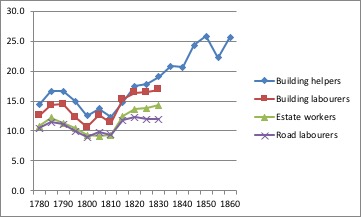
There is another investigation, by B. Eccleston, referring to building labourers and building craftsmen, estate workers, and road labourers in five Midland counties (Leicestershire, Nottinghamshire, Northamptonshire, Warwickshire, and Staffordshire) for 1750-1834, and with a large volume of documentation. The data for building labourers are commented in this section, and the data for building craftsmen in the section below on carpenters, joiners, bricklayers and stonemasons.   

We have the following movements in daily wage rates for building workers, estate workers, and road labourers. The figures are in nominal pence per day.

Fig. 9, Building Workers, mean wage rates

(Ecclestone, 1976, Fig. 9, p. 73)

Fig. 14, Estate Workers, mean wage rates

(Ecclestone, 1976, Fig. 14, p. 93)

Fig. 17, Road Labourers, mean wage rate

(Ecclestone, 1976, Fig. 17, p. 109)

From detailed figures in the appendices of the thesis, plus the data from Allen, we have:

Labourers (shillings per week)

BuildingBuilding EstateRoad
HelperslabourersWorkerslabourers
17808.77.66.56.3
17859.38.06.86.4
179010.08.76.86.7
179511.69.58.17.7
180013.211.29.89.4
180514.713.59.810.5
181016.215.012.212.3
181515.315.812.912.2
182014.513.611.310.2
182514.713.611.49.9
183014.913.211.29.4
183515.113.110.98.9
184015.3
184515.5
185015.7
185516.4
186017.1

Labourers (loaves per week)

BuildingBuildingEstateRoad
HelperslabourersWorkerslabourers
178014.412.610.810.4
178516.714.312.211.5
179016.714.511.311.2
179515.012.310.59.9
180012.510.69.38.9
180513.712.69.29.8
181012.311.49.39.3
181514.815.312.511.8
182017.516.413.612.3
182517.816.513.812.0
183019.016.914.312.0
183520.8
184020.6
184522.3
185025.8
185522.2
186025.7

Labourers (shillings per week)

Labourers (loaves per week)

We note that the data from Clark and the data from Ecclestone show a close coincidence, which allows us to state that the real incomes of unskilled labourers increased in the period from 1815 to 1860.

Another class of hard manual work was that of the railway labourers, when the railways started to be introduced in the 1830’s and 1840’s: “For many years the country was covered by armies of “navigators” or “navvies”, whom contractors employed to translate the grandiose dreams of the railway projectors and the capital of their shareholders into solid cutting, embankment, tunnel, and permanent way. In 1848 nearly 200,000 labourers, many of them Irish, were engaged in this vast task. With their rough habits and speech, high wages – pay day was usually a brutal debauch – and their generous taste in steak, plush waistcoats and whisky (they called it “white beer”), they uprooted ancient ways of living in every place where they encamped.”

(Bryant, English Saga, 1942, p. 83)

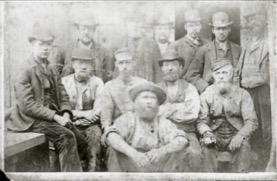
Group of Manchester workers 1848

James Cox, centre on the front row, surrounded by some of the men he worked with. The photograph was taken circa 1848. James Cox came to Manchester from Ireland in 1846 during the famine years. He first lived near Oxford Road Station, Mary Street, an area known as “Little Ireland”. He also worked on the Manchester Ship Canal in the later years of the 19th century. Mr. Cox, although he lived in the worst slum in Manchester, “Little Ireland”, does not appear to be poor or to have suffered hunger!

There does not seem to have been any negative effect from the Industrial Revolution on the wages on this segment of the working class, rather, they had a good life. What we can note, is that the invention of the steam engine, its use for long distance transport, the production in large volume and at low costs of the railway stock and the rails, and the increase in the purchasing power of a large segment of the public, made it possible for 200,000 men to have a well-paid job.

14.1. Most Important Occupations

If we want to have a correct “picture” of the development of wages in the working class during the first stage of the Industrial Revolution, we have to inspect the most important branches of employment, collect the figures, and see in which cases the wage level was fixed by factors apart from the general economic situation, i.e. it was influenced by the Revolution.            

Following, we have a list of the most common occupations in Great Britain, according to the Census of 1851 (the first one to collect these data in detail).

OccupationNumber
  
Agricultural labourer (males, outdoor)1,006,000
Domestic servant1,038,000
Cotton, calico, manufacture, printing, dyeing501,000
Labourer376,000
Farmer306,000
Boot and shoe maker274,000
Milliner, dressmaker267,000
Coal miner219,000
Carpenter, joiner182,000
Army and navy178,000
Tailor152,000
Washerwomen146,000
Woollen cloth manufacture137,000
Silk manufacture114,000
Blacksmith112,000
Worsted manufacture104,000
Mason, paver101,000
Messenger101,000
Linen, flax manufacture98,000
Seaman (merchant service)89,000
Grocer85,000
Gardener80,000
Iron manufacture, moulder, founder80,000
Innkeeper75,000
Seamstress, shirtmaker73,000
Bricklayer67,000
Butcher, meat salesman67,000
Hose (stocking) manufacturer65,000
Schoolmaster/mistress65,000
Lace manufacture63,000
  
Total of these 30 occupations6,221,000
  

(Registrar-General of Great Britain, 1854, Census of Great Britain 1851, Occupations of the People, pp. 72-73)

Note: the investigations of Feinstein and of Allen do not include any data as to the numbers supposed to be employed in each occupation (Feinstein’s working papers appear to be lost).

Of these occupations, it is not useful or possible to present data about wages or movements of the same: domestic servant, farmer, army and navy, washerwomen, blacksmith, messenger, seaman (merchant service), grocer, gardener, innkeeper, butcher, schoolmaster/mistress. It is probable that their incomes moved in step with the costs of food. In some of these cases, food and lodgings were provided by the employer, additional to a small cash payment weekly.  

The following occupations have been commented in detail in earlier chapters: agricultural labourer, cotton manufacture, woollen cloth manufacture, worsted manufacture, iron manufacture.  

Monetary system
Pounds (L.), shillings (s.), pennies or pence (d.)
1 Pound = 20 shillings, 1 shilling = 12 pence 

Wage of farm labourer = 9 to 12 shillings per week
Wage of male worker in textile factory = 20 to 30 shillings per week 
Dry weight measures
1 bushel wheat = 60 lb., 1 quarter = 480 lb. 

Price of 4 pound loaf of wheaten bread = 6 to 8 pence
Energy supplied by 4 pound loaf = 4,500 calories 
Price of butcher’s meat = 4 to 6 pence per pound

Chapter 14. Developments and Wages in the Other Occupations

14.1. Most Important Occupations https://history.pictures/2020/03/14/14-1-most-important-occupations/

14.2. Labourers https://history.pictures/2020/03/14/14-2-labourers/

14.3. Boot and Shoe Makers https://history.pictures/2020/03/15/14-3-boot-and-shoe-makers/

14.4. Milliners, Dressmakers, Seamstresses, Shirtmakers https://history.pictures/2020/03/15/14-4-milliners-dressmakers-seamstresses-shirtmakers/

14.5. Coal Miners https://history.pictures/2020/03/15/14-5-coal-miners/

14.6. Carpenters, Joiners, Masons, Bricklayers https://history.pictures/2020/03/16/14-6-carpenters-joiners-masons-bricklayers/

14.7. Tailors https://history.pictures/2020/03/16/14-7-tailors/

14.8. Silk Manufacture https://history.pictures/2020/03/17/14-8-silk-manufacture/

14.9. Hose (Stocking) Manufacture https://history.pictures/2020/03/18/14-9-hose-stocking-manufacture/

14.10. Lace Manufacture https://history.pictures/2020/03/18/14-10-lace-manufacture/

14.11. The Pottery Industry in Staffordshire https://history.pictures/2020/03/18/14-11-the-pottery-industry-in-staffordshire

14.12. Mechanics https://history.pictures/2020/03/19/14-12-mechanics/

14.13. Printers https://history.pictures/2020/03/19/14-13-printers/

14.14. Railways https://history.pictures/2020/03/19/14-14-railways

14.15. New Occupations https://history.pictures/2020/03/19/14-15-new-occupations/

13.10. Violence against Farmers

In the years after 1830, there was often friction between the farmers and the labourers, with respect to the standard wages. In many cases, the farmers could not pay the new wages out of their margin, and had to use their capital.

“In what state are the poor?” “They are generally in employ.”

“Have they been so continually?” “Since the year 1831.”

“Were they in employ before 1831?” “No, not so generally employed.”    

“To what do you attribute their being better employed since 1831, than before that?” “One thousand eight hundred and thirty was the time of the riots. We came to an arrangement with the labourers in our neighbourhood, without any difficulty; then, when we found that the great cause of the disturbance was the want of employ, we agreed voluntarily among ourselves to take each so many of the surplus labourers, and by that we set all to work who had nothing to do.”

“Had the riots been occasioned by men being out of employ?” “I fancied at the time that that was the case.”

“Had you rick-burnings in your neighbourhood?” “Yes, we had a considerable number of fires.”

“Did the rick-burnings and riots cease on the men being well employed?” “Yes.”            

“Can you afford, according to the present prices, to employ your labourers and pay them the same wages you are now paying?” “We make it our first object to pay them the amount we think them entitled to, to ensure them necessaries and comforts; but, certainly, we cannot afford to pay our rents of tithes and our labour at the present price for the produce of our farms.”

(Select Committee on Agriculture, 1837, Mr. John Thomas Twynam, Farmer, Hampshire, Q. 574, p. 30)  

“Are the poor dissatisfied in that country?” “They have been much.”

“What rate of wages do they receive?” “Two shillings a day.”

“Have you been obliged to lower them?” “No; we think it dangerous to reduce them.”

“For what reason?” “The fear of damage to the property.”

“Have there been many incendiary fires?” “There have been two fires in our place within the last five months; in the neighbourhood of Maidenhead.”

“What do you think is the occasion of the incendiary fires?” “From the dissatisfaction among the labourers. They have no interest towards their employers at all; they have no energy to work an hour longer without being paid for it, which used to be the case formerly.”

“Are the labourers in a much worse condition now than they were formerly?” “I think not; their wages were high.”

“Can the farmers possibly continue the payment of the present rate of wages?” “Not from the present price of corn.” 

“Would the lowering of the rate of wages produce the consequence you refer to, of  more general dissatisfaction among the labourers?” “I think it would.”

(Select Committee on Agriculture, 1837, Mr. Samuel Kendall, Manager of His Majesty’s farms, Berkshire, p. 60) 

“What is the state of the labourer?” “When they are employed I do not think it can be said to be very bad, but we are paying them double the money we can afford.”

“Can you keep up the present rate of wages?” “It is totally impossible. We do, fearing if we did not we should be burnt down; it is a sort of insurance on property. I am paying 40 per cent. more than I can afford, but not more than I conceive the labourer ought to have.”

“Has there been any apparent uneasiness among the labouring people who are out of employment?” “They are in a most feverish state. I have two men employed for no other reason than that should not rob on the highway, they having declared to me, that rather than go to the poorhouse they would rob. I do not believe there are two more honest men in the village.”

“They are driven to a state of great distress?” “Yes, they are.”

(Select Committee on Agriculture, 1837, Mr. William Thurnall, Farmer and owner, Chairman of the Agricultural Association of Cambridge, p. 123)

“Have you had many fires in Kent?” “Some.”

“Do you think the farmers are at all afraid of reducing the wages of the labourers?” “No, I do not think they are afraid; I think the present rate of wages is continued on principle.”

“Do you think they pay on principle more than they can afford?” “I am sure they do in many cases. It is not pleasant to have a man going away on Saturday night grumbling, and saying that he cannot support his family.”

“Can farmers go on paying these wages?” “They cannot go on, they must be losing their property.”

“What will be the end of that?” “Ruin.”

(Underline by this author)

(Select Committee on Agriculture, 1833, Mr. William Taylor, Farmer, Kent, p. 294)

“Are the wages you mention given on fair competition, or is it found prudent to give that rate of wages to the people?” “I think the probability is, we might get it done at a less price if we were to select our people in the market; but the persons we employ are those that have lived in the parish, and worked on the farm, and we think they cannot live for less.”

 “Does it arise from any fear on the part of the farmers of any acts of outrage?” “Decidedly not.”

“There is none of that apprehension in your part of the country?” “No.”

“Have you had any fires of late?” “No.”

“What do they pay for their cottages?” “About 3 l. a year.”

“Do you think cottage rents in the east of Sussex are generally as low as that?” “That is what I pay at East Dean” 

“Have most of them gardens?” “Yes, small gardens; we hire them of one person at 3 l.; but 1 s. 6 d. a week is a very common rent, with a garden.”

“Do you think the labourers live as well as they used to do?” “They never lived so well.”

“Do they eat as fine bread as they used to do ?” “They eat as fine bread as I do; finer than they used to do.”

(Select Committee on the State of Agriculture, 1837, Mr. James Hudson, Farmer, Sussex, p. 179)

13.9. Beer Drinking and Beer Houses

Another factor which affected the labouring people in late 1830 was beer. The Beer Act was passed in 1830, and came into effect on 10th October. This allowed any rate-paying person to open a beer-shop on the payment of 2 guineas annually. This was in addition to the existing public houses, which needed a licence from a magistrate. Further, the tax on beer was reduced, such that the effective price of beer to the client was reduced by 20 %. 

24,000 beer-shops were opened in England and Wales in the following six months, and we know that many were established in the following days in the principal areas of the Swing Riots, as there are many references to the plots hatched in them. The consumption of beer in the country – measured by the malt tax received by the Government – increased by 40 % from 1829 to 1831. 

The effects on the “disturbances” were various:

  • much of the conspiration was carried out in them;
  • many labourers were convinced to join in the riots, while they were under the influence of drink;
  • the men in the violent mobs going from town to town were often intoxicated (but, in general, not the groups who were negotiating wage increases with the farmers);
  • the men spent more on drinking than in the previous months, and thus required more income.

It is clear that men who are spending their evenings drinking, are not starving.

“A mob of 180 persons collected at his house, demanding “bread or blood.” The greater part of them were intoxicated, but they said, that they and their children were starving. The larger part of that mob consisted, not of agricultural labourers, but of smugglers from the small villages upon the coats of Sussex, whom the vigilance of the Government prevented from carrying-on their trade.”

(Mr. J. Smith, M.P. for East Sussex; Hansard, Special Commissions – Amnesty, House of Commons, 08 February 1831, p. 252)

“I have Reason to know that during the Agricultural Riots the Persons so excited were acted on in those Beer Houses, and that the Delegates who travelled and who preceded the Mob met them at the Beer Houses, and there met with them in a State of Excitement and Inflammation of Mind.”

(Select Committee of the House of Lords on Charges to County Rates in England and Wales, 1834, Evidence of Rev. Harry Farr Yeahman, Magistrate in Dorset and Somerset, p. 318)

“… I should state likewise, that the men who suffered the extreme penalty of the law, for setting fire to places in Hampshire, the whole of it came under my own investigation; I sat six weeks every day till I had sufficient evidence to convict; I had before committed them to prison, but finding the evidence not satisfactory to my own mind, I let them out on bail, and it was not till a twelvemonth afterwards that I procured sufficient evidence, by my own exertions, and by a little police I established, to carry the law into effect; these men I saw continually, and from the time of their committal till the day before their death, they entreated me to use every exertion I had in my power to put a stop to the beer-houses, for they said that those beer-houses brought them to their disgraceful end;  I am likewise the chairman of the visiting magistrates, in the absence of Sir Thomas Baring, and I have had a good deal of conversation with the characters committed at the special assize for punishment; I think we had 97, and I do not think out of the 97 there were twenty that did not date their misery to arise from those beer-houses.”

“How many were sentenced to death that you alluded to just now?” “Four were sentenced to death; one to transportation for life. I think I had 120 witnesses before me.” 

………

“Were either of those men who were under sentence of death or transportation, keepers of beer-houses?” “No, they were not; it is very remarkable, that all the leaders and agitators in that riot were petty tradesmen, such as journeymen blacksmiths, journeyman carpenters; not labourers, but men that really did not want; it arose from a love of mischief with them.”

……..

“During the time you have acted as a magistrate for the county, have you seen any alteration in the habits and morals of the lower classes, since the law was passed enabling the beer-houses to be set up?” “Not a week passes without having five or six women attending and complaining of the money which their husbands spend in the beer-houses, which is not brought home to their houses.”

……..             “You said that those persons that were convicted, two of whom were sentenced to death and one to transportation, admitted that the origin of their crimes arose at those beer-houses?” “I constantly attended them, and they begged me to warn every person that came before me, that they owed their untimely end to nothing but the company they met with in those beer-houses, and being enticed to do what they did.”

……..

“Have not the riots occurred during the last two years?” “They were in December 1830.” 

“Did not those arise from other circumstances besides the beer-houses; was there not great distress at the time?” “I think they arose more from people being led away by false views of things, and having placards placed in those houses, which were regularly sent round.”

……..

“You have stated that crimes have been concocted at the beer-shops; in you opinion did any incendiary fires take place previous to the passing of the Beer Act?” “None.”

“Have any incendiary fires taken place since the passing of the Beer Act?” “Yes; all the fires that have happened, have been since the passing of the Beer Act; I suppose 20 or 30 fires in the county.”

“Have any of the offenders that have been detected been traced upon the night when the fire happened to beer-shops?” “All of them to beer-shops that very evening.”

(Cobbett, Political Register, Vol. 81, 3rd August 1833, pp. 286-310, reporting on evidence from The Rev. Robert Wright, magistrate of the county of Hampshire, resident in Winchester)

“Do you attribute any thing to the better Economy pursued by the Poor themselves?” “No, I cannot say that I do. I think that there is a great deal more Money spent by the Poor in Beer now then there was some Years ago.”

“In consequence of the greater Cheapness of Beer?” “Yes.”

“And perhaps to the greater Facilities of buying it at the new Beer Shops?” “Yes; I am sorry to say that is very much so indeed.” 

“Have you found any sensible Diminution in the Sums of Money lodged in the Savings Bank the last Year?” “No, I have not; they are generally contributed by those Persons who are regular, and do not frequent the Beer Shops; but I hear very great Complaints from the Wives of poor Men at present, that their Husbands are tempted daily to go to those Beer Shops; and asking me whether there is any Remedy for their remaining in the Shops from Morning ‘till Night.”

“What Answer did you give to that Question?” “That I was not aware there was any Remedy.”

(Minutes of Evidence, 1830-1, p. 353)

13.8. Defence of the Farms by the Labourers

In the West Country, those labourers who had fixed employment with a farmer, did not take part in the violent riots and machine breaking. Rather, they volunteered to guard the property of the farmer or the landowner:

“During the riots which disgraced this county and the country in the latter part of the year 1830, my labourers rallied round me as one man; we conquered upwards of 300 of the rioters, as I have always found that 5 men embarked in a good cause, are equal to 50 in a bad one. I left my home without apprehension, and assisted in putting down riots in other parts of the county. During my absence my thrashing machine was at work; on my return my property was as secure as when I left it; and I feel proud to say, that throughout the parish of Winterbourn, there is not a single labourer but would at this moment risk his life in defence of his master or his master’s property.”

(Mr. Bott, Labourer’s Friend Society Meeting, Devizes and Wiltshire Gazette, 21 February 1833) 

”Do you conceive that any of your Parishioners had any thing to do with that fire?” “No, I have not the most distant Idea of it. The whole of them offered to watch every Night if I would let them; and there are Twenty-eight Men that watch nightly by Turns; they take it alternately; Four watch each Night once a Week, for which I pay them; but they are all anxious to watch; and they would be very glad, I believe, to detect any Person that was to commit that sort of thing, and they would stand by to protect any of our Property, to a Man.” 

(Select Committee to Consider the Poor Laws, 1830-1, Minutes of Evidence, p. 111)

Sir Thomas Baring, a progressive landowner, had heard of a band of several hundred man, “… advanced resolutely expecting to fight when conceive his surprise he found that the band was composed of his Stoke men who heard he was in danger, had mustered over to the Grange armed themselves out of the carpenter’s shop, stuck spruce in their hats and called themselves the Spruce body. He was affected even to tears ….”

(Afton, “The Motive which has operated…..” 1998, p. 114)

“Have any of your pauper Tenants joined in the late Disturbances in the County of Wilts?” “None; on the contrary they have come forward to a Man to defend Property if necessary; there has been within Seven Miles of this Place some Disturbances, at a Place called Sherston, but they did not join in.” 

(Minutes of Evidence, Poor Law, 1830-1, Mr. Richard Pollen, Chairman of the Quarter Sessions of Hampshire, but referring to North Wiltshire, p. 66) 

“Had you fires or disturbances in your neighbourhood?” “In my neighbourhood we had fires, though not very much in North Wilts. I am happy to say in my parish the labourers behaved themselves very wisely; they all willingly came forward to assist me in case of any dissatisfied people coming into the village, to prevent them doing me any mischief.”            

“You had some fires not far from you?” “Yes, we had; my labourers all volunteered to keep watch nightly, to detect incendiaries.” 

“Have you a thrashing-machine?” “Yes.”

“Do you keep it?” “Yes, I have kept it.”

“It remains unbroken?” “Yes.”

“Are there many more labourers out of employ than there were in 1812 in your parish?” “There are more labourers; but I have made a sacrifice of property to keep them employed; I could perhaps have had my labour done at less expense than I had; and that is the reason perhaps why I have not gained so much as some others.”

“From feeling you paid a higher rate of wages than your labour would allow?” “No, I employed a greater number; I paid the same rate of wages as other persons.”

“Do you think others from intimidation are doing the same thing?” “I do not know that they are; I did not do it from intimidation.”

“Do you think any farmers in North Wilts are employing a larger number than their profit will allow, from whatever cause?” “Yes.”

(Select Committee on Agriculture, 1833, Mr. William R. Brown, Farmer, Wiltshire, p. 515)

“Have you had any riots in Hampshire within these 14 or 15 years? “There were riots in the year 1830; but that was quite upon another question; that was upon the question of machinery; the labourers rose because they objected to the thrashing machine, not on account of game.”

“Was it in consequence of low wages?” “No; it was in consequence of their not being employed, and their attributing their non-employment to the thrashing machines which were put up; there was that cry at the time.”

“Do you know whether gentlemen preserved game before and in the year 1830, and consequently resided upon their properties?” “Quite as much as now.”

“That did not prevent the riots, and it did not prevent the outcry against the use of machinery?” “I cannot say whether it prevented the riots or whether it caused them; but I know that upon my estate, and on the estates contiguous to mine, our men assisted to put down the riots with great energy, and that the ringleader, a man who was afterwards hung at Winchester, who had come from Kent, was taken very near my place by some of our own labourers.”

“Were the riots in the neighbourhood of your property?” “They were all, I believe, men from Sussex, Kent, and from the eastern end of Wiltshire, but they were not joined by any people in Hampshire that I could make out, for that part of the country rose against the offenders. It was entirely attributable to that that they were defeated, for we had no troops within 50 or 60 miles; they were entirely put down by the farmers and the labourers.”

“Then it was not the labourers in Hampshire that complained of the machinery?” “It was not; I only said that those were the complaints of those men who had met them; we had no thrashing machines.”

“Then the riots were occasioned by the invasion of persons from East Wiltshire and from Kent, complaining of the use of machinery in those counties?” “They began in that way, and they proceeded to every sort of violence, attacking houses and marching with armed force to the westward; they were stopped near Ringwood, and were defeated and dispersed.”

“Do you happen to know whether there were riots in the neighbouring counties of Dorsetshire and Wiltshire?” “Yes, there were.”

“Do you know whether those were occasioned by the people themselves, or by a similar invasion to that which you had in Hampshire?” “I believe that the leaders came from other parts of the country; in fact, I know that they did; that was proved at the trials: I believe that in Dorsetshire the people in a certain district rose of themselves.”

“Do you know anything about the preservation of game in those counties?” “I know very little about it.”

“Do you know whether gentlemen reside upon their properties in those counties?” “Very much; perhaps in Dorsetshire more than anywhere.”

“But there were riots in Dorsetshire owing to the lowness of the wages?” “I do not know what they were owing to.”

“You do not happen to know what the rate of wages is either in Hampshire, or Dorsetshire, or Wiltshire?” “I can only speak of my own estate. The farmers are now giving about 9s., and I give from 9s. to 12s.; the farmers make those men pay 40s. a year for their cottages, and I give them their cottages rent free.”

(Select Committee on the Game Laws, Earl of Malmesbury, 31 March 1846, Parliamentary Papers, Volume 9, Part 2, Reports from Committees, Game Laws, Part II, Session 22 January – 28 August 1846, Ordered, by the House of Commons, to be printed, 6 July 1846)