Sir James Caird, an expert on farming in England, visited the majority of agricultural counties in 1850 and 1851, and wrote a number of reports on the farming activities in each area for “The Times”, which were then published in book form. He also noted the labourers’ wages and the cost of provisions, and presented in his letters a comparison of the 1850-52 numbers with those of Arthur Young in 1770:
(Caird, 1852, p. 474)
His general evaluation was as follows:
“In twenty-six counties the average rent of arable land, in 1770, appears from Young’s returns to have been
s. d. 13 4 an acre
For the same counties our returns in 1850-51 give an average of
26 10 “
Increase of rent in eighty years
13 6 or 100 per cent
Bushels
In 1770 the average produce of wheat was
23 an acre
In 1850-51 in the same counties it was
26 ¾ “
Increased produce of wheat per acre
3 ¾ or 14 per cent
s. d.
In 1770 the labourers’s wages averaged
7 3 a week
In 1850-51, in the same counties they averaged
9 7 “
Increase in wages of agricultural labourers
2 4 or 34 per cent
Bread Butter Meat
In 1770 the price of provisions was
1 ½ d. 0s. 6d. 3 ¼ d. per lb.
In 1850-51 it was
1¼ 1 0 5
s. d.
In 1770 the price of wool was
0 5 ½ per lb.
In 1850-51 it was
1 0 “
In 1770 the rent of labourers’ cottages
s. d.
in sixteen counties averaged
56 0 a year
[arithmetical error,
should be 34]
In 1850-51, in the same counties
74 6 “
It thus appears that, in a period of 80 years, the average rent of arable land has risen 100 per cent., the average produce of wheat per acre has increased 14 per cent., the labourers’ wages 34 per cent., and his cottage rent 100 per cent.; while the price of bread, the great staple of the food of the English labourer, is about the same as it was in 1770. The price of butter has increased 100 per cent., meat about 70 per cent., and wool upwards of 100 per cent.” (Ibid., p. 475)
He also gave a comparison of costs and wages for an area of North Lancashire:
In 1770
in 1850
Rent, 21s. an acre
Rent, 41s. an acre
Rates 3d. per pound
Rates, 3s 9d. per pound
Tithes compounded for
Tithes commuted, and included in rent
4-7ths of farm in grass
4-5ths of farm in grass
3-7ths arable
1-5tharable
Annual produce of a cow, 4l.
Annual produce of a cow, 9l.
Six horses in a plough, and do an acre a day.
Two, and sometimes three, horses in a plough.
First man’s wages, 9l. a-year,and his board
First man’s wages, 15l. to 16l.a-year, and board
Second man 5l. a-year, and board
Second man, 10l. a-year, and board
Dairymaid, 3l. and board
Dairymaid, 7l. 10s., and board
Bread (oat), 11 lb. for 1s.
Bread, 4d. per 4 lb. loaf, coarse wheaten bread; 5d. per 4 lb., best.
Cheese 3d. per lb.
Cheese, 5d. per lb.
Butter 8p. per lb.
Butter 11d. to 1s. per lb.
Beef, 2 ½ d. per lb.
Beef, 5d. to 6d.
Mutton 2 ½ d. per lb.
Mutton, 6d.
Labourers’s house-rent, 20s.
Labourer’s house-rent, 50s. to 100s.
(Caird, 1852, p. 283)
We also have a report, made by John Wade in 1832, of prices of wheat and husbandry wages from 1770 to 1832:
Year
Wheat per Quarter
Wages per Week
Wages in pints of wheat
s. d.
s. d.
1770
47 8
7 4
79
1790
50 0
8 1
82
1796
64 10
8 11
70
1803
91 8
11 5
65
1811
96 8
14 6
76
1819
84 8
12 0
73
1824
57 2
10 0
89
1829
62 1
11 0
91
1832
63 9
12 0
90
(extracted from Wade, 1832, p. 538)
One pint dry measure of wheat was one pound weight, so that the usage increased from 20 4-lb. units in 1770 to 22 4-lb. units in 1832, but passing through difficult times in 1796 to 1819.
The agricultural and non-agricultural occupations have to be calculated and analysed separately, as there are a number of differences in wages and in structure of expenses.
Wages
Agricultural
Non-agricultural
Wage level
Defined by farmers’ incomes, i.e. wheat prices
Defined by negotiations with business owners, or with impersonal market
Wages movements in high-inflation periods
Protected from high cereal costs
Not protected
Extra payments
Summer wages, harvest wages,task work, gleaning
No extra payments
Non-cash benefits
Beer/cider, some cottages free of rent, own collection of wood for fire
None
Expenses
Agricultural
Non-agricultural
Proportions food
50 % cereal, 10 % meat
25 % cereal, 15 % meat
Cereals
Baked in own ovens for bread
Loaves bought in bakers’ shops
Meat
No “red meat”
Beef, mutton, pork
Pig meat
Pig fattened at cottage, sold, or killed and eaten during the year
Pork meat bought
Clothing
Heavy duty
Change to cotton
The resumed data for the agricultural labourers for the whole period 1770 to 1860, based on the pages above and the previous chapter, are as follows:
(Average weekly winter wages per man)
The expenses, calculated according to the consumption percentages of an agricultural family, were:
And the wages adjusted for inflation (only the man’s weekly winter wages) increased by only 21 % from 1770 to 1860.
COMPARISON 1770 TO 1860 AGRICULTURAL WORKERS, WEEKLY WAGES 1770 = 100 WAGES 169 EXPENSES 139 REAL WAGE 121
We have to make adjustments from the man’s wage to the total family income:
The “model” for the agricultural families is as follows:
of the number of adult male workers in the basis data per year, 80 % are men of 20 years or more;
we suppose that exactly these men are heads of family, and thus this figure gives the number of families;
the extra income for the man is made up of: 4 months summer wage, 10 % more than the winter wage, 1 month harvest wage at double rate, task work at different percentages during our period;
for each family, there are proportionally 10 % young men of 16 to 19, who earn a full wage;
30 % of families have a son from 12 to 16 years, who earns 30 % of the father’s basic wage;
starting from 1770, and decreasing to zero in 1820, 80 % of the wives earn 3 shillings a week from spinning;
starting from 1840, 30 % of the wives work in the fields at 40 % of the man’s basic wage;
the income of little girls from spinning is negligible;
the income of little boys working in the fields is negligible.
Average wage
Average wage
Weekly wage
Bushel wheat
Shillings week
without spinning
Shillings
Shillings
Family
Man
1770
13.5
11.1
6.5
5.3
1775
13.7
11.3
6.6
6.2
1780
14.0
11.9
7.0
3.8
1785
13.3
11.9
7.0
5.1
1790
13.8
12.6
7.4
6.7
1795
16.2
15.2
8.9
9.1
1800
16.7
15.9
9.3
13.8
1805
17.3
17.0
10.6
10.9
1810
18.4
18.2
11.3
12.9
1815
19.5
19.4
12.1
8.0
1820
18.9
18.8
11.7
8.2
1825
17.5
17.5
10.9
8.3
1830
16.7
16.7
10.4
8.0
1835
16.4
16.4
10.2
4.6
1840
17.4
17.4
11.0
8.3
1845
15.1
15.1
9.5
6.3
1850
15.2
15.2
9.5
5.0
1855
17.3
17.3
10.9
9.3
1860
17.5
17.5
11.0
6.8
The above figures as to the man’s wages and the family’s wages, show an increase in real wages of only about 20 % from 1770 to 1860. But it must be taken into account that the wage figures start from a high position. The family income in 1770, including spinning, was 13 shillings per week, which could purchase 2.6 bushels of wheat.
COMPARISON 1770 TO 1860 AGRICULTURAL WORKERS TOTAL FAMILY, WITHOUT SPINNING 1770 = 100 WAGES 158 EXPENSES. 139 REAL WAGES 114
COMPARISON 1770 TO 1860 AGRICULTURAL WORKERS TOTAL FAMILY, WITH SPINNING 1770 = 100 WAGES 130 EXPENSES. 139 REAL WAGES 94
The calculation of the cost of living uses practically the same sources and rules, as for the chapter 1770-1815.
Clothing
“Do not they use fustian for their clothing?” “Yes; they cannot afford to wear their own native wool.”
“But they wear a great deal of fustian, which is cheaper than woollen cloth by half?” “Yes, they do.”
“Do not they wear cotton shirts?” “A great many of them do.”
“Are not those very much cheaper than they were?” “Yes.”
“And the cotton gowns for their wives, are they not much cheaper?” “Yes, they are.”
“What stockings do they wear?” “Woollen or worsted, but chiefly worsted.”
“Are they not cheaper?” “They are; but those things are rather a loss to the labourer, because their wives used to spin the stockings and the shirts, and now, instead of doing that, they are doing nothing.”
“How is it with regard to shoes?” “They are about 6 p. a pair cheaper.”
(Select Committee on Agriculture, 1833, Mr. Robert Merry, landowner, Yorkshire, p. 114)
“Do you recollect the prices of articles of cotton in 1812?” “I should say it was double then what it is now.”
(House of Commons, Select Committee on Agriculture, 1833, Mr. John Cramp, Farmer, Kent, p. 264)
“Are you sufficiently aware of the prices of boots and shoes and cloth, such as were used by agricultural labourers in South Wales?” “Yes, the shoes are at less price, the cloth is at a less price, there has been such a great fall in the price of wool. Twenty years ago, Glamorganshire wool would sell at 2 s. 4 d. a pound; for the last five or six years it has not been above 9 d. or 10 d. a pound.”
“What is the price of hats and clothing generally now as compared with former times?” “I think there has been a much less price had for those articles than during the war; the shoes they generally buy at about 8 s. and 9 s. to 9 s. 6 d. a pair, and great numbers not so much, for they wear wooden clogs and wooden soles.”
(House of Commons, Select Committee on Agriculture, 1833, Mr. Adam Murray, Land Agent and Surveyor, p. 14)
The clothing for the man was adapted to his heavy manual work, and thus was made of special materials. The prices did not decrease so rapidly as for the general run of industrial workers. We can estimate the movement from 1787 and 1795 to the 1830’s and 1840’s from the information of family budgets, given by Davies and Eden, and later Purdy.
Davies
Eden
Purdy
Purdy
Purdy
1787
1795
1837
1846
1860
Paupers
Man
Suit p. a.
4
Stout coat p. a.
13
Cloth coat p. a.
3.5
Fustian coat p. a.
3
Jacket p. a.
9
9
Jacket breeches p. a.
4
4
Trousers
9
9
7
Waistcoat
6.5
4
Shirt
4
4
3.5
2.5
2.5
Shoes (heavy)
7
7
7.5
11
Stockings pair
2
2
2.5
2.5
1.5
Davies
Eden
Purdy
Purdy
Purdy
1787
1795
1837
1846
1860
Paupers
Wife
Gown
4
6.5
5
6.5
4
Undergarment
2.5
Petticoat
4.5
4.5
3
Shift
3
3.5
1.5
Strong shoes
4
4
5
5.5
3
Stockings pair
1.5
3
1
1
Apron
1.5
1
1.3
1
We know that linen canvas, which was used for the “smock” of the labourer, decreased in price by 40 % from 1813 to 1833:
Tables of the Revenue, Population, Commerce, &c. of the United Kingdom, compiled from oficial returns, His Majesty’s Stationery Office, 1834, Part III, p. 395
As a conservative figure for the decrease in prices of farm clothing, we have used 1860 = 70 % x 1770.
The cottage rents have been defined with an increase from 1770 to 1860 of +100 %, as per the table a few pages below from Mr. Caird.
The yearly indices (1770 = 100) for expenses of an agricultural family are thus as follows:
1815
150.6
1841
151.7
1816
159.1
1842
137.3
1817
178.2
1843
126.3
1818
178.2
1844
127.9
1819
164.6
1845
129.2
1820
148.6
1846
136.7
1821
131.1
1847
154.0
1822
110.5
1848
128.6
1823
120.7
1849
117.6
1824
135.0
1850
111.0
1825
147.1
1851
111.1
1826
136.6
1852
112.5
1827
132.4
1853
131.5
1828
134.5
1854
160.0
1829
137.6
1855
162.4
1830
129.8
1856
157.2
1831
140.2
1857
142.0
1832
127.4
1858
124.9
1833
121.3
1859
126.1
1834
115.1
1860
139.3
1835
108.3
1836
122.1
1837
129.1
1838
138.9
1839
149.3
1840
153.9
The quinquiennal figures up to 1834 are very close to those of Clark for agricultural labourers:
The daily life of the farm labourers was made easier by the introduction of many implements and simple machines made of iron: scythes, forks, billhooks, hedgeslashers, ploughshares, clod-crushers, harrows, lightweight iron ploughs, horse-drawn butter churns, horse-drawn hay rakes and cheesepressers.
Hay raking The picture shows a horse-drawn hay rake and the traditional hand held wooden rake. Obviously the new hay rake is more efficient and saves work for the labourer. But it could only be built if the iron parts were cheap.
The presence of a steam-engine made many “muscular” tasks unnecessary: threshing machines (early versions powered by horse), winnowing / blower machines, elevators for hay, self-binding reapers.
These machines were in general introduced, starting in the 1840’s. While they made life easier for the labourer, they also gave the farmer leeway to reduce the payments for task-work, as there was no reason to pay for work which was not more difficult than daily field-work. Thus the percentage of “total yearly income” against “weekly winter wages, multiplied by 52” went down.
The use of the flail for threshing continued, because the farmers were obliged to give more paid work to the labourers. We can see this in the following discussion from the London Farmers’ Club, “The best and most economical mode of threshing grain crops”, Monthly Discussion, November 2, 1846, The Farmer’s Magazine, Vol. 14, July to December 1846, pp. 529-535. The farmers were all conscious that the threshing machine had advantages against the hand-flail, but they also saw that could not just diminish the income of the labourer.
“… The point will resolve itself into two heads, namely, the “best mode” and the “most economical mode” of threshing; and they will be found to be perfectly separate parts of the question; for that mode which is the best is not always the most economical, neither is that which is the most economical always the best (Hear, hear). …..
“It must be remembered, also, that in Essex we have a greater redundancy of labour than in other counties; the labourers have not been absorbed by railways and other works in this county as in some parts of England.
……
“The employment of horse-labour has in many instances deprived the labourers of their ordinary sources of employment in the winter months; and, in consideration of this state of things, many farmers have discontinued the use of the horse-power machine, by which, with two men, they can thrash from four to six quarters of corn a day, with as much advantage to themselves as when they formerly used the horse-power machine.
…….
At the same time, I admit that it is our bounden duty to employ the labourer as much as we can.
……..
We must, nevertheless, come to this question at last, “How are our labourers to live?” and in order to apportion the labour to the mouths which have to be fed, we had better use machinery as little as we can, if we consider the general good of society.
……..
If you have labourers on your hands, and have no other or better employment for them, it is very desirable that they should have threshing to resort to, as in certain seasons the poor man is very awkwardly situated (Hear, hear).”
All this gives the impression that the agricultural labourers in the period 1840 to 1860 lived well, or at the very least, that they went to bed with a full stomach. But there are a number of general reports that there was a lot of poverty in the countryside. The difference refers to that part of the rural population without a permanent job with an employer. These were the poor and very poor people. They are not included in the calculations of movements in income, because there are no statistics of the time as to their incomes, and particularly because in many cases they did not have a fixed occupation (or anything that would bring them money). We shall meet the poorest cases in the section about the Underclass.
Special Assistant Poor Law Commissioners were sent in 1843 to report on the Employment of Women and Children in Agriculture, in a number of counties in England.
The four commissioners visited a) Wiltshire, Dorset, Devon, and Somerset, b) Kent, Surrey, and Sussex, c) Suffolk, Norfolk, and Lincoln, d) Yorkshire and Northumberland. It is clear that this series of regions shows an increase from South-West to North in the monetary wages and in the amount of food consumed.
In the first group of counties, the average men’s earnings were:
Wiltshire, 8s. to 10s., yearly average including piece work 9s. 6d.;
Dorset, yearly average including piece work 11s., cottage often free, many with potato allotment;
Devon, yearly average 12s. 6d., including the profit from keeping a pig, which the majority of the families have (pp. 15-16);
Somerset, less money payment than Wiltshire, but three pints cider per day;
Many families rented a half acre allotment (15s. to 25s. a year), which gave 160 lb. of potatoes per year, or 3 lb. per week. Gleaning of the fallen grain brought 3 or 4 bushels a year, that is 25 to 30 shillings savings in food. In the part of Dorset investigated, nearly all the women and some girls were engaged in button making, which brought in from 3 to 5 shillings a week.
“In conversing with women accustomed to work in the fields, I found, nearly generally, that there was no complaint of a deficiency of food; in some cases the appearance of the cottages, of the women themselves, and of the children, proved that there could be no such deficiency.” (p. 17)
“The number of women employed in agriculture, either absolutely or compared with that of men so employed, must be to a great extent matter of mere conjecture, until a more minute and accurate inquiry than I had the means of executing, be made. From the information I was inclined to pay attention to, and from the looser statements of the farmers and other persons with whom I conversed, it would appear perhaps that in the hay-harvest about as many women and girls as men and boys, and that at other times of the year during which women are employed their number does not exceed one-third or one-fourth of that of the men, except at the corn-harvest, when their number may be nearly equal.” (p. 27)
“Generally speaking the labouring population is healthy; but it appears that when grown-up women are attacked by diseases of certain descriptions, the low quality of their food is unfavourable to their recovery. It would appear, also, that when the quantity of food is sufficient, any effects from its quality are less felt by women accustomed to out-door labour than by those who keep at home. In Wiltshire the food of the labourer and his family is wheaten (*) bread, potatoes, a small quantity of beer, but only as a luxury, and a little butter and tea. To this may sometimes be added (but it is difficult to say how often or in what quantities), cheese, bacon, and in the neighbourhood of Calne, a portion of the entrails of the pig,- a considerable trade being carried on at Calne in curing bacon. I am inclined to think that the use of bacon and those parts of the pig only occurs where the earnings of the family are not limited to those of the husband; or, if his wages form their sole means of support, then it depends on the number of his family. In more than one cottage, where the mother went out to work, or two of the boys were earning perhaps 3s. or 3s. 6d. between them, I saw a side of bacon hanging against the wall; but nothing of the kind was visible where the only earnings were those of the husband, or the family was numerous and young. Where, from poverty, bacon cannot be obtained, a little fat is used to give a flavour to the potatoes. In Dorsetshire and Devonshire, in cases where the labourer is in constant employ, and possesses the advantages he frequently enjoys in those counties, the consumption of bacon would appear to be more constant, with now and then a little fresh meat. …. But in Somersetshire the food appears to be much the same as in Wiltshire,- bread and potatoes, with bacon and cheese at times.”
(*) (footnote in the original text) “Barley bread, universally eaten by the labourer at the close of the last century, as I was told, has everywhere given place to wheaten bread.” (pp. 18-19)
“With reference to the question of clothing and linen for the family generally, a great change has been effected for the benefit of the labouring classes within these few years by the clothing clubs, which are excellently contrived for aiding the poor, and at the same time making such assistance depend on their own exertions and good conduct, and for avoiding all the mischiefs of indiscriminate charity. I had an opportunity of examining the clothing club at Blandford, in Dorsetshire, and its arrangements and working appeared equally excellent. Any labouring family of good conduct was allowed to belong to it, subscribing 1d., 2d., of 3d. a-week, according to its size and other circumstances. At the end of the year, Christmas, these subscriptions are doubled by the donations of persons in a better position of life living in the neighbourhood. The subscribers are then entitled to purchase of the tradesman appointed to supply the club, to the amount of their respective shares of the funds, any plain articles of dress or of household linen. ….. The effect of these clubs has been very great in increasing the linen and clothes of the labourers’ families since their establishment.”
(see also Kent, benefit societies, p. 144)
(pp. 22-23)
Conditions in the West of England in 1846
The Poor Law Commissioners in 1846 required from Mr. E. Carleton Tufnell, a report on the Conditions of the Agricultural Population in the West of England. His questionnaire to farmers and magistrates gave the following results:
Chippenham Wiltshire
Shaftesbury Dorsetshire
Langport Somerset
Weekly wages
8s. to 9s.
7s.
7s., plus 3 pints cider day; thrashing 15 p. day
Summer wages more? Employment during whole year
1s. to 2s. more. All seasons
8s.
2s. more. Great proportion are employed during the year
Earnings wife and Children
Women 7d. to 10d. day. Children 3d. to 1s. day
Women 6d. day. Children 3d. to 4d. day
Women 6d. day
Rent for cottage and garden
2 l. to 3 l. per annum
2 l. if of landlord; 4 l. if of farmer
1s. to 1s. 6d. week
Variations in wages in past years
1836 to 1846, varies from 8s. to 9s.
Impossible to know; many non-cash benefits
No great variation
Variations in wages affected by priceof food
Wages vary approx. with wheat price
None
Variation in price of corn impacts in amount of labour employed
Ordinary food of agricultural workers
Bread, potatoes, bacon, cheese, butter; little meat
Wheat (8 lb./pers/wk), potatoes, one pig eaten per year
Bread, cheese, bacon, potatoes, vegetables from their gardens
If income less than 10s., how is food + rent + clothing paid for?
Little left over
“A problem not to be solved by human calculation”
Man + wife + five children consume 3 / 4 bushel p week (4s. 6d.).
(Tufnell, 1846, pp. 122-139)
The professional classes had their doubts that the agricultural labourers told the truth about their total earnings:
“It is chiefly on the score of earnings that the labourer confounds all enquiries, either by taciturnity or misrepresentation. He calculates himself, or endeavours to persuade those who examine him, to calculate his yearly income from the average price of day labour in his parish. But as work is now very generally done by the piece, it is obvious that statements, formed upon such data, must be extremely fallacious; they however, are not without their use, and I have therefore inserted them; but the reader will, I trust, often be inclined to draw the same conclusion which I have drawn from them, that if the expenditure is not exaggerated, the income is, in most instances, considerably under-rated.” (italics in the original text)
(Brereton, 1825, Practical Enquiry into the Number of Labourers, p 101, quoting Sir Frederick Eden)
“The omissions in this calculation of expences are very considerable. It is well known that the peasantry do consume tea, sugar, tobacco, and they sometimes eat meat, and occasionally, as our village public-houses and the prosperity of brewers testify, drink beer. They do not indeed obtain these two comforts so freely as every poor man’s friend must desire, but they do consume no inconsiderable quantity of these articles.”
(Brereton, 1825, A Practical Inquiry…, p. 91)
“The greatest and commonest vice of the agricultural labourers is drinking, to which may be ascribed much of the extreme poverty and wretchedness which is met with amongst them. Were it not for the money spent on drink, I believe that the majority of them could command more commodious dwellings, and more animal food for themselves and families, than they have at present. The effect of the habit of drinking is to counteract any benefits from increased earnings. The labourer, whose family has the most limited means of subsistence, does not drink, he cannot afford it; but the frequenters of the beer-shops are the labourers, the aggregate earnings of whose families, if properly spent, would not only secure them from want, but even place within their reach many comfoerts now nearly unknown to the labourer’s cottage. Drunkenness practically renders higher wages of no avail; for the surplus of wages, above what is absolutely required for the lowest state of subsistence of the family, is spent at the beer-shop.”
(Ibid., pp. 35-36)
“Formerly my husband was in the habit of drinking, and everything went bad. He used to beat me. I have often gone to bed, I and my children, without supper, and have had no breakfast the next morning, and frequently no firing. My husband attended a lecture on teetotalism one evening about two years ago, and I have reason to bless that evening. My husband has never touched a drop a drink since. He has been better in health, getting stouter, and has behaved to me like a good husband ever since.”
(Evidence of Mrs. Britton, Calne, Wiltshire, wife of farm-labourer, pp. 66-67)
“But during the “forties”, at any rate, the provision of work by the farmers in many districts for surplus labour for which they had no need, in order to keep the men off the rates, tended to keep the wages low.
“The “Report on the Burdens on Land”, 1846, states that “in order to reduce the Poor’s Rate, the farmers in many parishes employ more hands than the economical working of the land requires.
Farmers on large holdings in Beds, Essex, Norfolk, Surrey, Wilts, Devon, Kent, Hunts, Cambs, Rutland, Herts, Bucks, Oxford, Hants, Suffolk, gave striking evidence before the Committee as to their practice of employing considerably more men than they required, finding it more economical to have them doing some work on the land than doing nothing, and being supported with their families out of the poor rate. Consequently preference was frequently given to the men with large families, who might not be the best workers, both by the farmers, and also by the local authorities, for employment at road work. Some of these witnesses stated that they did not use machinery, in order to be able to employ those men. Threshing with the flail was often resorted to for the sake of giving employment. As a Huntingdonshire farmer said to the Committee, they had “either to employ or maintain”.”
(Fox, 1903, p. 278)
“John Woollas, a Herefordshire labourer, aged 75, said to me in October, 1902: “Fifty-six years ago there were more allowances. A man could get a bag of wheat at market price from the farmer, and if he wanted a pig he could buy it from the farmer and pay for it in installments. Broth and milk were given to the children “graciously” in the old days, and if a man was kept late he was given supper. The men had as much supper as they liked then.” An old farmer in the same county, who had farmed for fifty years, and was once a waggoner, said: “In the old days men bought wheat from the farmers, ground the grain, and used the offal for the pigs. They all had ovens then, and now they are not used. After Arch came they had more money and less perquisites. When bread was dear the labourers often got dinners from the farmers, say twice a week. Farmers gave food rather than raise wages.”
James Bullock, 82 years of age, said: “In the old days farmers used to give a can of broth or some victuals, and you could fetch a drop of milk when you wanted it, and a bit of fuel sometimes. You were bound to get a bit of summat extra over if you had seven or eight to feed. Farmers also gave more potato ground then.””
(Fox, 1903, p. 289, footnote)
“The condition of the Dorsetshire labourer has passed into a proverb, not altogether just, as compared with the counties adjoining. The large farmers are anxious to vindicate themselves from the imputation of underpaying their labourers. Exceptional cases, they affirmed, had been taken as examples of the whole, and from these they had been unfairly believed to be heartless grinders of the poor. The labour books we examined showed that on the large farms the usual rate of wages for a labourer is 8s. a week, a piece of potato ground, fuel, beer in harvest time, with extra wages, and in some cases the principal servants have a house rent free. The fuel is brushwood and turf, which each labourer prepares for use himself, and which the farmer’s horses carry home for him. The allowance of beer is a gallon daily for each man, which is usually consumed in the following manner:- a quart to breakfast at ten o’clock, a pint at half-past eleven for luncheon, a quart during dinner between one and two o’clock, a pint at four, with something to eat at five, and the rest when the work is finished. On a large farm the consumption of beer occasions a cost of 70l. or 80l. for malt in a year. The supply commences with hay harvest, and ends when the corn crop is secured. Women are paid 6d. a day, and boys 2s. 6d. to 3s. 6d. a week. On the smaller farms, where the tenants are poorer, and the population in proportion to the means of support denser, the weekly wages are as low as 7s., and even 6s.; and we were told that even that small sum was in many cases paid in inferior wheat, charged at a price which the farmer could not realise in the market. Low as the rate of wages is, it has not fallen in the same proportion as the price of provisions, and the Dorset labourer is therefore at present more content with his circumstances than he was in times when the farmers enjoyed a prosperity in which he did not participate.”
(Caird, 1852, Dorset, p. 72)
“The wages of labour are lower on Salisbury Plain than in Dorsetshire, and lower than in the dairy and arable districts of North Wilts. An explanation of this may partly be found in the fact, that the command of wages is altogether under the control of the large farmers, some of whom employ the whole labour of a parish. Six shillings a-week was the amount given for ordinary labourers by the most extensive farmer in South Wilts, who holds nearly 5000 acres of land, great part of which is his own property; 7s., however, is the more common rate, and out of that the labourer has to pay 1s. a-week for the rent of his cottage. If prices continue low, it is said that even these wages must be reduced. Where a man’s family can earn something at out-door work, this pittance is eked out a little, but in cases where there is a numerous family, great pinching must be endured. We were curious to know how the money was economised, and heard from a labourer the following account of a day’s diet. After doing up his horses he takes breakfast, which is made of flour with a little butter, and water “from the tea-kettle” poured over it. He takes with him to the field a piece of bread and (if he has not a young family, and can afford it) cheese to eat at mid-day. He returns home in the afternoon to a few potatoes, and possibly a little bacon, though only those who are better off can afford this. The supper very commonly consists of bread and water. The appearance of the labourers showed, as might be expected from such meagre diet, a want of that vigour and activity which mark the well-fed ploughmen of the northern and midland counties. Beer is given by the master in hay-time and harvest. Some farmers allow ground for planting potatoes to their labourers, and carry home their fuel – which, on the downs, where there is no wood, is a very expensive article in a labourer’s family.
Both farmers and labourers suffer in this locality from the present over-supply of labour. The farmer is compelled to employ more men than his present mode of operations require, and, to save himself, he pays them a lower rate of wages than is sufficient to give that amount of physical power which is necessary for the performance of a fair day’s work. His labour is, therefore, really more costly than were sufficient wages are paid; and, accordingly, in all cases where task-work is done, the rates are higher here than in other counties in which the general condition of the labourer is better. We found a prevalent desire for emigration among the labourers themselves, as their only mode of benefitting those who go and those who remain behind.”
(Caird, 1852, Wiltshire, pp. 84-85)
“Do you remember the condition of the labourers at that time [during the war]: were they pretty well satisfied?” “They used to say they should be satisfied if they could earn a gallon of flour a day [8 pounds a day]; now they can earn two.”
(Select Committee on the State of Agriculture, 1837, Mr. John Neve, Land agent, Kent, p. 250)
“If the staple articles used by the labourers have fallen so much during the war, and his wages have fallen so little, is not his condition better than it was?” “I think it is rather better; the labourers in my part of the country are very well off; we always give them employment; I employ a great many in different ways. Lord Kenyon and other gentlemen in the neighbourhood have desired me not to let any man want work, and I do not if I can help it. Where the farmers have been in that state that they were not able to employ them so extensively as they had done, the gentlemen have come forward and drained, or otherwise improved their estates, which has caused a great deal of labour.”
(Select Committee Agriculture, 1833, Mr. Joseph Lee, Land agent and valuer, Cheshire, p. 271)
“Have you brought in aid of your system a small quantity of land added to the cottages?” “Yes: I consider that quite essential to the well-being of both classes, but I should prefer the land being provided by the proprietors rather than the parish. The quantity of land should vary from what is sufficient for a garden to employ the spare hours of men constantly employed to a quantity which will find occasional employment for a few day days or a week. These men contrive as much as possible to do their own work when they are least wanted by the farmer, and to apply to him at times when they get better wages, and their labour is necessary. I know several labourers who, having got an acre of arable land, and a little grassland for a cow, are actually saving money, and daily raising in the scale of society. We let such labourers as can raise a cow pasture in the lanes, they paying a small sum, and clubbing to find a person to take care of them. ……”
(Select Committee on Agriculture, 1833, Mr. Smith Wooley, Farmer, Nottingham, p. 576)
A certain number of agricultural labourers had the inclination and the money to visit the Great Exhibition in 1851 (obviously they had travelled by train):
The Illustrated London News, July 19, 1851
Dr. Edward Smith, the expert on nutrition, was requested by the Government in 1866, to audit the amounts and quality of food in the workhouses, and give suggestions as to how these could be improved to give a better level of health. As a part of his report, he inserted data taken from an earlier study made by him on the food of the working classes, showing the real consumption of food by inhabitants of rural areas in the North of England.
“Among country populations, bread, either bought or home-made, rice, potatoes, and sugar, are consumed universally. Oatmeal is eaten in Lincolnshire, Notts, and Yorkshire; and muslin in certain parts of Yorkshire only. Treacle is consumed by about one-half of the cases; butter by nearly all; dripping by a large majority; suet by about one-half; bacon by about one-half; meat by nearly all; fish by very few; new milk by about one-third; skimmed milk by about one-half; butter-milk by a few in Lincolnshire, Notts, and Yorkshire; cheese by about one-half, as Cambridgeshire, Lincolnshire, and Notts, but scarcely by any in Yorkshire; eggs by three-fourths in Yorkshire, one quarter in Cambridge, and one-half in Notts and Lincolnshire; tea universally, and coffee by all in Notts; one-half in Lincolnshire and Cambridgeshire, and two-thirds in Yorkshire.
The following table shows the average quantities per adult of the different classes of food consumed weekly in the houses of the labouring classes in the several counties. The quantity of garden vegetables which are consumed, varies much at the different seasons of the year, and cannot be satisfactorily estimated.
Bread Stuffs, Bread, Flour, Oatmeal, Rice, &c.
Sugar and Treacle
Butter, Dripping, Suet
Bacon, Meat
Milk
Cheese
Tea
lbs.
oz.
oz.
oz.
fluidoz.
oz.
oz.
Lincolnshire
12 ¼
7
3 ¼
21
45
8 / 10
35 / 100
Notts
13 ¼
8
3 ½
24
54
9 / 10
45 / 100
Cambridgeshire
14 ¼
7 ¾
6
17
9
1 1/3
37 / 100
Yorkshire
12 ¾
10 ¼
7
26
75
60 / 100
As a general expression it may be stated that the food obtained by the labouring districts in my district consists of from 1 ¾ to 2 lbs. of bread-stuffs daily; ½ lb. of sugar or treacle weekly; ¼ to ½ lb. of butter or other fats weekly; 1 lb. to 1 ¾ lb. of meats weekly; ½ pint to 4 pints of milk weekly; 1 oz. of cheese weekly; and ½ oz. of tea weekly.”
(Smith, Dr. Edward, Dietaries for the Inmates of Workhouses, 1866, The ordinary Food of the Labouring Classes, pp. 55-57)
It should be noted that these figures refer inhabitants of country districts in the North of England; the amounts of consumption in, as the extreme example, the South-West of England, were considerably less.
Mr. Purdy, the head of the Statistical Area of the Poor Law Administration, gives some real cases of expenses.
A family in Kent, November 1835:
s d
Earnings
9 0
Flour
5 gallons
4 2
Bacon
3 ½ lbs.
1 5
Butter
1 ½ lbs.
1 2 ¼
Cheese
1 lb.
0 7
Sugar
1 lb.
0 6 ½
Tea
2 ½ oz.
0 8
Soap
½ lb.
0 3
Candles
½ lb.
0 3
Total
9 0 1/4
(Purdy, 1861, p. 348)
8 families of 53 persons in total, residing in Kent, Sussex, Devonshire, Cumberland, 1835, (figures per family):
s d
Earnings
11 2 ½
Flour
35 lbs.
5 8 ¼
Bread
7 ¼ lbs.
1 1
Potatoes
0 2 ½
Bacon
½ lb.
0 4 ½
Meat
1 ¼ lb.
0 6
Butter
1 ¼ lb.
1 1 ¾
Cheese
2 lbs.
0 11
Tea
1 ½ oz.
0 5 ½
Sugar
1 lb.
0 7
Cider
0 3
Total
11 2 ½
(Ibid., p. 350)
47 families, 91 adults and 191 children, Lincoln and Leicester, 1838 (figures per family):
s d
Earnings
11 0
Flour
39 ¼ lbs.
6 4
Bacon and meat
3 ¾ lbs.
1 10 ½
Groceries
0 4 ½
Clothes
0 6
Firing
0 11
Rent
0 9
Sundries
0 1 ¾
Total
10 10 ¾
(Ibid., p. 365)
The food quantities are in many cases higher, as those families who had a pig, and slaughtered it at the end of one year, could have available 220 pounds of meat per year. Also many labourers had allotments, where they could cultivate potatoes and other vegetables.
There are other reports of family budgets which show weekly payments for schooling of the children, and of amounts of 6 pounds and 8 pounds (amortized over the year) for clothing.
(Lord Sidney Godolphin Osborne, A View of the Low Moral & Physical Condition of the Agricultural Labourer, 1844, p. 32)
“Do the labourers bake at home, or do they send to the baker?” “We allow them ovens as much as possible. The great advantage that the poor have in this new system is, that they are not now at the mercy of the bakers and the little shopkeepers, as they used to be; they used to pay, to my knowledge, 20 to 25 per cent. More for every article they consumed than the higher ranks; now, under the new system, that is in a great measure destroyed.”
(Select Committee on the State of Agriculture, 1837, Mr. R. Hughes, steward for landowners, Wiltshire, p. 162)
In 1795, as a response to the high prices of corn, the “Speenhamland System” for subsidising the poor was introduced in a large number of agricultural parishes. The idea was to guarantee the head of family, or the single man, a cash income calculated as a function of the number of members of the family, and the corn price in shillings per bushel in eash month. If the man did not reach this level of earnings with his weekly wage from the farmer, etc., then the parish would make up the difference. The moneys came from the rents collected from the persons with houses or properties in the parish. The parish authorities continued with their payments to ill persons, orphans, and widows.
This system worked without large problems during the War years, that is, from 1795 to 1815. This was because there was more agricultural work to be done than there were adult workers, due to the large number of men taken to fight in the Army and Navy. The parishes were practically only paying cases of families with large numbers of children, and families with the father away in the wars. The lack of working men was partially compensated by the introduction of the threshing machines.
But from 1815 onwards, the situation in the villages changed, as suddenly there were 300,000 men returned from the wars, and there was no work for them. For the first time in English history, the parishes had to pay “able-bodied men” who had no work, or work at very low pay.
This caused a number of problems:
many men decided not to work on the farms, as they had their income guaranteed;
the farmers did not have enough workers for the activities on their farms;
thus the agricultural output of the country suffered;
there was a lot of “gaming the system”, for example, men who worked at non-agricultural employment with good wages during the summer, spent all the money, and “threw themselves on the parish” in the winter half-year;
in many cases, the parish put the unemployed men to non-useful work, such as picking up stones in the roads, just to be sure that they were not doing nothing;
there was friction between the farmers and the ratepayers, as the latter had to pay higher rates.
As an added financial problem, the small farmers were in a bad situation, because they were losing money in their operations. The income from the sales prices was too low, and they had high expenses from paying land that they had taken up, and from tithes and taxes.
The British Government in 1834 decided to make a radical change which was generally known as the New Poor Law. The decision was to abolish “outdoor relief”, that is, there would be no payments in cash or in kind to people who were housed outside official facilities. These workhouses were deliberately organised, such that no one who could work would want to live in them. They were built like prisons, the food was sufficient but uninteresting, education for children and clothing were given, and the sexes were separated in different sections and the families could only have contact at mealtimes and at Divine Service. Obviously, a large number of families decided to work at very low wages, instead of going into the workhouse. At the maximum moment, there were 300,000 to 400,000 persons in the workhouses. The New Poor Law, which was basically designed to solve the problems in the agricultural southern counties, was not fully introduced in the North, and in the South many parish administrators found pretexts to make payments from the rates to deserving cases.
The effects on the living conditions and the incomes of the agricultural families were as follows:
a large number of “able-bodied men” did decide to take up work at the wage level that the farmers were offering;
the men who had had long-term employment with the farmer, continued at the same wage level (thus the statistical unit, “weekly winter wages”, stayed constant);
many families went into the workhouses, because they had no option;
in many cases, the earnings of men who had not had fixed employment, but now started working, had to accept very low wages, about 6 shillings, which was not enough to feed a family;
the women and small children in large families had to work in the fields, to bring more money to the family.
The last point shows that the situation for large families was worse than in 1787, as in the earlier date, the parish authorities did give money to families with a number of small children.
“Even granted that the labourer himself now needed no allowance, what had he in place of the allowance for his family and the out-of-work relief? Something in place of these he must have, for even labourers’ families must live, and he got nothing now from the poor-rates, while the farmer neither could nor would give higher wages, and paid only for work done. What was the way out? The labourer must sell more labour-power: and since his own was already sold, he must put that of his family on the market. This was how the problem of the wage of the married man was solved.” (Hasbach, 1894/1908, p. 224)
“When Dr. Kay [proponent of the New Poor Law] was examined before the Lords’ Committee on the Poor Law Amendment Act, he described the astonishment of travellers at the number of women and children working in the fields, and traced their increased employment to the Poor Law.” (Ibid., p. 225)
A parish priest, reporting the incomes of agricultural families in his area of Somerset in 1846 to the Poor Law Commissioners, with respect to the worst paid example, showed how the position of the worker was affected by the reglamentation of the Poor Law and the Workhouses.
“…. You see the funds from which he has to draw; whatever other means he has must be from private benevolence or dishonest ways. The master will not, nor can he expected to give higher wages to a man with family, than one who has none, and the law affords him no help; he can, therefore, barely drag out a miserable existence without a sufficiency of the poorest food to satisfy his hunger. Their condition has certainly become worse from the operation of the New Poor Law, for without opening any new method for improving their condition, or in the least raising wages, it has deprived many families of at least 2s. a-week. I am not an advocate for returning to the old system of head-money, but I am confident that something must be done to better the condition of these families; the poor man coming to the Board of Guardians with his tale of woe must not have his complaint always met with the same reply- “You are an able-bodied man, we can do nothing; here is an order into the house;” but his circumstances must be enquired to, and assistance given with discretion. At least some clothing to the elder children as soon as the parents would get a respectable situation, would be a great encouragement to the parents, as they would then see in prospect some end to their toil; but now, if they have a girl of 11 or 12, they have no means of buying suitable clothes, and few will take her into a house without them. So they go into the fields to work at 2d. or 3d. a-day, spoiling the few things they have, and doing themselves little good.
…….
Let me entreat you to give this your serious attention, and to use all the influence which your office and ability afford you, to arouse in the hearts of all men in authority a deep sense of their obligation to obey the Divine command, and remember the poor.”
(Tufnell, 1846, evidence of Rev. W. S. Escott, pp. 138-139)
“The farmers do not hesitate, if a man has a large family, to say, “I cannot afford to keep him, he wants more wages than I can afford to pay;” consequently many men with large families are turned upon the parish; and if the farmers can give but 6s. a week, they must either reduce the quantity of labour on the farm, or they must have the same number of men at a less price. They are getting now into the habit of hiring men at reduced wages; and as young healthy men have no resource, from the new Poor Law, they are offering their services at less money.”
(Select Committee on the State of Agriculture, 1837, Mr. John Lewis, Miller and corn merchant, p. 52)
The economy of Great Britain from 1815 to 1821 went through a very bad time. As the War with France had finished, the Government stopped immediately payments for arms production, uniforms and boots, and infrastructure. The soldiers and sailors were licenced, so as to save money on their wages. Many companies went bankrupt. The emergency law from wartime, which prohibited payments in gold coin and only allowed payments in bank notes, was rescinded in 1819 (“Mr. Peel’s Bill”). But this was under conditions which meant that those who owed money had to pay it back at a disadvantage, i.e. the money that they paid represented more real wealth than the debt that they had taken. This caused a considerable decrease in the amount of money in circulation, and thus a monetary deflation. In 1816, there was the “Year without a Summer”, caused by the explosion of the volcano Tambora in Indonesia, and the subsequent dust clouds and cold weather.
As to agriculture, there were two specific problems. Firstly, the farmers and landowners were in a very bad situation. From the coincidence of the lower wheat prices, and the higher costs of interest and taxes, many of these had higher costs than income; the smaller farmers (those that had few labourers, or none) had to give up, and look for work as day-labourers. The middle-size farmers could still carry on, but making a loss each year, and paying it out of their capital. It should be noted that the Select Committees in the Houses of Parliament, referring to “Agricultural Distress” were primarily informing themselves about the difficult situation of the landowners and farmers, since they were worried that these could not continue producing food, but not necessarily about the situation of the labourers.
It is also important to keep in mind that the main factor in the movements in the labourers’ level of wages, was the amount that the farmers were able to pay them, in function of the sales income of the farmers; this was, in turn, defined primarily by the wholesale price of wheat or other cereal.
The second problem in the the country districts was the sudden arrival in 1815 of 300,000 to 400,000 released soldiers and sailors. The farmers had been working well in financial terms during the French Wars, that is, the real number of labourers was close to – and at harvest time less than – the number that was needed for the tasks on the farms. In a number of cases (the majority in Scotland and the North of England), the threshing machines were introduced to cover the lack of hands. But for 300,000 to 400,000 additional men there was no work, and no way to pay them. This caused the “two-level system” of the next twenty years:
the majority of the men worked for their farmer during all the weeks in the year, at the standard “winter weekly wage” in each county, plus summer difference, harvest bonus, and task-work special tariffs;
a minority of floating – “superfluous” – men, found work in the summer and harvest periods at full wages, but in the winter, they had to find work by the day, to be paid by the local group of farmers for work on i.e. mending roads, or receive weekly “poor-law” payments from the parish.
“Your labourers get as much as they did several years ago?” “Yes; I keep a regular set of labourers; some of them have been with me 30 years: I do not change them: they have been born on the spot, and stop with me.”
(Select Committee Agriculture 1833, Mr. William Smith, Farmer (tenant), Derbyshire, p. 591)
“How do you account for wages not falling, when you say the number of labourers out of employ is greater: how is it wages do not drop?” “Because we most of us have a certain number of men that we employ both summer and winter, and we give them 2s. a day in winter, and by task-work they will make about half-a-crown; it is only those who have no fixed masters that are thrown upon the rates; we might perhaps want one or two each if we could afford to employ them.”
“If there are a number of men on the market not employed, does not that lower the rate of wages?” “No, not with us; I keep a set of men, and if a man does not commit a fault I keep him on in constant work, and give him 2s. a day, and frequently give him task-work, by which he can make 2s. 6d. and 3s.”
(Select Committee Agriculture, 1833, Mr. William Simpson, Farmer and valuer, N. Riding, p. 145)
“How is it that the farmer pays these high rates of wages, when there must be great competition for labour?” “I have a set of men that have worked for me for some years, and so has every farmer in the parish, and if they are good and honest set of labourers we do not think of taking advantage of them because there is a competition, since they cannot live comfortably with less wages.”
(Select Committee on Agriculture, 1833, Mr. William Taylor, Farmer, Kent, p. 294)
“Have you any labourers that you employ yourself all the year round?” “Yes, mine are all employed the year round, and at a birth-day dinner they will muster 40.”
(Select Committee on Agriculture, 1833, Mr. John B. Turner, Farmer, Herefordshire, p. 390)
In general, the descriptions of suffering by the labourers and their families, refer to the second group. We have a number of pieces of information about individual farms of villages, that show that the wages paid to workers in continuous employment were the standard wages during 10 or 20 years.
In 1816, the British Board of Agriculture required answers from the authorities in each county, as to the financial and productive situation of agriculture, which were then reported in: Agricultural State of the Kingdom, in February, March, and April, 1816; being the Substance of the Replies to a Circular Letter sent by the Board of Agriculture, to every Part of the Kingdom.
The document was primarily focused on the financial state of the landowners and farmers, which was effectively very bad, with a large proportion of bankrupts, abandonments, and rents in arrears. The results are exhibited in tables of one page per county.
There was however one question about the “State of the Labouring Poor”. Of 273 answers received, 237 “describe the state of the Poor under various expressions, denoting a want of employment, in terms more or less forcible”, and of these, 101 “expatiating on the degree of this want of employment, describe the extreme distress resulting from it as amounting to great misery and wretchedness, and in some cases to an alarming degree.” One tabulated answer says simply, “they suffer”. One paragraph says that the “state of the poor is very deplorable, and arises entirely from the want of employment, which they are willing to seek, but the farmer cannot furnish.” 18 letters report “neither better nor worse than formerly”, and 25 letters “give a favourable report”.
Swing Riots
The major governmental sources for the incomes and food expenses of the farm labourers in this period are the reports of the Select Committees on Agriculture of 1833 and 1837. It is important to note that these dates are ony a few years after the “Swing Riots” of 1830, which apparently were due to conditions of hunger for the majority of labourers in southern England. In the following chapter the conditions of the labourers and the causes of the riots will be scrutinised in detail. Things were not what they seem to be.
Improvements up to 1833
The Committee in 1833 was happy to be able to report that the situation of the labourers had improved considerably since a similar report in 1821:
“Amidst the numerous difficulties to which the Agriculture in this Country is exposed, and amidst the distress which unhappily exists, it is a consolation to Your Committee to find that the general condition of the Agricultural Labourer in full Employment is better now than at any former period, his Money Wages giving him a greater command over the necessaries and conveniences of life.
As an illustration of this fact, it may not be inexpedient to institute a comparison of the condition of the Labourer in some one county at the present moment, contrasted with his condition in 1821, when the last general inquiry was instituted into this subject.
At that time Mr. Hanning, a gentleman from Somershire, appeared before the Committee, and gave the following Evidence:
William Hanning, Esq., p. 44.
“Has there been a change in the food of the labourers within the last two years?»
«Unquestionably: I see the labourers being constantly moving about my own farms; I see them now almost wholly supplied with potatoes. Breakfast and dinner brought to them in the fields, and nothing but potatoes.”
“Were they in the habit in better times of consuming a certain quntity of animal food?” “Some certain portion; for instance, bacon and cheese, which they do not eat now.”
“Has there been a decrease in their use of malt liquors?” “In my neighbourhood it is principally cider. As to malt liquor, I only state the information of a tenant or two of my own who alehouses and inns, who say they do not sell so much as they used to sell, but I cannot vouch for that.”
“Will not the increased consumption of potatoes you have mentioned account in a great degree for the reduced price of wheat?” “The lower orders, from necessity, eat less wheat.”
“Of course then a less consumption of wheat will produce a depreciation?” “I think their poverty drives them to eat a worse food.”
By Your Committee on the present occasion, Mr. Weston Peters was called, a gentleman residing at Petherton, in the county of Somerset, occupying 600 acres of land, partly his own property, and agent to Mr. Portman, who possesses large estates in that county. By him the following Evidence is given on this point:
“Do the tenants employ less labour on their lands than they used?” “No; I think they employ every labourer in this parish; there is not one unemployed.”
“What is the rate of their wages now?” “I suppose they average about 8s. a week; then the farmers find them potato-ground; and in most of our parishes they have allotments of about 40 perches a man, independent of that.”
“What used to be their wages eight or 10 years ago?” “About the same; the shepherd and carter have generally got about 9s. a week.”
“Their money wages are reduced about 1s. per week, all the other allowances remaining the same?” “Yes, and most of the farmers, I cannot say for all, but a great many supply their labourers with wheat under the market prices besides.”
“Those allowances have not changed within the last eight or 10 years?” “No, I apprehend not.”
“The reduction in the money-wages is about 1s. a week?” “It was reduced 1s. a week; but I think it is about the same again now.”
“What is the condition of the labourer now, considering the price he pays for the articles he consumes, compared with his condition eight or 10 years ago, when he got 1s. a week more wages?” “It is a great deal better.”
“And the agricultural labourer in Somersetshire is better off than he was?” “Yes, I think so.”
“Is it apparent in his condition that he is better off?” “Yes, I think it is; most of them now keep a barrel of cider, and a pig besides, which they used not to do; malt liquor is not much used in Somersetshire, on account of the large number of orchards.”
“They used not to have cider in their cottages?” “No.”
“Have they now pretty generally?” “There are exceptions, and so there are to wages, because one man deserves more than another; but speaking generally to their wages, I should say from 7s. to 9s.”
“You say generally that their condition is better than it was?” “Yes.”
“Have most of them cider in their houses?” “Yes; and besides, the greatest part, I think, of those men who have from 7s. to 9s. a week have three pints of cider a day generally allowed, and in summer more.”
“You mean to say, that at the present time they are more in the habit of having a small cask of cider in their houses than they used to be?” “Yes, now they have.”
“The labouring poor, you think, are in a better condition than in dear times?” “Yes.”
“You state the farmers have reduced the scale of their living; have the labourers reduced theirs?” “I do not think they have.”
“Do they eat more meat than they did?” “I think they do.”
“To what extent?” “I cannot say. Formerly, if they got a pig, they used to sell it to pay their rent, now they feed and kill it.”
“How often will a farm labourer in full employ in Somersetshire eat meat in the course of the week?” “Nearly every day, I should suppose, the best labourers.”
“What kind of meat?” “Generally bacon, and when they go to market they buy coarse pieces of beef in the evening.”
“Do they not in the course of the week get some beef or mutton?” “I think they generally get some beef.”
“Used they formerly to have some meat in the course of the week?” “No; I think the labourers have had much more meat latterly than they used to do.”
“You think that though the farmers have suffered by alteration of prices, the labourers are better off?” “Yes.”
“Is your knowledge of the situation of things during high prices in the war sufficiently accurate to enable you to speak to the condition of the labourer now and then?” “Yes; I can recollect when the labourer ate barley-cake without meat or cheese. I was then quite young, living with my father, but I recollect seeing the men come.»
“Had they their barrels of cider then was when I was a boy living at home with my father, and men used to come with a piece of barley-cake to work, without meat or cheese on it.”
“You have stated that the generality of labourers in Somerset have meat every day; are you speaking of the single man, or are you speaking of a man with wife and two children?” “The greatest part of the best labourers have meat every day.”
“The Committee may collect from your evidence that the labourers are better off now than they were before, from whatever cause arising?” “Certainly.”
(Select Committee on Agriculture, 1833, introductory report, pp. vii-viii)
According to the answers of a farmer in Kent, the labourers (those with constant employment) in 1833 were eating well, and had about the same living standards as during the high price situation during the Wars. Kent was known to be the county in Southern England with the best-paid agricultural labourers.
“Is the expense of labour on the farm different from what it was formerly?” “Yes; I go back 50 years [1783; before the French Wars and the high prices]; my father paid his labourers 1s. 6d. a day, I pay 2s. 3d., and usually 2s. 6d. where it is an able-bodied man; I need not go back further than 45 years, which is in recollection as to that rate of wages.”
“This you have mentioned is the usual rate of wages?” “Yes, 2s. 3d. appears to be the universal price for an able-bodied man.”
“Can any able-bodied man insure 1s. 9d. a day through the county of Kent?” “No, not the superfluity of labourers; the portion of labour I allude to is that of the steady men, employed from one end of the year to the other, whom we do not suffer to lose a day’s work; but our supernumeraries we take according to their ability, and some may be inferior; I never pay a man less than 2s. a day if he is an able-bodied man.”
“Has the price been increased since what are called the agricultural riots or disturbances?” “No, it was so before.”
“No alteration has taken place in the price of agricultural labour in consequence of those disturbances?” “Not in the Isle of Thanet.”
(Select Committee on Agriculture, 1833, Mr. John Cramp, Farmer (tenant), Kent, p. 263)
“You say you recollect the wages paid by your father were 1s. 6d. a day; and that to able-bodied men in the same capacity you now pay 2s. 3d.; do you remember the prices of the principal articles of clothing and subsistence used by your father’s labourers as compared with the existing prices?” “I should say the articles of clothing were dearer in those days than now; I should say that food was cheaper, malt also was much cheaper, it was before the high duty was levied upon it, and every man had a barrel of beer in his cellar; now I do not believe there is a barrel in any labourer’s cellar in the Isle of Thanet.”
“What is the meat they eat?” “When they can obtain it, it is pork; that is dearer; it was 5p. a pound; now it is 7d.”
“Is fuel cheaper?” “That is about the same, it has been much higher; coal has fallen of late; I should think there is very little variation; I think the price of coals was then from 30s. to 32s., they are now sold in the market at 28s.”
“Recollecting the prices which your father paid for the articles of consumption, and comparing those wages and prices with the present wages and the present prices, should you say upon the whole the condition of the labourer in full employ was better or worse than at the present moment?” “I think the condition of the labourer in full employment is quite as good as it was at that day, but those who are are subject to the fluctuation of employment are in a much worse situation; at that time there was no superfluity of labour.”
“Bring that comparison of labour and wages down to the present time, and compare the situation of the labourer with his condition at the end of the war; with higher probable wages and higher prices with the present, was his condition better or worse than now?” “I think his condition was better than now; I paid every labourer 3s. 6d. a day.”
“What was the price of pork then?” “7d., 8d., and 9d. a pound; pork is a very fluctuating article; if it becomes a profitable production, large quantities are speedily reared and brought into market; it is not so with mutton or beef; I am now carrying my recollection back to the war, say in 1812; I have known pork to be 9s. a pound by the whole side, nay, even 10d., and at the same period I have known it so low as 6d. or 7d.”
“What is the price of the quart of ale?” “Four pence.”
“What was it in 1812?” “Sixpence: we have various prices now; but I confine myself to the same quality.”
“What is the clothing of the labouring classes, woollen or cotton?” “Both; they have of late preferred cotton rather beyond woollen.”
“Do you recollect the prices of articles of cotton in 1812?” “I should say it was double then what it is now.”
“Shoes?” “Upon shoes I think there is not so great a variation; I should say one part in six.”
“What are the other articles of their diet besides pork?” “If they cannot obtain animal food, of course bread and cheese and butter; but if they can obtain animal food, they always prefer pork to any other.”
“Do you recollect the prices of bread and cheese and butter in 1812?” “Yes, the same description of cheese now bought for 6d. a pound was then bought for 8 ½ d. and 9d.; I speak of the low Dutch cheese, which they most generally consume.”
“Butter?” “In butter there is not so great a variation; they are obliged to give 12d. a pound; they cannot get anything below 10d. fit to eat.”
“Recollecting the price of articles most consumed than and now, do you think their condition was made better in 1812 than it is at present?” “Oh yes, there is no doubt of it.”
“What is the price of a gallon loaf now?” “I cannot say; we never buy any bread.”
“Supposing a man has a wife and four children, what quantity of bread will they consume?” “They will consume about a quartern loaf a day.” [Families who ate predominantly bread, consumed in general two quartern loaves a day; this means that in this case the half of their consumption by volume, was potatoes, meat, and vegetables]
“What is the price of the quartern loaf?” “I think about 10d.”
“Their bread will cost them 5s. 10d. a week?” “Yes.”
“You pay them 13s. 6d. a week?” Yes.”
“That leaves, after the payment of the bread, the clear sum of 7s. 8d.?” “Yes.”
“They have that to expend on the other necessaries of life?” “Yes.”
“What was the price of bread when you paid them 3s. 6d. a day? “It was exceeding fluctuating; in 1800 the same loaf was 20d.; I think that lasted but a little while; if I took an average of somewhere about 14 or 15 years, it would be different. I continued for seven years to pay them the 3s. 6d. a day; I think that during the seven years I continued to pay them 3s. 6d. the average; but I am speaking a little without calculation; supposing I were to exercise my best judgement it would be about 15d. for the quartern loaf during those seven years; sometimes it was 18d. and 20d., and sometimes down to 1s.”
“Bread for a man and his wife and four children would of course at that time at that rate cost about 8s. 9d. or 9s.?” “Yes; then he has 12s. to go to market.”
“Was he better off with the 12s. to go to market than now, when he has but 7s. 8d.?” “No doubt he was better off with the 12s.; I have looked at the whole of this question, and having taken it every way, I think that their condition was evidently better; I know that there was not so much complaint, and that the men were better satisfied.”
“They could get more of the comfort of life at that period than now?” “Yes.”
“Was it not the fact that that there was more employment for the whole family, for the children?” “Yes.”
“There is not now employment for the whole family?” “Not quite; but we make it a rule for all the extra labour, such as weeding and grass-picking, to employ the children of our labourers before we go elsewhere.”
“From your general impression, did the labourers drink as much ale in 1812 as they do now?” “I should think they drink three quarts to one.”
“Notwithstanding the price was then 6d. and now it is 4d.?” “Yes.”
“Do you think they ate as much meat then?” “I think they had everything in greater abundance.”
“You have stated that the clothing was dearer formerly than now?” “Yes.”
“Was not that clothing knitted at home?” “The largest portion of stocking work would be, but now it is to be purchased cheaper than it can be made.”
“Formerly there was no person out of employment you say?” “No; if I am to average the labourers I find a very large disproportion in their situation, because then I must take into account those living on the parish fund, where it is resorted to in greater proportion.”
“Suppose there were no poor-rates and all the labouring classes were in a state of comparative employment at full wages, and that the women were not fully employed, would they not be more profitably employed in knitting the stockings, although they can be purchased at a comparatively lower price?” “No, I think the raw material would be very near the manufactured price; but if the labour were reduced so as to bring all to a level, the whole would be in a wretched condition, taking them away from the poor-rate.”
“Is there anything to prevent their knitting at home now if they think fit?” “No.”
“Then if they do not do it now and did it formerly, is that not a proof that they have a more profitable employment of their time?” “I do not know that it is more profitable.”
“They find that they can buy them cheaper than they can make them?” “Yes, calculating anything for their time.”
“Does not their being unable to buy the raw material but at a high price prevent them?” “That is the effect.”
“There has been a great fall in the price of the raw material?” “Yes; but a greater fall in the price of the manufactured article.”
“You do not think that the wages have fallen in proportion to the price of produce where labourers are employed?” “No.”
“Is that a state of things likely to continue?” “It must continue, for there is no remedy; if I do not pay them, they must be paid out of the poor’s-rates; they must be sustained.”
(Select Committee on Agriculture, 1833, Mr. John Cramp, Farmer (temant), Kent, p. 264)
Another farmer from Kent confirms that the wages had been constant from 1814 to 1833 (that is to say, they were not low in 1829-1830):
“What sort of wages do the men get that are employed?” “Our men earn by task-work from 15s. to 16s. a week, and to a labourer by the day we give 2s. 3d., and in some instances 2s. 6d.”
“Are those wages much the same as they have been used to be?” “They have been the same since 1814; up to that time they paid 2s. 6d. a day, and in some instances 3s., where they were very able-bodied men.”
“Is the condition of those on the rate very much worse than those in constant employ?” “Certainly, their allowance from the rate is not at all equal to what they can earn.”
“What is the allowance from the rate to an able-bodied man?” “I cannot say, but it depends on their families, and I scarcely ever go to a parish meeting.”
“How is it that the farmer pays these high rates of wages, when there must be great competition for labour?” “I have a set of men that have worked for me for some years, and so has every farmer in the parish, and if they are good and honest set of labourers we do not think of taking advantage of them because there is a competition, since they cannot live comfortably with less wages.”
(Select Committee on Agriculture, 1833, Mr. William Taylor, Farmer, Kent, p. 294)
A farmer in North Wiltshire also reports that his labourers are better off (however, it was in the south-eastern half of the county that the Swing Riots took place):
“What is the condition of the labourers in North Wilts, are the able-bodied men mostly employed?” “Generally in the agricultural villages, I think they are.”
“When you began farming in 1812, what wages did you pay?” “Nine shillings a week in money, and we always gave our labourers beer, and generally they had their houses rent-free; the wages are now 8s.”
“The labourer has a reduction of only 1s. a week?” “Yes.”
“Do you remember the prices of articles used by the labourer in 1812, and the present prices?” “Yes, they are much cheaper.”
«What is the effect of the reduction of wages to the extent only of 1s. a week from his former wages?” “His condition is better now than I have ever known since I have known agriculture.”
“Is he fed better?” Certainly.”
“Is his clothing better?” “Certainly.”
“Is the furniture of his cottage better?” “Every thing is better.”
“Is he more contented?” “That I will not say.”
“What do you think upon that point?” “I think he is not more contented; I fear his mind is too much occupied with politics; there are a great number of people going about the country disseminating very pernicious doctrines among the labourers and other classes, and that the state of society has not been improved by them.”
“Their physical condition is better?” “Yes, but their moral condition certainly is not improved.”
(Select Committee on Agriculture, 1833, Mr. William R. Brown, Farmer, Wiltshire, p. 515)
In Somerset we have more positive news about the wages, and additionally the farmers give the labourers a plot for potatoes and an allotment for growing wheat (or possibly partially vegetables). Further, in may cases, the farmers sell them the weekly quantity of wheat at subsidised prices.
“What is the rate of their wages now?” “I suppose they average about 8s. a week; then the farmers find them potatoe ground, and in most of our parishes they have allotments of about 40 perches [1 perch = 30 sq. yd.] a man independent of that.”
“What used to be their wages eight or 10 years ago?” About the same; the shepherd and carter have generally got about 9s. a week.”
“Their money-wages are reduced about 1s. a week, all other allowances remaining the same?” “Yes; and most of the farmers, I cannot say for all, but a great many, supply their labourers with wheat under the market price besides.”
“These allowances have not changed within the last eight or 10 years?” “No, I apprehend not.”
“The reduction in money-wages is about 1 s. a week?” “It was reduced 1 s. a week, but I think it is about the same again now.”
“What is the condition of the labourer now, considering the price he pays for the articles he consumes, compared with his condition eight or 10 years ago, when he got 1 s. a week more wages?” “It is a great deal better.”
“And the agricultural labourer in Somersetshire is better off than he was?” “Yes, I think so.”
“Is it apparent in his condition that he is better off?” “Yes, I think it is; most of them now keep a barrel of cider and a pig besides, which they used not to do; malt liquor is not much used in Somersetshire, on account of the large number of orchards.”
“They used not to have cider in their cottages?” “No.”
(Select Committee on Agriculture, 1833, Mr. John Weston Peters, Farmer, Somerset, p. 231)
Another report from Somerset mentions that the men, at least, generally eat meat every day, although this is often second-class parts at half-price.
“You have stated that the generality of labourers in Somersetshire have meat every day; are you speaking of the single men, or are you speaking of a man with a wife and two children?” “The greatest part of the best labourers have meat every day.”
“Those who are earning 8 s. a week?” “Yes.”
“What price do they pay for their meat?” “They generally go to market in the evening of the market, and they buy up the coarse pieces of meat.”
“At how much a pound?” “Probably 3 d. a pound; the legs and stickings, and so on.”
“Do you conceive that meat a 3 d. a pound with a man earning 8 s. a week, can give a man, his wife, and two children meat every day?” “They get the potatoes and all the vegetables very cheap, the farmers letting them land at a low rent; the vegetables cost a mere nothing.”
“And their cider?” “They have cider; the labourers now have all the winter two or three pints of cider a day; in summer I cannot say what they have.”
In Herefordshire the farmer pays 7 shillings a week with non-monetary assistance, or 9 shillings without:
“You have stated that a good many of your labourers are out of employment?” “Throughout the county they are, part of the year.”
“Have your poor-rates increased?” “In some places they have, in others they have not.”
“Were those people employed during the higher prices of the war?” “Undoubtedly hands were then very scarce the year round.”
“Were they better off then?” “On the whole they were, but the working people when they are employed are better off now than they were then.”
“Do you think the general state of the labouring class taken altogether is better or worse?” “They must be worse off now, being often out of work.”
“To what do you attribute the want of employment?” “To the low price of produce; if we had a better price we could employ not only those, but the superfluous people of the towns.”
“What is the peculiar diet of the poor people of Herefordshire?” “They live very moderately, very much upon bread and potatoes, and all careful men have a good fat pig during the year.”
“What are their wages?” “The money wages are about 7 s., and the people have a good many indulgences, but it is 9 s. where they have not indulgences; in fact, my men have a large garden and potato ground for 50 s. a year, and drink.”
“So that he gets 9 s. and pays you 50 s.?” “Where the people are at liberty, and they do not work constantly for some master, they sometimes get large wages, and sometimes go without work; they get large wages in the time of harvest and summer, and go to the parish in winter; but at 9 s. there are plenty of men to be had, and without indulgences, for constant work.”
“You pay 7 s.?” “I pay 7 s. with indulgences.”
“Do the men care about their wages as long as they have cider to drink?” “They cannot live entirely on that.”
(Select Committee on Agriculture, 1833, Mr. John B. Turner, Farmer, Herefordshire, p. 389)
“Do you farm your own land?” “I do.”
“Have you made any attempt to reduce wages?” “We have reduced them to 12 s. a week; we used to pay 15 s.”
“Have you made any attempt to reduce them to lower than 12 s.?” “No; in fact we are going to raise them about Lady-day to 15 s. again.”
“For what reason?” “It adds to the comfort of the poor, I think, and it keeps them more quiet.”
“What do you mean by keeping them more quiet; are you apprehensive of fires?”
“We are desirous of attending to the comfort of the poor; they are not altogether very desperate with us, but they are not far off, I believe.”
“Do you not think 12 s. a week wages for the labouring classes, at the present price of wheat, high wages?” “Yes, it is; but is generally given with us; near town the wages are generally rather higher.”
“How far are you from London?” “Nine miles.”
“How long is it since they were reduced below the 18 s.?” “I should think 18 or 20 years; when corn was at an extravagant price, we thought to increase the wages.”
“Can you recollect what the wages were in 1828 and 1829?” “No, I cannot, without reference to my books; but when the corn was so extravagantly dear we advanced the wages to 18 s., and continued them till it decreased in price again; then they were at 15 s. for some years; we have only lowered them in the last two years to 12 s.”
(Select Committee on the State of Agriculture, 1837, Mr. J. Green, Farmer, Kent, p. 8)
A famous collection of data made by the Poor Law Commissioners in 1834, known as the “Rural Queries”, shows that the in the great majority of the counties of England, the families could eat sufficiently with 10 shillings basic wage per week, and a majority had enough to buy meat.
(His Majesty’s Commissioners for Inquiring into the Administration and Practical Operation of the Poor Laws, Report; Rural Queries, session 1834, vols. xxx-xxxiv, p. lxxxix)
The corn prices in this period were practically the same in all parts of England, so that for a comparison of wages per county in terms of weight of corn, we can use just one figure for each date given.
(prices in shillings per bushel of grain)
1824
1832
1833
1837
1850
1850
1860
1860
1860
Average
6.2
7.5
6.7
6.8
5.0
5.0
6.8
6.8
6.8
The following table gives the weekly winter wages in terms of 4 pound units of wheat grain which could be purchased per week:
Abstr Wages
Poor Law
Select Comiss
Purdy
Agric Gazette
Caird
Purdy
Agric Gazette
Board Trade
1824
1832
1833
1837
1850
1850
1860
1860
1860
Bedford
21.5
18.9
21.0
24.0
27.0
22.1
23.2
Berkshire
19.3
21.6
22.5
19.9
26.5
Buckingham
19.6
25.5
25.5
24.3
Cambridge
20.8
20.0
27.0
22.1
22.1
Cheshire
24.7
17.8
21.3
28.7
24.0
25.4
24.3
25.4
Cornwall
16.7
20.1
27.0
24.3
24.3
Cumberland
28.2
18.5
24.6
26.5
31.5
39.0
33.1
33.1
29.8
Derby
21.6
26.9
26.5
30.0
26.5
24.3
26.5
Devon
16.9
17.6
33.0
19.9
25.4
22.1
Dorset
17.5
16.0
16.5
21.0
22.5
21.0
17.6
21.0
Durham
26.8
22.0
26.5
33.0
30.9
28.7
30.9
Essex
23.3
20.3
20.1
23.2
30.0
24.0
24.3
22.1
24.3
Gloucester
21.2
17.6
19.9
25.5
21.0
21.0
22.1
21.0
Hampshire
21.3
20.2
22.4
21.0
24.0
27.0
26.5
22.1
28.7
Hereford
16.4
20.1
17.6
24.0
19.9
22.1
21.0
Hertford
21.8
21.0
27.0
27.0
22.1
22.1
22.1
Huntingdon
24.1
24.0
25.5
24.3
Kent
26.3
24.7
31.3
26.5
28.5
26.5
25.4
26.5
Lancaster
28.2
21.4
30.2
40.5
40.5
33.1
30.9
Leicester
19.8
22.4
27.0
25.4
28.7
Lincoln
25.5
23.9
26.5
27.0
30.0
28.7
26.5
29.8
Middlesex
26.0
24.1
Monmouth
23.1
20.0
23.2
27.0
25.4
26.5
26.5
Norfolk
22.5
19.4
24.6
23.2
24.0
25.5
23.2
19.9
23.2
Northampton
19.4
17.9
19.9
25.5
27.0
24.3
26.5
25.4
Northumberld
57.0
20.7
26.5
36.0
33.0
30.9
33.1
30.9
Nottingham
22.9
29.1
26.5
30.0
30.0
27.6
24.3
27.6
Oxford
18.4
22.5
27.0
24.3
Rutland
21.6
27.0
24.3
25.4
Shropshire
17.3
19.9
27.0
22.1
22.1
22.1
Somerset
15.7
19.0
18.8
21.0
22.1
22.1
22.1
Stafford
25.0
22.4
26.5
28.5
27.6
22.1
27.6
Suffolk
20.5
18.5
23.2
22.5
25.5
23.2
19.9
25.4
Surrey
23.2
22.4
23.2
36.0
28.5
28.7
28.7
Sussex
25.9
22.7
21.3
23.2
27.0
31.5
25.4
25.4
25.4
Warwick
20.7
22.1
24.0
25.5
23.2
24.3
23.2
Westmoreld
20.5
26.5
33.0
30.9
30.9
Wiltshire
17.5
17.9
17.6
19.5
21.0
21.0
18.8
21.0
Worcester
18.9
20.1
21.0
24.0
22.1
22.1
22.1
York E Rid
27.0
24.8
28.0
26.5
30.0
36.0
29.8
30.9
York N Rid
21.9
19.4
26.5
30.0
33.0
29.8
30.9
29.8
York W Rid
26.6
21.2
26.9
26.5
30.0
42.0
29.8
30.9
33.1
Average
23.1
20.2
23.3
22.4
27.3
28.8
25.4
24.7
25.7
We note that with 15 units of 4 pounds (one bushel) of wheat grain a week, a family has enough to eat each week; with the additional earnings from harvest month, task-work, and work by the wife and children over 10, they can pay for cottage rent, clothing, and fuel.
From the following comparison per year of weekly winter wages and wheat prices per bushel, we can see that in practically all the years from 1815 to 1860 (with the exception of 1816-1818), the wages on average in England were above this limit.
The movements in this comparison are practically all due to the changes in the price of wheat:
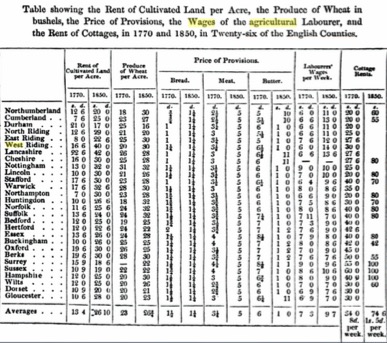
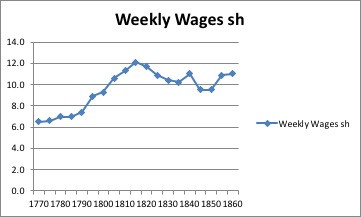

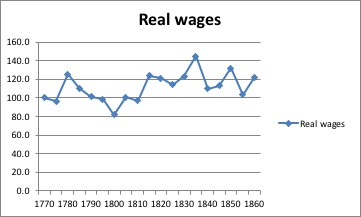

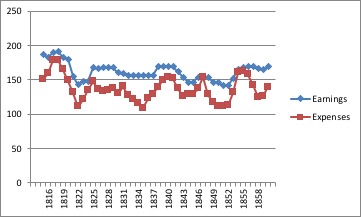
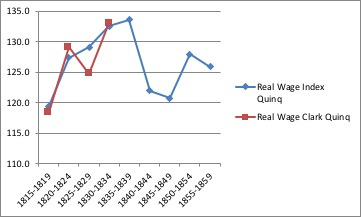


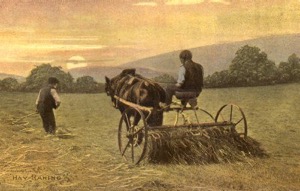
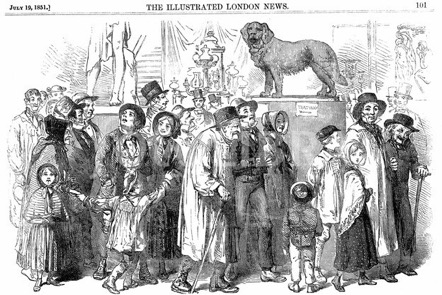
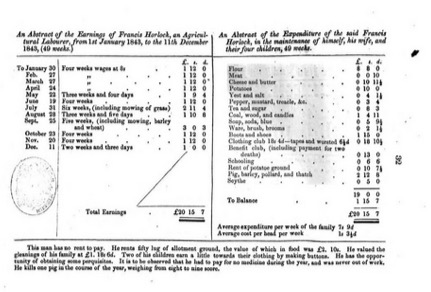


 The Industrial Revolution in England was not All Bad