3.4. The Worsted Industry in the West Riding

Woollen (or cloth) was manufactured from the short curly hair of the upland sheep, and worsted from the longer hair of lowland sheep. The long hair of woollen had to be carded before spinning to bring all the hairs into line, which was a long process; after weaving, as it was not strong, it had to be fulled (soaked in water, and then pressed on, to make a matted cloth), and this required finishing, that is, raising a nap, and then cutting it off at a level of the cloth, to make it smooth. 

Worsted wool had to be only combed through, as it was already nearly parallel; it was also easier to work in spinning and weaving, as it was stronger. In both cases, the wool was less strong and more breakable than cotton. Due to these differences, the use of machinery for spinning and weaving came earlier for worsted than for woollen. The worsted cloth was used for clothing for persons (hard-wearing fabrics), and the woollen for blankets and knitwear, (soft and warm fabrics). Woollen items were made in the region around Leeds, Wakefield, and Huddersfield (“fancy goods”), and worsted in the region around Bradford; Halifax had worsted, woollen and cotton production.

For our investigation it is important to distinguish between worsted and woollen, because the changes in processes came about 20 years later in the woollen manufacture, and in the woollen industry the hand-loom weavers did not suffer extreme poverty or hunger.

The wool industry in the West Riding of Yorkshire was only partially similar to the cotton industry. The history of this industry goes back to the Middle Ages, as there had always been a great number of sheep in the county. In the Eighteenth Century it was the main commercial basis for the population, and the county was rich. 

The yearly volumes of wool, from domestic sources plus import, were:

YearDomestic production (lbs.) Foreign wool imported (lbs.)Colonial wool imported (lbs.)Of which AustraliaTotal imported (lbs.)
180094,000,000 8,609,000008,609,000
1810  10,879,00034,00020010,914,000
1820  9,653,000122,00099,0009,775,000
1830111,000,000 30,303,0002,002,0001,967,00032,305,000
1840157,000,000 36,585,00012,850,0003,558,00049,436,000
1850228,000,000 26,102,00048,224,0009,721,00074,326,000
1855  24,681,00074,619,00039,018,00099,300,000
1857  44,522,00082,868,00049,209,000127,390,000

(We do not have a division between worsted and woollens, as the British Government did not collect the figures with this differentiation)

(Baines, 1859, Tables (B) and (C), p. 10; domestic production figures very approx.)

The phases in the production of worsted cloth, before industrialization, were: 

a)         sorting;

b)        washing and combing;

c)         carding;

d)        drawing;

e)         slubbing or roving (pulling out the wool, and winding it on bobbins);

f)         spinning;

g)        weaving;

h)        dyeing.

The major changes by inventions and in the chain of production were:

1790’s Fly-Shuttle

1810 Manual spinning replaced by machines

(saved 95 % of cost of labour)

1810-1825 Combing machine (William Cartwright), for preparing the wool in parallel threads.

This reduced the number of men required from 30, to 1 man with 5 children.

The cost of combing inferior wool was reduced from 2 ½ d. to 1 d. per pound, and of finer wool from 6d. to 1 ½ or 1d.

1820’s Steam-powered mills

1820’s Introduction of power-loom in factories, in small quantities

1840    Worsted spinning by throstle, replacing the jenny

As there were not many inventions to increase the speed of the spinning operations, the price of worsted yarn did not decrease after 1825. The price of one pound of yarn was 2s. 4d. in 1822 and 2s. 4d. in 1853, with levels in intermediate years from 3s. 0d. to 1s. 8d. The change in the structure of the spinning activities was only in the increase in volume produced and sold. The price of finished woven articles was reduced in the long term, due to the suppression of a number of stages in the process of weaving. 

In the eighteenth century, the commercial process for producing worsted was as follows. The weaver or “manufacturer” bought the wool from the farmer, took it to the spinners, received the yarn from the spinners, wove it in his own cottage, and then took it to the town, to be sold to the merchant in the Piece Hall.

In the 1790’s the first factory buildings were constructed, rather small, with mules and frames, but in the first years they produced low quality yarn. The spinning operators were girls and women, as not much physical strength was required. Of the total of persons employed in the factories, about 12 % were from 9 to 13 years old, and 50 % from 13 to 18 years old. From 1800 to 1814, 7 factories were built in Bradford Borough, from 1815 to 1829, 24 factories, and from 1830 to 1841, 37 factories (Koditschek, 1990, Table 3-1, p. 84)

In the 1820’s power looms for weaving were introduced in the mills, but the volume really picked up from 1840 (2,800) to 1850 (29,500). In this period, the number of worsted hand-loom weavers in the county decreased considerably, and in 1850 there were only about 10,000, in very bad conditions.

The mills started with only the preparation and finishing processes, then added spinning machines, and later the power looms for weaving; in 1850 there were 163 factories of spinning only, 90 of weaving only, and 149 with spinning and weaving. With the increase in production volume, the mills became larger, and some had very good installations for the workers (Saltaire). The number of persons employed in worsted factories in the West Riding increased from 29,000 in 1838 to 75,000 in 1850.   

            The distribution of the processes changed through time as follows:

Before 1800

Cottage

Spinning: Spinning wheel, Women

Weaving: Hand-loom, Men

1810-1830

Factories for Spinning, Cottage for Weaving

Spinning: Mules and throstles, Women

Help spinning: Small children

Weaving: Hand-loom with Fly-shuttle, Men

1820-1850

Factory in town, with steam power

Spinning: Mules with steam power, Women and children

Help spinning: Children

Weaving: Hand-loom (in own cottage), Men

          OR Power-loom in factory, Young women

(change from hand-loom in cottage to power-loom in factory, gradually during this period)

After 1840

Factory in town, with steam power

Spinning: Mules with steam power, Women and children

Weaving: Power-loom in factory, Young women
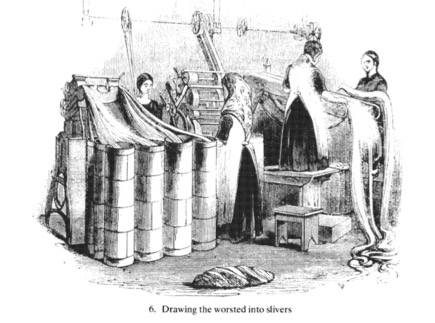
(Labour and the Poor in England and Wales, 1849-1851, Letters to the Morning Chronicle, plate after p. 42)

Monetary income levels

Arthur Young reported on the wages of worsted workersin Leeds in 1769. Male weavers 5 to 12 shillings the week, average 7s.; boys 13-14 5s.; women weavers 3s. 6d. to 4s.; wool combers 6 to 12 shillings; women spinners 2s. 6d. to 3s. the week; girls 13-14 1s. 8d. the week. The price of oats was 10 ounces for one penny, and beef 4 pence the pound, so that the average income for a man weaver could buy 50 pounds of oatcakes or20 pounds of beef (we can add the fact that all the family members worked). (Young, 1771, Vol. I, p. 137-139). There was always enough work.

In 1797, weavers earned 8 to 9 shillings the week, wool sorters and combers 12 shillings, hand spinners 4 shillings. Since oats were at 2s. 8d. for 16 lb. and beef was 6p. the lb., the weavers could buy 48 lb. oatmeal or16 lb. meat each week. (James, 1857, p. 547)

The incomes for the domestic hand-loom weavers were low from 1800 to 1803, then increased considerably to 1815, and then showed a slow but continuous decline. In 1815 it was possible to earn 30 shillings in some weeks, and in 1831, 18 shillings. On the other hand, bread, meat and other expenses were much cheaper in the 1830’s than in the 1800’s. In 1800 a week’s wages would buy 0.7 bushels [40 pounds] of wheat or17 ½ pounds of meat; in 1837 a week’s wages would buy 1.6 bushels [100 pounds] of wheat or 34 pounds of meat. (House of Lords, Handloom weavers, pp. 573-575) 

When the wool combers went on strike in 1825, they were earning 23 shillings a week, and wanted an increase. The strike failed. The masters started introducing combing machines, in order to be less exposed if there was another strike (James, 1857, pp. 400-407).

The incomes of the workers in the mills were sufficient (taking into account that generally a family would have at least two members employed), although they could be reduced in times of depression: 

 18231824182518261827182818291830
  s. d. s. d. s. d.s. d. s.  d. s. d.s. d. s. d.
Weavers from 12 to 16
years old
12  1 9 10   7 6  8 1   7 117 11  7 6
Weavers from 16 and upwards13 813 2 10 3 11 1 10 610 210 3
Reelers of worsted yarn, women10 012 11   9 4  9 4   9 8  8 7  9 4
Warpers of worsted yarn, women12 012 0 12 012 0 12 012 012 0
Hands working by
the day in factories from 
9 to 11 years,
chiefly Girls
 2 3
to 
3 9
2 3
to 
3 9
 2 0
to 
3 6
 2 0
to 
3 6
 2 0 to
3 6
 2 0 to 
3 6
 2 0 to 
3 6
Hands from 11 to 14, chiefly girls3 9
to 
6 0
3 9
to 
6 0
 3 6
to 
5 9
 3 6 to 
5 9
 3 6 to 
5 9
3 6 to
5 9
 3 6 to 
5 9
Hands from 14 and upwards, women8 0
to 
8 6
8 0
to 
8 6
 7 6
to 
7 0
 8 0 to 
7 0
 8 0 to 
7 0
 8 0 to 
7 0
 7 6 to 
7 0
Overlookers18 0
to 
26 0
18 0
to 
26 0
 18 0 to 
26 0
18 0 to 
26 0
18 0 to
26 0
18 0 to
26 0
18 0 to
26 0
Woolcombers18 0
to 
24 0
18 0
to 
24 0
 18 0 to 
24 0
18 0 to
24 0
18 0 to
24 0
18 0 to
24 0
18 0 to
24 0

1825 = “Lock-out”, Strike  

(Adapted from James, 1857, p. 413 and p. 432)

            Following, we have a list of wages in a worsted mill (without the weaving function) in 1833:

(James, 1857, p. 443)

We can compare the data of 1833 and of 1840 with a general list of wages in the Bradford area in 1860, which shows a number of new work functions:
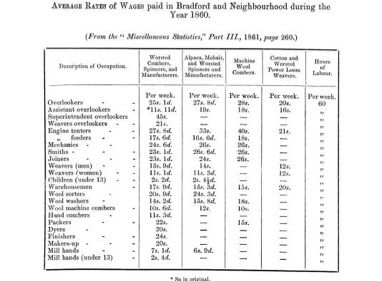
(Secretary of Board of Trade, Returns of Wages, 1887, p. 116)

We see that there are not many jobs in direct contact with the wool. The spinning is done by children under 13 who earn less than 3 shillings, as the machines (throstles) are easy to use and watch over. The weaving (all in-house) costs about 12 shillings. There are some manual wool sorters and combers. The other positions are technological, administrative, and engineering, and they are all well-paid, that is, from 20 to 30 shillings.

What has happened is that the worsted wool industry has been fully mechanized (see the table below). The important work is not done “on the production line”. This complicates our analysis of the movements of wages. It is true that the wages for spinning and weaving have gone down considerably. But new jobs have appeared, that did not exist before 1833. We cannot show these on the graphs, because we do not have comparable “starting figures” for them. The graphs show a general decrease from 1830. But it is very probable that the average income for workers in the worsted mills increased. Also there were new companies in Bradford, which produced textile machinery, and employed engineers and mechanics at good wages.
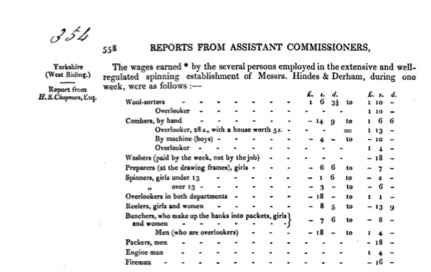
(Report on the Condition of the Hand-Loom Weavers, p. 558, Worsted spinning mill at Bradford)

We see that the number of persons employed, and of power looms, increased particularly in the worsted business from 1838 to 1856:

                 FACTORIES OF THE UNITED KINGDOM IN 1838 AND 1856

                   Persons employed              Horse Power                    Power Looms

                   (only those in factories)

Factories18381856Incr.18381856Incr.18381856Incr.
Cotton259,104379,21346 %59,80397,13262 %108,751298,847175 %
Woollen54,80879,90144 %20,61725,90125 %2,15014,453572 %
Worsted31,62887,794177 %7,17614,904108 %2,96938,9561,212 %
Flax43,55780,26284 %11,08918,32265 %1,7149,260440 %
Silk34,30356,13764 %3,3845,17651 %2097,6893,579 %
TOTALS423,400682,49761 %102,069161,43558 %115,793369,205219 %

(Baines, 1859, Table (A), p. 8)

The problem was the income level (piece rates) of the hand-loom weavers. In a bad year like 1838, there were 13,800 in the Bradford district (James, 1857, p. 482), who only earned 6 or 7 shillings, which was absolutely not enough for the food of a family. Also, if the children went to work in the mills, they could earn more than the father. 

(House of Lords, Sessional Papers, 1840, Hand-Loom Weavers, p. 575)

Worsted workers (shillings per week)

Wool SortersWool CombersSpinnersWeavers
In-house
WeaversWeaver Domestic
MenMen10 yrsMenWomenMen
1800 10
1805 17
1810 17
1815 31
1820 21
18251217311521
18301212310318
18352716415
1840 12
1845 
1850 
185521 31010
18602131411

Mill workers: James, 1857, pp. 412, 432; Weaver domestic: Hand-loom weavers p 57.

Worsted workers (loaves per week)

Wool SortersWool CombersSpinnersWeaversWeaversWeaver
Domestic
MenMen10 yrsMenWomen
1800 9
1805 16
1810 
1815 30
1820 25
18251521413625
18301515413423
18353722621
1840 16
1845 
1850 
185528 41414
18603252117

Worsted workers (shillings per week)

Worsted workers (loaves per week)

3.3. Family Budgets

The spinners in the cotton mills, who usually had at least one other family member working, had enough income to purchase a good level of food.

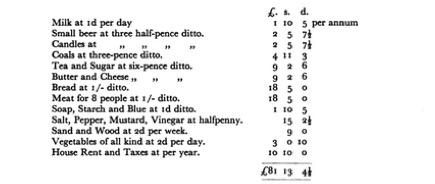
The earliest budget calculation that we have is from 1806:

(“Calculation of the Expense of maintaining a man, his wife, and six children for a year”, “Tax on Labour”, Manchester Mercury, 29thJuly 1806; quoted in: Gordon Brindley Hindle, Provision for the Relief of the Poor in Manchester, 1754-1826; Manchester University Press, Manchester, 1975)

We see that the family (apparently a normal case) has a total income of 81 pounds per year, or 31 shillings a week. The food expenses are equivalent to a weekly consumption for the whole family of: 7 quartern loaves, 7 pounds of meat, 5 pounds of cheese and butter, 7 pints of small beer, and 7 pints of milk. This would appear to be a more than sufficient amount of food. 

2 spinners, man and wife, with 2 children, Manchester, 1833, weekly income and expenses:

  L  s  d
   
Earnings 2 10  0
   
Bread30 lbs.0  4   2
Beef 8 lbs.0  4   4
Potatoes20 lbs.0  0 10
Butter  3 lbs.0  3   0
Sugar3 ½ lbs.0  1  9
Tea2 oz.0  0  7 ½ 
Coffee2 oz.0  0  2 ½ 
Flour3 lbs.0  0  6
Oatcakes120  1  0
Ale7 quarts0  2 11
Milk7 quarts0  1  6
Soap1 lb.0  0  6
Candles½ lb.0  0  3
Rent 0  3  6
Washing 0  2  4
Fire  0  1  0
   
Total 1  8  5

(Factories Inquiry Commission – Supplementary Report, 1833, p. 170)

The figure of 2s. 4d. for the washerwoman is very interesting. It shows that a) well-paid spinners had interest in having clean clothing, and were willing to pay for it, b) they had a full change of clothing, because otherwise they could not give their clothes to be washed. But also, if we suppose that the washerwomen did her work at a speed of one family’s washing per day, we see that she earned more than 12 shillings a week.

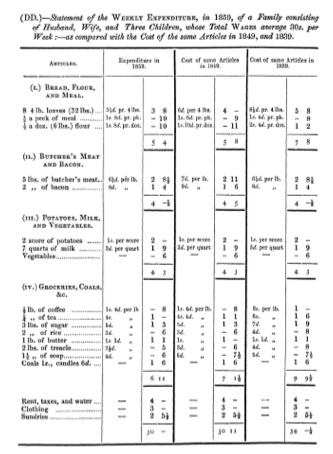
We see below that a family of 2 adults and 3 children in 1839, 1849, and 1859, with a total income of 30 shillings per week could have a comfortable life, consuming 8 4-lb. loaves and 5 lbs. of butcher’s meat per week.

(Line 2: ½ peck = 7 ½ lbs.)

(Chadwick, 1860, Table (DD), p. 35)

Mr. Edward Baines (author of “History of Cotton Manufacture in Great Britain, and part of the woollens “establishment” at Leeds) was convinced that the totality of the cotton factory workers had a good standard of life: 

“The eleven tables now given establish beyond all controversy that the 237,000 work-people employed in the cotton-mills of Great Britain are in the receipt of wages amply sufficient to yield them not merely the necessaries of life in food, clothing and habitation, but also many comforts and some superfluities, – to enable the adult workmen, with proper management and frugality, to educate their children, and to provide against sickness and old age, – and to admit of children contributing materially to the support of necessitous parents. Where a spinner is assisted by his own children in the mill, as is very frequently the case, his income is so large that he can live more generously, and clothe himself and his family better, than many of the lower class of tradesmen; and, though improvidence and misconduct too often ruin the happiness of those families, yet there are thousands of spinners in the cotton districts who eat meat every day, wear broad cloth on the Sunday, dress their wives and children well, furnish their houses with mahogany and carpets (*), subscribe to publications, and pass through life with humble respectability.  

Wages, it will be seen, have declined in nominal amount since the war, but not so much as the prices of provisions and clothing; so that the workmen are now receiving higher real wages than at any former period. The rate of payment has in many cases been reduced on a given quantity of work, yet without diminishing the receipts of the workmen – the improvements in machinery enabling them to throw off a greater quantity of work in the same time, and thus compensating for the reduced rate of payment.”

(Baines, 1835, p. 446)

(*) There are references in other sources to good furniture:

 “The town itself [Sheffield] is ill built and dirty, beyond the usual condition of English towns; but it is the custom for each family among the labouring population to occupy a separate dwelling, the rooms in which are furnished in a very comfortable manner, the floors are carpeted, and the tables are usually of mahogany; chests of drawers of the same material are generally seen, and so in most cases is a clock also, the possession of which article of furniture has often been pointed out as the certain indication of prosperity and of personal respectability of the part of the working man.”

(Porter, 1851, p. 523)

 “…. whilst in all the concerns of the leading manufactures [in Bolton], whose command of money has enabled them to work their mills on full time, regardless of losses, there are large numbers above want, and some who enjoy small luxuries, such as a house with three sleeping rooms, enabling them to cultivate delicacy in their families, who have a good stock of books, furniture, and clothing, and educate their children even at some sacrifice of their earnings, – indications which lead to a gratifying estimate of their tastes and feelings.”

(Ashworth, 1842, p. 79)

“Nothing struck me more, while visiting and comparing notes in the different operative districts of Manchester, than the regularity with which the better style of house and the better style of furniture went together; it being always kept in mind that, so far as wages are concerned, the inhabitants of one locality are almost, if not quite, on a par with those of another. But the superior class room seemed, by a sort of natural sequence, to attract the superior class furniture. A very fair proportion of what was deal in Ancoats was mahogany in Hulme. Yet the people of Hulme get no higher wages than the people of Ancoats. The secret is that they live in better-built houses and consequently take more pleasure and pride in their dwellings.”

(Morning Chronicle, 1850, “Manchester”)

“One can nearly always see from the furnishings of the dwelling, how much wages the worker receives weekly. With 15 shillings, which is a very moderate wage, there is rarely a carpet covering the stone floor – usually a small mat is found in front of the fireplace -, the walls are without decoration, the whole furniture is just a table, chair and bed. With 20 shillings the appearance is better; the chairs have cushions, the carpet – a necessary object in England, due to the climate – is larger, on the cupboard there are glasses and cups, and from the ceiling hangs a whole ham or a side of bacon. The people who receive 30 shillings, allow themselves a certain level of comfort, which extends to the small figures, cups and glasses, which embellish the shelf above the fireplace.” 

(Translation by this author)

 (Weerth, 1843-1848, Ch. 7 The English Workers [Bradford])

The weavers of wool in the West of England had a good standard of living up to 1830:  

3.2. Monetary Income Levels

Monetary system Pounds (£), shillings (s.), pennies or pence (d.)
1 Pound = 20 shillings, 1 shilling = 12 pence 
Wage of farm labourer = 9 to 12 shillings per week
Wage of male worker in textile factory = 20 to 30 shillings per week 
Dry weight measures 1 bushel wheat = 60 lb., 1 quarter = 480 lb. 
Price of 4 pound loaf of wheaten bread = 6 to 8 pence
Energy supplied by 4 pound loaf = 4,500 calories 
Price of butcher’s meat = 4 to 6 pence per pound

The situation in Lancashire before the introduction of the fly-shuttle for the loom, was of reasonable prosperity. The spinners and weavers could sell their respective merchandises at a sufficient price. The majority of these people, apart from their textile production, also had a small farm for their food necessities.

When Arthur Young visited the town of Manchester in 1769, he found much activity in the cotton industry. There were a lot of different types of cloth made, and the men weavers earned from 5 to 10 shillings a week for “velverets”, “thicksets”, “quilts” and “petticoats”, and from 3 to 7 shillings for other fustians (mix of cotton and linen yarns); for all the “check” branch, the men earned 7 shillings. The women cotton spinners earned 2 to 5 shillings, and girls of 6-12 years received 1s. to 1s. 6d.

He was told that there were 30,000 in the families of spinners in the town, and 50,000 in the country around. The major part of the production was exported to North America and the West Indies. There was always enough work for everybody, and the master manufacturers usually had pending orders in their books. Bread (mixture of wheat and barley) was at 1 ½ pence the pound and beef at 2 ½ pence the pound, so that 7 shillings a week would buy 56 pounds of bread or 35 pounds of beef (Young, 1771, Vol. 3, pp. 186-194).    

As a general statement for the period 1770 to 1840, the incomes in Lancashire from sales of own work, piece work, and later the wages from working in factories, were good by the standards of the day. The exceptions were the low wages for the small children working in factories, the low piece work rates for domestic hand-loom weavers from 1817 onwards, and temporary reductions in weekly wages or in number of personnel, in times of recessions. The farmers, the coal miners, and the mechanics building the textile machinery had very good incomes.  

With the fly shuttle, the weavers earned more, because they received more thread from the spinners (which might be own family members), and thus had more output per day. 

With the jenny, men began to spin, as this required more strength and skill. Jennies could be worked economically only by skilled spinners; their effect was to reduce the quantity of labour for a given output, and to substitute men’s labour for that of women and children, as more strength was needed, i. e. women did not do much textile work in the cottage. 

The period from 1785 to 1805 was a “golden age” for the weavers and their families. There was a great increase in the volume of production; many barns and outbuildings were converted to loom-sheds, and many new weavers’ cottages (with workrooms for looms) were built. Some families had a total income of 40 to 100 shillings per week.

By the 1820s, all cotton was spun in mills; but this yarn went to outworking weavers who continued to work in their own homes. 

The first steam power weavers (1820-1830) were women, assisted by children, due to the negative of the men to work in the mills. Hand loom weaving had been a man’s occupation but in the mill it could and was done by girls and women. Thus the main income of a family was often that of the wife and a daughter.

The proportions of each type of personnel in spinning and weaving mills (that is, excluding hand-loom weavers working in their houses) in England in 1833 were as follows (Baines, 1836, p. 379):

It is very difficult to construct a series of wages for cotton factory workers for the years from 1770 to 1820:

  1. we have very few data;
  2. there are no series of yearly figures reported in that period, presented by one person or one authority;
  3. the net incomes for spinners, were after subtracting the wages of the “piecers” (boys who joined together broken threads), who were paid by the spinner, and we have very little data about the piecers;
  4. the gross piece rates for the spinners were contractually agreed with the masters on the basis of volume produced, so that the real net income in a given week was the multiplication of the piece rate by the production amount, i.e. the income was in function of the speed and technique of each spinner;
  5. the piece rates were different in each town;
  6. the piece rates were different for each fineness of yarn;
  7. the spinners themselves, in their arguments with the owners about general wage levels, were not consistent;
  8. the piece rates were often reduced temporarily (6 to 24 months) by the owners, when there was a “slump”.

We do have a table of earnings for a number of job descriptions in the cotton industry for the period of 1810 to 1825. These come with incomes for other types of employment in Lancashire, and the costs of food. The data were collected by the Chamber of Commerce of Manchester, and transmitted to the Board of Trade, and we also have data from 1825 to 1832 collected by Mr. Baines (Baines, 1835, pp. 438-439).

We see that the cotton spinners earn in the majority of the years, 32 shillings, while the carpenters, stonemasons, bricklayers, and painters (who in general were well paid in all parts of England) earned 21 to 25 shillings, and the tailors 20 shillings. This shows that effectively it was necessary for the mill-owners to pay superior wages to these people, to induce them to change to cotton spinning. Flour went down from 4 shillings for 12 pounds to 2 shillings during this period, and butcher’s meat from 8 pence the pound to 5 pence. Thus the spinners’ families certainly were able to eat well.  

In 1906, the company of McConnel & Kennedy – who had constructed one of the first large mills in Manchester – published a Centenary magazine with information about the past of the company. Included was a list of standard wages, made out by a manager in 1819. 

Page scan of sequence 95

(Note that the men spinners have to pay out of their wages, the wages of one piecer)

(McConnel, 1906, p. 51)

The amounts of food which could be bought with one week’s earnings improved considerably from 1804 to 1833:

(Taken from the Report of the Commons Committee on Manufactures, Commerce, and Shipping, 1833, p. 319)

In 1818, according to a newspaper in Manchester, the spinners had a net weekly wage of “upwards of 31s.; and for boys and girls, spinners, upwards of 17s., clear of all charges and deductions whatsoever”; “No class of people have had such constant and uniform employment, for the last twenty-eight years” (Kirby, R. G., Musson, A. E.; The Voice of the People: John Doherty, 1798-1854 : Trade Unionist, Radical and Factory Reformer; Manchester University Press, Manchester, 1976; p. 19). In 1827, according to a newspaper advertisement, spinners on numbers 110 to 200 would be earning “from 34s. to 38s. per week, clear of all expense” (op. cit., p. 44).

In 1829, in reply to exaggerated information from the owners, the spinners’ union put out a statement that “There are about 2,400 spinners in Manchester and its immediate vicinity, twenty-five, or may be thirty of these could, before the reduction was proposed, have earned 60s., 250, or perhaps 300, could have earned 40s., 600 25s., and 1,500 about 16s., some being as low as 12s.; …” (op. cit., p. 64). 

It is important to note that generally 2, 3, or 4 members of one family worked in the cotton mills; very often, the piecer for a spinner was his own son.

This means that the weekly income for the family (i.e. used to cover expenses) was often 30 to 40 shillings.

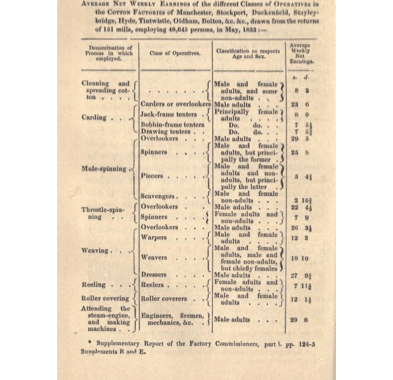
The typical incomes in 1833 for each productive activity and age/sex of the worker were:

(Baines, 1835, p. 436)

With respect to family incomes in the cotton mills in the year 1847, we have a long document from the Factory Inspectors. This was a list of interviews with male and female workers, as to their opinions about the “Ten-Hour Bill”, and their experiences up to that date with different hours of work and corresponding wage levels. We can also see in which cases the husband and the wife both worked.

Page scan of sequence 175

(Inspectors of Factories; Reports, for the Half-Year ending 31st October 1848; Appendix, Evidence of the Opinions of Persons employed in Factories respecting the Ten-hours’ Act, collected in September, October, and November, 1848, by Mr. Horner and the five Sub-Inspectors in his District; Her Majesty’s Stationery Office, London, 1849)

The wages in 1839, 1849, 1859, for a number of tasks in the cotton industry were the following:

  183918491859
   s. d.  s. d.s. d.
Spinners Self-acting mulesMen16 018 020 0
Spinners ThrostlesWomen  7 0  7 6  9 0
WarpersMen22 022 023 0
DoublersWomen  7 0  7 6  9 0
Piecers 14 to 18 yrsBoys  5 6  5 6  6 0
Spinners Hand-mulesMen25 021 025 0
Weavers Power-looms (2 looms)Women  9 0  9 010 0
Weavers Power-looms (4 looms)Women17 016 018 0
Hand-loom weavers
Fancy fabrics (working at their 
own house) 
Men16 015 016 0

(In all cases, the hours were 69, 60, 60)

(Chadwick, 1860, Tables (N), (O), (P), pp. 23-25)

As to the destination of the wealth generated by the cotton industry, we have a calculation by the radical newspaper, “The Gorgon” in 1818, which shows that a master spinner (i.e. mill owner) would earn 4 pounds 3 shillings 4 pence from the production of 20 lbs. of cotton yarn, while the spinner would earn 18 shillings net from working this amount in one week. (However, the arithmetic of the spinner’s net income is misleading. One of the piecers is very probably his son, as the spinner could choose who would work with him, and thus the piecer’s wages go directly into the father’s pocket. The other two piecers are sons of other workers, who will also pocket their sons’ wages; the money is an income for the totality of the spinners in Manchester.) Thus the net income of an average of spinners is 2 pounds 0 shillings 4 pence.

Manchester was not only “cotton”. Less than 25 % of the adult workers in Manchester worked in cotton production, and not all of these were employed in continuous work on the machines. According to Benjamin Love, quoting a report of the Manchester Statistical Society, of 71,799 employed in Manchester and Salford in 1834, 18,353 worked in cotton factories (Love, 1842, p. 95). According to the 1851 Census, 16.0 % of males over 20 worked in cotton manufacture, and 13.9 % of females over 20 (Bolton, 28.2 / 20.9; Preston 30.6 / 28.5; Oldham 30.4 / 25.4)  (Danson, Welton, 1860, Table XXIV, p. 67). The other industrial activities were: iron foundries, construction of stationary steam engines and of locomotives, construction of machinery for textile factories (especially power looms), dye works, bleaching works, calico printing, chemical works. In these industries the factories worked six 10-hour days. The commercial activities of the town were equally important to the industrial: banking, insurance, purchase and sale of commodities, warehousing, transport.

Family budgets

The farmers in Lancashire and Cheshire had good incomes during this period, because they could sell their produce to the operatives in the cotton industry; the agricultural labourers were the best paid in England, with wages of 15 shillings cash, or bed and board calculated at 9 shillings plus 6 shillings cash. Miners earned 25 shillings, plus free coal. Skilled mechanics earned from 25 to 35 shillings.  

In each of the sections for the different occupations, we shall be showing the wages in shillings per week (numbers and graph), and in quartern loaves per week (numbers and graph). The conversion to loaves is with the intention of presenting real incomes, that is, after adjusting for price inflation in food. The choice of a quartern wheat loaf is not altogether logical, as a proportion of people in the North ate oatcakes or a loaf of mixed barley and wheat, and a number of agricultural families did not eat shop bread, but bought flour to bake their bread. But this arithmetical rule is useful, because it is comparable over all the data, and the people of the eighteenth and nineteenth centuries expressed their expenses in this way. 

The “poverty line”, that is, the man’s earnings at which the family could eat just enough, but did not go to bed with hunger, was at about 8 white bread quartern loaves per week, or 6 quartern loaves equivalent, if the family did not buy white bread loaves, but wheat flour or oatmeal to make the bread at home. This is supposing that other members of the family earned money, or that the father had in addition earnings from harvest or task-wages. 

As the price of the quartern loaf oscillated strongly, such that the prices for the years 1800, 1805, 1810, ….., were not representative, the average of each quinquennium is used  (e.g. 1800-1804). But the bread prices for exactly the years 1800, 1801, 1810, were very high, so that the people did suffer hunger.

The lines of data generally are each taken from one source or authority, with the intention that there are no sudden movements due to changes in definitions.

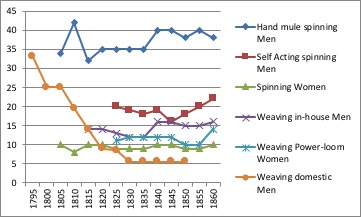
Cotton workers (shillings per week)

Hand mule spinnerSelf Acting spinnerSpinnerWeaver
in-house
Weaver Power-
loom
Weaver domestic
MenMenWomenMenWomenMen
1795 33
1800 25
1805 34  10 25
1810 42 8 20
1815 32 10 14 14
1820 35 10 14 9
1825 35 20 9 13 11 9
1830 35 19 9 12 12 6
1835 35 18 9 12 12 6
1840 40 19 10 16 12 6
1845 40 16 10 16 12 6
1850 38 18 9 15 10 6
1855 40 20 9 15 10
1860 38 22 10 16 14

(Note that the men spinners referenced are the 1st class, in the finer threads; the average incomes for all men spinners were about 70 % of the 1st class)

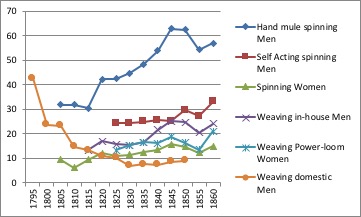
Cotton workers (loaves per week)
Hand mule spinningSelf Acting spinningSpinningWeaving in-houseWeaving Power-loomWeaving domestic
MenMenWomenMenWomenMen
1795 43
1800 24
1805 32 9 23
1810 32 6 15
1815 31 10 14 14
1820 42 12 17 11
1825 42 24 11 16 13 10
1830 45 24 11 15 15 7
1835 48 25 12 17 17 8
1840 54 26 13 22 16 7
1845 57 23 14 23 17 8
1850 62 30 15 25 16 9
1855 54 27 12 20 14
1860 57 33 15 24 21

Cotton workers (shillings per week)

(Spinning and weaving in mills: Returns of Wages; Weaving domestic men: Committee Commerce, Manufacture, Shipping, 1833, pp. 699-700)

This is a very important graph. It shows the changes in income for men and women, in function of the changes in the processes and machines. The men are employed in spinning on the mules during all the period. They are also employed in the self-acting machines from 1825; thus (although this is not shown) the proportion of men on hand mules decreased, as they only worked on the heavier mules for the finer threads. The women starting working on the power-looms, when these were introduced in 1825-1830; the work was not muscular, but only inspection and adjustment of the machines, which is why it was only done by women, and at 10s. to 12s. the week. Those hand-loom weavers who had a salaried contract with a mill earned a reasonable income; they generally wove the more complicated and artistic pieces. The hand-loom weavers who worked on a piece rate basis had a very low income from 1817 onwards.  

Cotton workers (loaves per week)

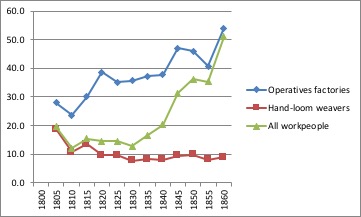
From these data above, it would seem to be difficult to calculate an average for the whole of the cotton industry (men, women, and children) during this period, to see if the wages in general increased. Luckily, George Wood in his “History of Wages in the Cotton Trade”(1910) does give us exactly the required figures, based on his years of experience and investigation of the incomes data. We see that the nominal wages for factory workers maintained in the range from 100 pence to 126 pence in the period 1806 to 1855 (but we will show in a later section, that wages for cotton workers at the beginning of the nineteenth century were clearly higher than those for the occupations that they had left). The average of real wages went up from 10 loaves a week to 18 loaves a week. 

                Operatives                           Hand-loom                 All Workpeople

                in Factories                         Weavers                      (Cotton)

Year Number empl.Weekly wage Number empl.Weekly wage Number empl.Weekly Wage
  ‘000Shillings ‘000Shillings ‘000Shillings
          
1806 9010.1 18420.0 27418.3
1810 10010.5 20014.2 30013.0
1815 11410.5 22013.5 33412.5
1820 12610.3 2408.3 3669.0
1825 1739.8 2408.3 4138.9
1830 1859.6 2406.2 4258.7
1835 2209.6 1886.2 4088.0
1840 2629.3 1236.2 3858.3
1845 2739.9 696.2 3339.2
1850 3319.2 436.2 3748.8
1855 37110.0 276.2 3989.7
1860 42711.6 106.2 43711.5

(Extracted from: Wood, 1910, Table 41, pp. 127-128; pence converted to shillings by this author)

It must however be pointed out that these figures of about 10 shillings a week are for one average person. In the majority of cases in the cotton industry, 2 or 3 family members worked. Thus we might well have a man cotton spinner (average job level) with 22 shillings a week, his wife or daughter (18 years old) with 12 shillings, and a boy (10 years old) with 6 shillings, giving a total of 40 shillings.   

Thus, following we give a re-expression of “number employed” and “weekly wage” for factory operatives per family of 3 persons in the factories. 

                Operatives                           Hand-loom                 All Workpeople

                in Factories                         Weavers                      (Cotton)

Year Families
employed
Weekly
Wage
 Number
employed
Weekly
wage
 Families
Employed
Weekly
Wage
  ‘000Shillings ‘000Shillings ‘000Shillings
          
1806 3030 18420 21421
1810 3331 20014 23316
1815 3831 22014 25816
1820 4232 2408 28212
1825 5829 2408 29812
1830 6228 2406 30210
1835 7327 1886 26112
1840 8728 1236 21015
1845 9130 696 16020
1850 11028 436 15322
1855 12430 276 15126
1860 14236 106 15234

Graph of the above table (cotton industry):

Average wages in shillings

Average wages in loaves

The question is, why did the mill owners pay such high wages to the male spinners? From their point of view, because the spinners were the most important link in the production chain, and because they needed men with skill to guarantee the quality of the thread and the daily volume of production. But from the point of view of the men, it was because the work on the mule was physically hard, and required much stamina during the 14 hour day; many of the spinners had to leave the work at 40 years old, because they were just too tired. They needed a good income, in order to cover the large amounts of food that they had to consume.

“In its domestic industry phase, mule spinning acquired the status and characteristics of a craft. Many factors served to restrict entry into the occupation: the strength required to push to mule carriage back and forth; the skills required to draw out the yarn evenly to the required fineness, to wind the yarn properly into the form of a cop on the spindle, and to maintain (and perhaps even construct) the mule; and the capital required to buy the machine. As a high-paying occupation that required concentrated physical strength and the supervision of assistants, mule spinning remained a male-dominated craft as it moved into the factory setting. Attracted by high wages in an expanding industry, many artisans – shoemakers, joiners, and hatmakers – left their trades to take up mule spinning.” (Lazonick, 1992, Ch. 3, Minders, Piecers and Self-Acting Mules, p. 81)

“These manual operations also required a considerable amount of physical strength to push the mule five feet up to the roller beam to wind the spun yarn. In the 1830s a mule on which coarse counts of yarn were being spun had to be put up about three and one-half times per minute, or about 2,200 times (allowing for stoppages) for a twelve-hour day. In 1838 the weight of a mule carriage of 336 spindles for spinning course counts was 1,400 pounds and that of a carriage (“constructed on the lightest Principle”) of 816 spindles was 1,755 pounds.“ (ibid. p. 83). 

Domestic hand-loom weavers

The weaving of cotton by domestic hand-loom workers continued up to 1840, but was accompanied by an extreme reduction of the incomes of the weavers starting from 1817. The power-looms, which were more efficient, started around 1810, but did not take over the majority of the production until about 1830. It is not true that the power-loom took away the work from the hand-loom weavers, and thus forced them to offer their cloths at a very low price. For a long time the power-looms could not work the “fancy” weaves.

The poverty of the domestic hand-loom weavers from 1817 to 1835 is commented in a separate chapter.

3.1. The Growth of the Lancashire Cotton Industry

(Board of Agriculture / Mr. John Holt, General View of the Agriculture of the County of Lancaster, 1794, plate facing title page)

The phases in the production of cotton cloth, before industrialization, were: 

a)         cleaning; 

b)         carding (pulling the threads all in one direction, using brushes in the hand);

c)         spinning;

d)        weaving;

e)         bleaching;

f)         dyeing.

During the late eighteenth century and the early nineteenth century there were a number of inventions which increased the quantity of cotton which could be spun or woven by one person. It is important to list all these changes, because they influenced the wage levels for each occupation, and the changes in employment for men, women, children, and small children.

1738 Fly-shuttle (John Kay)

This changed the operation of loom by the weaver, from throwing the shuttle from one side of the loom to the other and then back to the first side, to pulling a string to hit the shuttle with a horizontal hammer from left to right, and then pull the string to have another hammer hit the shuttle from right to left. 

In this way, the weaver could produce more cloth per day, and also could on his own weave much broader cloths. But, he required even more quantity of spun yarn from the spinners.

1738 Roller spinners (John Wyatt)

This permitted spinning of a number of threads at one time. It produced matted rolls of threads of many yards instead of a few inches.

1748 Carding engine (Lewis Paul)

This machine was invented to pull the fibres all in one direction, and had the wire teeth on a moving cylinder instead of on a fixed board.

Weavers could now obtain a very large quantity of yarn, at a reasonable price. Manufacturers could use warps of cotton, which were much cheaper than linen warps. (Warp is the base thread put on the loom; weft is the “sideways” thread which is woven into the lines of the warp) 

1760 Drop-box (Robert Kay, son of John) 

This allowed the weaver to change from a shuttle with thread of one colour to a shuttle with a thread of another colour, without manually touching the shuttle.

1764 Spinning Jenny (James Hargreaves) 

This was a rectangular frame which included 8 spindles set vertically (instead of one, horizontally, before). It could therefore increase the spinning throughput of one person by a factor of eight. Versions in later years reached 120 spindles. The smaller “hand jenny” was used by women in their cottages; the larger jenny could only be used in houses or mills.

1769 Water Frame (Richard Arkwright)       

This produced a much higher quality of thread, and more resistant, due to the movements on rollers. It was able to make both warp and weft. Thus no more wefts of linen were needed, only threads of cotton. It was a heavy machine, and thus it required to be moved by water power. The first use of steam power for this machine was in 1785. It was the first type of machine to be installed in a factory. 

With the introduction of these new machines, the cottages or work-rooms of the individual spinners did not have enough room, due to their size and weight. They needed a lot of force to move the individual parts, so they had to be close to a river, for the waterwheel. Also they cost more to construct, and required specialised workers for their maintenance. Thus some “capitalists” built the first “mills” or factories, where a number of these machines could be placed in large rooms.

1771 First spinning mill, Cromford Mill, Derbyshire (Arkwright)

This had different machines in the process line, one after the other. It saved time, instead of transporting the semi-finished materials from one house to another. Better supervision, team of mechanics for maintenance.

1775 Carding machine (Arkwright)

Improved efficiency, pulled off longer strips

Much more volume of cotton yarn could be processed, and thus the weavers had much more work. More spinning mills were built.

1779 Spinning Mule, or Mule Jenny (Samuel Crompton)

This was a hybrid of spinning jenny and water frame, with finer thread at a lower cost, the input was raw cotton and the output was cloth.

The wheels moved on a carriage.

The men spinners could gain good wages on the Mule, and thus people from other occupations changed to spinning in the factories.

1781 Rotary steam engine (James Watt)

This allowed the installation of spinning machines of large capacity in the mills, without worrying about the geographical location. Without this assistance, the number of spinning machines would have been limited by the total amount of water energy in Lancashire or another county, and also limited to those areas where there were fast-flowing rivers (up to this moment, the lower parts of the Pennines).  

1785 Cylinder printing machine (Bell)

The piece of cloth is imprinted with the design on the cylinder. This required 2 minutes, instead of 400 applications by a wooden block

1787 Power Loom (Edmund Cartwright)

This was an important new idea, which permitted the basic movement of a loom to be made much more quickly, and used a non-human power source. However the Cartwright design had a number of technical problems for its practical use, and required a number of adjustments, until a feasible version was introduced around 1820. 

1788 Bleaching with liquid lime chloride (James Watt)

The bleaching process in the mid eighteenth century consisted of leaving the cloth soaking in an alkaline liquid, soaking it in sour milk, leaving it stretched out in the sun, and repeating the process a number of times. This required 6 to 8 months. Using liquid lime chloride the time was reduced to 2 days, and a cost to one halfpenny a yard. 

1789 First steam-powered mills

These were erected in towns, as there was now no need for rivers for water-power.

1790 Import of raw cotton (more than 50 %) through the port of Liverpool

Until this date, the larger part of the import had gone through the port of London,requiring high transport costs from London to Lancashire.

1793 Cotton Gin (Eli Whitney, United States)

This allowed a worker (black slave) to clean 50 times the volume of raw cotton than before. Thus the United States could export much more raw cotton, and the advantage for the British cotton industry is that they did not come up against a limit of processing volume. Imports from USA: 1792 138,000 lbs., 1794 1,601,000 lbs., 1798 9,360,000 lbs. (Baines, 1835, p. 302)

1804 Dressing frame (Radcliffe) 

Improved the process of “dressing” the warp, that is, wetting it before it was put onto the loom. The change was to dress a large length of the thread in one movement, and not have to do this many times for small amounts. Without this, one man was required continually, which did not bring any increase in efficiency from the loom. This was a necessary change for the effective use of the power loom.

1806 Gas lighting

It cost about 75 % less than oil lamps or candles.

1812 First mills with power looms (Ashton)

This allowed the whole operation from the arrival of raw cotton to exit of the cotton cloth (spinning machines + weaving by power looms) to be carried out in one building, which made for a great efficiency in the movement of the materials.

1813 Improved power loom (Horrocks)

This was made of iron.

The great importance of the power looms was that they could be moved by an external power source, which might be a water-mill on a fast-flowing river, or a stationary steam engine, and not be restricted by the strength of one human being. The advantage was that they could weave from 20 threads simultaneously.  

The industry wide advantage was that it corrected the imbalance between number of spinners and number of weavers; that is, before, the spinners in total could produce more thread than the weavers in total could handle.  

In the beginning the power loom was only 1 x the efficiency of the hand loom, because it required much time to “dress” the cloth.

1816 Expansion of cotton cultivation in the United States, from the Atlantic States to the Deep South States (extensive flat agricultural areas with alluvial soil). 

1811: Virginia + N. Carolina + S. Carolina + Georgia + Florida; crop 39,000,000 lbs

1834: Virginia + N. Carolina + S. Carolina + Georgia + Florida; crop 180,000,000 lbs.

1834: Alabama + Tennessee + Mississippi + Louisiana; crop 277,000,000 lbs 

This reduced the export price of raw cotton from 25 U. S. cents / pound to 10 U. S. cents / pound from 1815-17 to 1832-34; landed price at Liverpool from 20 pence / pound to 8 pence / pound. This caused the cost of finished cotton cloth in (for example) 1834 to decrease by 25 %.  

(Secretary of the Treasury, United States of America; Cotton: Cultivation, Manufacture and Foreign Trade of ….; Doc. No. 146, March 4, 1836; Pamphlets on Cotton, Wool, etc., 1836)

1820-1840 General introduction of the Power Loom in the cotton industry

In 1813 there were only 2,400 in the United Kingdom, in 1820 there were 14,150, and in 1833, 100,000; but at that time there were still 240,000 hand-looms. These power looms were installed in mills, so that now some mills had the spinning and the weaving processes. 

1825 Throstle frame. 

This was a spinning machine, descendant of the water frame, which unified the processes of drawing, twisting and winding, in one continuous process.

A further advantage was that it was much lighter than a mule, and could be worked by a woman, instead of a man.

1825 Self-acting Mule (Richard Roberts), improved version introduced 1830

The movement of the apparatus on the wheels is made by the machine, not by a human operator. All the processes are automatic, the only labour is of the men and children who join the broken threads (“piecers”); the men spinners also had to revise the quality and speed of the machine.

However, the hand-mules were retained for the finer threads (No. 40, and upwards).

1830 Power Loom (Richard Roberts)

This was a perfected version of the power loom. 

A hand weaver made 100 picks (traverses) / min., which with 35 % downtime, was 65 / min.

Horrocks’ machine could make 52 theoretical or 35 real picks (traverses) per minute (but had the advantage of more working hours, and women workers with less wages)

With the implementation of the dressing machine in 1821, one person could manage 2 power looms.

The Roberts patent machine improved in the following years, giving much higher speeds. 

Roberts patent 1822: effective 76; 1836 effective 100; 1842 effective 130; 1860 effective 200.

Only with the higher speeds could the power loom be much more efficient than the domestic hand-looms.

1842 Lancashire Loom (James Bullogh and William Kenworthy)

Had a warning bell, for each time the thread broke on the loom. Thus instead of one man supervising one loom, the man could supervise up to four looms, with a corresponding saving in labour costs.

These inventions brought the following changes in the employment or unemployment of the inhabitants of Lancashire.

(Note: from 1740 to 1800, there were geographically two groups of cotton workers in Lancashire:

  • living in the countryside, in a rented house with a plot of farming land, working basically in spinning and weaving, and cultivating their land, solely for own food consumption;
  • living in Manchester or nearby towns, in rented rooms or cellars, weaving in these buildings, and purchasing their food.) 

Before 1740

Cottage or rented room

Spinning: Spinning wheel, Women

Weaving: Hand-loom, Men

1740-1770

Cottage or rented room

Spinning: Spinning wheel, Women

Weaving: Hand-loom with Fly-shuttle, Men

1770-1800

Cottage or rented room

Spinning: Spinning Jenny, Men

Weaving: Hand-loom, Men

1780-1810

Mills on river in hills or rural areas

(These mills were put up in 1780 to 1810, and continued in operation until the second half of the 19th century)

Spinning: Water Frame, Women and children

Help spinning: Small children

Weaving: Hand-loom, Men 

1790-1830 

Factory in town, with steam power

Spinning: Mules with steam power, Men (heavy machines), Women (light machines)

Help spinning: Small children

Weaving: Hand-loom (in own cottage or rented room), Men

1820-1850

Factory in town, with steam power

Spinning: Mules with steam power, Men (heavy machines), Women (light machines)

Help spinning: Children

Weaving: Hand-loom (in own cottage or rented room), Men

          OR Power-loom in factory, Young women

(change from hand-loom in cottage to power-loom in factory, gradually during this period)

After 1850

Factory in town, with steam power

Spinning: Mules with steam power, Men (fine threads on hand mules), Women (coarse threads on self-acting mules)

Weaving: Power-loom in factory, Young women

(Note: after 1820, the majority of the spinning mills were in South Lancashire, south of Bury, and the majority of the weaving factories were in Central Lancashire, north of Bury)

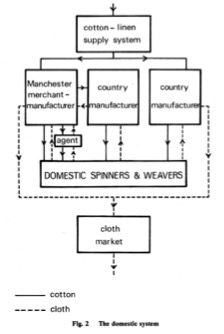
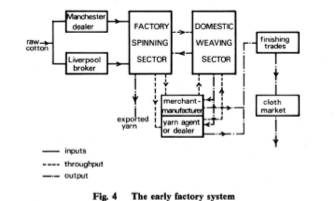
The commercial interrelation of the processes at different dates can be shown as follows:

(Kenny, 1982, p. 8, p. 12, p. 19)

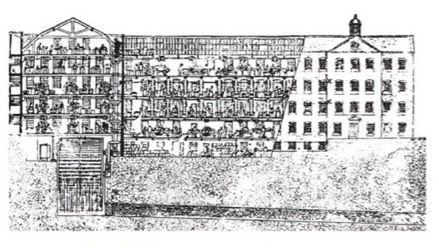
Quarry Bank Mill: a cutaway drawing illustrating the scale of the 1817 iron waterwheel and the distribution of power to the machinery on each floor.

(National Trust Bank Mill Archive)

On the left, on the top floor, preparing yarn for the looms and winding the yarn on to a package; on the lower four floors, throstle spinning on Arkwright’s water frame. On the right above, carding (untangling) and straightening the cotton; in the two middle floors, the mules, attended by women.

The savings that could be made with these technologies were considerable. A worker spinning cotton at a hand-powered spinning wheel in the 18th century would take more than 50,000 hours to spin 100 lb. of cotton; by the 1790s, the same quantity could be spun in 300 hours by mule, and with a self-acting mule in the 1830’s it could be spun by one worker in just 135 hours.

This series of inventions caused an extreme reduction in the price of cotton yarn to the weaver, and of finished calico cloth to the public:

Prices of cotton-yarn, 100 hank

YearPrices d. per lb.YearPrices d. per lb.
    
178638   0179910 11
178738   01800  9   5
178835   01801  8   9
178934   01802  8   4
179030   01803  8   4
179129   91804  7 10
179216   11805  7 10
179315   11806  7   2
179415   11807  6   9
179519   0…… ……
179619   0 1829  3   2
179719   01832  2 11
1798  9 10  

(Data as to 1795-1798, spun with different variety of cotton)

(Porter, 1836, Vol. 1, Production, p. 212, quoting an article in the Encyclopaedia Britannica)

Export prices of cotton yarn:

 Declared value per lb.
pence
181452.41
181543.47
182029.45
182523.58
183015.35
183516.46
184014.39
184512.37
185011.66
185510.44
186012.00

(Extract from: Board of Trade, Report on Wholesale and Retail Prices, 1903, p. 46, Cotton Yarn)

Export prices of finished calico cloth:

 Cotton piece goods (plain)Cotton piece goods (printed or dyed)
 Declared value per yard, penceDeclared value per yard, pence
182011.5113.80
18259.1511.04
18306.439.08
18355.977.09
18404.325.70
18453.424.83
18503.074.34
18552.794.01
18603.094.21

(Extract from: Board of Trade, Report on Wholesale and Retail Prices, 1903, p. 48, p. 49)

Cost and Selling Price of One Piece of Calico, from 1814 to 1833

YearAverage Prices Sold for in Manchester
through the year
 L. s. d. 
18141   4   7
18150 19   8
18160 16   8
18170 16   1
18180 16   8
18190 13   9
18200 12   1
18210   9   8
18220   9   3
18230   8 11
18240   8   5
18250   8   0
18260   6   3
18270   6   6
18280   6   5
18290   5   8
18300   6   3
18310   6   2
18320   5   8
18330   6   2

(Baines, 1835, p. 356)

(Harley, 2010, p. 8)

The volume of production in the cotton industry increased dramatically:

Year Consumption of Cotton (lbs.)Export of Cloth (Value in Pounds)
   
1701 1,985,000  23,000
1776-80 6,766,000 355,000
1790 31,447,000 1,662,000
1800 56,010,000 5,406,000
1810123,701,00018,951,000
1820152,829,00022,531,000
1830269,616,00041,050,000
1835333,043,00052,333,000
1840528,142,00073,152,000
1849775,469,000112,416,000

(To 1800, Baines, 1835, p. 215) (From 1801, Porter, 1851, p. 178)

Chapter 3. Growth of the Cotton, Worsted, Woollen, and Metals Industries

3.1. The Growth of the Lancashire Cotton Industry https://history.pictures/2020/01/20/3-1-the-growth-of-the-lancashire-cotton-industry/

3.2. Monetary Income Levels https://history.pictures/2020/01/21/3-2-monetary-income-levels/

3.3. Family Budgets https://history.pictures/2020/01/22/3-3-family-budgets/

3.4. The Worsted Industry in the West Riding https://history.pictures/2020/01/22/3-4-the-worsted-industry-in-the-west-riding/

3.5. The Woollen Industry (Cloth) https://history.pictures/2020/01/22/3-5-the-woollen-industry-cloth/

3.6. The Metal Industries in the West Midlands https://history.pictures/2020/01/23/3-6-the-metal-industries-in-the-west-midlands/

2.5. Non-representative Regions and Industries

When trying to make useful generalizations about a group of persons with variable characteristics, one recommended step is to identify some “abnormal” sub-group, separate it from the rest of the group, and then analyse the data of the abnormal sub-group, and analyse the data of the majority. What we should not do is to take the textile industries of Lancashire and the West Riding of Yorkshire from 1770 to 1820 as representative of the entirety of England, Wales and Scotland. We should remember that 35 % of the population until 1840 was in agriculture, and 20 % in non-machine (domestic) industries. 

The following maps show that the areas where the majority of the men and women were engaged in industry were Lancashire (cotton) and the West Riding (wool), and a lesser percentage in the West Midlands (metals and metal manufacturing)

The Cambridge Group for the History of Population and Social Structure, Cambridge University; Mapping the occupational geography of England and Wales c. 1817-1881 http://www.campop.geog.cam.ac.uk/research/projects/occupations/britain19c/occupationsenglandwales/secondary.html

The Cambridge Group for the History of Population and Social Structure, Cambridge University; Mapping the occupational geography of England and Wales c. 1817-1881; http://www.campop.geog.cam.ac.uk/research/projects/occupations/britain19c/occupationsbritain/secondary.html

The above maps of the occupational situation in 1851 can be “filled out” with the following information as to the geographical distribution of textile and other manufacture in 1835.

Page scan of sequence 92
Page scan of sequence 93
Page scan of sequence 94
Page scan of sequence 95
Page scan of sequence 96
Page scan of sequence 97
Page scan of sequence 98

(Ure, Andrew; The Philosophy of Manufactures: or, An Exposition of the Scientific, Moral, and Commercial Economy of the Factory System of Great Britain; Charles Knight, London, 1835, pp. 74-80)

E. P. Thomson in his “Making of the English Working Class” clarifies that Lancashire and cotton was not “the only possible picture” of Industry in this period:

 “From the time of Arkwright through to the Plug Riots and beyond, it is the image of the “dark, Satanic mill” which dominates our visual reconstruction of the Industrial Revolution. In part, perhaps, because it is a dramatic visual image – the barrack-like buildings, the great mill chimneys, the factory children, the clogs and shawls, the dwellings clustering around the mills as if spawned by them. …. In part, perhaps, because the cotton-mill and the new mill-town – from the swiftness of its growth, ingenuity of its techniques, and the novelty or harshness of its discipline – seemed to contemporaries to be dramatic and portentous. ….. And from this both a literary and an historical tradition is derived. Nearly all the classic accounts by contemporaries of conditions in the Industrial Revolution are based on the cotton industry – and, in the main, on Lancashire: Owen, Gaskell, Ure, Fielden, Cooke Taylor, Engels, to mention a few. Novels such as Michael Armstrong or Mary Barton or Hard Times perpetuate the tradition. And the emphasis is markedly found in the subsequent writing of economic and social history.

But many difficulties remain. Cotton was certainly the pace-making industry of the Industrial Revolution, and the cotton-mill was the pre-eminent model for the factory system. Yet we should not assume any automatic, or over-direct, correspondence between the dynamic of economic growth and the dynamic of social or cultural life. For half a century after the “break-through” of the cotton-mill (around 1780) the mill workers remained as a minority of the adult labour force in the cotton industry itself. In the early 1830s the cotton hand-loom weavers alone still outnumbered all the men and women in spinning and weaving mills of cotton, wool and silk combined.” (p. 192)

The “Times” in 1833 corrected a German politician who thought that England was “one huge factory”:

“His description is not overcharged as limited to our factory children, although he is wrong in applying its features inconsiderately to our whole population. He seems to imagine that England is one huge factory; that all our children are employed in spinning cotton or weaving calicoes for German consumption; and that there is a perfect contrast, resulting from this labour, between an English and a German village. Now, we need not remind our own countrymen, though we may apprise M. Gagern and our German customers, that although a large body of children in our manufacturing towns are subject to the toils and restraints which he so feelingly describes, the blight has not spread over the whole land; and that our villages are often as happy as those of any nation which wears our broad-cloths or our calicoes.”

(Editorial of The Times, 1833, replying to the passionate speech of M. Gagern in the Hesse Parliament, about the bad treatment of children in the English cotton mills; quoted in “Wettlauf in die Moderne: England und Deutschland seit der Industriellen Revolution”, ed. Adolf M. Birke, K. G. Saur Verlag, Munich, 1988, p. 44)  

2.4. Time Frame

Your author is not happy with the idea that to calculate “the change in living standards due to the Industrial Revolution”, one should start from 1770, or perhaps 1790.

The Industrial Revolution, that is, new processes, new machines, production in factories, started in the cotton industry in Lancashire in around 1780. Even then, the growth of the factory population was not impressive. In 1815, there were only 43 mills in Manchester, with a total of 13,000 workers; seven employed less than 100, fourteen 100-200, thirteen 200-400, five 400-700 (Select Committee on the State of the Children Employed in the Manufactures of the United Kingdom, 1816, p. 374; quoted in Chapman, 1915, p. 477). In 1791-1800 the production of cotton yarn in the country was 30 million pounds per year, that is, only 40 pounds per inhabitant of Lancashire or 3 pounds per inhabitant of England.       

In Bradford, the main worsted town, there was no spinning or weaving machinery before 1810, the year in which the first spinning frames were installed in buildings; the first few power-looms were installed in the 1830’s. In the West Riding, in 1805, of 300,000 cloths woven in total, only 8,000 were produced in factories. In Leeds, there was practically no spinning machinery before 1820, and power-looms started in small numbers in the 1830’s. In 1841, only from 20 % to 25 % of occupied persons worked in factories. 

In the West Midlands, although it was a more gradual process, we might say that it started in 1780 with the stationary steam engine and the increase of production of pig-iron. 

In the rest of the country, the industrial production processes did not begin until 1835-1845, with the geographical extension of the railway system:

“To turn over the pages of the early volumes of the Illustrated London News, which was founded in 1842, is to experience a social revolution. The first volume depicts an England that, apart from the capital, is mainly rural – a land of cathedral spires embowered in trees; fairs and markets; fat cattle, gaitered farmers and squired and smocked peasants. Where the manufacturing districts appear they do so as an almost savage terra incognita, with rough unpaved roads, grim goal-like factories and men and women of sullen and brutish appearance. …. 

Yet before the end of the ‘forties the scene has completely changed. It is an urban England that is engraved on the crowded page. The stress is now on paved streets, vast Gothic town halls, the latest machinery, above all the railroad. The iron horse, with its towering, belching funnel and its long load of roaring coaches plunging through culvert and riding viaduct, had spanned the land, eliminating distance and reducing all men to a common denominator. And the iron horse did not go from village to village: it went from industrial town to town.”  

(Bryant, English Saga, 1942, Ch. 3, The Iron Horse, p. 80) 

(In the film of “Sense and Sensibility”, which is set in about 1810, we do not see any industry) 

The effects on the population as consumers did not begin until about 1820, with the introduction of cheap cotton clothing. 

“It is impossible to estimate the advantage to the bulk of the people, from the wonderful cheapness of cotton goods. The wife of a labouring man may buy at a retail shop a neat and good print as low as fourpence per yard, so that, allowing seven yards for the dress, the whole material shall only cost two shillings and four pence. Common plain calico may be bought for 2 ½ d. per yard. Elegant cotton prints, for ladies’ dresses, sell at from 10d. to 1s. 4d. per yard, and printed muslins at from 1s. to 4s., the higher priced having beautiful patterns, in brilliant and permanent colours. Thus the humblest classes have now the means as of great neatness, and even gaiety of dress, as the middle and upper classes of the last age. A country-wake in the nineteenth century may display as much finery as a drawing-room of the eighteenth; and the peasant’s cottage may, at this day, with good management, have as handsome furniture for beds, windows, and tables, as the house of a substantial tradesman, sixty years since.” 

(Baines, 1836, p. 358)

The effects on the population as wage-earners, due to the general economic circumstances certainly may have started before, but to include the years 1790 to 1815 is not useful for an analysis of the major part of the country. A much larger effect on the economy and the standard of living was given by the French Wars. These increased the general price level to 200 %, took 400,000 men out of civilian production (agricultural and industrial) to fight in the armed services, required a considerable increase in taxes on the population, and increased poverty for those families who lost the father in the wars. On the positive side, the government purchased huge quantities of uniforms from Yorkshire, and millions of muskets, plus land and sea cannons from Birmingham. But also, in the years 1795 to 1815, England experienced a number of very bad harvests.

Your author is also not happy with the calculations of the economic historians, which for each year or each decade, give just one figure for real incomes, averaged over all the occupations. As the Industrial Revolution “reached” different industries in different dates, and some not at all, obviously the movements in real wages would be affected in different ways by the Industrial Revolution. The figures should be compiled and presented for each occupation. At the very least there should be separate calculations for agricultural and for non-agricultural workers and families. 

In the humble opinion of this author, these calculations should include the following effects, if they are to show the movements of income and the absolute incomes of the workers and their families:

  • they do not include the income for the agricultural families, up to 1800, from the spinning of wool (3 to 4 shillings per week); the loss of this work was the first bad effect of the Industrial Revolution; 
  • for the agricultural families, they do not include the income from harvest month, and from task-work (+ 30 %);
  • the average income of the cotton mill workers is represented as each person with a wage of i.e. 10 shillings a week, whereas it should be one family of 3 persons (father, wife, son) with a total wage of 30 shillings a week;
  • the reduction in cost of clothing from 1770 to 1860 is given as 25 %, when it should be 75 – 80 % (the Industrial Revolution started with large quantities of cheap cotton goods).   

2.3. Development of Living and Working Conditions

The morally worst aspect of the Industrial Revolution was the employment of small children for long hours, and in bad conditions, in the factories. In the eighteenth century, children did have to work, but generally in their home or in a small workshop, and not continuously in the same activity for 12 hours or more. 

With reference to the textile mills, until 1819 the employment of children of under 9 years was legally permitted, and in many cases they worked 12 hours or more; from 1819, children under 16 could not work more than 12 hours per day; from 1833, children from 9 to 13 could not work more than 8 hours a day, and children under 18 could not work at night; from 1844, children from 9 to 13 could only work 6 ½ hours, and women and young people could not work at night.

The problem was not that the work for the children was hard, or required much energy per hour. In the majority of the cases they had to walk back and forward accompanying the machine, continuously for a total of 12 hours a day, only resting a short time for food; some of these died in the months or years after leaving the mill, from accumulated exhaustion. In other cases, they had problems with the spine, or “knock-knees”, due to working continuously in the same bodily position.   

The adults in the textile factories generally worked 12 hours, 6 days a week, up to 1833. In 1843, the employers in all the companies in Manchester, decided without legal requirement, to stop working their businesses at 2 p. m. on Saturday, without reducing weekly wages. 

In other industrial activities the adults usually worked 10 hours a day, 6 days a week. 

Many adults in “domestic manufacture” or “sweated labour” had to work more than 12 hours a day, in order to produce enough articles for sale, to have a minimum income. The worst cases were the seamstresses and shirtmakers, who on occasion had to work 18 hours a day, for a pittance.

The infant (0-12 months) and child (13-60 months) death rates in the period 1750-1800 were about 180/1000 for the infants in towns and in villages, and 180/1000 for the children in towns and 110/1000 for the children in villages. During the Industrial Revolution, the figures got better for the agricultural counties, and got worse for the industrial counties and towns. The figures for infant mortality in 1844 were: Average England and Wales 151/1000, Metropolis 161, Manchester 207, Liverpool 239, Leeds 154, Birmingham 173, Berks/Hants/Sussex 124, Devon 103, Dorset/Wilts 109. 

The high infant and child mortality in the industrial towns were not due to the bad – or non-existent – sanitary arrangements in their house or in their street. They were due to the lack of care by the mother, and lack of feeding. The mothers were working long shifts in the factory, and had only a few weeks free for the birth of the child.  

With respect to the life expectancy, the doctors of the time did not have access to assured data of births occurred, and so they used the term “Value of Life”, which was the proportion between deaths and the number of population. This improved in the following sequence: 1780 1/45; 1801 1/47; 1811 1/50; 1821 1/58; 1831 1/58. 

There was extreme housing overcrowding in nearly all the industrial towns, as the number of inhabitants increased more rapidly than the houses could be built. This process started about 1800 in Manchester and Liverpool, and about 1820 in the other towns. In Liverpool, and in a lesser proportion in Manchester, many families lived in cellars (which had originally been weavers’ workshops). On the other hand, in Manchester, starting in 1820-1830, there were large amounts of construction of houses in the new suburbs (in 1844, there were 130,000 inhabitants in the Old Township, and 200,000 inhabitants in the suburbs). In Birmingham and in Sheffield, the housing situation was better: no one lived in cellars, and each family lived in one house.   

The sanitary arrangements in the industrial towns were very bad, or rather, non-existent. There were very few sewers to take the rubbish and excrement away from the houses; the blocks of houses had very few privies (outside), often 3 privies for more than 100 persons. Obviously, these conditions made the transmission of infectious diseases (cholera, typhus) easy, and caused much diarrhea. In many towns there were no local governments which might have addressed these problems earlier. The sewers and the state of the streets were improved by the authorities, starting in around 1840 (in Manchester, 1832). 

The really bad conditions (“Engels”) were confined to smaller districts inside the towns; visitors were taken to see them.

The unhealthy situation in the towns was not replicated in the “country mills”, of which there were a considerable number with 500 or more workers. These were really “mill villages”, or communities. There was no problem with sanitation (in many cases, the owners built cottages, each with an outside privy), and the owners treated the workers and their families well. But the workers and their children did have to work 10 or more hours a day. 

The extreme working conditions and the long hours caused bodily deformation and – in the earlier years – early death, or lack of strength after 40 years of age. Working in different environments caused industrial diseases and injuries. The towns and regions with metal and chemical industries had a large amount of pollution; the worst factor in general was the coal smoke (supposedly in Leeds, you could only see the sun on Sunday, when the factories stopped).

These bad conditions would appear to have made living during the Industrial Revolution, at least from 1820 onwards, a horrible experience. But it must be remembered that the majority of the population did not work in the industrial towns.

The Industrial Revolution also brought a number of improvements for the population: trains, gas lighting in the towns, postage stamps. The work in agriculture and in mining was made easier by the use of new metal implements.

2.2. Development of Monetary Income and Real Income

The question is whether the workers during the period 1770-1860 had enough income to lead a normal life, and if this changed or improved in this time. One would think that the new inventions would improve monetary incomes and living standards. But there are a number of “scenes” of poverty or of insufficient food. However, it should be taken into account, that many of the cases of bad living conditions in the modern industries were not due to insufficient wages, but due to the fact that the workers had to live in the towns where the work was.

Average non-agricultural wages increased a little from 1770 to 1790, increased by 25 % up to 1800, due to the general increase in prices, caused by the scarcity of wheat, and then remained practically constant up to 1850. The average weekly wage of the agricultural labourers increased a little from 1770 to 1790, went up by 50 % during the period 1790 to 1815, and then oscillated around an amount 15 % less than 1815, for all the period 1820 to 1860. 

The average wage of non-agricultural and agricultural labourers together doubled from 1770 to 1860, because a large number of people changed from the agricultural sector to the non-agricultural sector, and thus the weighted average went up.

There were some abrupt changes in incomes and costs with long-term effects: 

  • increases in wages of at least 50 % around 1790-1810 for the men who changed from other occupations to working in the cotton spinning mills (added to the possibility of employing also the wife/daughter and a small son);
  • the loss of income from spinning wool, starting in 1790 and reaching zero income in 1820, for the wives and daughters in the agricultural families (probably one million families), due to the mechanization of wool processing in Yorkshire, which made it impossible for persons to compete on costs;
  • the fall in incomes from 17 shillings per week to 4 – 8 shillings, for the domestic cotton hand-loom weavers from 1817 to 1833, which meant that from around 1830 many of them were starving, and by 1850 nearly all had changed to other (low-paid) occupations; 
  • the introduction of the New Poor Law in 1834, which abolished cash payments to the poor, and offered them the alternative of existence in the workhouse, thus reducing the “market minimum” of wages for poor people who could find some work;
  • repeal or reduction in 1830 to 1845 of taxes on consumption on sugar, tea, malt, coffee, beer, spirits, tobacco, soap, and salt, which had been in the worst previous years a charge of about 30 % on the labourer’s expenses;
  • repeal of the Corn Laws (tariffs on import of wheat) in 1846, causing a reduction in the price of wheat from 8 shillings a bushel to 6 shillings.

There were also industrial recessions in the years 1810-12, 1816-17, 1819, 1826-27, 1830-31, 1839-42, and 1847-48. The worst was in 1839-42, and was a large part of the cause of the strikes and social unrest in those years; some people in the North died from starvation, or from pneumonia or fever acting on weakened bodies. In all cases of recessions, there was considerable unemployment and reductions in wages in the industrial areas. 

On the other hand, there were periods of full employment in practically all industrial occupations, with increases in wages to attract labour, particularly in 1835-1838 with large investments in textile plants, and in 1848-1852 due to the great expansion in railway infrastructure. 

The pattern of consumption of cereals for bread changed from 1800 to 1850. In 1800 wheaten bread was generally eaten in the South and East of England, rye in Yorkshire and the northeast of England, oats in Lancashire, and barley in Wales, the East Midlands, and the southwest of England. But by 1850, practically all England was eating wheaten bread. Wheaten bread cost more than the inferior cereals, but the working class was able to absorb the extra cost; the agricultural field labourers insisted on having wheaten bread, as it gave them more energy to carry out their work. 

In nearly all the years from 1815 onwards, there was sufficient production of cereals to feed the whole country (obviously in some occupations and some regions, the people did not eat very well). In 1833 and 1834, there was such a high volume of the wheat harvest, that the excess could not be consumed by the population, and was given to cattle and horses as fodder. 

As to meat consumption, we do not have much data. It appears that eating meat became common in the industrial towns of the North in around 1780-1800. By 1825, the populations of the industrial towns were eating 80 pounds of meat per person per year (average of parents, children, babies, indigents), that is, 8 pounds per family per week. The majority of the rest of the population except paupers were eating 2 pounds per family per week (the poor workers ate second-class cuts of meat).

The level of real income for the field workers, measured by the amount of food which could be bought, was the same in 1860 as in 1770. But this hides the decrement of at least 15 % due to the loss of spinning up to 1810, and the grave problems from insufficient harvests in 1795 and in 1800. The agricultural labourers did have more income than indicated by their basic weekly wage, because they had double wages and free food during the harvest month, and a lot of work was done at higher, “task-work”, daily rates. In the period 1830 to 1860, the labourers in the South and South West really suffered, because they had basic weekly wages of only about 7 shillings.  

The non-agricultural workers had on average the same wage, expressed in quartern loaves (4 pounds) from 1770 to 1830, but with a lower amount in 1810 and 1815, due to the bad harvests. The number was from 15 to 20 quartern loaves in the above period, but increased to 30 loaves in the period 1830 to 1860. It was generally taken that 15 quartern loaves was just enough for a decent life.

 We shall see in later chapters that many reports of the way of life of the non-agricultural workers give us to understand that the living standards improved by more than the movements in the average wage of individuals. 

It should be noted that the main cause of poverty in the Industrial Revolution in certain regions and certain jobs, was that there were many more people than jobs, which in turn was due to an increase in population and a lack of purchasing power. First, the agricultural revolution in England added to the “enclosures”, which brought a considerable increase in the efficiency of work in the countryside, forced many peasants to seek work in the cities and in the factories (but starting about 1820), since they could not find any other work. Additionally, when the Industrial Revolution in England had started, Irish peasants and weavers – who lived in very poor conditions – emigrated in boat to England, disembarking in Liverpool (this explains the particular accent of the Beatles!), at a rate of thousands per year. Yet the number of adult people looking for work increased because in many cases the factories took first the children, who cost less. When there are much more people than there is work, this leads to high unemployment, and a general reduction of salaries to a minimum at which people have not enough to eat normally. 

There was a considerable differentiation inside the segment of non-agricultural workers, between the “modern industrial” workers and the “sweated trades”. The first group had good incomes, because the use of machinery permitted an impressive increase of production volume, and a decrease of prices, such that the consuming public could buy all these products. The second group (i.e. dressmakers and shirtmakers) could only increase their “sales volume” by working more hours, as they had no mechanical help; their prices to the wholesaler were depressed by the competition between worker and worker, and the prices of the wholesaler were depressed by the competition between wholesaler and wholesaler.

2.1. Introduction to the Industrial Revolution in England

The Industrial Revolution changed England into a country which the world had never seen before: a country in which the physical work was not done by men, women, or horses, but by machines which were faster, stronger, more exact, and more dependable. The net effect on the people from 1770 to 1860 was positive, as to increase of income, food consumption, and reduction of physical work. But there were many bad experiences along the way. 

The first technical changes occurred in metal working in the West Midlands, with the production of better types of iron, which are demonstrated in the famous Ironbridge at Coalbrookdale (1779). In the cotton industry, which was small at the beginning of the period, there were a number of inventions in spinning and weaving, which increased the output per person by a factor of 100 times, and the output of the country by much more. The price of clothing to the people decreased to one quarter, and cotton was exported to all the world. The production of woollen clothing was also made more efficient, and the price went down considerably. From 1835 railways were built all over England, which made possible the fast and cheap transport of people and goods. In all industries, the inventions increased the efficiency of production and decreased the costs of the articles produced.

The population of England and Wales increased from 6,000,000 in 1780 to 15,000,000 in 1860. The Agricultural Revolution, and a continuous improvement in farming methods up to 1860, made it possible to produce enough food for the population, with only a small increase in the number of agricultural workers. This meant that a large number of people from the rural areas had to find work in the towns – that is, they could work “under cover”, and in general with less bodily work -, but also that there was a large pressure on wages due to the number of people seeking work.

The most important currents as to the position of the United Kingdom in the world, were the victorious wars against the French Revolutionary forces and against Napoleon, the conquest of India and of other non-European parts of the world, and the large-scale exports of textiles. The internal condition of the country was marked particularly by the Reform Bill of 1832 (which created parliamentary seats for the new manufacturing towns, and abolished “rotten boroughs”), and the New Poor Law in 1834 (which introduced the workhouses, and abolished payments to unemployed outside the workhouses). As a general statement, the country was ruled by the “upper classes”, formed by the land-owners, the professional men in the House of Commons, with “input” from the commercial and factory-owning classes. Obviously, the majority of the people did not have the vote. There was no imprisonment without trial, and little press censorship.           

The country was not poor in 1770 or in 1790. Nearly everyone had a productive job, there was enough bread to eat, and many people ate meat regularly; the old people in the poorhouses ate well. From 1795 to 1815 there were a number of years with a scarcity of cereals, and some deaths from starvation. The general level of wages (adjusted for inflation) increased a little from 1790 to 1830, and then improved by about 30 % to 1860. The very good situation of the working classes in general in 1851 was illustrated by the installation of the Great Exhibition.

The general improvement in monetary terms has to be evaluated against the very bad working and living conditions in the industrial towns. There was a general lack of sanitary installations (privies in the houses, sewers in the town), overcrowding of the houses, very high infant and child mortality, long hours and bad treatment of the children in the factories (up to 1833), long hours for the textile workers, and pollution and industrial diseases. 

It is the purpose of this book to present a comparison of the good effects and the bad effects of the Industrial Revolution, and also to investigate if the bad conditions applied to 100 % of the times and places.