5.2. Working Conditions

The bad working conditions of the apprentice children in the mills in the Pennines, up to 1800, were described by Dr. Aikin:

“The invention and improvements of machines to shorten labour, has had a surprising influence to extend our trade, and also to call in hands from all parts, especially children for the cotton mills. It is the wise plan of Providence, that in this life there shall be no good without its attendant inconvenience. There are many which are too obvious in these cotton mills, and similar factories, which counteract that increase of population usually consequent on the improved facility of labour. In these, children of very tender age are employed; many of them collected from the workhouses of London and Westminster, and transported in crowds, as apprentices to masters resident many hundreds of miles distant, where they serve unknown, unprotected, and forgotten by those to whose care nature or the laws had consigned them. These children are usually too long confined to work in close rooms, often during the whole night; the air they breathe from the oil, &c. employed in the machinery, and other circumstances, is injurious; little regard is paid to their cleanliness, and frequent changes from a warm and dense to a cold and thin atmosphere, are predisposing causes to sickness and disability, and particularly to the epidemic fever which so generally is to be met in these factories. It is also much to be questioned, if society does not receive detriment from the manner in which children are thus employed during their early years. They are not generally strong to labour, or capable of pursuing any other branch of business, when the term of their apprenticeship expires. The females are wholly uninstructed in sewing, knitting, and other domestic affairs, requisite to make them notable and frugal wives and mothers. This is a very great misfortune to them and the public, as is sadly proved by a comparison of the families of labourers in husbandry, and those of manufacturers in general. In the former we meet with neatness, cleanliness, and comfort; in the latter with filth, rags, and poverty; although their wages may be nearly double to those of the husbandman. It must be added, that the want of early religious instruction and example, and the numerous and indiscriminate association in these buildings, are very unfavourable to their future conduct in life. To mention these grievances, is to point out their remedies; and in many factories they have been adopted with the true benevolence and much success. But in all cases the public have a right to see that its members are not wantonly injured, or carelessly lost.”

(Aikin, 1795, pp. 219-220)

 Sir Robert Peel had observed that this conditions also obtained in his own mills, and did not like this situation. He managed to have a bill passed in 1802, which limited the hours for the apprentices to 12, and prohibited work at night.

As a result of the 1802 Act, in the following years magistrates or other classes of visitors were appointed to inspect the mills, to ensure that the apprentices were treated as the Act ordered, and the buildings were kept in a clean condition.  The results of the inspections, which were not frequent, were collected in a document of the House of Lords in 1818. 

“An Account of the Cotton and Woollen Mills and Factories in the United Kingdom of Great Britain and Ireland whereof Entry has been made at the Epiphany Sessions in Every Year from the Year 1803 to the Last Year ….

Appendix: Copies of Reports made by Visitors …..”

The reports in general gave positive valuations:

Appendix A, Chester, 1803, 2 mills, very satisfactory state, good ventilation, spacious rooms.

Appendix B, Chester, 1803, 5 mills, good conditions, ventilation, receive weekly wages, 12 hours work sometimes less.

Appendix C, Derby, 1802, 1 mill, 60 girls, “remarkable healthful and clean appearance”, writing and work in school. 

Appendix D, Derby, 1803, Mr. Strutt at Belper and Milford, cleanliness of all kinds, work 13 hours with sufficient time for meals.

Appendix E, Derby, Wirksworth, 1803, 9 mills, incl. Cromford of Mr. Arkwright, as required by the Act.

Appendix F, Derby, Wirksworth, 1804, as previous, as required by Act.

Appendix G, various mills, unclear 

Appendix H, Derby, Scarsdale, 1807, regulations strictly observed, “health, instruction, and morals of the apprentices receive a conscientious attention from the two resident proprietors”.

Appendix I, as E, 1807, as required by Act.

Appendix J, as E, 1808, as required by Act

Appendix K, 1811, Glossop and neighbourhood, 13 mills, all clean and whitewashed, but 1 dirty, Mr. Oldknow at Mellor: “any commendation of mine must fall short of Mr. Oldknow’s very meritorious conduct towards the apprentices under his care, whose comfort in every respect seems to be his study; they were all looking well, and extremely clean”; Mr. Litton at Needham: 15 hours work less ¾ for food, instructed in reading and writing on Sundays; Mr. Newton at Cressbrook: very comfortable, live well, 14 hours work less 1 hour food.

Appendix L, County of Lancaster, 1803, 12 mills, incl. Staylely Bridge, very good to indifferent.

Appendix M, Salford Hundred, 1803, 3 mills, require more ventilation.

Appendix N, Salford Hundred, 1803, 4 factories, cleanliness and ventilation highly satisfactory.

Appendix O, Ashton-under-Line, 1803, workers are not apprentices, no comments.

Appendix P, Todmorden, 1803, all the cotton mills, Act very well observed.

Appendix Q, Calderbrook, w/o date, 4 factories, 2 good 2 bad as to ventilation.

Appendix R, Lancs. Horton, 1803, all, conform to Act.

Appendix S, Walton-le-Dale, 1803, 5 mills, all good.

Appendix T, Goosnargh, 1803, 2 mills, all cleanly and wholesome, people orderly and regular.

Appendix U, Blackburn, 1803, one mill, clean.

Appendix V, Blackburn, Livesay, 1803, one mill, washed and ventilated.

Appendix W, Blackburn, Samlesbury, 1803, one mill, 45 apprentices, rooms clean, one suit of clothes per year, separate room for instruction in reading, writing and arithmetic in working hours, apprentices sleep 2 to a bed.

Appendix X, Horwich, 1803, no apprentices, no comments.

Appendix Y, Lancaster, Middleton, 1803, 2 mills, “remarkable good state of health”.

Appendix Z, Salford Hundred, Chadderton, 1803, one mill, agreeable to the act.

Appendix A.1, Eccles, 1804, 4 mills, “every thing highly satisfactory”

Appendix B.1, Barton, 1804, 1 mill, conducted according to the Act

Appendix C.1, Leyland, 1806, 2 mills, no apprentices, good ventilation and whitewashing

Appendix D.1, Manchester, 1810, Mr. Merryweather (Weaving Factory), Mr. Murray, Mr. Crowther, Mr. Gratrix, Mr. Mitchell, Mr. Pollard, Mr. Kennedy, Mr. Buchan, Mr. Birley, Mr. Marsland, Mr. Wilson; all cases insufficient ventilation, infrequent whitewashing, temperatures 75, no Rules put up. Mr. Merryweather’s mill: “The Potatoes for Dinner were boiling with the Skins on, in a State of great Dirtiness, and eight Cow Heads boiling in another Pot for Dinner; a great Portion of the Food we were told was of a liquid Nature; the Privies were too offensive to be approached by us; some of the Apprentices complained of being overworked.” Mr. Mitchell’s mill: “The apprentices appeared to us to be well-fed and clothed, and in a most comfortable situation.”

Appendix E.1, Nottingham, 1804, 6 mills, consonant to the Act.

Appendix F.1, Staffordshire, 1804, one factory, “much to our satisfaction”.

Appendix G.1, Reigate, 1805, one factory, “all is well”.

Appendix H.1, Reigate, 1806, same factory, “all is well”

Appendix I.1, Reigate, 1807, same factory, “all is well”.

Nearly all the boys and girls could read.       

As to the inspections in Manchester in 1810, we see that the administrative part was absolutely insufficient, but in only one case did the apprentices complain, it appears that there was no gross mistreatment.

In 1817, 1818, and 1819, there were parliamentary hearings on the matter, which confirmed the reports of extremely bad conditions, particularly in Manchester. 

On the other hand, a number of witnesses reported that, as an indirect effect of the 1802 Act, the infrastructure of the mills had been improved: “There has been a very great improvement in the condition of the mills; they are better ventilated, they are better heated, and the modern mills are more elevated in the rooms than the mills formerly were.” 

(Select Committee on the State of Children….., 1816; William Sidgwick, cotton spinner, Skipton, Yorkshire; p. 114)

“Have you often been in the factories yourself?” “I have never been in them to visit them professionally; I have taken strangers and friends that have come from a distance through the mills, but my observation was not particularly directed to the health of the children; I have heard my friends frequently lament the looks and appearance of the children, how wretched their state was; and on inquiring how long they worked, and what they were subject to, they have regretted it particularly; ….”

(Reasons in Favour of Sir Robert Peel’s bill,…., 1819, Evidence of Dr. John Boutflower, p. 81)

“You have said you could point out the children in the streets; do you mean that in many instances where there were a number of children, you, as a medical man, were able to point out which child was employed in a cotton factory, and which not?” “I have pointed out such children, indeed, we generally know them, there is a peculiar cast in their countenances indicating general debility.”

“Did you fail in any of the conclusions you drew upon these occasions, or were you right?” “Perfectly right in every instance, and in adults the same.”

“And those instances were many?” “Yes, it was a subject of conversation; I have pointed them out, and said, Here is a factory face.”

(Reasons in Favour of Sir Robert Peel’s bill, …, 1819, Evidence of Dr. William Simmons, p. 86)  

“You can hardly speak of them [his children] without crying?” “Yes.”

(House of Lords, Reasons in favour of Sir Robert Peel’s bill…., 1819, Evidence of Edward Francis, shoemaker, p. 58) 

The bad conditions of work in the cotton-mills in Manchester, particularly from about 1815 to 1825, included:

  • long working hours, from 13 to 16 hours, net of food breaks;
  • often there were no food breaks, and the food had to be eaten standing;
  • the children could physically not continue working all the hours, and were beaten to keep them awake, and continue with the work processes;
  • the children had to clean the machinery after the contractual work-time;
  • the men who were pushing the spinning mule backwards and forwards, had to do this continually through the day;
  • the boys and girls (“piecers”) who accompanied the machine in its movements, walked at least 8 miles each day; 
  • the heat was extreme, particularly in the spinning of fine number, where it had to be 75º to 80º F;
  • there was much cotton dust and small pieces of cotton (“flyings”) in the air, which got into the lungs;
  • some of the moving equipment was not fenced off.

The effects of this maltreatment were:

  • deaths of some children, from consumption of the lungs, or from exhaustion (some girls died before reaching puberty);
  • deformation of the legs and spines of the children (some needed “irons” on the legs);
  • the children suffered hunger;
  • stunted growth of the children;
  • the men were too physically exhausted to work at more than 40 years old;
  • in winter, the men and children often had to leave the hot rooms at the end of the day, and go out into the cold air;
  • for three-quarters of the days of the year, the adults and children, went to work and came back to their housing, in the dark;
  • those who could eat enough food, ate it quickly, and thus is was not well digested;
  • the children did not have any time or energy for schooling;
  • breakages and amputations of fingers and arms;
  • marks of scrofula on the cheeks and neck, due to the bad nutrition.

“Do you know any thing of the state of health of those children [factories in Manchester]?” “There are many there who look extremely ill indeed; I have had an opportunity of seeing them come in a morning, and they look very ill in a morning.”

(Select Committee on the State of Children…., 1816, Thomas Whitelegg, retired merchant, Visitor of schools, Manchester, p. 147)

“What is the general appearance of the children working in the factories, as to growth, health, dress, and cleanliness?” “In judging of children frequenting mills, by their size I have often taken them to be some years younger than they are, and the same remark has been made to me by others – generally speaking, their appearance is delicate, and less healthy than that of children confined to fewer hours of labour in the day; many of them, the younger children especially, are very badly clothed, and dirty. Upon the authority of a very experienced medical gentleman I state, that scrofulous complaints prevail very much amongst them, which he attributes chiefly to debility arising from excess of labour and confinement; and two other medical gentlemen asserted, that those complaints prevailed most in debilitated habits – the youngest children, moreover, from inattention and carelessness, often become crippled by being entangled in the machinery.” 

(Select Committee on the State of Children….., 1816, George Gould, merchant, visitor Sunday Schools, Manchester; p. 98)

Dr. Boutflower of Salford is quoted that cotton factories are “a great national evil as they are conducted; that attending them checks the growth of young people, causes much disease, much deformity, particularly in the legs and knees, makes a short-lives puny race, promotes scrofulous complaints,”, “that of seven or eight thousand patients who are annually admitted to the Manchester Infirmary, one half of the surgical complaints are scrofulous.” 

(Select Committee on the State of Children….., 1816, Nathaniel Gould, merchant, visitor Sunday Schools, Manchester; p. 328)

Zachariah Allen, a visitor from the United States in 1825, did not see these scenes of maltreated men, women, and children:

“When all the machinery of the cotton mills is simultaneously stopped at the usual hours of intermission, to allow the laborers to withdraw to their meals, the streets of Manchester exhibit a very bustling scene; the side walks at such times being crowded by the population which is poured forth from them, as from the expanded doors of the churches at the termination of services on the Sabbath in the large cities of the United States. On first beholding these multitudes of laborers issuing from the mill doors, I paused to examine their personal appearance, expecting to behold in them a sickly crowd of miserable beings, …. In this respect my anticipations were disappointed; for the females were in general well dressed, and the men in particular displayed countenances which were red and florid from the effects of beer, or of “John Barleycorn”, as Robert Burns figuratively called his favorite potion, rather than pale and emaciated by excessive toil in unwholesome employments in “hot task houses”. Every branch of business being in a prosperous state when I had an opportunity of noticing them, they may have appeared, perhaps, under favorable circumstances, and in the possession of more than their usual share of comforts and enjoyments. The children employed in the cotton mills appeared also to be healthy, although not so robust as those employed as farmer’s boys in the pure air of the open country.” 

(Allen, Z., published 1832, referring to his visit in 1825, pp. 147-148)

Following we have detailed information from Dr. Thackrah, who wrote the first book on occupational medicine, “The Effects of Arts, Trades, and Professions, and of Civic States, and Habits of Living on Health and Longevity”, in 1832. The book includes observations and measurements on about 100 occupations.

“COTTON-WEAVERS in large mills we remark to look better and be more healthy than the other operatives. At Manchester we saw 300 weavers, chiefly young women, at work in one room. This was, however, nearly three-fourths of an acre in area, well ventilated and lightsome. Scarcely any dust is produced by the weaving of cotton.”

(Thackrah, 1832, p. 37)

“COTTON-WORKERS, persons I mean who are employed in the several processes by which the plant is formed into yarn for weaving, are subject to considerable heat, and to some injurious agencies. I shall first refer to the process and operatives as I found them in a large mill at Manchester, and one, I believe, of the best conducted. In the first process, the machining, or cleaning and opening the cotton, no increase of temperature is required; the labour is light; the operatives are not crowded, nor is there any defect in ventilation. …. The children in this room made no complaint. The oldest man in it had been 16 years at the employ. He was thin but not sickly. 

In the carding and preparing room the temperature is above 60°, a heat necessary to the working of the cotton and the machinery. The dust is not great; the labour is light, and the operatives are not crowded. The children, however, are puny. Head-ach [sic] and gastric disorders are frequent, especially among beginners. …..

In the spinning rooms the temperature is 60° to 70°. Particles of cotton float like thistle-down, but there is little dust. The machines are small, and the muscular exertion is good.  In the dressing department, where the paste is applied to prepare the material for weaving, the heat of the room is greater than in any other process. We found it 98°, but were informed that it is generally rather higher. The men, however, appear healthy. Some complained of “aching of the bones”, but serious disease is rare except as a result of intemperance. They do not experience inflammation of the lungs, pleurisy, or rheumatism. There are few examples, however, of the men at the employ as old as 58.”   

(Thackrah, 1832, pp. 144-145)            

“I stood in Oxford-row, Manchester, and observed the streams of operatives as they left the mills, at 12 o’clock. The children were almost universally ill-looking, small, sickly, barefoot, and ill-clad. Many appeared to be no older than seven. The men, generally from 16 to 24, and none aged, were almost as pallid and thin as the children. The women were the most respectable in appearance, but I saw no fresh or fine-looking individuals among them. And in reference to all classes, I was struck with the marked contrast between this and the turn-out from a manufactory of Cloth. Here was nothing like the stout fullers, the hale slubbers, the dirty but merry-faced pieceners [i.e. at Leeds, where Dr. Thackrah was resident]. Here I saw, or thought I saw, a degenerate race, – human beings stunted, enfeebled, and depraved, – men and women who were not to be aged, – children that were never to be healthy adults. It was a mournful spectacle. On conversing afterward with a mill-owner, he urged the bad habits of the Manchester poor and the wretchedness of their habitations as a greater cause of debility and ill-health than confinement in the factories; and from him and other sources of information, it appears that the labouring classes in that place are more dissipated, worse fed, housed, and clothed, than those of the Yorkshire towns. Still, however, I feel convinced that independently of moral and domestic vices, the long confinement in the mills, the want of rest, the shameful reduction of the intervals for meals, and especially the premature working of children, greatly reduce health and vigour, and account for the wretched appearance of the operatives. To establish or correct this opinion, I afterwards examined a cotton-mill at Thorner, a village in an agricultural district, and where there is no other manufactory. Here, though the children had a somewhat better appearance than those at Manchester, they were decidedly more sickly in countenance and figure than the operatives in cloth-mills, and still more decidedly, than the peasantry around them. Though the temperature in this mill was not so high as those of Manchester, the air was more oppressive and ventilation less regarded. We had no reason to believe that either at these places or at the Leeds mill examined before, urgent diseases are often produced or the immediate mortality great. Disorders of the nervous and digestive systems are frequent, but not severe.”

(Thackrah, 1832, pp. 145-147)

Possibly the morally worst aspect, was the employment in these difficult conditions, of children under 9 years old. The ages of the totality of persons working in a selection of cotton mills in Manchester, at the time of the 1819 investigation, were:

80under 9 years old
764from 9 to 11, both inclusive
127112 to 15, ditto
78116 to 19, ditto
71520 to 24, ditto
53320 to 24, ditto
31730 to 34, ditto
21135 to 39, ditto
19640 to 49, ditto
7050 and upwards
  
4938 

(Observations as to the ages of persons employed….., 1819, p. 3)      

The situation a few years earlier was much worse, as the ages of these people when they went into the mills, was much lower. 

1658under 9 years old
1667from 9 to 11, both inclusive
77012 to 15, ditto
37116 to 19, ditto
25320 to 24, ditto
12225 to 29, ditto
4730 to 34, ditto
2635 to 39, ditto
2140 to 49, ditto
350 and upwards
  
4938 

(Ibidem, p. 4)     

There is a table from the same document, of “Ages in first going to a Cotton Mill”

55 ½ 66 ½ 6 ¾ 77 ¼ 7 ½ 7 ¾ 88 ¼ 8 ½ 8 ¾ Total
33351919413011312204344

Report from Messrs. McConnel and Kennedy’s factory, of 1115 persons employed

(Ibidem, p. 16)

“The inference [from the preceding tables] therefore is, that of 4466 persons who begin their labours in a Cotton Mill at all ages under 20, only 1573 who arrive at their 20thyear continue to be engaged in the business.” 

(Ibidem, p. 10)

“… The question instantly arises, What must be the fate of a great majority of the children brought up in Cotton Mills? For it is most evident that only a small proportion of those who do not die young can be continued in the business when they are grown up. The difficulty of their obtaining any other employment is well known; and might, indeed, have been presumed from merely reflecting, that their constitutions are generally enfeebled, that they have been habituated to no other business, and are, for the most part, in all other respects, extremely ignorant. Neither can it be said that they have any reasonable hope of obtaining, or, if obtained, of holding, for any length of time, those advantageous situations in the Factories occupied by grown-up people; …..”

(Ibidem, p. 10)

There is however a certain contradiction between the obvious physical exhaustion of the men, women, and children, and their activities outside the factory. One would suppose that the men would not do anything on Saturday night and during Sunday. But not only did they go out drinking, they also had time and energy to carry out a lot of union and radical political activities (See Foster, 1974, Table 8, pp. 145-146 for a list of about 45 working-class leaders 1795-1830). A certain number went to classes in the Mechanic’s Institutes; see the chapter on other activities.

It seems that the bad treatment and the bad positions in the work decreased considerably from 1819 to 1833. Also the hours of work were in some cases reduced to 12 per day, plus time for eating. The work rooms in new factories were made with higher roofs and better ventilation, the work places and the cottages (in about 25 % of the mills, the adults and children lived in buildings which were property of the mill-owner) were whitewashed annually. The design of new machinery in some cases made the work less strenuous. About 30 % of the mill-owners reported that the health of the workers and children had improved in the ten years up to 1833. The main problem was still the long hours for the children; practically all the mills worked 69 hours the week of six days, plus time for meals.            

The mill-owners of 1833 were convinced that the children and the adults in their factories were well treated. In a number of cases, they lived without charge in cottages nearby, they had rooms in the factory for eating and for changing their clothes on arrival and departure, and could regulate the ventilation themselves. But on the other hand, the owners were also absolutely convinced that it was not dangerous for the health of the children to work 12 hours a day, especially as in many cases the work was not physically tiring. See the 900 answers of the mill-owners to the questionnaires previous to the Factory Act of 1833: Factories Inquiry Commission, Supplementary Report, 1834, Part II.

To make a judgement as to the conditions in which the children were working in the cotton factories in the year 1833, as represented by the reports and inspections made for the Factory Bill 1833, we may take the resumed data given by Charles Wing in his “Evils ofthe Factory System, demonstratedby Parliamentary Evidence”. Mr. Wing was Surgeon at the Royal Metropolitan Hospital for Children, and dedicated his book to Lord Ashley (later Lord Shaftesbury). It is clear that he was on the side of the reformers. His digest (pp. xx-xxxvii) gives information in the following división:

The regular hours of labour. The time allowed for meals. The extra hours of labour. The age at which children begin to work. The nature of their employment. The state of the buildings in which that employment is carried on. The treatment to which the children are subject. The ultimate effects of their employment on their physical condition.

The regular hours of labour. In Scotland, in general from twelve to twelve and a half. In the North of England, generally twelve. In the Western district, do not exceed ten. These hours are exclusive of meals.

The time allowed for meals. In Scotland, half an hour for breakfast, half an hour for dinner, no stoppage for tea. In the North-East, half an hour for breakfast, one hour for dinner, half an hour for tea. In the Western district, one hour for breakfast, an hour for dinner, half an hour for tea. 

The extra hours of labour. It is not an unusual practice, for the workpeople to use part of the dinner hour to clean the machinery. Time for additional production is paid proportionally. 

The age at which children begin to work. The majority begin work at nine years old, and a few at lesser ages. Some branches of manufacture do not employ children at under ten years. 

The nature of their employment. The types of employment do not, as such, cause health problems, providing the hours are sufficiently limited. But the continuous work with the machinery, the erect posture, and the lack of sleep have deleterious effects on the mind and body. Even light work, when carried out for an extreme number of hours, can damage the health. In many cases, in the factories, the children have to walk a large distance of miles each day. 

The state of the is buildings in which that employment carried on.The old and small mills are dirty, low-roofed, ill-ventilated, no separate conveniences, machinery not boxed in. The large and recent constructions have better ventilation, higher roofs, little danger to the workers from the machinery. In all cases the sanitary installations are very bad.

The treatment to which the children are subject. There are many factories in which corporal punishment is strictly forbidden. In the smallest mills (particularly in Scotland and Eastern England) there are a number of cases of violence, usually inflicted by the adult worker on his child helpers. Many witnesses testify that formerly there was a great deal of “strapping”, but very little now.  

The ultimate effects of their employment on their physical condition. Many children have severe pains in the legs and back, and suffer from extreme fatigue. The constant standing, and the abnormal positions in the work station, together with the elevated temperature, and the congested atmosphere, all cause considerable damage to the body. In the worst mills, there are also accidents caused by errors in the use of machinery, which cause mutilations.   
5.1. Long Working Hours

The working hours, for men, women, and children, were very long, from 12 to 15 hours. It appears that in the first years of the factories, the hours were not so long, but were increased starting in about 1815. Anyway, the long hours were part of the “contract”. The tiredness was exacerbated by the fact that the work was absolutely continuous, following the movements of the machines, and that the workpeople had to continue with the work, even after 12 hours, when they were already exhausted. To the times in the factory, were also added the times of walking to and from the factory. The work was made easier by automating some processes in the spinning machines from 1820; the weaving process was introduced in the factories starting from 1830, and could be carried out by women and girls.

In order to evaluate the amount of “overworking” of the men, women, and children, we have to take into account that there was a division between the “town mills” (principally Manchester) and the “country mills”. The country mills started in 1770-1780, and the town mills in 1790-1800, with the introduction of the stationary steam engine. The technical differences were that the country mills worked water-frames with water power (water wheels situated on rivers), and the town mills worked spinning mules with steam power. Estimates from 1819 give us to understand that one-third of the cotton production was from country mills, and two-thirds of the production from town mills (Lords Committee, “An Act to Amend and Extend an Act …”, 1818; evidence of Mr. Buchanan, pp. 116-118; evidence of Mr. Hodgson, p. 203); probably the proportion of number of persons was 40 to 60. 

The overworking of the men, women, and children, should be calculated more exactly using a multiplication of the hours, by the amount of physical work per hour. In the country mills, i.e. water frames, there were practically no men directly in the spinning process, the women worked standing at the machine, and the boys and girls only worked as “scavengers”, picking up pieces of thread from under the machine, or in general cleaning and maintenance.  This means that it was physically impossible for the mill owners to work the operatives to exhaustion. In the town mills, i.e. mules, the man had to push hard on the central position of the mule, there were few women in the spinning process, and the piecers had to walk along the length of machines to find and repair the broken threads, which meant long distances every day.

In both species of work, the working day was usually 12 or 13 hours, plus 30 or 60 minutes for the midday meal.

The social structure was also differentiated between the country mills and the town mills. The country mills were in the countryside, and thus the owner had to found a “village” with shops and with housing for rent; the community existed in the long term. The men were employed to weave the threads on weaving machines in their rooms (Arkwright at Cromford), to work in carpentry or mechanical maintenance, or to tend the fields where the cereals and vegetables were grown. In Manchester, the labourers lived in rented rooms in the town; no labour contract was valid for more than a week. The adults and children who worked in the country mills had to walk 200 to 500 yards to reach the door of the factory; the adults and children in the towns had to walk longer distances from their habitation to the mill.        

“The work requires more the attention of the eye and the hand, than labour?” “The work is little or nothing with the young children, they have merely to attend there.”

(Select Committee on the State of Children…. , 1816, Archibald Buchanan, manager and partner, Catrine Cotton Works, Ayr, p. 6)

“From your observation, is the growth of the children affected by being in the factory?” “Those who have grown up in the mills where I have been, appear to be as stout as any people in the country; they go to all trades, masons, and joiner, and weavers, and so on.”

(Ibidem, p. 10)

“Should you suppose, in the morning and the afternoon altogether, half an hour or three quarters of an hour is occupied in taking refreshment?” “As to myself, I view it in this way, that there is no remittance of labour; the labour of these mills is not perpetual labour, it is attention; and the child may be half an hour together, and have no labour to perform; so that the child takes refreshment at his convenience, and there is no interruption to the child; the master passes by and says nothing about it.” 

(Select Committee on the State of Children …., 1816, William Sidgwick, Owner, Cotton Spinner, Skipton, p. 116)

 “Are the children who attend the spinning department incessantly employed?” “They are not constantly occupied, there is not more than half of their time actually employed in piecing.”

 “What do they do?” “They generally have a book in their bosom, or they have a book tied round a post in the passage reading it. I must observe that their attention is required every three quarters of a minute, or a minute: but between the time of the carriage coming out and going in, they have nothing to do.”

“Do they sit down in that time?” “They have no means allowed them to sit down, and it would be scarcely worth their while from the space of time, but they generally have books in their bosoms to read.”

“Do they appear dull and fatigued at work?” “No, they do not; they are generally either reading or singing, or talking to their neighbours.”

(Select Committee on the State of Children…., 1816, Henry Houldsworth, Proprietor of spinning factories in Scotland, p. 232)        

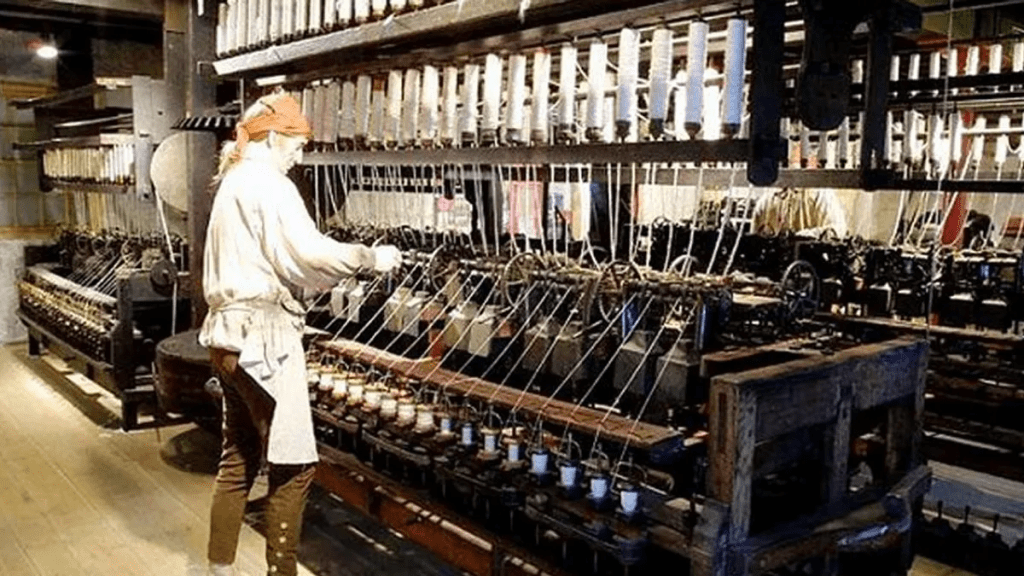
Following we have a photograph of the only original water-frame in England, which probably worked in Cromford, and is now in Helmshore Mill Museum.  

a

PHOTOGRAPH COURTESY OF THE LANCASHIRE COUNTY COUNCIL MUSEUMS SERVICE

NOT TO BE REPRODUCED

In the years around 1800, the children did not have to work long hours, and were not badly treated:

“How long have you been in the cotton trade?” “I have been intimately acquainted with it forty-two years [1791]. I first came here in the employment of Bolton and Watt, and my business was chiefly to set up steam-engines for cotton factories. I have been a spinner myself thirty-six years.”

“Do you remember the time when mills were worked in private houses?” “Yes; when I first came here none were turned by power, and some of the first engines I set up were for the purpose of moving them by power.”

“Can you contrast the condition of the spinners and of the children employed by them as it was then and it is now?”  “Yes; at that time the spinners were not held to any regular hours of work; they frequently spent two or three days in the week in idleness and drinking, while the children they employed were often waiting on them at the public houses till they were disposed to go to their work; and when they did go they continued it sometimes almost night and day. Such is the case generally with all trades where the wages are high, and the work carried on in private houses.”

“Did the children attend them during these long hours?” “Yes; they could not do without them, and that was very injurious to the children’s health.”

“How many spindles did a mule contain at that time?” “About 120.”

“Was the work at them, in a given time, harder than it is at present?” “No, it is about the same, as the decreased labour which the spinners have to undergo by not working the mill by hand is made up to them by working two mules of much larger dimensions.”

“Is the work of piecers in general the same?” “The work of the piecers is about the same.”

“Do you remember any facts respecting the morality of the children forty years ago?” “They spent too much of their time about the public-houses and in idleness.”

“Were the spinners oftener drunk than now?” “Certainly; then they sometimes neglected their work for two or three days for the sake of frequenting the public house, but now it is so much the interest of the proprietor of a mill the keep the machinery in regular work, that unless spinners attend every day to their work they are dismissed.”

“Were women employed at that time in cotton-spinning?” “Only in water-twist mills and in the mills for making roving, and in jenny-spinning, which latter occupation is almost wholly superseded by the mules.”

(Factory Inquiries Commission, Second Report, 1833, Lancashire District Medical Reports, Peter Ewart, Master Cotton Spinner and Weaver, examined by Mr. Tufnell, D.2. p. 36)

“For several years after I began to work in the mill [1795], the hours of labour at our works did not exceed ten in the day, winter and summer, … 

(Fielden, 1836, p. 31)

“Another remarkable fact within my own knowledge I must also state; when my father introduced the machinery that is now used, into his own mill, the hours of labour were increased to twelve, for five days in the week, and eleven for Saturdays, making seventy-one hours in the week.”

(Fielden, 1836, p. 34)

“What Observations did you make during that Practice? [1800-1805]” “During that Practice the Children in the Cotton Factories were in general Healthy, and the Appearance of the whole of the Operators was friendly to Health; at that Period Labour was scarcer, the Men took more Liberties than they do now, the Children were not so closely employed, the Food was better, their Hours of Labour less, nominally the same, but they were then permitted to go Home to Breakfast, and in the Afternoon, and very frequently they worked only Five Days in a Week the Plan of conducting the Mills was not so systematised as it is now.”

(Minutes of Evidence …  State and Condition of the Children…, 1819, Dr. Thomas Jarrold, p. 311)

“The Children Fourteen Years ago at Stockport, or rather Four Years preceding the last Fourteen, were better fed in your Opinion?” “The whole Circumstances of the Children were better.”

“That they were better fed?” “Yes.”

“And worked fewer Hours?” “Yes.”

“And got better Wages?” “Yes.”

“Can you account for their getting better Wages for fewer Hours Work than at present?” “Labour was scarce.”

(Ibid., p. 314)

“There is one point I wish to mention, with regard to the prevalence of long hours, the practice is rather of recent date, for at the time when they were spinning night and day, they could not be employed a longer time than twelve hours each; but, since that time, I believe five or six or seven years back, it has become more general; the hours have been gradually growing longer and longer.”

(House of Lords, Reasons in Favour of Sir Robert Peel’s Bill…, 1819, Evidence of Dr. William Simmons, p. 87)

Anyway, the long hours were part of the “contract”. The tiredness was exacerbated by the fact that the work was absolutely continuous, following the movements of the machines, and that the workpeople had to continue with the work, even after 12 hours, when they were already exhausted. To the times in the factory, were also added the times of walking to and from the factory. The work was made easier by automating some processes in the spinning machines from 1820; the weaving process was introduced in the factories starting from 1830, and could be carried out by women and girls.

An important part of the evidence of bad treatment of the children was that of the “piecers”. These were children who had to walk along the length of the spinning mule, and join the ends of a cotton thread when it broke. The spinning mule was a series of spindles (rather like bicycle wheels), about 150 feet long in the 1819 version; on the longer mules, more than one piecer was employed. The whole series was moved backwards and forwards by the pushing movement of the adult spinner. The individual movements were not physically difficult; the problem was to keep walking for 12 to 15 hours, with a short pause for eating. The children usually could not keep it up for more than 12 hours, and were often hit by the adult spinner; there is no doubt of this from the 1819 evidence of spinners and parents.

The small boys and girls (6 to 9 years old before 1819, 9 to 12 years after 1819) were generally employed as “scavengers”. They had to crawl under the machinery to pick up the small pieces of cotton that had fallen to the floor. This work was not continuous, but in periods of about 6 minutes, perhaps several times per hour.

The above only applies to mule spinning. In water-frame spinning, the machinery was not moved, and there were no piecers. 

The expression of “children” referring to the piecers, is misleading; at the time of the 1833 investigation, they were not small children. In the factory of M’Connel and Kennedy, in 1819, there were 11 piecers of less than 10 years old, 320 piecers of 10 to 16, and 142 piecers of more than 16 years old, of a total of 1,125 persons.

(1819, evidence of Mr. John M’Connel, superintendent of the mill in Manchester, p. 438)

In Bolton in 1833, the big piecers were from 16 to 18 years old, or until they were promoted to spinner, and earned about 7s. 6d.; the middle piecers were from 12 to 15 years old, and earned from 3s. 6d. to 4s. 6d.; the scavengers were from 9 to 12 years old, and earned from 2s. to 2s. 6d. The spinners earned from 28s. to 30s. 

(Factories Inquiry Commission, Supplementary Report 1833, Part 1; p. 164)

For an idea of the movements of the spinning mule, see the video:

https://en.wikipedia.org/wiki/Quarry_Bank_Mill

Gallery: Working Machine

We have two detailed government investigations as to the conditions in the textile factories, one which was carried out in Lancashire in 1819 as preparation for the debate on the Factory Act of that year, and an another as to the whole of England and Scotland for the Factory Act of 1833. There was a considerable improvement in the health situation of the adults and children between the two dates. In 1819, the adult male spinners usually died by the age of 40, or were so reduced in their bodily strength that they could not find work; the children were literally dying. 

The reality in 1819 was 14 to 15 hours total hours worked (72 to 74 per week, actual labour).

“What becomes of persons of the age of forty, when they are turned off?” “Some get to sweeping the streets and work of that sort, and some are sent to their own parishes.”

“When people of the age of forty leave the factories, is it generally on account of finding the work so severe?” “It is on account of their not being able to do so much work as the others, and the master will have the work done by them or somebody else.”

“Do you consider that when they quit the factories at that age, it is from feeling themselves to be worn out?” “Yes.”

(House of Lords, Reasons in favour of Sir Robert Peel’s bill,…., 1819, Evidence of John Frost, spinner, p. 7) 

(Similar information from William Boyle, spinner, p. 10; Robert Hyde, spinner, pp. 27-28, p. 29)

“Do you happen to know what has happened to the afterwards of many of them who have quitted the factory?” “I do.”

“Give the Committee an account of what they have done, those you know?” “I have known some go to weaving, some to the trade of dyeing; sometimes in Manchester, I could shew some of them standing in the street row, selling oranges and apples, and others driving sand carts.”

“Are there not many of them who have not lived a long time?” “Leaving the factory and being in the open has prolonged their life much longer.”

(House of Lords, Reasons in favour of Sir Robert Peel’s bill,…., 1819, Evidence of Robert Hyde, spinner, p. 29)

“…. In the schools I visited, I assembled together all the children who are fatherless, including those illegitimate; and from one fourth to one fifth of the whole of those fatherless children were cotton spinners. I assembled together the whole of the children whose fathers worked in cotton factories, or who ever did, and from one third to one fourth of those children were fatherless. Of the children who were at the school, from a tenth to an eleventh were fatherless; that is, of the whole number collectively.”

(House of Lords, Reasons in favour of Sir Robert Peel’s bill,…., 1819, Evidence of Thomas Jarrold, doctor, p. 89)

The children literally died from their work:

“From your experience of 24 years at Stockport, are you of the opinion that a greater number of children die in proportion who have been working in cotton factories than have died among children in other employments?” “I can have no doubt of it; I think by the bill of mortality for the parish of Stockport, that there are not less than 200 who have died of consumption in the last year.”

“Have you any data upon which you form your opinion as to the number who die?” “I form it from the number of cases which come under my care; I am frequently called in, and I frequently see them go off consumption before they come women; the females are more affected than the other sex.”

“Can you venture to state that young women in cotton factories do die in a much greater proportion than other persons of the same age in Stockport?” “I can, from much experience and observation.”

(Reasons in favour of Sir Robert Peel’s bill…, 1819, Evidence of Dr. John Graham, p. 67)

“Did they look much more unhealthy than other children?” “Yes; so much that I thought in a little time I had scarcely any occasion to ask; I could say, you work in a factory, do you not?”

(Reasons in favour of Sir Robert Peel’s bill…, 1819, Evidence of Dr. Henry Dadley, p. 80)

“From what I have long observed, I am satisfied, that instances are very frequent of people brought up in Factories dying of consumption, whose parents, brothers, or sisters, not so employed, enjoy a good state of health”.

(Answers to certain objections…., 1819, Evidence of Thomas Bellot, surgeon, pp. 43-44)

“Having been solicited to give my opinion as a minister, who for nearly 12 years have been almost constantly engaged in visiting the sick poor, in the populous town and vicinity of Manchester, I do not hesitate to affirm, in seven cases in ten, which I have attended, I have found the patients to be those whose illness has been occasioned by working in Cotton Mills; and I have observed, that most of these have been young people, and whose disorders have generally proved fatal. I have remarked, that consumptions have been the most prevalent diseases to come under my observations, and sometimes asthmas.”

Rev. Abraham Hepworth, Curate of St. Luke’s, Chorlton-row, in the Parish of Manchester; Manchester, March 21st. 1818

(Answers to Certain Objections….., 1819, Evidence of Rev. Abraham Hepworth, Curate of St. Luke’s, Chorlton-row, in the Parish of Manchester; Manchester, March 21st. 1818, p. 55) 

The parents told the Commission how their children died:

“Have you ever worked in a cotton factory?” “No.”

“Have you any children employed in any?” “Yes.”

“Give the Committee their names and ages?” “William, he would have been twenty-two if he had lived, but he is dead; John would have been twenty, but he is dead; Peter, he is living, he is about sixteen, turned; and there is Ann, turned thirteen; and Mary, turned twelve; those are all we have who have worked in factories.”

“These two sons you have lost, was their health good before they went into a cotton factory?” “Yes.”

“At what age did they go in?” “One went in at six and a half, or thereabouts, and the other about eight.”

“Of what complaint did they die?” “They grew weak with their employment.”

“How soon did you perceive them grow weak?” “We perceived it in about five years.”

(Reasons in favour of Sir Robert Peel’s bill…, 1819, Evidence of Joseph Cartledge, labourer, p. 52)

“How old was your son James when he went?” “Ten”

“How was his health when he worked in the factory?” “When he first went he was a stout boy; but after he had been there a little while he began to grow very pale and white; and when he was about thirteen he began to have a pain in his limbs; he complained very much of it, and it continued till he was about fourteen, and then he began to grow very much out, bow-legged; and Mr. Murray recommended us to the Infirmary, and they ordered him irons; but he had grown so much out, the irons took no effect; they said it was owing to standing so long in the factory; he was near sixteen years of age then, and he began to decline very much; I took him from his work, and he worked about nine months at weaving; and he got quite stout again; after he was stout and healthy the weaving was very low, and he went to his work at the factory; he had not been there long before his health began to decline again, and he was twenty-two weeks off work, and did nothing; he got better again, and went to the factory in a little boy’s place at little wages, and he worked there about ten weeks; then he could not stand it, he was so weak in his legs; they grew so much out he could not bear irons on them; he came home, and in ten weeks after that he died.”

“You ascribe all his ill health and his death to the hardships in the factory?”  “Yes, that was his own statement; he believed it was nothing else; he was at that age, and so steady, he could not think it was any thing else; he was kept in the factory, being a big piecer; the big piecers spin a great deal, and they are obliged to spin at times when the spinner is eating his meat; and he, being weakly, and having to spin a great deal, it hurried him and overdid him, and he could not stand it; and that was the reason I took him home.”

(Reasons in favour of Sir Robert Peel’s bill…, 1819, Evidence of John Houlsworth, weaver, p. 52)

The bad treatment and the long hours in the factories were well known, and generally felt to be inhumane. So much so, that a petition was sent to the House of Commons in 1819, signed by 1700 prominent personages of Manchester, including many magistrates, doctors, and priests:

“…. That the Manufacturies for spinning and preparing Cotton in Manchester and Salford, and their immediate vicinity, are very numerous, and the hands therein employed (consisting of children as well as adults) form a large proportion of the working classes in this district.

That your Petitioners most feelingly deplore the sufferings of those who are thus employed, inasmuch as their daily labour is not only protracted to an unreasonable and destructive extent in point of time, but is generally performed in a temperature and under circumstances, connected with the process of manufacture, which render the pressure of its lengthened duration still more highly prejudicial.

That the species of labour above-mentioned occasions results fatally injurious to many of the individuals who pursue it, and especially to the delicate frame and strength of children, who, in common with other hands, are obliged to attend the Factories early in the morning, and continue their toil until late at night; whence it is evident, that in passing to and from their houses, they experience the inclemencies of weather in a more than ordinary degree of severity and danger, owing to the heated and relaxing state of the Mills where they are so long and so closely immured.           

That from the generality of the practice which is productive of these evils, and the natural competition of the trade, such evils cannot be removed without the aid of legislative authority; and your Petitioners are unable to express the satisfaction they feel in the existing prospect of parliamentary relief. But your Petitioners, nevertheless, hope that they may be allowed to submit to your Honourable House the sentiments with which the subject so strongly impresses them. 

And earnestly to solicit the enactment of such regulations as may effectually reduce the working hours in Cotton Mills to reasonable limits, and, in principle, embrace the other humane provisions of the Bill recently introduced by Sir Robert Peel.”

(Answers to Certain Objections …, 1819, pp. 66-67)

An important witness as to the fatigue for the children in the factories was Mr. John Fielden. He was a Member of Parliament and a mill-owner, and an active part of the movement in the 1820’s-1840’s to reduce the hours worked by the children. But he had a personal experience of working long hours as a child, as his father – who owned a mill –put him to work with the other children. His particular point was that the very long hours made the children tired, even if the work was not physically demanding.

“As I have personally and from an early age engaged in the operations connected with factory labour; that is to say, for about forty years, a short account of my own experience may not be useless in this place, as it is this experience which teaches me to scoff at the representations of those who speak of the labour as “very light”, and “so easy, as to require no muscular exertion.” I well remember being set to work in my father’s mill when I was little more than ten years old [approx. 1795]; my associates, too, in the labour are fresh in my memory. Only a few of them are now alive; some dying very young, others living to become men and women; but many of those who lived, have died before they had attained the age of fifty years, having the appearance of being much older, a premature appearance of age which I verily believe was caused by the nature of the employment in which they had been brought up. For several years after I began to work in the mill, the hours of labour at our works did not exceed ten in the day, winter and summer, and even with the labour of those hours, I shall never forget the fatigue I often felt before the day ended, and the anxiety of us all to be relieved from the unvarying and irksome toil we had gone through before we could obtain relief by such play and amusements as we resorted to when liberated from our work. I allude to this fact, because it is not uncommon for persons to infer, that, because the children who work in factories are seen to play like other children when they have time to do so, the labour is, therefore, light, and does not fatigue them. The reverse of this conclusion I know to be the truth. I know the effect which ten hours’ labour had on myself; I who had the attention of parents better able than those of my companions to allow me extraordinary occasional indulgence. And he knows very little of human nature who does not know, that, to a child, diversion is so essential, that it will undergo even exhaustion in its amusements. I protest, therefore, against the reasoning, that, because a child is not brought so low in spirit as to be incapable to be incapable of enjoying the diversions of a child, it is not worked to the utmost that its feeble frame and constitution will bear. 

I well know, too, from my own experience, that the labour now undergone in the factories is much greater than it used to be, owing to the greater attention and activity given to the machinery that the children have to attend to, when we compare it with what it was thirty of forty years ago; and, therefore, I fully agree with the Government Commissioners, that a restriction to ten hours a day, is not a sufficient protection to children.

The work at which I was employed in my boyhood, while it was limited to ten hours a day, was similar to the work that children have to do in the woollen mills of Yorkshire at the present time, with this difference, that wool is the manufacture in the Yorkshire mills to which I allude, and the manufacture that I was employed in was cotton, the mode of manufacturing which, has been altogether changed since that period by the improvements made in machinery. These are facts which I mention, because the labour of the child in the woollen now, is what its labour in the cotton was then, the work being done on what are called “billies” and “jennies”; and I mention them, too, because the woollen manufactures would have had it believed (and Mr. Richards the Inspector appears to countenance the opinion) that the work of children in woollen mills is lighter still than in the cotton factories, and that children, much younger than those whose labour is now limited to eight hours a day, be worked sixty-nine hours a week. Indeed, it is on this, that the Yorkshire mill-owners have petitioned the House of Commons to allow them to work children of eight years of age as many as seventy-two hours in the week, or, twelve hours in the day!

Another remarkable fact within my own knowledge I must also state; when my father introduced the machinery that is now used, into his own mill, the hours of labour were increased to twelve, for five days in the week, and eleven for Saturdays, making seventy-one hours in the week. This he was obliged to do in his own defence, because others who used the same sort of machinery, worked their hands seventy-seven hours, and some even so much as eighty-four hours a week, a practice which continued to 1819, when the 59th of Geo. 3 was passed, and which limited the time-labour for children under sixteen years of age to seventy-two hours in the week, that is, one hour more than the time of work of both children and adults at the establishment in which I had worked myself, but in which I had now become interested as a partner. These hours I always thought and said were excessive; I thought so from my own practical bodily experience; and therefore, I have always been an advocate for a reduction by legislative enactment.” 

(Fielden, 1836, pp. 31-34)

“At a meeting in Manchester a man claimed that a child in one mill walked twenty-four miles a day. I was surprised by this statement, therefore, when I went home, I went into my own factory, and with a clock before me, I watched a child at work, and having watched her for some time, I then calculated the distance she had to go in a day, and to my surprise, I found it nothing short of twenty miles.”

(Fielden, speech in the House of Commons, 9th May 1836)

(But there were other calculations, which gave only 8 to 10 miles. The explanation is that with fine spinning mules, which were heavier and slower, the distance required was shorter, and with the coarse spinning, the distance per day was much more. See the information from Thomas Wilson, who had worked in both modes when he was a piecer from 10 to 16 years old [1811-1817], and had great pain in his legs when working in the coarse spinning mill; Factories Inquiry Commission, Second Report, …., 1833, p. 63.

Even today, there are jobs that require walking 15 miles a day (adults!).

“I wasn’t prepared for how exhausting working at Amazon would be. It took my body two weeks to adjust to the agony of walking 15 miles a day and doing hundreds of squats. But as the physical stress got more manageable, the mental stress of being held to the productivity standards of a robot became an even bigger problem.”

(Emily Guendelsberger, “I worked at an Amazon Fulfillment Center; They treat Workers like Robots”, Time Magazine, July 18, 2019)       

It is not clear why the mill-owners in Manchester and neighbourhood insisted on working such long hours. Apparently, it was a sort of rivalry, too see who could work most hours, and who could produce most yarn per day. “An invincible jealousy regarding the hours of work pervades the whole race of cotton spinners (Messrs. Calrow’s and Messr’s Grant’s are certainly exceptions), each competing with the other as to greatest quantity of yarn to be turned off, pending the protracted hours of labour, and yet collectively and individually a strong wish is expressed for such legislative restrictions as will apportion the hours of confinement, labour, and refreshment, to the age and strength of this juvenile class of our fellow-creatures. Mistaken, too, on the score of individual interest is this excess of confinement; because, by correct calculations, it is ascertained that, where establishments are conducted upon the humane principle that they ought to be, that where the health and comfort be a primary duty, as much yarn is spun, and betterspun, in twelve hours than in fifteen; in the one instance, human life is happily prolonged; in the other, misery, disease, and sorrow are identified with a short existence.”   

(Reasons in Favour of Sir Robert Peel’s Bill, 1819, James Watkins, magistrate, Bolton, p. 45)

“You think the different proprietors are less induced to shorten the hours than they would be, because the neighbouring factories have worked longer?” “That has been the answer; when I have complained, they have said, that my neighbour works his mill to such an hour, and as long as he works, I will work mine.” (Ibidem, p. 46)

“…. when my father introduced the machinery that is now used, into his own mill, the hours of labour were increased to twelve, for five days in the week, and eleven for Saturdays, making seventy-one hours in the week. This he was obliged to do in his own defence, because others who used the same sort of machinery, worked their hands seventy-seven hours, and some even so much as eighty-four hours a week, a practice which continued to 1819, ….” (Fielden, 1836, p. 34)

All of this gives the impression that we have here a cartel, with the intention to make sure that all the owners produce the maximum possible. The idea may have been to have a maximum purchase volume from the United States, and that there should not be any “free riders”.  

But many spinners and supervisors were convinced that the extra hours did not bring any extra production volume. 

“Do you think the masters would gain so much profit at the end of the year in well-conducted factories, if they worked only eleven hours instead of fifteen, if there was to be no change in the hands?” “I do.”

“Why do you think so?” “On account of the sicknesses and the loss of time, and the fatigue of the children, and their going out, the changing of the hands, and various other things, which make me think that the hours are so long that less hours would bring as much profit to the employer.”

“Do the children do as much work in the latter hours of the day as in the early hours of the day?” “They do not.”

“Do they do as much good work?” “No, they do not.”

(Reasons in Favour of Sir Robert Peel’s Bill,1819, Clement Dodenhoff, Manager Cotton Mill, Wigan, p. 16)

“Are you aware that if the Machinery worked Two Hours less than at present the Article could not be produced at the same Price?” “I am aware that it would make a small Difference, but very little. I have seen a Calculation made, and the Calculation was put to the Masters; and it would not make the Difference of a Farthing a Yard in a Hundred Reel of Cloth.”

(Lords Committees, State and Condition of Children…., Thomas Worsley, 25, spinner, Stockport, 1819, p. 25) 

“Do you believe that the Spinners in general wish their Hours of working in the Factories lessened, if their Wages were to be lessened also?” “In our Country it is the Desire.”

“Do you believe you could do more Work in Eleven Hours a Day, working only Eleven, than you would in Eleven Hours if you work 13 or 14?” “Yes, they would.”

“Do you believe there would be nearly as much Work done by the same Hands if they continue to be worked in the Factory all the Year, and worked Eleven Hours, as if they worked Twelve Hours?” “They would do more Work if they worked Eleven Hours than Twelve.”

“Why so?” “In working Twelve Hours it fatigues them more, and causes them to fall sick.”

(Lords Committees, State and Condition of Children…., 1819, John Moss, 26, spinner, Ashton-under-Line, Stockport, p. 39) 

Same idea in the same document from: John Frost, 32, Spinner, Stockport, p. 50; Roger Haslam, 34, Latchford, Spinner, p. 72; William Royle, 30, Warrington, Spinner, p. 78. 

There is, of course, a moral question, as to if the owners knew what was happening to the children. They did: 

“ … and when he was about thirteen he began to have a pain in his limbs; he complained very much of it, and it continued till he was about fourteen, and then he began to grow very much out, bow-legged; and Mr. Murray [the owner] recommended us to the Infirmary, and they ordered him irons; but he had grown so much out, the irons took no effect; they said it was owing to standing so long in the factory; he was near sixteen years of age then, and he began to decline ….” 

(Reasons in favour of Sir Robert Peel’s bill…, 1819, Evidence of John Houlsworth, weaver, p. 52)

“Are the present hours of work longer than they used to be?” “Yes.”

“Since when?” “Since this day fortnight; we had a report that the Time Bill was thrown out of the house, and on the Tuesday following the hours were lengthened from six to half past nine, and half an hour for dinner; and before that it was from six to half past seven, and an hour for dinner.”

“Do the work-people complain of the hours being lengthened?” “Yes, we opposed it, and gave over that evening; when the master [Mr. Goff] came the next morning he went to the manager, and I believe he swore, at least he told me so, that those men that did not choose the hours might go about their business; we told him the children could not stand the hours.”

(Reasons in favour of Sir Robert Peel’s bill…, 1819, Evidence of George Paxton, spinner, p. 35)

“When you were discharged from the factory, was anything said to you?” “Mr. M’Connel [administrator of the mill, brother of the owner] told me, it was killing me by inches, and that my Parents must get me some other Trade.”

“Do you know whether any other Persons were discharged from the Factory at the same Time?”  “Yes, several.”

 “Were those deformed who were discharged?” “Some were deformed in their Knees, and some were sickly.”

 “How many were discharged of that Description?” “I cannot say.”

……

“How long did you work there?” “About a Twelvemonth at that Time.”            

“Were any Complaints made of you before you were turned away?” “No.”

“None at all?” “No.”

……

“You mentioned that when you were discharged there were some others discharged who were deformed or sickly, cannot you mention the number?” “No.”

“There was a good many, but you cannot say how many?” “No.”

“There were Ten?” “Yes.”

“At that Time?” “Yes.”

“All from being sickly?” “Yes; sickly and deformed.”

(Lords Committees, State and Condition of Children…., 1819, Thomas Wilson, 18, had been spinner, Manchester, pp. 190-191) 

[The statement starts out, as if the manager was interested in the health of the worker; but really the owners were “cleaning out” the deformed workers, before the doctors came to inspect the mill.] 

It is very clear that the mill-owners in Manchester were not good persons. 

When they knew that some doctors were going to inspect the mills, following the instructions of the Select Committee, they threw out some young persons who were crippled, they had the children’s hair cut, they adjusted the mules adjusted to run more slowly, and they lessened the heat. It is probable that they gave the doctors money to give false information to the Committee. They also sacked those workers who had given testimony to the Committee. 

They also did not support financially the primary schools (in contrast to the owners of the country mills!):

“It has also been stated, that the children in general who work in spinning factories have no other means of instruction than what the Sunday-schools afford. It has also been stated, that the annual contributions towards the support of all the Sunday-schools amount to about 2,400 l. or 2,500 l. I beg now to observe, that on carefully perusing the yearly reports of the several Sunday-schools, it appears to me highly probable that the owners of the spinning-factories, who it is conjectured employ at the least 23,000 spinners, scarcely contribute one-twentieth part of the money raised to the support of these schools. In examining the several reports, I had the assistance of an intelligent gentleman, who is better acquainted with the town of Manchester than I myself am, and on extracting a list of subscriptions of the owners of spinning factories, we found the united amount of them was not 90 l.”

(Select Committee on the State of Children…., 1816, Mr. Nathaniel Gould, Merchant and visitor of Sunday-schools, p. 337)

“Are there no schools in Manchester kept by Manufacturers?” “I do not know of one.”

(Select Committee on the State of Children…., 1816, Mr. George Gould, Merchant and visitor of Sunday-schools, p. 101)

There were many cases in other industrial regions, where the children had to work 12 or more hours a day. The difference was that in the cotton mills, they had to work without rest, at the speed of the machine.

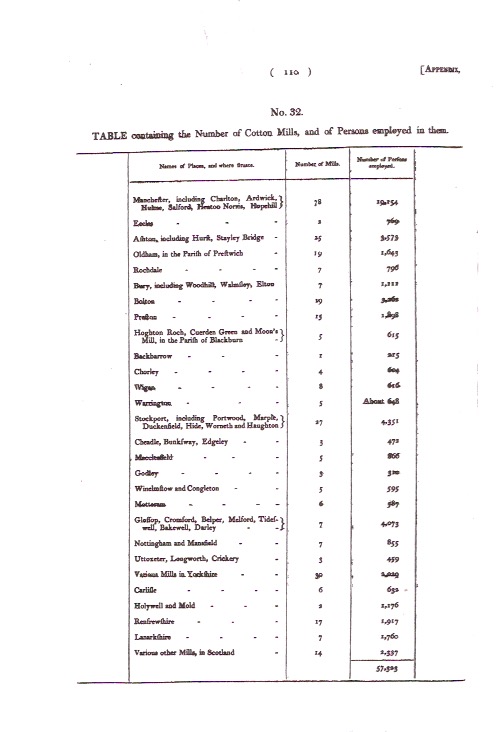
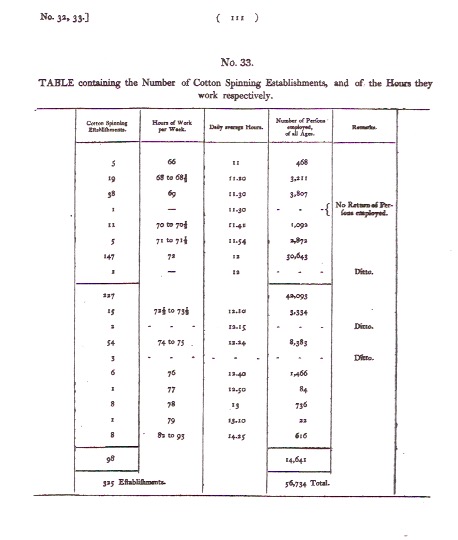
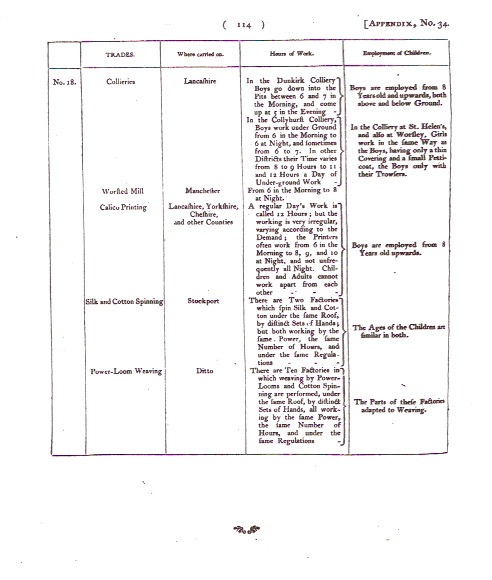
(Lords Committees, State and Condition of Children…., 1819, Appendix, Tables 32-34, pp. 110-114) 

In 1833, the Factory Inquiries Commission recollected data from 904 factories (including Scotland), as preparation for the debate in Parliament on reducing hours of work, and limiting the ages of children employed. 

The reports sent in by the owners of the mills under oath to the Factory Inquiry Commission of 1833, from the reports of the Commissioners in their visits, and from the reports of doctors, show that the conditions in the textile mills had improved considerably. It is very clear that there were no cases of deaths of children, and that the adult male workers were able to work up to 50 years old. The working week was in general 67 hours (5 days of 12 hours and Saturday of 7 hours).

A Dr. Phillips informed the Commissioners as to the longevity of persons working in the mill of M’Connel in 1833 (total work force about 1000). “Persons still working” were 41, all except three, were between 47 and 68 years, all except 14 had worked in the M’Connel mill over 20 years. Those that had worked for M’Connel, had left the mill, and were still alive, were 35 persons (*); all except three were over 55 years, nearly all had worked 20 years in the mill. (*) Obviously, only those who could be located.

(Factories Inquiry Commission, Supplementary Report, Part 1, 1833, pp. 292-294)

We do have information that contradicts the idea that the amount of work that the men spinners had to do in 1833, was the maximum that they could physically carry out:

“Are they able to do more work in a given time [in 1833, in comparison to 1814]?” “Considerably more, in consequence of becoming more proficient, and the improvements in machinery.”

“Are they employed more or less hours in the day?” “I think they are employed a less number of hours than they used to be.”

“Do they earn less wages than they did?” “I do not think they earn less money on the whole.”

“Does that apply to the average of operatives, or to any particular class of operatives?” “There are classes that are suffering more than they were then; but the majority, I think, taken upon the average, receive more. But there is to be said, that the working classes work much harder than they did.”            

“When you say they work harder, do you mean that they work more hours in the day, or that they work harder while they are at work?» “They work harder while they are at it; there is a disposition among some men to do a great deal, to make a boast of it, and they make a good week’s work, and it goads others on to do the same. They do more than human nature ought to do, to live and enjoy health.”

“If they earn the same amount of money wages that they did in 1814, and if the price of provisions has materially fallen since that time, supposing two families of equally prudent habits at each of the two periods, would not the condition of the family at the present period be very much improved?” “Very much.”

(Underline by this author)

(Report from the Select Committee on Manufactures, Commerce and Shipping, 1833, Evidence of Mr. Henry W. Sefton, p. 623)

“All the seriously-deformed persons who were sent to me were adults; nor did a single case of a child badly deformed by its work come to my notice. The reason is this; many years ago it was the practice to work much longer hours than at present, and several persons who were injured by overwork at that time may be met with. But a far more potent reason for deformity being so much less frequent now than formerly is the disuse of the old spinning frame, which was made so low for many years after its invention by Arkwright that many thousand persons were deformed by working at it, before the introduction of the throstle machinery.”

(Factory Inquiries Commission, Supplementary Report, Part 1, 1833, Report by Mr. Tufnell, section, D.2., p. 200)

It remains to be explained how the fatigue for the men spinners and for the child piecers had decreased by 1833, such that the men were not exhausted by 40 years of age, and the child piecers did not die during their time employed in the mills. This despite the fact that the amount of cotton per hour per machine increased from 1819 to 1833, and the number of hours decreased only from 15 to 12 (!).  It appears that a large part of the explanation is the decreased physical exertion needed for the machines (particularly the fine mule spinning), the slowness of the machines, and the number of piecers per mule, which was now much longer. 

Mr. Tufnell, the Commissioner reporting on Lancashire, gives a description of the slower movements:

“The lightness of the labour is owing to the slowness with which the machinery moves in spinning fine numbers. The mule in spinning No. 30 or 40 makes in general three stretches a minute; in the high numbers only one, and sometimes less. This fact I have ascertained with the utmost precision by frequently timing the motion of the machine, holding a watch that marked the moments in my hand. During at least three fourths of this minute the piecers, five of whom usually attend two mules, each containing 360 spindles, have literally nothing to do; they then stand listlessly by, their attention engaged by anything but their work, till the mule recedes, when they instantly proceed to piece the threads which break or are purposely broken (in fine spinning, if a knot is perceived in any part of the yarn, it is intentionally broken). The piecing cannot take long, as the mule has no sooner arrived at the frame than it instantly begins to advance, and when it has got about a foot and a half or two feet from the frame, it is impossible to reach over to the rollers, and the period of idleness begins.” 

(Factories Inquiry Commission, Supplementary Report 1833, Part 1, Report by Mr. Tufnell on the Lancashire District, p. 207)

See again the video of the mule at Quarry Bank:

https://en.wikipedia.org/wiki/Quarry_Bank_Mill

Gallery: Working Machines

We see that the machine waits for 2 pauses of 10 seconds in a cycle of 40 seconds.

We also see that the mule is about 250 feet long, and thus 4 piecers would be needed to walk along sections of the machine; one child could not do it. We know that the total of mule spinners for fine threads in Manchester in 1833 used 4 piecers each (837 spinners, 3,233 piecers). 

These spinners certified in a personal interview, that in their opinion, the piecers did not suffer in health from the 69 hours of work (66 % not injured, 21 % injured, 13 % no opinion). As to their own health, 75 % said they had good health, 20 % “pretty good” health, 5 % indifferent; 30 % of them had reported sick in the previous year. The average age of the spinners was 32, and they had worked 22 years in mills. 

(Shuttleworth, Vital Statistics of the Spinners and Piecers employed in the Fine Spinning Mills of Manchester, Journal of the Statistical Society of London, 1842, Vol. V, pp. 268-273)

Many of the mules in 1833, were much lighter, and could be managed by women or by young persons.

“Do you remember any Dispute upon Wages?” “Yes, a great many.”

“Ten Years ago?” “I have made my Observations on several of the Mills, and it is from finding that their Ages bear so less a proportion than ours that it caused me to examine more particularly the Cause of it; we employ Men regularly through all our Works as Spinners, but in many of the large Mills, is consequence of the Difficulty that the Masters had with the Men in arranging with them about Prices, the Men have been very apt to turn out at different Times, and the Masters have about Ten or Eleven Years ago (*) adopted the Plan of employing younger People, and encouraging young Boys and Women to work the Machinery instead of the Men; this has been followed by a great many of them; I could mention the names of several of them, if it be of any Use.”

“Has this been the Cause, in your Opinion, why a considerable Number of Persons more advanced in Age have been turned out of the Mills?” “I am quite confident of it; there has been a great many old Men whom I know, who are out of Employment in consequence of these Turn-outs, and the younger Hands are employed instead of them in a very considerable Proportion.”

“In your Opinion, many of the Masters have dismissed the older Hands in consequence of those Disputes, to replace them with Women and younger Hands, from whom they expected less Difficulty?” “They do not exactly discharge them; the Men turned out, and while the Men were out, other Persons were taken in, and they left them out; and when they would come in, the Masters would not receive them.”

“Can you state the Names of any of these Masters?” “M’Connel and Kennedy’s have Two-thirds of the whole Machinery carried on by these young People and Women, James Kennedy the whole, Birly and Ormby, Fogg and Hughes have one Mill entirely, and several others; Marriott’s is another; several within these few Years, in consequence of this, have made the Machinery of a smaller Size, to make them more suited to these younger People.”

(*) (It was actually in 1812, according to a list of wages made by a manager of M’Connel and Kennedy in 1819; the men spinners earned 30 to 34 shillings, and the women spinners 16 to 18 shillings. McConnel, 1906, p. 51)

(Lords Committees, State and Condition of Children…., 1819, Thomas Welsh, 36, Master Spinner and Manufacturer, Manchester, p. 342

In 1843, a number of young men in the Manchester Athenaeum, led by William Marsden and Robert Lowes, embarked on a campaign to convince the owners of shops, warehouses and factories to reduce the working day on Saturdays, from a whole day, to a half-day ending at 1 pm. This was done without reduction of weekly earnings. They were successful, and a joint document was signed by 440 business owners in September 1843.

Manchester Courier, and Lancashire General Advertiser, Saturday, November 4th, 1843; http://www.genesreunited.co.za/searchbna/viewrecord/bl/0000206/18431104/054/0005; British Newspaper Archive)

(The Spectator, Volume 16, 7 November 1843, p. 1079)

The effect was to give the working people more time for leisure activities on Saturdays, including concerts: 

(Report of the Proceedings Connected with the Grand Soirée of the Manchester Athenæum, Held on Thursday, October 3rd, 1844: From the Manchester Guardian of Saturday, October 5th, 1844, Printed by Cave & Sever, Manchester, 1844; p. 6)

Engels was in Manchester in 1843 and 1844, but he does not comment this change, and the good intentions, in his book on Manchester in 1844!

We see that the change did not bring the feared licentiousness of the workers. In fact, the project was extended to other towns in the following months:

(The Student: A Magazine of Theology, Literature and Science; Provincial Intelligence: Half-Holiday for the Young Men engaged in the Retail Trade, Vol. 1, James Gilbert, London, 1844; p. 288) 

Chapter 5. How was their new Life in the Factory?

5.1. Long Working Hours https://history.pictures/2020/01/31/5-1-long-working-hours/

5.2. Working Conditions https://history.pictures/2020/02/03/5-2-working-conditions/

5.3. Children’s Employment https://history.pictures/2020/02/03/5-3-childrens-employment/

5.4. Life in the Mills outside the Towns https://history.pictures/2020/02/04/5-4-life-in-the-mills-outside-the-towns/

5.5. New Wage Conditions in the Factory https://history.pictures/2020/02/04/5-5-new-wage-conditions-in-the-factory/

            The earliest existing advertisement of Arkwright for factory workers offers “good wages”:

(Derby Mercury, 10th December 1771)

We have seen that the people who entered into the textile factories in the towns, that is, “the first generation”, in general came from the same town, or from regions (urban or rural) nearby; they will have been spinners working in a house in town or in their farmhouse, or artisans (carpenters, masons, tailors) from the town. The men had been earning 7 to 10 shillings per week; in many cases the wife or a son or daughter of 10 to 15 years old had been earning 5 or 6 shillings extra. The work was hard, but with opportunities for rest. 

In the cotton factories, the best spinners earned over 30 shillings a week, and the average spinners about 20 (but there were only about 2,000 spinners in Manchester mills in 1830). The women and children could earn somewhat more than previously. We note that the men who went into the factories, did not do so because they were poor and needed a better job; they did so, because they were offered much higher wages than in their previous occupation. The difficult part of the transaction was that they all had to work very long hours, without rest (except at mealtimes), often in bad postures or moving all the time, and in rooms at high temperatures and with cotton flakes in the air.

The description by Mr. Chadwick, Treasurer of Salford, in 1859, is that “Cotton factories are generally very clean, well ventilated, and healthy. The labour of the various persons consists mainly in watching and directing the operations of the various machines, the placing of material in the machines, the “tenting” or watching the processes, the “piecing” or tying of loose ends or threads, and the removal of the finished products in the various stages of manufacture. 

It cannot, therefore, be considered very laborious work for even Women or Children; and the amount of their earnings, and the comparatively agreeable nature of their occupations, present a constant temptation for girls and young women to enter the factory rather than engage in domestic service”. (But this is 1859; things were not so good in 1810!)

Dean Mills: The Doubling Room

(Illustrated London News, October 25th, 1851)

4.4. What were their Monetary Incomes?

Adam Smith was of the opinion that every working man in Great Britain had enough to live on: “In Great Britain the wages of labour seem, in the present times, to be evidently more than what is precisely necessary to enable the labourer to bring up a family. In order to satisfy ourselves upon this point, it will not be necessary to enter into any tedious or doubtful calculation of what may be the lowest sum upon which it is possible to do this. There are many plain symptoms, that the wages of labour are nowhere in this country regulated by the lowest rate, which is consistent with common humanity.”

(The Wealth of Nations, 1776, Book 1, Chapter 8, The Wages of Labour)

The incomes in the cotton business in Oldham were about 9 shillings a week in 1760:

“The weaver, if the spinning was not done by his own family, paid the spinner for the spinning, and the spinner paid the carder and the rover. The weaving of a piece of chains or thicksets, containing twelve pounds of weft, at 1s. 6d. per pound, occupied a weaver about fourteen days, and he received for the weaving 18s. The spinning of the weft, at 9d. per pound, amounted to 9s.; and the picking, carding, and roving of the article, at the same sum per pound, reached 9s. Thus, when the weaver took the piece to the master, he received 36s., out of which he paid the spinner 18s., the spinner paying 9s. for the carding and roving. A weaver required three grown persons to supply him with weft.

At this period (1760) wheat was 5s. per bushel, of 70 lbs.; meal, 20s. per load; beef, 2d. per lb.; a neck of mutton, 9d.; and cheese, 2 ¼ d. per lb. Land let for £1 10s. the Cheshire acre, and a weaver’s cottage, with a two-loom shop, for £2 or £2 10s. per annum.

The average rate of wages earned by power-loom weavers at the present time (1847) is 10s. per week each, cotton spinners 17s. per week, card-room hands from 9s. to 10s., and adult piecers from 9s. to 11s. At the present period, wheat is about 10s. 6d. per bushel, of 70 lbs.; meal, £2 l0s. per load; beef, 6 ½ d per lb.; and cheese, 7d. per lb. Land in this part of the country now lets for £5 per Cheshire acre, and the annual rent of an ordinary factory operative’s cottage is about £6 10s. to £7 10s.”

(Butterworth, 1856, pp. 103-104)

Thus the wages of the men increased by 100 % in this period, if we compare with the work in the mill as spinners (the power-loom weavers at the later date would have been women). Wheat increased by 100 %, oatmeal by 150 %, beef by 200 %, and cheese by 200 %. Cottage rent increased by three times, but the cottages would have been of improved quality, in the town. In 1760, the weekly earnings were equivalent to 1.8 bushels of wheat or to 33 4-pound units of oatmeal, and in 1847 the wages were equivalent to 1.6 bushels of wheat or to 25 4-pound units of oatmeal. 

In order to make comparisons of purchasing power of the wages in the different dates, we give the costs of bread and of meat.

1769: bread 6p. quartern loaf, meat 3 ½ p. pound.

1797: bread 7 ½ p. quartern loaf, meat 5p. pound.

1815: bread 10p. quartern loaf, meat 7 ½ p. pound.

Increase: 1769-1797 bread 25 %, meat 42 %; 1797-1815 bread 33 %, meat 50 %

There were a number of professions and activities which paid very well in the period 1770-1795. The first numbers come from Arthur Young in 1770 (when the quartern loaf was 6 pence, and meat was 3 pence a pound); the table shown next refers only to places in the North of England.

(Young, “A six month tour through the north of England….”, 1771, pp. 321-322)

The following table references “manufacturers” in the South of England:

(Young, “A Six Weeks Tour through the southern counties …”, 1769, p. 328)

According to Arthur Young’s report on the town of Manchester in 1769, the men weavers earned from 5 to 10 shillings a week for “velverets”, “thicksets”, “quilts” and “petticoats”, and from 3 to 7 shillings for other fustians (mix of cotton and linen yarns); for all the “check” branch, the men earned 7 shillings. The cotton spinners earned 2 to 5 shillings for women, and girls 6-12 years received 1s. to 1s. 6d.

Bread (mixture of wheat and barley) was at 1 ½ pence the pound and beef at 2 ½ pence the pound, so that 7 shillings a week would buy 56 pounds of bread or 35 pounds of beef (Young, 1771, Vol. 3, pp. 186-194).    

Arthur Young reported on the wages of worsted workers in Leeds in 1769. Male weavers 5 to 12 shillings the week, average 7s.; boys 13-14 5s.; women weavers 3s. 6d. to 4s.; wool combers 6 to 12 shillings; women spinners 2s. 6d. to 3s. the week; girls 13-14 1s. 8d. the week. The price of oats was 10 ounces for one penny, and beef 4 pence the pound, so that the average income for a man weaver could buy 50 pounds of oatcakes or 20 pounds of beef (we can add the fact that all the family members worked). (Young, 1771, Vol. I, pp.137-139). There was always enough work.   

He also gives us the incomes for cloth workers in Leeds in 1769. The men weavers earn 10s. 6d. a week if they are fully employed, but the real yearly average is about 8 shillings; a boy of 13 or 14 earns about 4s. a week, and some of the women earn as much as the men. There is not always enough work. The weekly income of the men weavers is equivalent to 60 lbs. of oatcakes or 24 lbs. of beef. (Arthur Young, 1771, pp. 137-139)  

The comments in Sir Frederick Eden’s book, for a number of towns in 1795, as follows (quartern loaf at 10 pence, and meat at 5 pence the pound): 

Dunstable        Straw work (hats), women 6s. to 12s. a week, children 2s. to 4s. a week.

Reading           Weavers of sacking 16s. a week; weavers of gauze 15s. to 30s. a week; weavers of sail-cloth 18s. a week; spinners of hemp 3s. a week; common labourers 9s. a week.

Chesterfield   Men working at the founderies 14s. a week; stocking-weavers 1s. 6d. to 2s. 6d. a day; masons, joiners, etc. 2s. 6d. a day.

Derby              Common labourers cutting canals 2s. to 2s. 6d. a day; children, from 7 to 12 years of age, in silk and cotton mills, 1s. to 2s. 6d. a week; stocking-weavers 6s. to 20s. a week; paper and china manufacture 10s. to 21s. a week.

Wirksworth    Common labourers 1s. 4d. to 1s. 8d. a day; lead miners 10s. a week; women spinning worsted 5 ½ d to 6d. a day; women spinning cotton 3s. to 5s. a week.

Stanhope        Common labourers 7s. to 9s. a week, without board; masons, 14s. a week; miners average 25 pounds a year.

Colchester      Weavers 8s. to 9s. a week; woolcombers 10s. to 12s. a week;  spinners 4d. to 6d. a day; card-makers 2s. a day; women weavers 5s. to 5s. 6d. a week.

Bristol            Labourers in the different manufacturers 7s. to 35s. a week; common labourers 1s. 6d. a day, without victuals; children employed in cotton manufacture 1s. 6d. to 3s. a week.

Southampton Bricklayers, carpenters, etc. 15s. to 16s. a week; common labourers 1s. 8d. to 2s. a day.

Bury                Women spinning wool 3s. to 4s. a week; common labourers 2s. to 2s. 6d. a day; common mechanics 2s. 6d. to 3s. a day. “Manufacturers and other labourers are better paid here than in Manchester. 16s. a week are considered as moderate earnings. The wages in the woolen are much lower than in the cotton manufacture.”  

Lancaster      Common labourers 2s. 6d. to 3s. a day; masons 3s. a day; common carpenters 3s. a day.

Liverpool       “Common labourers earn from 2s. to 2s. 6d. a day, ship-carpenters, from 2s. 6d. to 4s.: and other artificers in proportion.”

Manchester  Women in cotton 8s. a week; children 7 to 8 years old, 2s. a week; children 9 to 10 years old, 4s. a week; printers of cotton 31s. to 40s. a week; common labourers 2s. to 2s. 6d. a day. “From the accounts of well-informed persons, I think the average weekly earnings of manufacturing labourers in Manchester, may be stated at about 16s.; but it is to be observed, that they rarely work on Mondays, and that many of them keep holiday [drinking !],two or three days in the week.” “Women and children are employed in winding cotton, reeling and ending, cutting fustian, picking cotton, managing the spinning jennies, &c. Women earn from 6s. to 12s. a week; their clear weekly earnings may be stated at 8s. Children, of 7 or 8 years, can earn 2s. a week; of 9 or 10 years, 4s. a week; printers of cotton, from £1 1s. to £2 a week, common labourers, from 2s. to 2s. 6d. a day.”

Preston          Common labourer 2s. a day; masons and bricklayers 3s. a day; carpenters 15s. to 16s. a week.

Ashby de la Zouch Wool spinners 1s. 6d. to 3s. a week; wool-combers 12s. to 14s. a week; stocking-weavers 7s. to 17s. a week; hatters 12s. to 20s. a week.

Leicester       Stocking-weavers 7s. to 21s. a week; wool-combers 9s. to 12s. a week; worsted-spinners 4d. to 8d. a day.

Norwich        Weavers (were 21s. fine work, 12s. coarse work) now 7s. to 8s. a week; women weavers 5s. to 6s. a week.

Northampton   Women and children in cotton manufactory 2s. to 5s. a week; shoemakers 10s. to 15s. a week; wool-combers 9s. to 12s. a week; lace-makers 1d. to 1 ½ d. an hour; common labourers 14d. to 18d. a day.

Rode              Lace-workers 8d. to 10d. a day; masons 2s. a day, with beer; joiners 12s. to 15s. a week; common carpenter 1s. a day with board.

Newcastle    Pitmen 1s. 6d. to 3s. 6d. a day, average 16s. a week, plus rye at 4s. the bushel.

North Shields  Common labourers 12s. a week in summer, and 10s. a week in winter; masons 15s. a week; joiners 15s. a week; colliers 15s. to 18s. a week.

Nottingham  Weavers 8s. to 40s. a week, average 10s.; lace-workers 20s. to 40s. a week; women and children manufacturing cotton and silk, 10d. to 4s. weekly; common labourers 10s. week in summer, and 8s. a week in winter.

Frome            Sheermen [sic.] 15s. to 20s. a week; scribblers 12s. a week; weavers 20s. a week.

Wolverhampton Different manufactures 9s. to 40s. a week.  

Birmingham Buttons and buckles, men 20 to 30s., women 7 to 10s., boys 4s. a week; gunsmiths 42s. a week; common labourers 10s. a week; bricklayers 3s. a day, their men 2s. 6d. a day; labourers cutting a canal 3s. a day. 

Coventry       Ribbon-weavers 8s. to 12s. a week; children winding silk 2s. to 3s. a week; common labourers 6s. a week in summer and 4s. in winter, with victuals; carpenters 2s. 6d. a day; masons 2s. 4d. a day; masons’ labourers 20d. a day, with 2 pints of beer, but no victuals.

Kendal           Weavers, men 8s. to 12s. a week, women 4s. a week; dyers 9s. a week; wool-combers 12s. to 16s. a week; masons and carpenters 12s. a week.

Orton             Masons and joiners, 1s. 4d. a day, with diet; tailors 10d. a day.

Bradford on Avon Sheermen 17s. a week; scribblers 12 to 15s. a week; weavers 10 to 24s. a week.

Trowbridge  Sheermen 14s. a week; scribblers 10s. 6d. a week; weavers 10s. 6d.; women dressing cloth 5s. a week.

Inkborough “Females are employed in spinning and weaving; by the former, an industrious woman will earn from 4p. to 9p. a day; by the latter, from 6s. to 8s. a week; where the man and the wife both weave, it frequently happens, that the man, finding a resource in the industry of his partner, spends the produce of his own labour at the ale-house, and returns to his family to devour the food of his children.”

Bradford      Ordinary labourers 1s. 6d. a day, with 2 pints of beer; tailors 10d. a day with victuals; carpenters, masons and joiners, 2s. 0d. to 2s. 6d. a day, with victuals; weavers 7s. to 11s. a week; wool-combers 11s. to 12s. a week.

Ecclesfield (near Sheffield) Nails 6s. to 12s. a week; files 10s. 6d. a week

Halifax         Agricultural labourers receive from 1s. 6d. to 2s. a day, and two pints of beer, but no victuals. It is a very general practice in this part of the country, to allow drink, both in the forenoon and afternoon, to labourers of every description; and the custom has taken root so deeply, that it would be difficult to eradicate it. Weavers are paid from 7s. to 11s. a week; wool-combers 9s. to 12s. a week; masons, joiners, carpenters, 2s. to 2s. 6d. a day; tailors 10d. to 1s. 1d. a day, with victuals.

Hull               “The earnings of a labourer have already been noted; including the increase of wages in harvest, and the advantages arising from task-work, those of an industrious man may be estimated at about £ 40 a year, (exclusive of the earnings of his wife and children;) a sum equal to the support of a man and his wife, and from two to three children, which, it is conceived, is about the average of families. From the most accurate calculation it appears, that 4 ½ persons are the average number to a house in Hull.”

Leeds           Weavers woollen manufacture 12s. to 18s. a week; scribblers of wool, dressers of cloth, 12s. to 21s. a week; bricklayers and masons 2s. 6d. to 3s. a day, their assistants 2s. a day; joiners 2s. 6d. a day; ordinary labourers 9s. to 10s. 6d. a week.

Sheffield     Ordinary labourers 2s. a day, with one pint of ale and half a quartern loaf; masons 2s. 8d. a day, their assistants 2s. a day; in the various branches of cutlery, 10s. to 30s. a week; women, spinning lint, 6d. a day; washer-women 1s. a day, with victuals.

Skipton       Workmen in the lime-stone quarries, 2s. to 2s. 4d. a day in summer, without victuals, and 1s. 6d. to 1s. 8d. a day in winter, without victuals; women in the cotton mills, 4s. to 5s. a week; women spinning worsted, 4d. to 6d. a day.

In only a few points, Sir Frederick’s rapporteur informs that “there is not always work”. This gives us to understand that in these non-agricultural occupations, there was close to full employment. 

Incomes in the countryside

As we shall see in the chapter on Agricultural Labourers (1770-1815), the field workers with their families had high incomes in the period 1770-1795. This was due to the fact that, additional to their basic weekly wages (about 7 shillings), they earned a double wage in the harvest month and the farmer brought their food out to the field without charge; they could have a daily wage of about 150-160 % of the basic wage when they did task-work. The women and children could earn about 3 or 4 shillings from spinning wool. The family income averaged over the year could reach 14 shillings weekly. 

4.3. How Long did they Live?

The general idea, that the infant (0-12 months) and child (13-60 months) death rates in England in the Industrial Revolution were much higher than in the preceding decades, is not true. The infant and child death rates were very high in England during the eighteenth century, around 170 / 1000 for infants and around 170 / 1000 for children, in the whole country. This compares with 150 / 1000 and 130 / 1000 for England in 1841. Manchester had 210 and 200 in 1841, Liverpool 220 and 220, and the rest of Lancashire somewhat less.

The death rates for under-fives in London decreased considerably during the eighteenth century:

“BIRTHS and DEATHS under 5 Years of Age, according to the “London Bills of Mortality”, for 100 years, in 5 Periods of 20 Years each; and the NUMBERS DYING under 5 Years out of 100 born:”

 1730-491750-691770-891790-18091810-29
Total Births315,000307,000349,000386,000477,000
Total Deaths under 5 Years235,000198,000180,000159,000151,000
Dying per Cent. under 5 Years74.568.051.541.331.8

(T. R. Edmonds, On the Mortality of Infants in England, Lancet, Vol. I, 1835-36, London, p. 689; taken from the Mortality Bills of London)

We have some data from Dr. Roberton [sic] in his “Observations on the Mortality and Physical Management of Infants” (1827). He tells us that in the town of Manchester in 1773, the population was 27,000, and one out of 30 – children and adults – died annually (numbers from a Dr. Percival, who was active there at that time); 12 years earlier, the figure was one in 21, and one half of the children died under 5 years of age. 

He gives some tables of mortality of children, showing the deaths per age group as a percentage total of deaths in the year (Roberton, 1827, pp. 11-29).The following lines are selected, taking only the oldest data for each locality.

LONDON

TownYears Bills of MortalityAverage deaths
p. a. 
Under the age
of 1
Between 1 and 2Between 2 and 5Between 5 and 10Total under 10 
        
London1786-
1793
19,60022.0010.689.993.9146.58
        
Simple Average  22.0010.689.993.9146.58

LARGE TOWNS

TownYears Bills of MortalityAverage deaths
p. a.
Under the age of 1Between 1 and 2Between 2 and 5Between
5 and 10
Total under 10 
        
Liverpool1812-18152,50020.0011.2810.915.5947.81
Glasgow1783-17891,60026.0013.4010.663.4253.48
Manchester1816-18231,10026.5913.8114.784.4759.65
        
Simple Average  24.2012.8312.124.4953.64

SMALLER TOWNS 

TownYears Bills of MortalityAverage Deaths
p. a.
Under  the age
of 1
Between 1 and 2Between 2 and 5Between 5 and 10Total under 10 
        
Chester1772-178140019.708.8211.854.0544.42
Carlisle1779-178720021.199.4013.514.8348.93
Warrington1773-178130024.0914.4112.833.7955.12
Northampton1735-178010022.0010.607.804.2844.68
        
Simple Average  21.7410.8111.504.2448.29

VILLAGE PARISHES

TownYears Bills of MortalityAverage deaths
p. a.
Under  the age of 1Between 1 and 2Between 2 and 5Between 5 and 10Total under 10 
        
Spalding1798-181110035.644.304.453.7548.14
Lymm1817-18254024.926.604.803.9040.22
Eccles1818-182550024.0011.4610.922.9649.34
        
Simple Average  28.197.456.723.5445.90

AGRICULTURAL PARISHES

TownYears Bills of MortalityAverage Deaths
p. a.
Under  the age of 1Between 1 and 2Between 2 and 5Between 5 and 10Total under 10 
        
Winwick1812-182115016.887.066.124.6634.72
Grappenhall1815-18254020.385.057.302.2634.99
Great Shefford1747-17571020.0010.124.823.6138.55
Ackworth1757-17671013.306.6410.253.2033.39
Holy Cross1750-17593015.175.179.657.9337.92
        
Simple Average  17.146.817.634.3335.91

We can convert this approximately to child deaths as a fraction of births per year, dividing by 1.3 for the factor of total births per year to total deaths in the year. If we express this as numbers per thousand, we then have figures with roughly the same definition as in sources with respect to the nineteenth century.   

LONDON

TownYears Bills Of MortalityAverage deaths
p. a.
Under the age of 1Between 1 and 2Between 2 and 5Between 5 and 10Total under 10 
        
London1786-
1793
19,600169827730358
        
Simple Average  16982          7730358

LARGE TOWNS

TownYears Bills of MortalityAverage deaths
p. a.
Under the age of 1Between 1 and 2Between 2 and 5Between 5 and 10Total under 10 
        
Liverpool1812-18152,500154  878443368
Glasgow1783-17891,6002001038226411
Manchester1816-18231,10020410611434458
        
Simple Average  186999334412

SMALLER TOWNS 

TownYears Bills of MortalityAverage deaths
p. a.
Under the age of 1Between 1 and 2Between 2 and 5Between 5 and 10Total under 10 
        
Chester1772-1781400151689131341
Carlisle1779-17872001637210437376
Warrington1773-17813001851119929424
Northampton1735-1780100169826033344
        
Simple Average  167838832371

VILLAGE PARISHES

TownYears Bills of MortalityAverage deaths
p. a. 
Under the age of 1Between 1 and 2Between 2 and 5Between 5 and 10Total under 10 
        
Spalding1798-1811100274333429370
Lymm1817-182540192513730309
Eccles1818-1825500184888423380
        
Simple Average  216575227352

AGRICULTURAL PARISHES

TownYears Bills of MortalityAverage deaths
p. a.
Under the age of 1Between 1 and 2Between 2 and 5Between 5 and 10Total under 10 
        
Winwick1812-1821150130534736266
Grappenhall1815-182540156395617268
Great Shefford1747-175710154783728297
Ackworth1757-176710102517825256
Holy Cross1750-175930117407461292
        
Simple Average  132525833275

RESUMED DATA

Town type Under the
age of 1
Between 1
and 2
Between
2 and 5
Between 5
and 10
Total 
under 10 
       
London 16982          7730358
Large towns 186999334412
Smaller towns 167838832371
Village parishes 216575227352
Agricultural Parishes 132525833275

To check if the death rate was particularly differentiated between manufacturing and agricultural areas, or possibly between large towns and small towns/villages, we can extract the data as to Population and as to Bills of Mortality, in the sections of Sir Frederick Eden’s “State of the Poor” (the following table includes all the towns and villages for which there was sufficient information).

CountyTownPopulation Yearly
Births
Yearly
Burials
Per
Cent
Per
Cent
  Most recentAverage
1790-94
Average
1790-94
  
       
BedfordshireDunstable1,00032123.21.2
BuckinghamBuckingham2,00076393.81.9
BuckinghamWinslow1,10038243.52.2
CumberlandCumwhitton4501272.71.6
CumberlandHarrington1,40037262.61.9
CumberlandKirkoswald95018171.91.8
DerbyshireChesterfield4,0001561133.92.8
DerbyshireDerby8,0001821542.31.9
DevonClyst. St. George230953.92.2
DevonSouth Tawton2,50051292.01.2
DevonTiverton7,1002031602.92.2
DorsetBlandford2,10069523.32.5
DurhamSouth Shields15,0003513472.32.3
DurhamTanfield2,00073693.63.4
HampshirePetersfield1,00045294.52.9
Kent Ashford2,00044342.21.7
KentCobham56015142.62.5
KentMeopham60023153.82.5
LancashireBury17,0004852762.91.6
LancashireLancaster8,0002961373.71.7
LancashireLiverpool56,0002,4731,9604.43.5
LancashireManchester
w/o Salford
50,0002,5991,7125.23.4
LancashirePreston7,0001712332.43.3
LancashireWarrington8,8004553375.13.8
LeicesterLeicester2,80072722.62.6
LincolnshireLouth4,000126893.22.2
LincolnshireSpilsby85026153.11.8
LincolnshireSwineshead155065474.23.0
LincolnshireWilloughby400982.22.0
MonmouthshireAbergavenny2,50060562.42.2
NorthamptonshireBrixworth80024193.02.4
NorthumberlandNorth Shields10,0003503503.53.5
NottinghamshireNewark7,0002261503.22.1
NottinghamshireNottingham22,0008065173.72.3
ShropshireBishop’s Castle1,35038252.81.9
SomersetshireMinehead1,20036243.02.0
SurreyFarnham3,000141874.72.9
SurreyReigate2,00072503.62.5
SussexWinchelsea55022104.01.8
WarwickSoutham75028213.72.8
WestmorelandKendal8,0002052502.53.1
WestmorelandOrton1,50033182.41.6
WiltshireTrowbridge7,0001341481.92.1
YorkshireGreat Driffield1,60040292.51.8
YorkshireKingston-upon-Hull22,0007526623.43.0
YorkshireLeeds31,5001,1169673.53.1
YorkshireMarket-Weighton1,20037243.12.0
YorkshireSheffield35,0001,6261,3144.63.7
YorkshireSkipton2,10063513.02.4
YorkshireStokesly1,60053443.32.8

It is very clear that the large, industrializing, towns had high figures of death rates; Liverpool, Manchester, Preston, Warrington, North Shields, Kingston-upon-Hull, Leeds, and Sheffield, are all above 3.0 %. What is not clear is if the reason is: size of town (overcrowding and bad sanitation), industrial processes, or increased formal employment of women (less time to look after their little children). The question arises because the large towns were not yet industrialized; not even in Manchester were there any mills before 1792.

Herewith we show a specimen of a Bill of Mortality (Liverpool, 1795-96), from Sir Frederick Eden, “State of the Poor”.

Book page image

q

b

The excessive number of deaths (more than the births) will have been due to the shortage of cereals in this year.

To see what was happening in Manchester, Liverpool, and Leeds, with reference to the living conditions of the people from 1770 to 1800, we can calculate the birth rates and death rates from the Bills of Mortality in the “State of the Poor”; the numbers of inhabitants are interpolations from a few real enumerations.
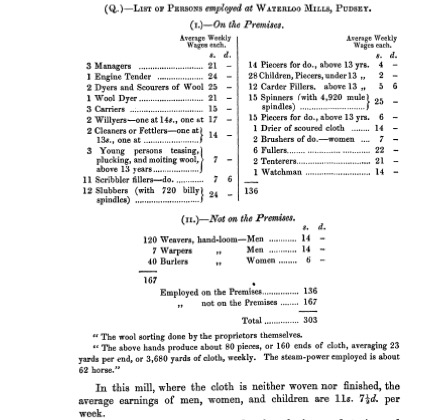
Manchester, Township

 PersonsBirthsBurialsBirth
Rate %
Death
Rate %
      
177019,4001,0509885.415.09
177120,4001,1699935.734.87
177221,4001,1279045.274.22
177322,4001,1689235.214.12
177423,4001,2459585.324.09
177524,4001,3598355.573.26
177625,6001,2411,2204.854.76
177726,8001,5138645.643.22
177828,0001,4499755.173.48
177929,3001,4641,2885.004.39
178030,6001,5669935.123.24
178132,0001,5911,3704.974.28
178233,4001,6789845.022.94
178335,0001,6151,4964.614.27
178436,6001,9581,1755.353.21
178538,0001,9421,7345.114.56
178639,4002,3191,2825.883.25
178741,2002,2561,7615.474.27
178843,0002,3911,6375.563.81
178944,5002,4871,7885.594.02
179046,0002,5761,9405.604.22
179147,5002,9602,2866.234.81
179249,7002,6602,1225.354.27
179351,9002,5792,2234.974.28
179454,0002,3452,5724.344.76
179556,5002,2962,6614.064.70
179658,5002,5322,0954.323.58
179760,5002,7672,3224.573.83
179862,5002,7892,5534.464.08
179965,0002,8282,6254.354.03
180067,5002,5902,3673.833.50
180170,000    

(1770-1793, Eden, State of the Poor, Vol. II, p. 355); (1794-1800, Census 1801, Parish Register Abstract)


Dr. Percival, who carried out an informal “enumeration” of Manchester in 1773, gives us his comments, as to why the death rate was decreasing:

“It is pleasing to observe, that, notwithstanding the enlargement of Manchester, there has been a sensible improvement, in the healthiness and longevity of its inhabitants; for the proportion of deaths is now considerably less, than in 1757. But this is chiefly to be ascribed, as Dr. Price has justly observed, to the large accretion of new settlers from the country. For as these usually come in the prime of life, they must raise the proportion of inhabitants to the deaths, and also to births and weddings to the burials, higher than they would otherwise be. However, exclusive of this consideration, there is good reason to believe, that Manchester is now more healthy than formerly. The new streets are wide and spacious, the poor have larger and more commodious dwellings, and the increase of trade affords them better cloathing and diet, than they before enjoyed. I may add too, that the late improvements in medicine have been highly favourable to the preservation of life. The cool regimen in fevers, and in the small pox, the free admission of air, attention to cleanliness, and the general use of antiseptic remedies and diet, have certainly mitigated the violence, and lessened the mortality of some of the most dangerous and malignant distempers, to which mankind are incident.” (pp. 5-6)

(Percival, Observations on the State of Population in Manchester, and other adjacent Places, 1773)

By 1790 there were only 8 cotton mills in Manchester, none with steam power, and by 1800 there 29 cotton mills, 6 steam powered. All of these were outside the continuous built-up area (Nevell, 2003, Chapter 3, table 3.1 and map 3.14) 

Liverpool, parish only

YearPersonsBirthsBurialsBirth
Rate %
Death
Rate %
      
177031,4001,3471,5624.294.97
177132,4001,4709514.532.93
177233,4001,3751,1034.113.30
177334,4001,3971,1094.063.22
177435,5001,4511,1664.093.28
177536,6001,4981,3524.093.69
177637,7001,5411,1134.092.94
177738,9001,5381,1863.953.05
177840,1001,6161,5114.033.77
177941,4001,6481,4893.983.60
178042,7001,7091,5444.003.61
178144,0001,7601,3834.003.14
178245,2001,7661,6873.913.73
178346,4001,8721,6964.033.65
178447,6002,0681,6354.343.42
178548,8002,0071,7784.113.64
178650,2002,1431,7724.273.53
178751,6002,2671,7734.393.43
178853,0002,3321,5644.402.95
178954,5002,3661,6624.343.05
179056,0002,2441,7634.003.15
179157,6002,4912,1664.323.76
179259,2002,6061,7674.402.98
179361,0002,5001,4644.092.40
179462,8002,5272,0094.023.20
179564,6002,2522,3943.483.70
179666,0002,1221,6093.212.43
179767,8002,3821,4963.512.20
179869,6002,4642,2503.543.23
179971,4002,6642,1523.823.01
180073,2002,9032,7823.803.80
180175,000    

(1770-1795, Eden, State of the Poor, Vol. II, p. 337); (1796-1800, Census 1801, Parish Register Abstract)

Leeds, township only

YearPersonsBirthsBurialsBirth
Rate %
Death
Rate %
      
177015,4005525703.583.70
177115,7006105183.883.30
177216,0005865283.663.30
177316,3006146473.773.97
177416,700543 4663.252.79
177517,1006255583.653.26
177617,5006374653.642.65
177717,9006356183.543.45
177818,3007096353.873.47
177918,7006136673.273.57
178019,1006735763.523.01
178119,5006546533.353.34
178219,9006565813.292.92
178320,3006396653.153.27
178420,7007405963.572.88
178521,2007637073.603.33
178621,7008156363.752.93
178722,2007737023.483.16
178822,7008138643.583.81
178923,2008736503.762.80
179023,7009999534.214.02
179124,2001,0036774.142.79
179224,7001,0259164.153.70
179325,2001,0611,1074.214.39
      
180130,700    

(1770-1793, Eden, State of the Poor, Vol. III, p. 862)

Leeds, Town and out-townships

YearPersonsBirthsBurialsBirth
Rate %
Death
Rate %
      
179446,0001,5451,3943.353.03
179547,0001,5671,2533.332.66
179648,0001,5291,3923.182.90
179749,0001,6621,3483.392.75
179850,0001,7661,3323.532.66
179951,0001,7481,3213.422.59
180052,0001,7421,4283.352.75
180153,200    

(1794-1800, Census 1801, Parish Register Abstract)

Deaths in Childhood: Chester 1772-1774 and Carlisle 1779-1789

  Chester  Carlisle
  Under 1 Year1 to 5 Years Under 5 Years
Small pox 55140 225
Consumption 412 34
Convulsions 13955 10
Whooping cough 1516 18
Weakness of infancy 2027 204
Measles    28
Scarlet fever    31
Thrush 1  63
Infantile remittent fever    19
      
Other and unknown 2128 74
      
Total 254278 706

(“Convulsions” were generally caused by extreme diarrhea or by fevers)

(Roberton, 1827, pp. 84-85)

The people who were born in the late 18th century, and supposing that they survived childhood, could expect to live to a good age.  Comparing data from births in 1770, etc., and persons living in 1841 according to the Census, we can show that 23 per cent of persons from 1770 were still alive in 1841, that is, they reached an age of 70.

YearBaptisms Year Age 1841Number Living Per cent Surviving
        
1770207,000 18417048,000 23.6
1780222,000 18416083,000 37.4
1790249,000 184150127,000 51.0

(Births extracted from: Marshall, 1832, p. 61)

(Number Living extracted from: Accounts and Papers of the House of Commons, p. 286: Statement of the Ages of Persons living in England and Wales, as ascertained by the Census of 1841)

The doctors and intellectuals of the late eighteenth century did not have enough long-term data to calculate an expectation of life. What they used was the “value of life” or “average of mortality”, which was the total population of the town in the year, divided by the number of deaths registered in the year (child and adult). This gave a good approximation to the average expected age at death, so long there was not a large growth in the population. The parameter was easy to calculate, and could be used for comparisons between cities or between countries; the increase in this number through the years, would show the improvement in health conditions. 

In the course of collecting the infant and child death rates for a number of towns, Dr. Roberton was also able to find some data as to the “value of life” in each case, and its progression through the years.

For Glasgow, Dr Roberton (following Dr. Watt, official of the town) gives us numbers of 26.7 for 1780-1785, 27.9 for 1786-1791, 35.2 for 1792-1801, and 40.8 for 1802-1811. For Liverpool we have 39.3 for 1811-1821. For Manchester, there are some individual data of 21 in 1761 and 30 in 1773. In Warrington, the registers give 26.5 for 1773-1781, and 37 for 1811-1821. For Chester in 1774, the figure was 31.0; for Carlisle in 1779-1787 it was 40. As to the smaller units, Holy Cross (1750-1780) was 33.1, Ackworth (1747-1767) was 55.3, Great Shefford (1747-1757) was 51.2, Spalding (1798-1811) was 31.3, Eccles (1818-1825) was 48.3, Lymm (1821) was 56.5,   

The figures from the Bills of Mortality (yearly or monthly official reports of births and deaths) in London remained fairly constant through the eighteenth century, from 34.0 in 1701-10 to 37.2 in 1791-1800. The “value of life” in the nineteenth century improved from 40 in 1841-1850 to 52 in 1891-1900. 

Lifespans were fairly long, once the child had passed the 5-year hurdle. According to later analysis, a child of 10 years old in 1770 had an average expected age at death of 47, and a man or woman of 30 would expect on average to live to 54. 

(Brownlee, John; The Health of London in the Eighteenth Century, 1925; whole document)

For the whole of England and Wales, the “annual mortality” was 40 in 1780, 45 in 1790, 47 in 1801, 50 in 1811, and 58 in 1821 (Hawkins, 1829, p. 16).

4.2. How did they live?

There is no reason to suppose that the men and women working in the countryside of Lancashire and Yorkshire in the late eighteenth century and the beginning of the nineteenth century, and who entered the mills in the following years, were poor, hungry, and backward. 

Defoe in 1727 gives his impressions of the country district around Halifax: 

“This country seems to have been designed by Providence for the very purposes to which it is now allotted – for carrying on a manufacture – which can nowhere be so easily supplied with the conveniences necessary for it. Nor is the industry of the people wanting to second these advantages. Though we met few people without doors, yet within we saw the houses full of lusty fellows, some at the dye vat, some at the loom, others dressing the cloths; the women and children carding or spinning; all employed, from the youngest to the oldest, scarce anything above four years old but its hands were sufficient for its own support. Not a beggar to be seen, not an idle person, except here and there in an almshouse, built for those that are ancient and past working. The people in general live long; they enjoy a good air, and under such circumstances hard labour is naturally attended with the blessing of health, if not riches. The sides of the hills were dotted with houses, hardly a house standing out of a speaking distance from another; and the land being divided into small inclosures, every three or four pieces of land had a house belonging to them. . . In the course of our road among the houses we found at every one of them a little rill or gutter of running water; . . . and at every considerable house was a manufactory, which not being able to be carried on without water, these little streams were so parted and guided by gutters and pipes that not one of the houses wanted its necessary appendage of a rivulet. Again, as the dyeing houses, scouring shops, and places where they use this water, emit it tinged with the drugs of the dyeing vat, and with the oil, the soap, the tallow, and other ingredients used by the clothiers in dressing and scouring, &c., the lands through which it passes, which otherwise would be exceeding barren, are enriched by it to a degree beyond imagination. Then, as every clothier necessarily keeps one horse at least, to fetch home his wool and his provisions from the market, to carry his yarn to the spinners, his manufacture to the fulling mill, and when finished, to the market to be sold, and the like, so every one generally keeps a cow or two for his family. By this means the small pieces of inclosed land about each house are occupied; and by being thus fed, are still further improved by the dung of the cattle. As for corn, they scarce grow enough to feed their poultry.”

(Defoe, Tour through Great Britain, 1727, vol. 3, p. 98)

The rural areas in East Lancashire had the same type of cottage industry:

“The neighbourhood of the town,” he says, “was thickly studded with groups of cottages, in hamlets or folds as they are there called, many of which have since been surrounded by new houses, and now form part of the town itself. There were no tall chimneys in Bolton in those days, but many considerable warehouses to contain the heavy fustians and other piece goods made in the neighbourhood …. “

(French, Life of Crompton, p. 4, quoted in Chapman, 1904, p. 8)

“In the year 1770, the land in our township [Mellon] was occupied by between fifty to sixty farmers; rents, to the best of my recollection, did not exceed 10s. per statute acre, and out of these fifty or sixty farmers, there were only six or seven who raised their rents directly from the produce of their farms; all the rest got their rent partly in some branch of trade, such as spinning and weaving woollen, linen, or cotton. The cottagers were employed entirely in this manner, except for a few weeks in the harvest. …… The father of a family would earn from eight shillings to half a guinea at his looms, and his sons, if he had one, two, or three along side of him, six or eight shillings each per week; but the great sheet anchor of all cottages and small farms, was the labour attached to the hand-wheel, and when it is considered that it required six or eight hands to prepare and spin yarn, of any of the three materials I have mentioned, sufficient for the consumption of one weaver. This shews clearly the inexhaustible source there was for labour for every person from the age of seven to eighty years (who retained their sight and could move their hands) to earn their bread, say one to three shillings per week without going to the parish.”

(William Radcliffe, Origin of the new System of Manufacture: …, J. Lomax, Stockport, 1828, pp. 59-60)

John Marshall, the major flax manufacturer in the country, giving evidence to Select Committee on Hand-Loom Weavers’ Petitions in 1834, gives his memory of the situation in the countryside in about 1800, before the loss of employment in wool spinning:

“My own knowledge of the fact embraces an extensive district in the midland counties, in which I can look back on the habitations of 50 families, whom I knew as agricultural labourers 35 or 40 years ago, living in great comfort, the mother and children of the family exchanging the produce of their labour at the wheel to the extent of 2s., 3s., 4s., or 5s. a week, all of which operation is now annihilated; ….. “

(Analysis of the Evidence taken before the Select Committees on Hand-Loom Weavers’ Petitions (1834-1835), evidence of Mr. John Marshall, p. 19)

Arthur Young confirms that the poor (except those on parish relief) ate well:

“Bread in England may be reckoned at 1 ¼ a pound; but we must not, therefore, conclude, that it is near double the French price; for the materials are not the same. In England, it is very generally made of wheat, and the poor, in many parts of the kingdom, eat the whitest and best”

(Arthur Young, Travels During the Years 1787, 1788, & 1789, ….The Kingdom of France, 1794, Vol. I, W. Richardson, London, p. 442)

“In England, the consumption of meat, by the labouring poor, is pretty considerable; … the consumption of cheese in England, by the poor, is immense.” (Arthur Young, op. cit. p. 443)

The variety and quantity of food in Manchester and environs were considerable:

 “The supply of provision to this populous town and neighbourhood is a circumstance well deserving of notice. Formerly, oatmeal, which was the staple article of diet of the labouring class in Lancashire, was brought from Stockport: … Since that time, the demand for corn and flour has been increasing by a great amount, and new sources of supply have been opened from distant parts by the navigations, so that monopoly or scarcity cannot be apprehended, though the price of these articles must always be high in a district which produces so little and consumes so much.

Early cabbages, and cucumbers for pickling, are furnished by gardeners about Warrington; early potatoes, carrots, peas, and beans, from the sandy land on and about Bowden Downs. Potatoes, now a most important auxiliary to bread in the diet of all classes, are brought from various parts, especially from about Runcorn and Frodsham, by the duke of Bridgewater’s canal. Apples, which form a considerable and valuable article of the diet even of the poor in Manchester, used in pies or puddings, are imported from the distance of the cyder counties by means of the communicating canals, and in such quantities, that upwards of 3000 l. in a year has been paid for their freight alone. The articles of milk and butter, which used to be supplied by the dairy-farmers in the vicinity, at moderate rates, are now, from the increase of population, become so dear as in the metropolis, and are furnished in a similar manner; viz. the milk, by means of milk houses in the town, which contract for it by the great, and retail it out; and the butter from considerable distances, as well as salt butter from Ireland and other places. Of butcher’s meat, veal and pork are mostly brought by country butchers and farmers; mutton and beef are slaughtered by the town by the town butchers, the animals being generally driven from a distance, except the milch cows of the neighbourhood, which are fattened when old. The supply of meat and poultry is sufficiently plentiful on market days; but on other days it is scarcely possible to procure beef from the butchers; nor is poultry to be had at any price, there being no such trade as a poulterer in the whole town. Wild fowl of various kinds are brought to market in the season.

With fish, Manchester is better provided than might be expected from its inland situation. The greatest quantity of sea-fish comes from the Yorkshire coast, consisting of large cod, lobsters, and turbots, of which last, many are sent even to Liverpool, on an overflow of the market. Soles, chiefly of a small size, come from the Lancashire coast. Salmon are brought in plenty from the rivers Mersey and Ribble, principally the latter. The rivers in the neighbourhood abound in trout, and in what is called brood, which are young salmon from one to two years old, and not easily distinguished from trout, which they closely resemble in shape, but are more delicate in taste. Salmon trout is also plentiful, and likewise small eels. The Irwell at Manchester and for some distance below is, however, destitute of fish, the water being poisoned by liquor flowing in from the dye-houses. Many ponds and old marl-pits in the neighbourhood are well stored with carp and tench, and pike and other fresh fish are often brought to market. The poor have a welcome addition to their usual fare, in the herrings from the Isle of Man, which in the season are brought in large quantities, and are sold at a cheap rate.”  

(Aikin, 1795, pp. 203-205)

The living standards of the men in the period just before the introduction of the cotton mills were sufficient:

“The workman generally earned wages which were sufficient not only to live comfortably upon, but which enabled him to rent a few acres of land, thus joining in his own person two classes that are now daily becoming more and more distinct. His farming being but a subordinate occupation, the land yielded only a small proportion of what, under a better system of culture, it was capable of producing. A garden was likewise an invariable adjunct to the cottage of the hand loom weaver; and in no part of the kingdom were the floral tribes and edible roots more zealously or more successfully cultivated. Of simple habits and few wants, the diet of the manufacturing labourers consisted chiefly of oatmeal pottage and milk, bread, beef, cheese, &c., the uses of tea, coffee, and groceries in general being but little known. The amount of labour gone through was but small, for the operative worked by the rule of his strength and convenience.”

(Butterworth, 1856, p. 105)

These people working in the countryside could save a large part of their income, as they did not have the costs of buying grain or bread.

The most complete data that we have referring to the end of the eighteenth century come from the investigation organized by Sir Frederick Eden in 1797, and published as “The State of the Poor”. He was a member of the lower aristocracy, but very interested in social reform, and in order to have a good idea of the level of poverty in the country, he sent an employee to collect data from a large number of towns and cities. These data included the incomes and costs of the workhouses or poorhouses, and how these treated the poor people. Also the income levels, the costs of food, and the number of friendly societies.

The general reports for each town show that in the North there was little extreme poverty.

Leeds: “Wheaten bread is generally used here; some is partly made of rye, and a few persons use oat bread. Animal food forms a considerable portion of the diet of the labouring people; tea is now the ordinary breakfast, more especially amongst women of every description; and the food, both of men and women, is, upon the whole, much more expensive than what is used by persons, in the same station of life, in the more northern parts of England.” 

Sheffield: “Wheaten bread universally used here; malt liquor, and butcher’s meat form part of the diet of all ranks of people. The tradesman, artisan, and labourer, all live well.” 

Halifax: “Butcher’s meat is very generally used by labourers”

Hull: “The usual diet of labourers in Hull, and its neighbourhood, is wheaten bread; (but since the great advance in the price of wheat, their bread has consisted, two-thirds of wheat, and one-third rye; which is about half the price of wheaten-bread); the cheapest sort of butcher’s meat; potatoes; and fish; the latter may be frequently bought on moderate terms.” 

The most impressive part of the reports, in each case, is that referring to the workhouses. These are practically all run with a good administration, requiring the inmates to do some light work (except the old, the infirm, and the lunatics). The food is good: in the majority of the houses, beef is given 3 or 4 days a week, being 2 pounds in total (at Preston, beef every day). At Alcester, Warwickshire, “the diet is extremely good; hot-meat dinners three times a week, with good small beer; the other days cold meat, if any left, with bread and cheese, broth for breakfast; and bread and cheese for supper, except on meat days.” In one workhouse, iron bedsteads were bought for the older people; in another, the old people slept 4 to a small room, but with its own hearth.

Of all the poor in the history of the world up to this date, these must be the “least poor”. Sir Frederick’s book is called “The State of the Poor”, but these poor are not really suffering, as some sections of the population did 30 years later. The problem as to words is that we today have the idea that the poor must necessarily be hungry, dressed in rags, and with horrible housing. This is an idea that we have from the images of the Industrial Revolution. Sir Frederick’s idea of the poor is of people who have no income, or very low income, but who are not suffering; the reason that they are not suffering, is because society is looking after them.

There was considerable consumption of milk, butter and cheese, in and around the towns. In the 1790’s, in the Liverpool area there were 600 cows which gave about 12 quarts of milk daily; the price of cream was 14d. per quart, 2p. per quart for new milk, and 1d. per quart for inferior milk. 

(General View of the Agriculture of Lancaster, 1794, pp. 14-17), (General View of the Agriculture of Lancashire, 1815, p. 545).   

In Yorkshire in the second half of the eighteenth century the working people also ate well, although obviously the poor did not eat the better quality of food:

“Cereals were the staff of life. The poorer workers in both the North and West Ridings consumed oats, the cheapest grain, and poured boiling milk or water over the meal. Oatmeal-based diets essentially required milk and butter, and these articles were especially important in the West Riding. But the eighteenth century witnessed the partial replacement of oats, barley and rye, by wheat, the most expensive cereal. The more affluent workers adopted it first; it symbolized their relative wealth. By 1800 claims were made that wheat has also largely replaced barley-bread, the one-time staple food of the East Riding population. The most prosperous workers could also afford a more varied diet, especially meat, which was high on the list of plebeian preferences governing the expenditure of surplus incomes. Potato consumption had also risen among all workers; the poorest used potatoes in conjunction with oatmeal, while the affluent used them in their meat stews.”

(Wells, 1972, p. 13)

The general level of food on feast days was very good, as shown by the contrast commented by a diarist in the famine (bad harvest) of 1800:

“A strange Christmas this! I have known every family in this Town have plenty of roast Beef, pies, cheese & Ale etc very great supperings nights Christmas, with singing and mirth …. at this time there is not five famileys here that has bread enough. What will be the event of such Distress God knows.”

(Diary of William Wyatt for Christmas 1800, quoted by Wells, 1972, p. 12)

“The Corn-Market is held every Tuesday in Cross-Parish, and begins at eleven o’clock in the forenoon; but as a market for grain, Leeds does not rank very high. In the Autumn the quantity of Fruit brought here to be sold every Market-day is almost incredible. The Shambles are abundantly supplied with all kinds of butcher’s meat. The beef is remarkably fine. On a Saturday evening the town is crowded with the workpeople of the surrounding villages, who come to lay in a stock of provisions for the week. The town is well supplied with Fish from the East coast, the Market-days for which are Monday and Thursday.

(Billam, A Walk through Leeds, 1806, p. 13)

The people in the villages of Yorkshire or on their farmsteads were not poor or backward. They were also not physically weak. The men walked 10 miles twice a week to the “big town” to sell their woven wool.

The Cloth Makers, The Costume of Yorkshire, George Walker, 1814, Archival Reprint Company

The “Shearers” or “Croppers”, who cut the nap from the surface of the cloth, used shears of 4 feet and 40 pounds.

The Cloth Dressers, The Costume of Yorkshire, George Walker, 1814, Archival Reprint Company

Work on the farm was physically hard, but not with exceptionally long hours, except in the harvest months, when everyone would work from sun-up to sun-down, defined as when there was no more light.

The weavers in the farmhouse had to take up a difficult bodily position, and many had to work 12 hours even before the Industrial Revolution; but they could take a rest or do some task on the farm when they wanted.  

“WEAVERS have a confined atmosphere, and though the limbs are fully exercised, the trunk is kept comparatively fixed, and the chest is not fully expanded. This stooping, however, is somewhat diminished by the mode of casting the shuttle with a string instead of the hand. When weaving is carried out at home, the rooms are often small, and ill-ventilated.  …. Fever is rather frequent among weavers, but other acute diseases are rare; the men, however, seldom enjoy health. The appetite is often impaired, digestion is almost always imperfect; …. Asthma and other affections of the chest are common. They complain of the smell of the oil lamps. This no doubt annoys the lungs, but their reduction in health is attributable chiefly to the confinement. The susceptibility to fever may arise from the frequent defect of proper nourishment. … Notwithstanding the poverty and general reduction of health among the weavers, longevity is by no means rare. ….  ”    

(Thackrah, 1832, p. 34)

As general inputs, we may state that many working people, at least in the North, were eating “animal food”, and the women were taking tea. The proportion of the population eating bread from wheat instead of from inferior cereals increased in the second half of the eighteenth century. In the poorhouses, meat was usually served three times a week. 

The people had enough money to make payments to building societies and to savings banks (Hart, 2009).

The workers in the industrial towns had enough money to not work every day, but rather to go drinking: “It is well known that in the great trading towns, such as Manchester, Sheffield, etc., four days work in a week amply supply the dissolute and the drunken.” (Davies, 1795, p. 163)

4.1. Where did these Persons come from?

Years ago, the general academic position was that these people came from the poorest parts of the countryside, in a number of different and distant counties. This idea has now been discarded, due to a number of small-scale studies of areas which lost people to emigration, and of industrial areas, particularly Lancashire and Yorkshire, as to the birthplaces of the inhabitants. In all the investigations, it is shown that the emigration was to nearby places, and that in the case of Lancashire and Yorkshire, nearly all the people came from the town where they were working, some from a village or countryside nearby, and in a few cases from neighbouring counties. To this, obviously, one must add the immigration of the Irish.

One part of the question was to suppose that the persons who went to work in the industrial towns, did so because they did not want to stay in the countryside where they were apparently experiencing much poverty, disease, insanitary conditions, and either unemployment or very hard work. (Arthur Young, writing in 1771 about people moving to London in large numbers, did not share this vision: he thought that they had been tricked to “quit their clean healthy fields for a region of dirt, stink and noise”.)

In order to review this assumption, we have to investigate who were the people who migrated to the towns, a) by geographical origin and distance, b) by occupation. When we have these data, we will be able to evaluate if they improved their economic or personal situation. If we find that they are in general agricultural “outside workers” from rural areas of high employment, they we can build a picture that they made their lives better by moving and finding better work. If they are artisans, skilled workers, or assistants to professional people, and from county towns, then we can only understand their decision as being a calculation about increased income.  

We have a number of small-area studies that demonstrate that the great majority of changes of domicile were of short distance. These studies refer to rural towns, with analysis of the people who left, or to industrial towns, with analysis of people who arrived. There is also a survey over the whole of England, which collected information from amateur historians about the journeys made by their eighteenth- and nineteenth-century ancestors. This shows that for the period 1750-1839, the average per person of the total displacement was: 53 % of the cases were 1 to 10 km., 28 % were 10 to 50 km, and 19 % were more than 50 km. Further, the analysis per occupation level shows: 29 % professional and intermediate, 49 % skilled, and 22 % semi-skilled and unskilled. (Pooley, Turnbull, 1998; Table 3, p. 56)   

We also have a detailed study made in the year 1859, by two professional statisticians, Mr. Danson and Mr. Welton, referring to the population of Lancashire plus Cheshire in the period 1801-1851. Their judgment about the increase of the population and migration is “(1) that in no part of the kingdom is there so strong a tendency to retain those born within its limits as in our own division [Lancashire plus Cheshire]; (2) that this division has also made large additions to its population by immigration from the adjoining counties, and especially those lying within fifty miles of its frontier; and (3) that Ireland and Scotland have also sent in large numbers of their people to share in its prosperity.” ….  “It may even be surmised that, excluding the immigration to our largest towns, the increase by way of immigration is derived in the main from a circle of very moderate radius from the increasing place” (pp. 62-63).   We note that the case of immigration from Scotland and Ireland does not exist for other English counties. 

We may therefore take it that the men and women who went to work in the industrial towns, in the majority came from areas around each town, and in the great majority from the same county (with the additional case of the Irish in Lancashire).  

It is improbable that agricultural labourers were an important proportion of the people who went to work in the industrial towns. From the study of Pooley and Turnbull cited above, we have that the agricultural workers moved an average of only 16 km., farmers 19 km., domestic employees 42 km., and skilled non-manual workers 98 km. (Table 5, p. 65).

We have comments from two mill owners of Lancashire, concurring in that the new workers had not come from other parts of the country. 

“The English agricultural labourer could find no employment in our mills if he were to come. I never heard of any instance of an English agricultural family bringing their children to Manchester to work in the factories.” 

(Commissioners for Enquiring into the Condition of the Poorer Classes in Ireland, Report on the State of the Irish Poor in Great Britain, 1834, Appendix III, Manchester, Lancashire, Cheshire; John Guest, cotton manufacturer, of Manchester, p. 69)

“I never heard of any men coming from Kent, Surrey, or any of the southern counties, and asking for work in Lancashire or Cheshire. I never received any application of the kind. If it was general, I should be almost sure to hear of some of them: a great many people come to me in the course of the year. We never hear of anybody coming from the south at all. We have Scotch occasionally. Our demand is supplied from the neighbourhood and from Ireland.”  

(Commissioners for Enquiring into the Condition of the Poorer Classes in Ireland, Report on the State of the Irish Poor in Great Britain, 1834, Appendix III, Manchester, Lancashire, Cheshire; James Taylor, owner of Newton Heath silk-mill, near Manchester, p. 69)            

In Oldham (including out townships) twelve small cotton mills were erected between 1776 and 1778. In 1788 there were 25 mills in the parish. The first steam engine for a cotton mill was introduced in 1794. The town’s population had now earnings possibilities in cotton spinning, cotton weaving, coal-mining, hat making, and the construction of textile machinery (spinning jennies).  

“So rapid was the increase after this period [1773], that in 1789 an enumeration of the inhabitants of the township of Bolton gave the amount of 11,739 persons; and the augmentation visibly went forwards till the beginning of the present war. Even at this time, notwithstanding the great numbers who have enlisted, houses for the working class are not procured without difficulty; and last summer many houses were built in the skirts of the town, which are now occupied.” 

(Aikin, 1795, pp. 261-262)

We have some information presented to the Manchester Literary and Philosophical Society in 1819, by Mr. Kennedy, one of the major mill-owners in Manchester, and who had arrived in Manchester in 1791. He explains how the cotton workers in the rural districts came into the towns:

“….. Exercising however great labour and ingenuity in carrying into execution their various inventions, they soon found that if they could readily get a blacksmith’s or a carpenter’s assistance, they would be able to get their little apparatus more substantially made. This induced them to remove to villages, where such men were to be found, and receiving from them the assistance so much wanted, the improvements made more rapid progress.” 

(Kennedy, 1819, p. 120)

“ ….. The people, being placed in a new situation, having food better in quality and in greater abundance, and the means of increasing almost all their other comforts, began to feel their independence, acquired new wants, and endeavoured to gratify those wants, each according to his taste. 

A desire for better dwellings, as well as a demand for a greater number of them, became general; and the land-owners found their advantage in supplying land for building upon, at moderate chief rents.”

(Kennedy, 1819, p. 123)

“The unexampled progression of the cotton trade in the latter part of the last century cannot, perhaps, be better exemplified than by the rapid increase of the population of the towns and villages in the manufacturing district. Such places as had become rather large villages by the prosperity of the domestic spinning and weaving concerns, were rapidly transformed by the factory system into great and increasing towns; and such places as were mere obscure hamlets during the period of the primitive era of the manufacture, speedily became, by the extreme prosperity of the early stages of the factory system, large and flourishing villages. The population of the village of Oldham in 1756 was about 400, but by 1788 the place was fast assuming, so far as respected the number of buildings, the appearance of a town. In 1789 the population of the town or village of Oldham was about 1600. In the same year the number of the families in the township of Oldham was ascertained to be 2003, and the total population of the township would then be at least 8012. In 1778 the population of the entire parish was from 8000 to 10,000, but in 1789 the aggregate of inhabitants had increased to about 13,916.”

(Butterworth, 1856, p. 132)

“It was at this period, 1794, that what may truly be called the present system of the cotton manufacture commenced. Previously the manufactories were comparatively small, and in many instances the processes were conducted in large two storied and three storied dwelling-houses, or portions of dwelling-houses, chiefly in commodious chambers. A few edifices had certainly been erected for the sole purposes of the manufacture, of which I have already noticed several instances in Oldham and the neighbourhood; but the introduction of the steam engine led to the building of spacious mills, devoted to all the processes of the spinning department of the trade.”

(Butterworth, 1856, p. 135)

In the cotton industry in Lancashire, in the Manchester area, the spinning, weaving and commercial activities had been going on since the first half of the eighteenth century, and carried out by persons born in the county, and who were in general part-time farmers. The increase from 1770 to 1830 in persons working in the industry was from 80,000 to 200,000. This could have come from the natural increase in the general population. A certain number would have been the unfortunate orphan children brought in from London. There was of course immigration from Ireland. It should also be noted that a large proportion of the men working in the mills from 1770 to 1810 were a “floating population”, that is they only worked for a few months in a given factory, and then disappeared.    

The men who changed from other activities to working in the mills in the large towns, were in general not agricultural workers, but different sorts of artisans. 

“When I began work in the cotton manufacture the workmen were not accustomed to that description of labour; they were joiners, carpenters, and colliers, who were induced by the higher wages which spinning yielded, to abandon their handicraft trades, and become spinners. These men brought their wives with them, women who had been accustomed to outdoor employment.” (Titus Rowbotham, mechanic, quoted in Faucher, 1845, p. 73)

“The art of spinning on Crompton’s machine was tolerably well known, from the circumstance of the high wages that could be obtained by those working on it, above the ordinary wages of other artisans, such as shoemakers, joiners, hat-makers, &c., who on that account left their previous employment.” (Baines, 1835, pp. 203-204)     

“You have been a witness of the formation of the operative class in these parts: you have seen it grow from nothing into a great body in the space of a few years; how was it recruited; of what was it composed; what were the spinners taken from?” “A good many from the agricultural parts; a many from Wales; a many from Ireland and from Scotland. People left other occupations and came to spinning for the sake of the high wages. I recollect shoemakers leaving their employ and learning to spin; I recollect tailors; I recollect colliers; but a great many more husbandmen left their employ to learn how to spin; very few weavers at that time left their employ to learn to spin; ….” (Factories Inquiry Commission, Supplementary Report, 1834, Evidence of Mr. Thomas Yates, spinner and foreman since 1797, Part 1, p. 169)  

“You are a native of this part of the country, but you quitted it about the year 1800, at the time when spinning by power was just coming into general use. Can you give me any information about the manner or way in which the persons who were then being wanted for spinners were procured and collected together by the masters?” “The deficiency of hands led the masters to give great wages, and that led the people to transport themselves to these depôts of machinery, and they came in flocks from all occupations, and thus the great mass of operatives was assembled in these depôts.” (Factories Inquiry Commission, Supplementary Report, 1834, Evidence of Mr. Richard Wilding, Part 1, p. 171)  

Those agricultural workers in Lancashire who changed to working in a cotton mill, did not do so because they were badly paid and were offered slightly less bad wages; they changed from a reasonable level of wages to very high wages: 

“The immediate wages to be obtained in the manufactories rob agriculture of its most valuable supporters;- the yeoman and the labourer are both tempted from the plough;- all competition is precluded.- Who will work for 1s. 6d. or 2s. a day at a ditch, when he can get 3s. 6d. or 5s. a day in a cotton work, and be drunk four days out of seven?” (General View of Lancaster, 1795, p. 213)

The twelve shillings a week should be compared with: 30 pounds of oats, costing 3s. 9d. wholesale, and 5 pounds of beef, costing 1s. 8d. retail. 

But that does not mean that the workers necessarily liked their new employment:

“…. As an evidence of the distaste which has ever been felt to the working in the factories, in the last war scarcely a youth of military age could be found in some entire streets, and the number attested as recruits for the army exceeded in the whole space of the war the number of males born in the town in the same time.”

(Factory Inquiries Commission, Supplementary Report, Part 2, 1834, Evidence Dr. Thomas Jarrold, p. 253) 

In the worsted areas of the West Riding, the majority of the men and women in spinning and weaving in the eighteenth century lived and worked in the villages in the regions around Bradford and Halifax. In the period from 1800 to 1850, there was a process of migration from the villages to the large towns. There is no particular evidence of migration from other counties to the towns, and neither to the villages.

A large part of the productive process of the woollen industry took place in the villages around Leeds, while in Leeds the cloth was finished and commercialized. 

Chapter 4. How was Life for the People before the Industrial Revolution?

4.1. Where did these Persons come from? https://history.pictures/2020/01/23/4-1-where-did-these-persons-come-from/

4.2. How did they Live? https://history.pictures/2020/01/24/4-2-how-did-they-live/

4.3. How long did they Live? https://history.pictures/2020/01/24/4-3-how-long-did-they-live/

4.4. What were their Monetary Incomes? https://history.pictures/2020/01/24/4-4-what-were-their-monetary-incomes/

The first point to be investigated is the change that was experienced by the people who moved from life in the countryside or in artisanal activities to life in the industrial towns and/or factories. To proceed with this investigation, we have to collect data to answer four questions:

  • Where did these persons come from?
  • How did they live?
  • How Long did they live?
  • What were their monetary incomes?

3.6. The Metal Industries in the West Midlands

The most important industry in England in 1780 to 1840, after cotton and wool, was that of Iron, Steel, and Metal Manufacturing. This had about one third of the output volume of the textile industries.

Industrial output weights

 1780-17871801-18311831-1850
Textiles (cotton, wool, silk, linen)44.8 %37.7 %30.3 %
Manufacturing (iron, steel, machine building)  6.5 %11.5 %12.2 %
Building9.8 %11.5 %11.4 %
Mining (coal, iron, lead)4.1 % 9. 6 %12.4 %

Broadberry, Stephen; van Leeuwen, Baas; British Economic Growth and the Business Cycle, 1700-1870: annual estimates; University of Warwick, Department of Economics, Working Paper No. 20 (2010); http://wrap.warwick.ac.uk/57326/1/WRAP_20.2010_broadberry_complete.pdf; Table A1, pp. 42-43 (extract)

The iron and steel industry grew even more quickly than the textiles industries. The volume of iron produced was 30,000 tons in 1760, 500,000 tons in 1820, and 30,000,000 tons in 1850. This growth was facilitated by a continuous path of inventions:

1709 Abraham Darby began smelting iron with coke instead of charcoal at Coalbrookdale 

1742 Benjamin Huntsman invented the crucible steel technique for smelting the metal at high temperatures

1743 Invention of Sheffield Plate

1766 Conversion of pig iron to wrought iron

1767 First steam-powered blast furnace

1775 John Wilkinson developed a method of boring cylinders with high precision; used for piston cylinders in steam engines, and for guns and cannon

1776 Construction of the first two Watt steam machines

1779 Construction of the Ironbridge at Coalbrookdale

1796 Isaac Mason invented the punch and die for complicated pieces, especially for gunlocks

1783 Henry Cort: Invention of rolling mill (produced iron plates 15 times more quickly than in the manual process)

1784 Henry Cort: puddling process for manufacturing iron (produced iron without grains)

1794 Philip Vaughan, ball bearings

1796 Opening of foundry in Smethwick by Bolton and Watt to manufacture steam engines

1800 Henry Maudsley: Screw-cutting lathe

1800 Joseph Bramah, Henry Maudsley: Hydraulic press.

1802 Henry Maudsley: Assembly line for blocks for ships

1820 John Birkinshaw patented rails from wrought iron (15 feet long) in substitution for cast iron (3 feet) 

1829 Stephenson’s Rocket built

1840 Iron rope, Andrew Smith, for hauling coal up from the mine works

A large part of this activity was concentrated in the West Midlands (Derbyshire, Herefordshire, Shropshire, Staffordshire, Worcestershire, and Warwickshire, including the city of Birmingham).  

The metal activities were iron foundries, gun barrels, buttons, railway engines and wagons, steam engines (for railway engines, and stationary as a power source), railway tracks, machinery for the textile industry, engineering, hand tools, precision tools and scientific instruments, decorative articles of brass, wire-drawing, nails and pins, coinage.           

This region, apart from metal processing, also had a large amount of production of: pottery (Wedgwood, Sprode), glass (in Stourbridge), carpets (in Kidderminster), gloves (in Worcester), watches (in Coventry), leather and saddles (in Walsall). The pottery industry, apart from giving direct employment to 15,000 to 20,000 people in the region, also gave work on a large scale in the whole country to inland carriers, colliers, producers of intermediate materials, coastal shipping, and export shipping (Evidence of Josiah Wedgewood to the Houses of Parliament in 1785, reported in Aikin, 1795, pp. 531-532). (The Potteries will be commented in a separate section, in another chapter).

Artisanal industry had begun in south Staffordshire and nearby parts of Worcestershire and Warwickshire about 1600-1650. The region had as mineral resources coal (the “ten-yard seam” reached the surface), ironstone, and limestone. There was wood for smelting iron, and rivers to power water mills for working iron. The rivers were also useful for bringing in the raw materials and transporting the finished articles to the retail buyers. 

The industry was formed around the ironmasters and the ironmongers. The ironmasters were the men who actually produced the metal articles in their workshops, which were next to their houses. Many of them also worked their fields. Normally they had one or two hearths, and used three or four journeymen and two or three apprentices. This is important in the long term, since still in the nineteenth century, and in the cities, the individual workshop was the normal production unit. Many of the ironmasters had two-story houses, and some had land or cottages in rent.

The ironmongers were the wholesalers; they provided the ironmasters with the metal, received the finished pieces, and sold these, usually in other counties of England. A number of these became fairly rich.

The metal industry started by producing nails, locks, bits, stirrups, and spurs, scythes (*) and reaping hooks, sold to London and all the south of England. Also small metal parts for ships were sold to shipbuilders and to the Navy. During the Civil War, the region produced 50,000 swords for the parliamentarian armies.

(*) scythes were difficult to make, as the blade was made of a number of layers of steel and iron, and then had to be ground to a sharp edge.

From 1700 we see extreme specialization and division of labour for a large volume market. In Birmingham there were 8,000 buckle-makers; different stages of the work were carried out by: buckle-filers, buckler-forgers, buckle-tongue forgers, buckle-tongue filers. The production of guns was subdivided into: barrel maker, borer, filer, ruff stocker, lock forger, lock filer, engraver, polisher, finisher.

Exports increased rapidly, and included watches, clocks, locks, buckles, buttons, and small luxury objects of brass, principally to Europe. Around 1766 150,000 guns were exported annually to the West Coast of Africa. Many farming implements were sent to the American Colonies and to the West Indies.

At the end of the eighteenth century, the Midlands was using very large quantities of ready prepared rolled plate, ready tinned plate, copper and brass. The number of rolling mills increased. Iron wire was produced in special wire mills. New technologies were introduced, such as stamping and pressing, made possible by new alloys of copper and zinc.

The Soho Manufactury was started in 1761, and at its height, employed more than 1,000 people. It was the first large building in the world to be totally illuminated by gas lighting. The Foundry was built in 1796, and produced steam engines to James Watt’s designs. 

“3 English miles west of Birmingham, on the road to Wolverhampton, is the large factory Soho, with a tasteful house and park. Here there are 1000 men in work. The factory buildings are all next to the Wednesbury Canal. Soho looks like a big village, with furnaces, foundry and die building. The houses of the factory workers are arranged in a number of “squares”. In the building with the steam engines for stamping coins, everything is made of cast iron (staircases, floor and ceiling). The staircase is cube shaped, painted in black. The workshops and streets in Soho are lighted with gas. The production of steam machines for the domestic and export markets represents the principal activity of the factory. These machines are, due to their excellent work in all aspects, everywhere much appreciated.”

(Translation by this author)

(Meidinger, 1828, p. 374)

The coal resources could be more easily used, once there was a network of canals in the second half of the eighteenth century; from the 1830’s there were railway connections to other cities in England. Coal was used for the stationary steam engines, of which there were 200 in the area in 1800. The coke was important, as this was used for the production of pig iron; more than the half of the production in England and Wales came from the West Midland area. 

The production facilities ranged from large and medium factories, through workshops of small masters, to small subcontractors and “back-room workers”.  Much of the work was in small workshops, not large factories, and was adapted to a limited number of machines. In many cases small groups of artisans came together in one building, in order to have a concatenation of the different steps in manufacturing the article. Only the larger firms could provide marketing, export, and financing functions. From 1783, there was “power to let”, shafts from a central steam engine to various rooms where a master could perform tasks of drilling and polishing, but would only pay for the amount of energy consumed in his tasks.
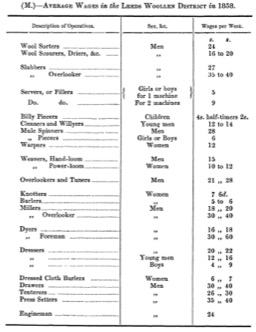
This type of “decentralized” industrialisation conserved the large number of small workshops, and close connection between masters and men. Small firms were encouraged by demand for a varied set of products, and that there was little economic or technological advantage in producing on a large scale in these industries.

This alternative path to industrialism was based on flexible labour-using technology and market specialization rather than mass production. Many factories were effectively a collection of workshops under one roof.

The competition was not of workers against business, but between masters and between companies, through new inventions. Inventive activity in Birmingham was provoked more by competition between firms, by patenting, by quality controls and by secrecy. Industrial relations in the city were good; the working class was not against the employers. There was a considerable “civic spirit”. The leaders of industry were in general nonconformists, Baptists, Unitarians and Quakers, who were willing to treat their employees well. There was a certain social mobility.

The effect of the “decentralized” industries in the West Midlands, was that there was no “oligopoly” of company owners, who could agree a common position on wage levels, as in Lancashire and Yorkshire. Further, the major part of the productive activity was for particular articles, which were constructed according to specifications, and thus the payment was in terms of a sales price per object, and not of a wage per day. The industries did not have repetitive processes, as did the textile industries, and thus it was not so useful to employ young children and girls for long hours.

A large proportion of the labour force was skilled. The better part of the labouring class had a positive attitude to education, and sent their children to good schools. There was a Birmingham Mechanics Institute, which in 1825 had 1000 members paying 3 shillings each quarter.

In the 1830’s and 1840’s the working hours were 12 per day, less 2 hours for breakfast, lunch and tea. “St. Monday” was generally observed, and sometimes the morning of Tuesday was also taken free (Hopkins, 1982, p. 55). In those cases, in which a certain amount of production was required in the week, the custom was to work many hours on Thursday, Friday, and Saturday. “When demand increased, it was met by the employment of more labour in small workshops, and not by the installation of steam-driven machinery”.  In the ironworks it was impossible to work to exact times per day, as the processes were dependent on the quality and temperature of the metal in the blast furnace and other stages, and could not be hurried up or stopped suddenly. The small workshops and domestic trades (nails, firebricks, tanneries, glass, chains, metal hand tools), the people worked enough to make their incomes, but not according to predetermined hours per day. 

Income levels

The high incomes for workers in the West Midlands were well known. According to Arthur Young, in the eighteenth century, a skilled worker could earn more than 2 pounds a week (agricultural labourers had 7 shillings), but the wages were really piece work. In a Provident Association, with members of 100 different trades, all were paid wages of over 24 shillings per week. 

Report from Sir Frederick Eden’s book on Birmingham

“The trade of this “Toy-shop of Europe” as Mr. Burke calls it, has suffered considerably by the war; particularly in the article of buttons and buckles. When work was brisk, women, in this line, earned from 7s. to 10s. a week; boys, 4s., and men, from L. 1 to L. 1 10s.; working gunsmiths are paid about L. 2 2s. a week. Common labourers earn about 10s. a week; bricklayers, 3s. a day; and their men, 2s. 6d. a day. At the canal, which is cutting in the neighbourhood, men earn 3s. a day.”

And on Wolverhampton:

“The wages in the different manufactures vary from 9s. to L. 2 a week; men, in full employment, earn, on an average, from 15s. to L. 1 5s. a week. The manufactures are the heaviest sort of hard ware; such as axes, shovels. &c.; buckles, watch-chains, toys, spectacle-cases, &c.”  

For work in the city of Birmingham we do not have any statistical series of wage payments, as the types of articles made changed from month to month, and there were no well-defined occupations in industry. However, we can note from the table five pages below, that the prices of the articles varied greatly from year to year, and thus logically this would have been the case for the wages of the workmen.

“What is the rate of wages in Birmingham at present, taking the different classes, the skilful workman, the medium skilful workman, and the ordinary labourer?” “That is a very difficult question, though no man is better acquainted with the matter than I am; I am proprietor of a very large establishment for rolling metals for the different manufacturers, and I know what many manufacturers are doing; it gives me a very extensive knowledge of the nature of every manufacture; but the variations of prices in Birmingham are greater than in all the world, for this reason – there is such an extraordinary variety of manufacture; and good men get wages out of comparison to those of an inferior note; the wages of labour in Birmingham will vary from 10s. up to five guineas, in a few instances, per week; there are a few men in very particular trades very clever in their trade, who cannot be surpassed or equaled in that trade; then there are a great many women and boys employed, from 1s. 6d. or 2s. to 8s. or 10s. per week.”

“What would you say are the average wages of a moderate skillful workman, laying aside the extremes in one side and the other, in manufacturing labour?” “I should say, if he was a man who understood his business perfectly, and of good character (for that is important in those trades when they are working in valuable metals), he can generally get from 23s. to 25s. a week.”

“Has it advanced lately or been stationary?” “There has been no advance till lately; they have been reducing gradually, but in consequence of the great variety of trades, wages are never reduced to that low rate which they are where there is only one branch of manufacture; if a man cannot get work at one thing he does frequently at another.”

“They have been at that rate for some time?” “They have not advanced in proportion to the great advances in the raw materials; but when I came from home, a week ago, I know there was an intention on the part of the colliers in the neighbourhood to make a strike, as they call it, for increase of wages, in consequence of the rise in iron.”

“For how many years back have wages been stationary?” “I do not remember wages in the last six-and-twenty years to have been stationary for any long period, and I have been in active business that number of years.”

“You said they had not varied much lately?” “No, not materially.”

“For how many years have they been about stationary, at the average rates you have just stated?” “I cannot state they have been for many years, for the real fact is, that three years ago the wages were, in some instances, rather lower than they are now.”

“Cannot you state whether, for the last two, three, four or five years, the average wages of the workmen have advanced or fallen back?” “I should say the last three years or 30 months they have advanced rather than fallen back, because there has been an improvement in the quantity of trade, and then there is always a natural improvement in wages.”

“So that, though for the last 18 months or two years the price of bread has been lower than has ever been known, the wages of Birmingham have been rather increased than otherwise?” “Yes, I think so; but it is so small an increase it can hardly be called one; they have not increased generally; only in some few instances, and that has arisen in consequence of the advance given for good workmen. The wages have not advanced generally, but the situation of the artisans has been improved by the reduction in the price of corn.”

“There are savings banks at Birmingham?” “There is one.”

“Have deposits increased of late years?” “They have increased some thousands within the last few years.”

“You consider that as a symptom of the more easy conditions of the labouring classes, do you not?” “I do not know; that is rather doubtful; it depends on two circumstances – not what they obtain alone, but how they spend it; there is a considerable difference in our manufacturers as to temperance; I know there is a good deal of that with us. I can say, for the credit of the place and my own interest, drunkenness is not half so common as it was.”

“The moral condition of the people, upon the whole, is improving?” “The moral condition of the people of Birmingham is decidedly better than of any place I know.”

…..   

There has been an improvement in the quantity of trade, and then there is always a natural improvement in wages.”

…..   

“Is the employment of the manufacturers at Birmingham healthy or not?” “Some are unhealthy; but Birmingham, generally speaking, is healthy; the water is good, and it stands on high ground as well as on hilly ground.”

“In point of fact, they live to as advanced periods of life as persons engaged in other pursuits?” “Yes; many live to old age. They live in distinct separate houses, which conduces to much health; never in flats, as they do in many places; each man has his own house.”

“What is the rent they usually pay for their dwellings?” “That is very various; it will vary from 18d. a week to 5s. a week, for the dwellings of the operatives; one or two rooms below and a couple of rooms above; and some run in courts that stand back from the streets.”

“Families of five or six?” “I never inquired into the number of their families; I cannot speak to that.”

(Select Committee on Agriculture, 1837, Mr. George Frederick Muntz, merchant, Birmingham. pp. 280-284)

(Wade, 1833, XXII – Wages of Manufacturers and Artificers, pp. 573-574)

As the industry of hardware is not shown as such in the table of occupations of the 1851 Census, and it is difficult to ascertain the movements in the wages, the Birmingham industry is not included in the calculation of average wages in this investigation.

The wages of workers in Blast Furnace and Rolling Mills in the Wolverhampton region practically did not change from 1840 to 1860. Wage levels for the representative area of plate rolling were:

Puddler                         45 shillings (*)

Plate roller:                   20 shillings (*)

Furnace man:                 7 shillings

Sheet roller:                  28 shillings

Furnace man:                17 shillings

(*) net of payments to underhands

(Secretary of the Board of Trade, Returns of Wages, 1887, Table T4, pp. 146-147)

For Hardware and Cutlery in the Wolverhampton area, the wage levels also remained steady from 1840 to 1860. In the work area of edge tools, the workmen earned as follows:

Tilters                           37 shillings (**)

Tilters’ boys                  7 shillings 6 pence

Hoe makers                  30 shillings

Hoe makers’ helpers  16 shillings

Edge tool forgers        30 shillings

Edge tool helpers        16 shillings

Edge tool grinders      25 to 30 shillings

Blacksmiths                 25 shillings

Boys (for striking)       7 shillings 6 pence

Jobbing labourers       16 shillings

(**) net of payments to boys

(Secretary of the Board of Trade, Returns of Wages, 1887, Table Cc, p. 197)

The file blank forgers had the high rate of 30 shillings, as the work was dangerous (the grindstones could fly into pieces and kill or injure the man), and with a short working life (the metal particles could enter the lungs).

Family budgets

We have a list of outgoings for a workman’s family in the Black Country in 1850, which appears to be sufficient for the needs of the family. The text in the article following the table makes it clear that this was a “theoretical” calculation, as it corresponds to a situation of continuous employment; in many years the average income was below this amount, and thus the family had to do without these types of food and expenses. The contractual weekly wage rates (nominal) practically did not move in the period 1830 to 1880.

(Barnsby, 1972 , Table 6, p. 228)

“The social and political state of that town [Birmingham] is far more healthy than that of Manchester; and it arises from the fact that the industry of the hardware district is carried on by small manufacturers, employing a few men and boys each, sometimes only an apprentice or two; whilst the great capitalists in Manchester form an aristocracy . . . There is a freer intercourse between all classes than in the Lancashire town, where a great and impassable gulf separates the workman from his employer.” 

(Richard Cobden, letter of August 9, 1857, to Mr. Parkes)

“The operation of mechanism in this town, is to effect that alone, which requires more force than the arm and the tools of the workman could yield, still leaving his skill and experience of hand, head and eye in full exercise; – so that Birmingham has suffered infinitely less from the introduction of machinery than those towns where it is, in a great degree, an actual substitute for human labour.” 

(William Hawkes Smith, Birmingham and its Vicinity as a Manufacturing & Commercial District, Charles Tilt, London, 1836, p. 16)

Ironworkers West Midlands (shillings per week)

PuddlerPlate RollerFurnace manSheet rollerTiltersHoe makersEdge tool ForgersBlacksmiths
1800 
1805 
1810 
1815 
1820 
1825 
1830 
1835 
1840452072845303025
1845452072845303025
1850452072845303025
1855452072845303025
1860452072845303025

 (Secretary of the Board of Trade, Returns of Wages, 1887, Table T4, pp. 146-147)

Ironworkers West Midlands (loaves per week)

PuddlerPlate
Roller
Furnace
man
Sheet rollerTiltersHoe makersEdge tool ForgersBlacksmiths
1800 
1805  
1810  
1815    
1820 
1825 
1830 
1835  
1840612793861404034
18457131114471474739
18507433124674494941
1855612793861414134
18606830114268454538

Sheffield, Cutlery and Knives 

            The other major metals and metalworking region was Sheffield, where this had been the main activity since 1700. It began thanks to the resources of coal, iron ore, millstone grit for grindstones, and rivers for moving water-wheels. The main products were knives, shears, saws, files, edge tools, razors, spring knives and axes. In the 1740’s Benjamin Huntsman invented the crucible steel process for producing a better quality of steel, and Thomas Boulsover invented Sheffield Plate (silver plating fused onto a copper ingot). From 1840, there was a considerable increase in heavy industry and large steel articles. 

Toothing long saw

(Knight, 1844, Sheffield, p. 162)

Sheffield was known for the high wages of the workmen, who in general worked alone, and sold their products to masters. The high wages were due to the specific knowledge required for each process, the 100 % apprenticeship with “learning on the job”, and the fact that the men were organized in “combinations” – one for each trade – while the masters and merchants did not have enough bargaining strength. 

Sir Frederick Eden on Sheffield

“The wages of ordinary labourers are 2s. a day, with one pint of ale, and half a quartern loaf; masons are paid 2s. 8d. a day; their assistants, 2s.; in the various branches of cutlery (which is the staple manufacture of Sheffield), men receive from 10s. to L. 1 10s. a week; women follow many different employments; a few earn, by spinning lint, about 6d. a day; washer-women are paid 1s. a day, and victuals.”

In the first half of the nineteenth century, Sheffield was probably the city with the highest personal income in the whole world. “From what I have seen of the manufacturers of England, I believe the workmen in Sheffield are better clothed and better fed, and live in better houses than the workmen in any other part of the country, or in any other part of the world” (Select Committee of Commerce, Manufacture, and Shipping, 1833, Evidence of Mr. Samuel Jackson, Manufacturer of saws and steel articles, 11th June 1833). The only disadvantage was the dangerous nature of some of the manufacturing processes. The hours of work were 10 per day, plus 2 for mealtimes. In some trades the majority of the skilled workers could read and write. In general, each family lived in a house without other lodgers; each house contained a sitting room 12 feet square, a chamber 12 feet square, an attic 12 feet square, one day room, two sleeping quarters, a small cellar. No family lived in a cellar (Holland, 1843, p. 46).   

The workers in Sheffield deposited a considerable amount of money in the Savings Banks. In 1840 there were 5,000 depositors with a total amount of 158,000 pounds. The depositors divided into 2,700 men, 1,900 women, and 400 sick clubs and charitable institutions. Half of the depositors had an account of less than 20 pounds. (Holland, 1843, Chapter IX, The Savings Bank).The majority of the workers were members of a union fund, which paid contractual amounts when the person was ill, unemployed, or died. 
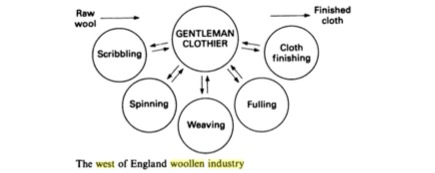
The wages in the saw-making trade in Sheffield moved very little from 1786 to 1833 (wages per piece or per week):

All the jobs for adult men had high wages:

(Secretary of the Board of Trade, Returns of Wages, 1887, Table Bb2, pp. 191-192)

Hardware and Cutlery Sheffield (shillings per week)

Saw grindersSaw makersRazors forgersFiles forgersSpring knives
grinders
Table knives
hafter
18006330
18057240
18108440
18157240
18206040
18257240
18306630
18356035
1840542735393527
1845542835403527
1850543035413527
1855543135433527
1860543235453527

(Sourced from the above two tables)

Hardware and Cutlery Sheffield (loaves per week)

Saw grindersSaw makersRazors forgersFiles forgersSpring knives
grinders
Table knives
hater
18006028
18056737
18106430
18157039
18207248
18258748
18308438
18358348
1840733647534736
1845784050575039
1850894958675844
1855734247584737
1860814853685341

Hardware and Cutlery Sheffield (shillings per week)

Hardware and Cutlery Sheffield (loaves per week)

3.5. The Woollen Industry (Cloth)

The woollen industry in the Industrial Revolution had a number of differences against the cotton industry:

  1. the commercial and social structure;
  2. the lesser strength of the thread, which made it more difficult to work it in fast machines; 
  3. the volume of production only increased by a factor of 5x;
  4. automation entered later, starting from 1820 for the spinning processes, and from 1830 for the weaving processes;
  5. less amount of personal suffering by little children or due to unemployment of handloom weavers. 

Commercial and technological structure of the woollen industry in Yorkshire in the period from 1700 to 1820: 

(Floud, Roderick; McCloskey, D. N.; The Economic History of Britain since 1700, Cambridge University Press, Cambridge, 1994, Vol. 1, Figure 6.2, p. 131)

The phases in the production of woollen cloth, before industrialization, were: 

a)         sorting and cleaning;

b)        carding;

c)         slubbing (pulling out the wool, and winding it on bobbins);

d)        spinning;

e)         weaving;

f)         fulling;

g)        washing;

h)        dressing and finishing;

i)         dyeing;

j)         raising the nap on the cloth;

k)        shearing.

The organization before 1800 was as follows: the farmer sheared the sheep, the spinner in his or her cottage scribbled and carded the wool, spun the thread, wove the cloth on his loom, the “clothier” or “master manufacturer” bought it from the spinner, in his cottage he wove the thread on his handloom to make the cloth, and he then transported it to Leeds on the back of a horse (*), where he sold it to a merchant in the Cloth Hall; the merchant then had it finished on his premises. Actually, in many cases, the clothier did not do the manual work himself, but had two or three weavers in the cottage/workshop, one for each loom, and the auxiliary work was done by journeymen and the children in the family. The expression “weavers’ cottages” is misleading: many of the buildings were of stone, two stories high, with rooms below for the looms and other equipment, and rooms above for living. 

(*) this was not efficient: the clothier lost two days productive time per week.

The dates of introduction in Yorkshire of the technological improvements were as follows (in a number of cases, an invention was patented and used in the cotton industry, but effectively introduced in the wool industry decades later):

1748 (Lewis Paul) Roller spinning / hand driven carding machine

1763-4 Introduction flying shuttle

1780’s Carding and slubbing partially mechanised, but still in domestic production 

1780’s Jennies, introduced in volume 1810  

These were small, they could be used in the cottage, but also in mill rooms; 

they reduced the work for women and children in the cottage. 

They produced more volume of production to weavers. 

The use of the 60-spindle jenny instead of the spinning wheel decreased the labour required by 95 %

1787-1794 Cropping or shearing frame (John Harmer) 

Mechanically operated the shears, and advanced the cloth by means of pulleys; one man could replace the work of ten.

1785-1805 Scribbling machines

These mechanized the process of taking the knots out of the wool.

In 1786, there were 170 around Leeds; each machine would put 12 men out of work, and only use one.

1790-1800 Groups of larger clothiers formed “joint-stock” mills

The processes of scribbling, carding, slubbing and fulling, were carried out all in one building (with simple machines, and steam power), and then the cleaned wool was sent to the cottages to be spun and woven.  

1803   Dressing frame (Radcliffe) starched the whole of the warp before it was bound on the loom

Saved the work of one person

1790-1820 First weaving mills, but small;

in 1805, only one-thirtieth of the cloths were produced in factories.

1796-1805 Arkwright carding machine with cylinders

1800-1820 Introduction of steam engines in mills

1800-1820 Introduction of gig mills 

This was for a process of removing knots from the surface of the cloth, and raising the nap, which would then be removed by the shearers to give a smooth surface; this had been done manually by pulling the cloth over brushes formed of teasles (*).

The machine was a freely rotating cylinder with teasles stuck on it, over which the cloth was pulled. 

Number of persons for a given quantity of cloth reduced from 18 men and 6 boys to 1 man and 2 boys.

Number of gig mills in Yorkshire increased 1806-1817 from 5 to 72.

(*) flower heads of a plant related to the thistle; these heads when dried were very hard and pointed.

1815-1820 Lewis cropping frame, with seven additional cutters, multiplied speed by eight (William Hirst)           

The shearers or croppers used very large shears (4 foot long blades, 40 pounds weight), parallel to the cloth, to cut the nap and leave the cloth with a perfect surface. These men were the best paid in the woollen industry, and the best organised.

The new shearing frame was a machine with two circular blades mounted crosswise, rather like a manual lawn mower (actually it led to the invention of the lawn mower in 1830; there is an early version in the Science Museum, South Kensington).

The number of mechanical frames increased 1806-1817 from 100 to 1462; of 3,378 shearmen, 1,170 were out of work and 1,445 only partially employed. 

1815-1820 Hydraulic presses for wet wool cloth (William Hirst)

1825    Mules introduced for spinning instead of jennies

(5 times productivity)

1830-1850 Power looms started in low volume in Leeds woollen industry.

1840-1850 Large increase of wool imported from Australia

1840-1850 Use of cotton for warps in the cloth

1858           Piecing machine

Replaced six half-timer boys

The changes in the use of equipment, and in the work of the people, were:

The first mills for woollens in the West Riding were set up in 1790-1800. But for a long time they were small (average 68 employees in Leeds in 1835). Spinning in these mills was with mules. But the majority of the personnel in the mills were employed for preparatory and finishing processes.

At the end of the eighteenth century, the lesser number of weavers required for the given volume of wool, allowed the large clothiers to reduce the payment levels to the domestic weavers. 

Starting from about 1800, the “domestic system” showed signs of breaking down. This system had had the characteristics of close relationships between the journeymen (individual weavers) and their masters, a steady income, identification with the manufacturing process, and security of job tenure. It was being replaced with working for pieces (when the mill owner gave you the order), instability of work, renegotiation of price levels, and little contact with other people. However, the small clothiers still had their farm holdings, so that they could produce their own food.    

We do not know how the domestic hand-loom weavers of woollens fared after 1840, but it seems clear that they continued in large numbers even after 1860, and with reasonable incomes. The information comes from Mr. Edward Baines, M. P. for Leeds, and writer of a history of the industry, in an address to the Statistical Society of London in 1859: “the hand-loom weaver in the Woollen Manufacture has never been reduced to the miserable wages paid to the same class of operatives in other manufactures, ..” (p. 4); “the continued existence of the system of domestic manufacture in the woollen trade;” (p. 4); “Four-fifths of all the hands employed in the worsted trade are in factories, whilst only about half of those in the woollen trade are in factories” (p. 7); “The manufacturers of the outlying district bring the cloth made in their looms, twice a week, to be sold to the merchants in the two great Cloth Halls of this town” (p. 29).  

Thus the general “picture” in each period was as follows:

Before 1800

Cottage

Spinning: Spinning wheel, Women

Weaving: Hand-loom, Men

1800-1840

Factories for Spinning, Cottage for Weaving

Spinning: Jennies, Men

Help spinning: Small children

Weaving: Hand-loom with Fly-shuttle, Men

1820-1870

Factory in town, with steam power

Spinning: Mules with steam power, Men

Help spinning: Children

Weaving: Hand-loom (in own cottage), Men, either paid by piece, or salaried out-work  

          OR Power-loom in factory, Young women

(change from hand-loom in cottage to power-loom in factory, gradually during this period)

After 1870

Factory in town, with steam power

Spinning: Mules with steam power, Men

Weaving: Power-loom in factory, Young women

Note that during the whole period, the spinning function is carried out by the men, and the weaving function is also done by the men (except in some, late, cases, where the power-loom weaving is done by women).

We have a list of the personnel in a woollen mill, with external weaving, in 1859. We see that the spinning and weaving functions are in general carried out manually by men. This was because the wool for cloth, due to the characteristics of the thread, could not easily be worked in fast and repetitive machines.

(Baines, 1859, Table (Q), p. 27)

Monetary income level

Arthur Young gives us the incomes for cloth workers in Leeds in 1769. The men weavers earn 10s. 6d. a week if they are fully employed, but the real yearly average is about 8 shillings; a boy of 13 or 14 earns about 4s. a week, and some of the women earn as much as the men. There is not always enough work. The weekly income of the men weavers is equivalent to 60 lbs. of oatcakes or 24 lbs. of beef. (Arthur Young, 1771, pp. 137-139)  

The following table of wages comes from the books of one woollens company, and is cited by Baines:

(Baines, 1859, Table (N), p. 25)

We see that the wages in general increased from 1795 to 1815, decreased somewhat to 1825, and stayed at the same level to 1857.

(Baines, 1859, Table (M), p. 24)

Note: Huddersfield was the centre of the “fancy trade”, that is, more complicated and decorative designs, for which the power-loom could not be used.

Woollens workers (shillings per week) 

Wool SortersSlubbersSpinnersWeavers
Power-loom
DressersWeavers
Domestic
MenMenMenWomenMen
1800 2217 
1805313125 
1810333128
1815373132 
1820332926 
1825292620 21 
1830282522 21 
1835272525920 
1840242724920 
1845222923920
1850222520920
18552124171020
18602327291220

Baines, 1859, Table (N), p. 25

No income data for «weavers domestic»

(1810, 1820, 1830, 1840, 1850 interpolated)

Woollens workers (loaves per week)

Wool SortersSlubbersSpinnersWeavers
Power-loom
DressersWeavers
Domestic
MenMenMenWomenMen
18002116
1805292923
1810252421
1815363031
1820403531
182535322425
183036322827
18353734341228
18403236321227
18453242331329
18503641331533
18552833231427
18603541441830

Woollens workers (shillings per week)

Woollens workers (loaves per week)

The wages in the hand-loom weaving of cloth were higher than those in the cotton and worsted industries, because it was very difficult to construct a power-loom which could work this type of thread:

“It will be seen hereafter, that the wages of the worsted weavers are considerably below those of the cloth weavers; whilst those of the cotton weavers are greatly below those of the first named. A worsted weaver will generally earn half as much again as a cotton weaver, whilst a cloth weaver will earn as much as both together.”

(House of Lords, Hand-loom Weavers, 1840, p. 551)

“…. the Power-Loom in the Woollen Manufacture works much more slowly than in the worsted manufacture; in the latter, on the average, the shuttle flies at the rate of 160 picks per minute, whilst the power-loom in weaving broad cloth only makes 40 to 48 picks per minute, that is, just the same as the hand-loom. The weaving of woollen cloth by hand is a man’s work, whereas the weaving of Cotton, Linen, or Silk by hand was a woman’s or a child’s work. Hence the hand-loom weaver in the Woollen Manufacture has never been reduced to the miserable wages paid to the same class of operatives in other manufactures, and hence he maintains a more equal competition with the steam-loom. It is to this cause that we must principally ascribe the continued existence of the system of domesticmanufacture in the woollen trade; and to the same cause we must ascribe the slower advances made in the woollen than in those manufactures where all the processes can be more advantageously carried on in factories, by one vast system of machinery, under a single eye, and by the power of great capital.”

(The italics are in the original text)

(Baines, 1859, p. 4)

Humphrey Boyle’s Estimate of Living Costs in 1832

The only findable source for a family budget in Leeds in our period, is a theoretical calculation made by Humphrey Boyle, a radical and “freethinker”.  For information as to Humphrey Boyle, see https://www.thoresby.org.uk/content/people/boyle.php

  Least possible sum per week for which a man, his wife, and three children can obtain a sufficiency of food, clothing & other necessaries – Feby. 12th, 1832                 
  
                                          s.  d.                                                                £.  s.   d.
Rent 2/-, fuel 9d., candle 3d.          3   0                 Brout up…                                  14   6 ½
Soap 3d., soda 1d., blue &                                       Vegetables 1d. per day                    7      
starch 1 ½ d.                                       5 ½           Salt, pepper, mustard, vinegar.        2
Sand, black lead, bees wax &c.             2               7 pts. beer 1 ½                              10 ½
Whitewashing a cottage twice                                 Water                                                 1   
a year                                                   ½              Schooling for 2 children                  6
1 ½ st. flour for bread – 2/6d             3 9               Reading                                            2
¼ st. flour for puddings – 2/8d. st.       8               Wear & tear in beds, bedding, 
Eggs 2d., yeast 1 ½ d.                            3 ½          brushes, pots, pans, & other
1 ½ pints milk per day at 1 ¼ d.        1 1               household furniture                    6
¼ stone oatmeal 2/2 d.                           6 ½          Clothing: husband ½ d., wife
1 lb. treacle 3 ½ d., 1 ½ lb. sugar                                   8d.                                         1  10    at 7d. lb.                                    1  2                        each child 4d.                      1    0
1 ½ oz. tea at 5d, 2 oz. coffee    
1 ½ d.                                                10 ½ 
5 lb. meat 6d.                                    2 6                                                        
 ——-                                                              ——–             
                                          14 6 ½                                                             £ 1  0  3     
                                                      ——-                                                              ——– 

Besides the sum required for the fund which it is agreed every workman [ought] to lay in store for sickness and old age, I have set nothing down for butter, not being certain whether it is essential to health, although it is to be found in almost every cottage where the weekly income is not more than half the amount I have stated for the proper support of a family: tobacco, although it is in very general use, I have omitted for the same reason: neither have I reckoned anything for religious instruction, which is thought by great numbers of the people as necessary to their happiness as is their daily bread: something, therefore, ought to be allowed for it.  The above is not made out from my own knowledge of housekeeping only; I have elicited from the most intelligent & economical of my acquaintances their opinion upon the most weight items of expenditure, which, if correct, would have made the account rather more than is here set down. If, upon the most strict enquiry, no material alteration can be made in the detailed estimate of the necessary weekly expenditure of five persons, I conceive that a case will be made out that the average earnings of workmen are not sufficient for the proper support of their families; and will prove at the same time that if greater economy was practiced, if less was spent at the public house, there would be a much greater degree of comfort in the workman’s cottage than to be met with at present. H. Boyle

In the family records of Boyle & Son, Leeds)    

(Yasumoto, 1995, p. 326)

From this document we can extract some useful conclusions:

  • the standard of living of the hypothetical family, measured by consumption of food and necessities of the home, was good;
  • the statement at the end of the table, seems to say that the father would only be earning 20 shillings a week, and thus could just pay for these expenses; actually, the majority of the men in constant employment had 20 shillings, but the older children would be earning another 5 to 10 shillings;
  • the table shows only 2 shillings for rent, which would be for a minimum type of house; with 20 or 30 shillings income, the hypothetical family could reallocate 2 shillings to pay for the rent of a better house, but one presumes that they cannot or will not;
  • the back-to-back houses, which were inhabited by the lower class of workers, were of two storeys, one room in each storey, each room 15 feet by 15 feet, and 10 feet high; we see that the fact that they live in these houses (5 to 6 people in each), does not demonstrate that they have insufficient income or insufficient food consumption;
  • apparently 5 pounds of meat weekly for the family, is taken to be a necessary amount.

West of England

The wool trade had been carried out in the West of England (Gloucestershire, and parts of Wiltshire and Somerset) since the Middle Ages. In the later eighteenth century it was about the third of the size of the West Riding industry, and it decreased somewhat during the first 30 years of the nineteenth century, for reasons which are not totally clear. The West of England produced cloth of a finer texture and more width than the West Riding; this was particularly used for men’s clothing. 

The commercial and productive relationships were different to those of the West Riding. Instead of a fluid contracting system between the different professions, in the West of England, the master clothiers (who were rich people, with large houses) had each a number of spinners, weavers, fullers, dyers, etc., working for them. 

Commercial and technological structure of the woollen industry in the West of England in the period from 1700 to 1820: 

(Floud, Roderick; McCloskey, D. N.; The Economic History of Britain since 1700, Cambridge University Press, Cambridge, 1994, Vol. 1, Figure 6.2, p. 131)

At the end of the eighteenth century, all of the different phases of processing the wool were done by persons. But with the coming of machines, a number of minor activities were not done by humans (see the calculation pages below); this had a special effect, because in a number of activities, the totality of the workers in one village did only this work. From 1790 to 1835, a number of businesses failed, and some could not find enough work. In 1825, there was a strike by the weavers for better pay to compensate for longer hours, and months later, the local banks failed, so that more businesses went bankrupt. 

The workers were in general paid enough (see the following table), but the humanitarian problem was that of the outwork weavers. They had very low wages, because there really was an excess of people. In 1839, those with contracted work in the factories of the clothiers earned 12 shillings a week, while those in outwork, and without guarantee of material each week, earned only 6 shillings 6 pence (there were reports of children dying from illnesses brought on by scarcity of food). However we are only talking about 1,800 families. 

Power looms were not used before 1840, as there were no manufacturers in the South of England. Fulling mills were replaced by rotary milling machines from 1834.   

The weavers of wool in the West of England with continuous employment had a good standard of living up to 1830:

1840 Southwest England

The Sessional Papers of the House of Lords, in the Session 1840, p. 374

The following data about cost savings come from a report about wool processing in the West Country. The costs and savings are similar to Yorkshire, but the dates of changes are somewhat earlier.

(Lipton, 1921, pp. 258-260; quoting House of Lords, Hand-loom Weavers, 1840, p. 439)

Statement of Weekly Wages of Trades and Callings in Stroud, 1836:

Trade or CallingAverage Working HoursWages or Earnings
Per Week
Agricultural Labourers12  9 0
Bargemen1214 0
Blacksmiths1315 0
Boot-closers1215 0
Bricklayers1015 0
 “ “ “ Labourers1010 0
 “ “ “ Makers1218 0
Carpenters1015 0
Dyers1010 0
Joiners1015 0
Masons10 15 0
Nailers12 16 0
Plasterers1015 0
Sawyers10 16 6
Shoemakers1214 0
Stonecutters1220 0
Tailors1318 0
Watchmakers1025 0

W. A. Miles, Royal Commission of Inquiry into the Condition of the Hand-Loom Weavers in England and Wales (1837-41), Gloucester Section, p. 139

Haz clic para acceder a coaley.net_miles_handloom_report_1839.pdf