Manchester, Salford, Chorlton
| Births | Burials | Under 1 Year | 1 to 4 Years | Per 1000 Births | Per 1000 Births | |
| 1838-1839 (+) | 10,700 | 9,276 | 2,045 | 2,214 | 191 | 207 |
| 1839-1840 (+) | 10,192 | 8,667 | 2,116 | 2,442 | 207 | 240 |
| 1841 | 14,051 | 10,378 | 2,651 | 2,546 | 188 | 181 |
| 1842 | 13,857 | 10,748 | 3,029 | 2,566 | 218 | 185 |
| 1843 | 14,109 | 11,057 | N/A | N/A | ||
| 1844 | 15,194 | 10,470 | N/A | N/A | ||
| 1845 | 15,802 | 10,898 | 2,944 | 2,470 | 186 | 156 |
| 1846 | 16,758 | 14,095 Typhus+ Irish | 4,225 | 3,508 | 252 | 209 |
| 1847 | 15,482 | 15,114 Typhus+ Irish | 3,413 | 3,441 | 222 | 222 |
| 1848 | 14,949 | 13,841 | 3,281 | 3,585 | 219 | 240 |
| 1849 | 16,686 | 14,426 | 3,631 | 2,876 | 217 | 172 |
| 1850 | 14,403 | 11,383 | 3,364 | 2,463 | 233 | 171 |
| 1851 | 17,570 | 11,855 | 3,418 | 2,173 | 194 | 123 |
(+) Only Manchester plus Salford
Figures from Annual Reports of the Registrar-General, 1838-1839 to 1851.
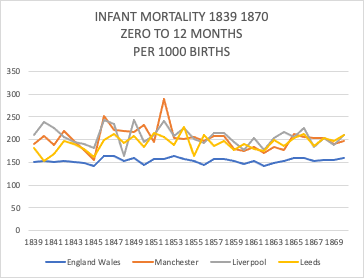
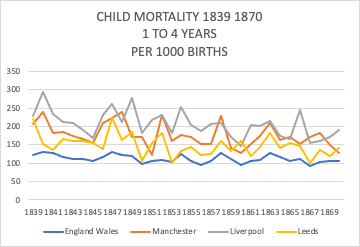
Graphical Representation of data from the previous page, continued with data extracted from Annual Reports of the Registrar-General up to 1870
The figures of infant mortality (zero to twelve months at death) in England as an average were lower than in other countries during the 19th century. The figures for Manchester and Liverpool, i. e. the worst cases in England, were on average 210 in 1841-1851, and decreased to about 175 in 1900. This means that the average in Germany was equal to Manchester and Liverpool from 1825 to 1845, and then was more throughout the rest of the nineteenth century. The data shown for each country include rural and urban areas; since industrialization did not start until 1830 on the European mainland, we can suppose that the figures correspond in a large proportion to agricultural communities and small towns. Thus the high figures (from our point of view) from industrial towns in England, are close to those from agricultural areas in all the other countries. 2.21
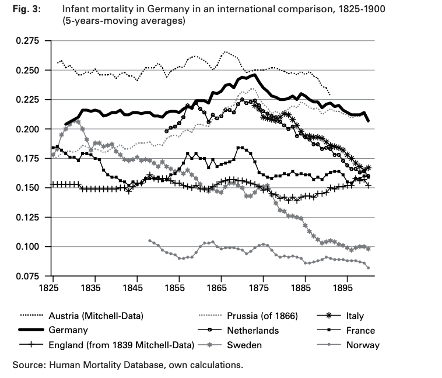
For the whole period 1830 to 1900, Bavaria and Baden were over 250/1000.
2.21 Gehrmann, Rolf, “Infant Mortality in Germany in the 19th Century”, Comparative Population Studies, 2011, pp. 839-869.
Taux de mortalité infantile depuis 1745
(Rate of infant mortality after 1745)
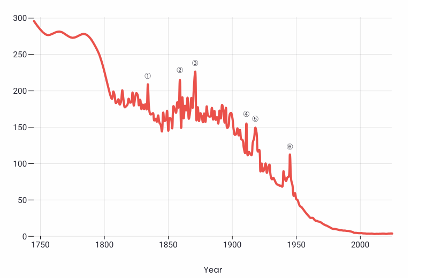
INED: Institut National d’Études Démographes, la mortalité en France en Chiffres: décès avant l’âge d’un an (Publié le 2/12/2015).
(INED: National Institute of Demographic Studies; Mortality in France in figures, death before the age of one year: Published 2/12/2015)
Chadwick informs us of extreme sanitary problems and high infant mortality in New York and Philadelphia. 2.22.
2.22 Edwin Chadwick, “On the Best Modes of Representing Accurately, by Statistical Returns, the Duration of Life, and the Pressure and Progress of the Causes of Mortality Amongst Different Classes of the Community, and Amongst the Populations of Different Districts and Countries”, Statistical Society of London, Vol VII, April 1844, pp. 1-40
https://www.jstor.com/stable/2337744
Mulhouse
In 1835, the Academy of Moral Sciences requested a doctor with a knowledge of statistics, Dr. Louis René Villermé, to conduct an investigation into the conditions of labour in the cotton, wool, and silk industries in France. Dr. Villermé finished his work (“Tableau de l’État Physique et Moral des Ouvriers dans les manufactures de coton, de laine y de la soie”) after some years (the on-the-spot investigation in Mulhouse was in June and July 1835 and September 1836), and published it in 1840. The conclusions with respect to some of the towns were very negative, and the worst case was Mulhouse.
The reaction of the French population was of anger, and in less than 12 months, a Law on the Employment of Children was passed. There was to be no employment of children under the age of 8 years old; the maxima of the working day were to be 8 hours for children of 8 to 12 years, and 12 hours for children of 12 to 16 years; no night work for children of under 13; children under 12 years had to attend school.
“As to the workers in spinning and weaving, who offer in all the stages of life the highest mortality, … one has forgotten without doubt how much they are wretched, pale, worn out by scarcities and fatigue. I use the word “scarcity”, as it is obvious that they are far from obtaining, in exchange for their work, good food and in sufficient quantity. It is therefore not surprising they succumb at all ages, in a higher proportion than all the others.
…..
The excessive mortality which reap the families of the workers employed in the spinning and weaving of the cotton in Mulhouse, has an effect particularly on the earliest periods of life. Exactly, while the half of the infants born in the class of manufacturers, of businessmen and directors of factories, will reach their twenty-ninth year, the half of the children of the weavers and the simple workers in spinning would have terminated their existence, one hardly dares to believe [“on ose à peine le croire”], before the age of two completed years.” 2.23
[Literally, the children of the poorest category of workers had an average life expectation of less than 24 months. Figures extracted from the Civil Register by Dr. Villermé, and accepted in a parallel investigation, carried out by a representative of the owners]
“It is necessary to observe them, arriving in the morning, and departing in the evening. There are, among them, a multitude of pale women, thin, walking barefoot in the mud, and who, as they do not have an umbrella, have upside-down on their heads, when it rains, an apron or an outside petticoat, to cover the body or the neck, with a considerable number of small children, not any less dirty, not any less haggard, covered with rags impregnated with the oil of the looms, which falls on them while they work. These last, better preserved from the rain by the impermeability of their clothing, have in their arms not even – as do the women of whom I have just been speaking – a basket with the provisions of the journey; but they have in their hands, or hidden in their jacket, as well as they can, the piece of bread which has to feed them until their return to the house.” 2.24
2.23 Villermé, Dr. Luis René, “Tableau de l’État Physique et Moral des Ouvriers dans les manufactures de coton, de laine y de lasoie”, 1840, Tome II, pp. 253-255
2.24 Villermé, Ibidem, Tome I, p. 26
Infant Mortality (causes)
The deaths in infancy in industrial regions of England were high, but this was not due to the very insanitary surroundings in which the small children were “brought up”, but rather to the very low level of care by the mothers, who did not have the time to look after them.
“The great mortality among children under 2 years of age is not directly chargeable to the factory system. The mortality between 1 and 2 is greater in Birmingham than in Manchester, for those are the two places especially contrasted. To what cause, therefore, may it be attributed? To no one in particular. The manners and habits of the people have much to do with it. That some localities are less healthy than others there can be no doubt. The most plausible reason which I can find is, not that the youths die in factories, but that the very young children are, under the existing system, not sufficiently taken care of by the mothers – both as regards themselves during gestation, and their offspring during childbirth. The women, during pregnancy, continue as long as possible at their work, and after child-birth return to it sooner than they ought, leaving their infants to the care of ill-paid and unsuitable persons. Nor ought we to omit, that soothing drugs, such as the well-known nostrum, Godfrey’s Cordial, are often had recourse to, with a view to ease the pains and to quiet the restlessness of infants; and it is perhaps to this improper use of narcotics that the frequent deaths from convulsions may be attributed. However desirable it may be, on other grounds, to regulate the labour of youths in factories, it is still more expedient, that mothers should not, if possible, be abstracted from attention to their helpless infants, particularly during the periods of lactation and teething.” 2.25
2.25 Johns, William (Registrar for Manchester), Report upon the Working of the Registration and Marriage Acts, during the Two Years 1837-38 and 1838-39, in the Registration District of Manchester
Journal of the Statistical Society of London, Vol. 3, No. 2 (Jul., 1840), pp. 191-205; Here: pp. 195-6.
https://www.jstor.org/stable/2337734
“From enquiries made by Dr. Willis from cellar to garret, and from house to house in Dublin, he found the average age at death of the working classes to be 18 years, decimal 65, which it will be seen, is about the same age as that in one of the lowest districts in London, Bethnal Green; it being in the best districts in London about 30. The average age at death of those of the working classes in Dublin who had attained 21, was no more than 34.70; whilst even in Bethnal Green it is not less, apparently, than 46.
Speaking of the deaths of children he [Dr. Willis] states, “the deaths up to 5th year are rather under those of Manchester, Leeds, &c.; above 5 and up to 10, the mortality is very great, and more than in any of your manufacturing districts. I wish to avoid all theory, yet I cannot resist endeavouring to account for this excess of mortality at the ages of 6 to 10.
The mothers with us have no employment, and, therefore, even in their wretchedness they bring up a greater proportion of infants, say up to 5th or 6th years; from this to the 10th year, very many of our poor children have not the same comforts as your factory children, and therefore furnish a larger proportion of deaths.
“The average number of children baptized to each marriage, is 5.70; average number now living to each marriage, 2.67. Of mothers who have had eight or more children, only 1 in 718 never lost a child; of mothers who have had six or more children, only 1 in 215 have never lost a child!”” 2.26
2.26 Chadwick, Edwin, “On the best Mode of representing accurately by Statistical Returns, the Duration of Life, and the Pressure and Progress of the Causes of Mortality amongst different Classes of the Community, and amongst the Populations of different Districts and Countries”, Journal of the Statistical Society of London, Vol. VII, 1844, pp. 1-39 (here, pp. 20-21)
“I now return to the dismal topic of infant mortality, the undue proportion of which arises from the neglect of mothers who are compelled to leave their young children at home while they labour in the mill. This I believe to be the blackest blot on the factory system. Whether it can be remedied is a question which I shall not attempt to answer. “Pregnant women” says Dr. Johns, “frequently continue their work up to the very last moment, and return to it as soon as ever they can move about.” “In Ashton-under-Lyne,” says Dr. Coulthard, “it is no unfrequent occurrence for mothers of the tenderest age to return to their work in the factories on the second or third week after confinement, and to leave their helpless offspring in the charge of mere girls or superannuated old women.” 2.27
2.27 Reach, Angus Bethune (reporter, 19th century, for Lancashire). Included in: Routledge Library Editions, The History of Social Welfare, Edited by J. Ginswick.“Vol. 3, Labour and the Poor in England and Wales 1849-1851, The Letters to the Morning Chronicle from Correspondents in the Manufacturing and Mining Districts the Towns of Liverpool and Birmingham, and the Rural Districts, Vol. 1, Lancashire, Cheshire, Yorkshire”. Here: p. 47.
“As in Coventry and Nottingham, so in Manchester, the large diarrhoeal mortality of children is partly attributed by the medical men to the neglect arising from the employment of women in factories. Infants, it is said, are frequently left by their mothers, at the age of three or four weeks, for the greater portion of the day, during which they are fed upon bread and water, and more rarely upon arrow-root and milk. Coffee, meat, and “little drops” of gin are also sometimes given to infants; and the system of drugging with Godfrey’s Cordial is so common, that one druggist is reputed to sell thirty gallons per week of this narcotic. Mr. Leigh, one of the sub-registrars, and likewise a medical practitioner, who has devoted much attention to the sanitary state of Manchester, attributes the frequency of atrophy in young children to this system of drugging them with opiates, and the large mortality among children from diarrhoea, to neglect; …..” 2.28
2.28 Dr. Heedlam Greenhow, “Report on Diarrhoea in Manchester”, Addressed to the Public Health Department of the Privy Council, presented to both Houses of Parliament in 1859.
Quoted in:
Kay-Shuttleworth, Sir James, Four Periods of Public Education, 1862, Sketch of the Progress of Manchester in thirty Years, from 1832 to 1862; pp. 87 to 170, here p. 164.

