Referring to the distribution of mortality in the Manchester Conurbation, we see that this is less in the suburbs, as there the houses and the drainage are better constructed, and the inhabitants are of a higher level.
“Although the occupations of the people, ascertained in the late Census, are not as yet published (from which the social condition of each of the townships might well have been inferred with more accuracy than can at present pretended to), it may safely be assumed that the townships of Cheetham-with-Crumpsall and Broughton, besides the advantage of salubrious situations, are chiefly occupied by the comfortable classes; that Chorlton-upon-Medlock, Ardwick, and Pendleton contain a considerable of the same; that Hulme, Salford, and Manchester are, to a very large extent, peopled by the labouring class; and that each of these townships again differs very considerably as to the more or less comfortable conditions of its inhabitants; for while Pendleton, Hulme (a newly-peopled township), and the parts of Chorlton-upon-Medlock, and of Ardwick, bordering on the Medlock, are occupied by the skilled or best-paid labourers, the township of Manchester, and that portion of Salford lying along the river Irwell, attract a large proportion of those of the lowest and poorest condition; of those whose habits. . of life, food, and lodging are, upon the whole, the least favourable to health.” 2.29
2.29 Second Report of Commissioners of Inquiry into the State of Large Towns and Populous Places, Volume II, Appendix, Part II, p. 106.
Births and Deaths in the Townships of Manchester
| Township | Births | One in … | Per cent | Deaths | One in … | Per Cent |
| Manchester | 6,263 | 26.16 | 3.82 | 5,499 | 29.79 | 3.35 |
| Salford | 2,308 | 23.05 | 4.34 | 1,644 | 32.36 | 3.09 |
| Chorlton-upon-Medlock | 1,085 | 26.11 | 3.83 | 727 | 38.97 | 2.56 |
| Hulme | 1,231 | 21.91 | 4.56 | 801 | 33.68 | 2.96 |
| Pendleton | 444 | 24.84 | 4.02 | 271 | 40.70 | 2.45 |
| Ardwick | 437 | 22.66 | 4.41 | 282 | 35.12 | 2.84 |
| Cheetham-with-Crumpsall | 270 | 32.69 | 3.06 | 159 | 55.51 | 1.80 |
| Broughton | 104 | 36.48 | 2.74 | 62 | 61.19 | 1.63 |
| Total | 12,142 | 25.16 | 3.97 | 9,445 | 32.39 | 3.08 |
Data are average of three years ending December 1842.
Extracted from Ibidem p. 107.
Birth Rates and Death Rates
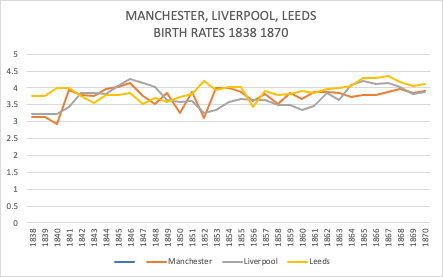
[The low figures for Birth Rates in Manchester and Liverpool for 1838/39/40, probably were due to incomplete registration of births in the General Register Office, as many people did not understand that they had to go to the offices of the GRO and make the declaration]
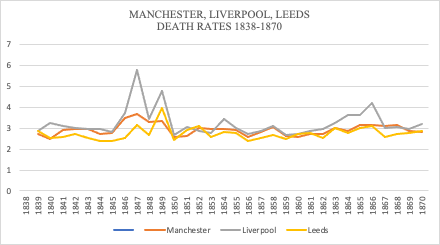
Manchester, Salford, Chorlton (Registration Districts), General Registration Office, 1838-1870.
| Persons | Births | Burials | Birth Rate % | Death Rate % | |
| 1838-1839 (+) | 340,000 | 10,700 | 9,276 | 3.14 | 2.73 |
| 1839-1840 (+) | 348,000 | 10,192 | 8,667 | 2.93 | 2.49 |
| 1841 | 356,000 | 14,051 | 10,378 | 3.94 | 2.91 |
| 1842 | 365,000 | 13,857 | 10,748 | 3.80 | 2.94 |
| 1843 | 374,000 | 14,109 | 11,057 | 3.77 | 2.96 |
| 1844 | 383,000 | 15,194 | 10,470 | 3.96 | 2.73 |
| 1845 | 393,000 | 15,802 | 10,898 | 4.02 | 2.77 |
| 1846 | 403,000 | 16,758 | 14,095 Typhus+ Irish | 4.16 | 3.50 |
| 1847 | 413,000 | 15,482 | 15,114 Typhus+ Irish | 3.75 | 3.66 |
| 1848 | 423,000 | 14,949 | 13,841 | 3.53 | 3.27 |
| 1849 | 433,000 | 16,686 | 14,426 | 3.85 | 3.33 |
| 1850 | 443,000 | 14,403 | 11,383 | 3.25 | 2.56 |
| 1851 | 453,000 | 17,570 | 11,855 | 3.88 | 2.62 |
Births and Deaths in Manchester Registration District (Township) in 1837-38 and 1838-39, detailed by Sub-district.
1837-38
| Sub-districts | Births | Deaths | Population 1841 | Birth Rate | Death Rate |
| Ancoats | 1,446 | 1,216 | 42,000 | 3.44 | 2.90 |
| St. George’s | 1,084 | 903 | 31,000 | 3.50 | 2.91 |
| Market-street | 815 | 1,300 | 27,000 | 3.02 | 4.81 |
| London-road | 1,163 | 1,088 | 29,000 | 4.01 | 3.75 |
| Deansgate | 950 | 1,104 | 33,000 | 2.88 | 3.34 |
| Total | 5,438 | 5,611 | 162,000 | 3.35 | 3.46 |
1838-39
| Sub-districts | Births | Deaths | Population 1841 | Birth Rate | Death Rate |
| Ancoats | 1,691 | 1,444 | 42,000 | 4.03 | 3.44 |
| St. George’s | 1,375 | 1,155 | 31,000 | 4.43 | 3.72 |
| Market-street | 897 | 1,338 | 27,000 | 3.32 | 4.96 |
| London-road | 1,153 | 1,184 | 29,000 | 3.97 | 4.08 |
| Deansgate | 1,242 | 1,113 | 33,000 | 3.76 | 3.37 |
| Total | 6,358 | 6,234 | 162,000 | 3.92 | 3.83 |
Without the smaller areas of: Newton, Cheetham, Failsworth, Blackley, Prestwich
“The number of deaths in the Infirmary, which is situated in the Market-street district, was 520 in the two years, the number in the workhouse, which is in the same district, was 550; and the number in the fever wards, which are in the London-road district, was 427 in the same period.” 2.31
“It has been suggested that this difference [the number of deaths under 6 years is greatest in Ancoats, and fewest in Market-street] may be in part owing to the circumstance, that Market-street district contains a large number of warehouses and shops tenanted only by adult apprentices and warehousemen, and that consequently the proportion of children residing in it and subject to casualties is considerably below that exisiting in the Ancoats district.” 2.32
“Comparative Deficiency in the number of Deaths registered.- The average proportion of births to deaths throughout the kingdom has been estimated as 28 to 20 in 1000 of the population. The births registered in the Manchester district during the first year were to deaths as 19.45 to 20; in the second year as 20.39 to 20. Although therefore the registry of births is becoming more general, yet the births registered annually do not bear a proper proportion to the actual number of births. The registry of deaths is obligatory, but that of births is to a certain optional, and is consequently neglected. Until therefore the registration be made compulsory in both cases, no certain or satifactory results with regard to the increment of the population can be obtained.” 2.33 [This happened in all the country, in the first years following the introduction of the General Register Office. The reason was that a proportion of the people, believed that that they could continue reporting births only in the church, and that the number would automatically appear in the documents of the General Register Office.]
2.31 Johns, Footnote to p. 199.
2.32 Johns, Footnote to p. 194.
2.33 Johns, p. 192

