There are a number of descriptions of the Lancashire cotton workers, referring to their sallow skin, low stature and thin body, sharp features of the face, and the skin being tight on the muscles and bones:
“These artizans are frequently subject to a disease, in which the sensibility of the stomach and bowels is morbidly excited; the alvine secretions [solid excrements] are deranged, and the appetite impaired. Whilst this state continues, the patient loses flesh, his features are sharpened, the skin becomes pale, leaden coloured, or of the yellow hue which is observed in those who have suffered from the influence of tropical climates.” 1.20
“It is perfectly true that the Manchester people have a sickly, pallid appearance; but this is certainly not attributable to factory labour, for two reasons; first, because those who do not work in factories are equally pallid and unhealthy-looking with those that do, and the sick society returns show that the physical condition of the latter is not inferior:- secondly, because the health of those engaged in country cotton factories, which generally work longer than town ones, is not injured even in appearance. … Mr. Wolstenholme, surgeon at Bolton, says that “the health of factory people is much better than their pallid appearance would indicate to any person not intimately acquainted with them”.” 1.21
1.20 Kay, Dr., 1832, pp. 11-12
1.21 Factories Inquiry Commission, “Supplementary Report … as to the Employment of Children in Factories, 1834, Part I,”, Mr. Tufnell’s Report from Lancashire, p. 198
“Of course the air in which they work exercises a marked effect upon the appearance of the people. This is a subject which I shall treat of at length later; but I may be here permitted to remark upon the more obvious physical characteristics of carders, spinners and weavers. In the first place I do not remember seeing one male or female adult to whom I would apply the epithet of a “stout” man or woman. There is certainly no superfluity of flesh in the factories. When I say this I do not by any means intend to insinuate that the people are unhealthy or unnaturally lean; they are generally thin and spare but not emaciated. By such occupation as is afforded in the various branches of cotton spinning, much muscle cannot be expected to be developed. There is no demand for it – the toil does not require it – it would be useless if it existed. I cannot therefore term the appearance of the people “robust”. They present no indication of what is called “rude” health. They are spare, and generally – so far as I can judge – rather undersized. At the same time their appearance cannot rightly be called sickly. Their movements are quick and easy, with nothing at all of langour expressed either in face or limbs. The hue of the skin is the least favourable characteristic. It is a tallowy-yellow. The faces which surround you in a factory are, for the most part lively in character, but cadaverous and overspread by a sort of unpleasant greasy pallor.” 1.22
1.22 Reach, Angus Bethune (reporter, 19th century, for Lancashire)
Included in: Routledge Library Editions, The History of Social Welfare, Edited by J. Ginswick., “Vol. 3, Labour and the Poor in England and Wales 1849-1851, The Letters to the Morning Chronicle from Correspondents in the Manufacturing and Mining Districts the Towns of Liverpool and Birmingham, and the Rural Districts, Vol. 1, Lancashire, Cheshire, Yorkshire”, pp. 15-16.
Angus Reach, of the Morning Chronicle, reports on the clothing of the workers in the factory, and then in their leisure time:
“The men wear blue striped shirts, trousers and slippers; the women generally envelop themselves in coarse pinafores and loose jackets tying round the throat.”.
“The outdoor dress of the men is comfortable and respectable. Velveteen jackets and shooting coats seem to be in great favour, with waistcoats and trousers of dark fustian cloth. The people are uniformly well shod, and their general appearance is one of unostentatious comfort.” 1.23
1.23 Reach, Letters to the Morning Chronicle, p. 15, p. 17
PICTURE
Edward Baines, jun., History of the Cotton Manufacture, 1835, p. 239, View of Power-Loom Weaving
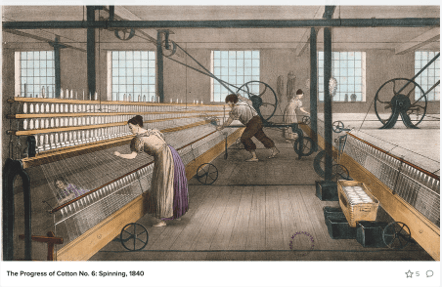
James Richard Barfoot, The Progress of Cotton: a Series of Twelve Engravings, Darton, 1840, Yale University Art Gallery
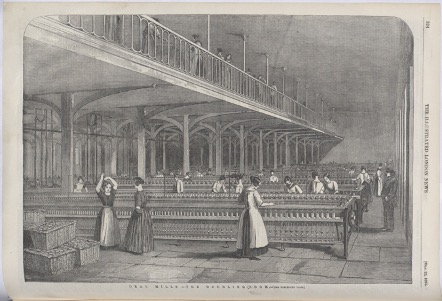
Dean Mills: The Doubling Room, Illustrated London News, October 25th, 1851
PICTURE
(Earliest photograph of English workers)
James Cox, centre of the front row, surrounded by some of the men he worked with. The photograph was taken circa 1848. James Cox came to Manchester from Ireland in 1846 during the famine years. He first lived near Oxford Road Station, Mary Street, an area known as “Little Ireland”. He also worked on the Manchester Ship Canal in the later years of the 19th century. Mr. Cox, although he lived in the worst slum in Manchester, “Little Ireland”, does not appear to be poor or to have suffered hunger!
[reference mislaid]
The workers may appear a little shorter than average, but this may be due to the fact that they are from Manchester.

