Reports of Animals deposited, sold, or slaughtered in Manchester
Note that the amount per person is fairly constant in these data, although types of transaction investigated are different from year to year.
The detailed calculations and the sources are to be found in the external file “Manchester Meat Market Reports”
| Years: 1801 – 1810 Yearly Average Animals: Cattle 10,988; Calves 12,252; Sheep 58,679. Evidence: Inspections of Hides and Skins Select Committee on the Distressed State of Agriculture, 1821 Consumption “on the bone”. Pounds / person /week. 2.10 Consumption edible meat. Pounds / person / week. 1.26 Consumption edible meat. McDonalds quarter pounders / person /week 5.04 |
| Inspections of Hides and Skins, Select Committee on the Distressed State of Agriculture, 1821 Years: 1811 – 1820 Yearly Average Animals: Cattle 14,252; Calves 14,692; Sheep 73,682. Evidence: Inspections of Hides and Skins Select Committee on the Distressed State of Agriculture, 1821 Consumption “on the bone”. Pounds / person /week. 2.05 Consumption edible meat. Pounds / person / week. 1.23 Consumption edible meat. McDonalds quarter pounders / person /week 4.93 |
| Inspections of Hides and Skins, Select Committee on the Distressed State of Agriculture, 1821 Years: 1815 – 1820 incl. Yearly Average Animals: Cattle 37,133; Calves 43,326; Sheep 24,553 (Total Liverpool, Manchester, Leeds, Sheffield) Evidence: Inspections of Hides and Skins Select Committee on the Distressed State of Agriculture, 1821 Consumption “on the bone”. Pounds / person /week. 2.36 Consumption edible meat. Pounds / person / week. 1.41 Consumption edible meat. McDonalds quarter pounders / person /week 5.64 |
| Manchester Statistical Society Year: 1836 Year Total Animals: Cattle 40,820; Calves 11,791; Sheep 105,040; Lambs 96,968 Evidence: Reports from Toll Offices Consumption “on the bone”. Pounds / person /week. 1.94 Consumption edible meat. Pounds / person / week. 1.17 Consumption edible meat. McDonalds quarter pounders / person /week 4.66 |
| Manchester Smithfield Market, Weekly Reports, Sales, 1834 Sales Week of May 7, 1834 Week Total Animals: Cattle 652; Calves 68; Sheep 2,646; Lambs 662; Pigs 658. Evidence: Weekly Reports, Manchester Times Consumption “on the bone”. Pounds / person /week. 1.86 Consumption edible meat. Pounds / person / week. 1.12 Consumption edible meat. McDonalds quarter pounders / person /week 4.47 |
| Animals slaughtered in Manchester Years: 1849, 1850, 1851 Yearly Average Animals: Cattle 67,484; Calves 12,434; Sheep 287,880; Pigs 30,133 Returns from Abattoirs and Market Inspectors. Braithwaite Poole, Statistics of British Commerce Consumption “on the bone”. Pounds / person /week. 2.95 Consumption edible meat. Pounds / person / week. 1.77 Consumption edible meat. McDonalds quarter pounders / person /week 7.08 |
| Salford Market Cross Lane, Weekly Reports, Sales, Reports: 6 Individual Weekly Reports, 1849-1855 Average of 6 Weekly Reports: Cattle 1,320; Calves 121; Sheep 6,084. Consumption “on the bone”. Pounds / person /week. 2.59 Consumption edible meat. Pounds / person / week. 1.55 Consumption edible meat. McDonalds quarter pounders / person /week 6.21 |
Copy of Weekly Market Report:
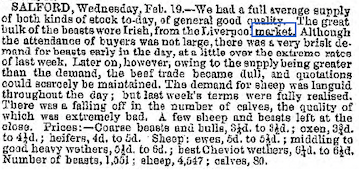
Salford Market Cross Lane, Weekly Market Report, February 19, 1851 (extract)
Number of beasts, 1,551; sheep, 4,547; calves, 80.
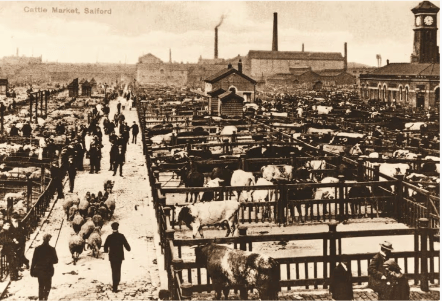
Cross Lane Market, Salford, Manchester
(The only meat market in the Manchester Conurbation from 1837; the second largest meat market in the country after Smithfield in London)
From 1837, the animals were bought and sold at Cross Lane Market. The majority were walked from the nearby train station to the shop of the butcher, where they were killed and cut up into joints. A further quantity of animals was walked to the abattoirs where they were killed and cut up, and the pieces were transported to butcher’s shops. A last segment was killed, and transported to surrounding towns.
There were 550 butcher’s shops in the Manchester Conurbation in 1841, according to Pigot’s Directory 1.14 (see external files, Manchester Supplements Butchers A / B / C; with names and addresses).
1.14 Pigot & Co.’s ….. Directory of Yorks, Leics, …Great Manufacturing Towns of Manchester and Salford, 1841, pp. 733-735.
The calculation of the meat actually eaten, requires the percentage of flesh in the carcasses:
“The amount of edible flesh carried by such carcasses has also been analysed (*), and it too varies according to the type of carcass 1.15
Type of Carcass
Lean. Average Fat
Lean Meat 66% 59% 50%
Edible Fat 13% 21% 32%
Tallow Fat 3% 4% 5%
Bone 18% 16% 13%”
(*) Quoted source not findable
The report about unskilled and semi-skilled workers in Manchester and Dukinfield in 1836, shows a consumption in Manchester of 1.0 to 2.0 pounds per person per week, and in Dukinfield of 0.5 to 1.0 pounds per person per week.
1.15 Gibson, A. G. S., “The Size and Weight of Cattle and Sheep in Early Modern Scotland”,
Agricultural History Review, Vol. 36, pp. 162-171, 1988
The rapporteur to the Poor Law Commissioners in Lancashire in 1834, Mr. Tufnell, gave the following information as to the amount of food eaten by the better class of workers:
“The mode of living of the factory workmen will be seen from the following extracts:-
“What do the factory operatives usually live on?” “They won’t take anything but the best of flour, potatoes, and mutton. I hardly go into one house but what I see they have beer; and they have five meals a day; breakfast at eight, lunch at eleven, dinner betwixt twelve and one, their bagging at four, and supper about seven.”
“For how many of these meals do they leave the mill?” “Breakfast, dinner, bagging, and supper; they only lunch in the mill, on beer, and bread and cheese.”
“Do they eat meat every day for dinner?” “I think generally they do; they live full as well as most labouring people; better than farmers in general; they would not eat the same flour as is eaten in farm-houses.”
“Do they live better than the hatters and hand-loom weavers?” “Yes, they do; the hand-loom weavers are the most miserable part of the population; they scarcely eat meat once a week.”
Mr. Butcher, overseer [Poor Law administrator] of Salford, Hulme, and part of Manchester, says that the factory operatives “in a general way have fresh meat about twice a week, fried bacon two days a week, and liver and a little bacon generally on a Friday, and the other two days bread and cheese, bread and butter, and water-gruel”. The overseer of the township of Heap, in answer to my question concerning the usual diet of the factory operatives, says, they have either tea or coffee for breakfast, and fresh meat for dinner, and tea in the afternoon; and for supper, porridge, which some of the poorer classes have in the morning. The same witness also states, that the factory operatives are better off than any other class, except perhaps general mechanics, and that he has not had to relieve one spinner since he came into office.”” 1.16
The sampled workers in Manchester and Dukinfield ate from 5 to 7 lbs. of bread per person per week (including in some cases, oatcakes): this was the normal consumption in England.
Dr. Kay informs us of a great improvement in food quantities from 1832 to 1862:
“The diet and household management of the factory operatives have undergone a great change since this was written. Tea, coffee, wheaten bread, and animal food, are now much more consumed.- J. P. K. S. 1862”. 1.17
1.16 Factories Enquiry Commission, “Supplementary Report”, Part I, D2 Lancashire District, 1834; Report by Mr. Tufnell, pp. 203-4
1.17 Kay-Shuttleworth, Dr., “Four Periods of Public Education”, 1862, note on page 8, updating his original report of 1832.
The weekly provisions for prisoners in the Manchester New Bailey in 1844 were as follows: 1.18
| s. d. | |
| Seven loaves of twenty ounces each, costing | 1 1 |
| Thirty-one ounces of flour | 0 4 |
| Five pounds of potatoes | 0 1 |
| One pint of pease | 0 1 |
| Three ounces and a half of salt | 0 0 |
| One pound of beef | 0 4 |
| One quart of beer | 0 0 |
| Total | 1 11 |
These data show consumption of 2 and 3 pounds of meat per person per week 1.19
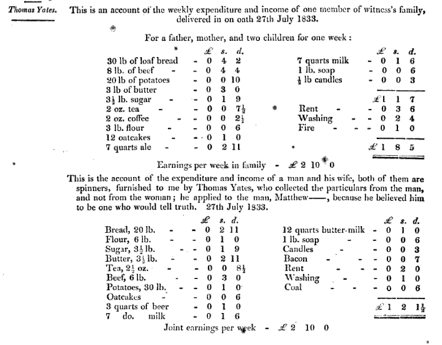
1.18 Kohl, 1844, p. 111
1.19 “Factories Inquiry Commission, Supplementary Report, Vol. I”, 1833, D. I. Lancashire District, Bolton, Evidence Thomas Yates, p. 170

