In 1843, a number of young men in the Manchester Athenaeum, led by William Marsden and Robert Lowes, embarked on a campaign to convince the owners of shops, warehouses and factories to reduce the working day on Saturdays, from a whole day, to a half-day ending at 1 pm. This was done without reduction of weekly earnings. They were successful, and a joint document was signed by 440 business owners in September 1843.
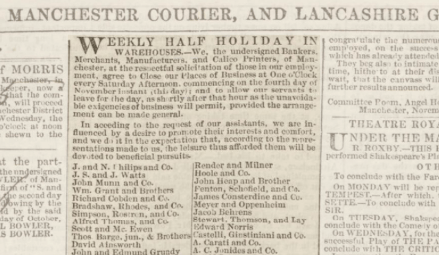
Manchester Courier, and Lancashire General Advertiser, Saturday, November 4th, 1843
http://www.genesreunited.co.za/searchbna/viewrecord/bl/0000206/18431104/054/0005
British Newspaper Archive
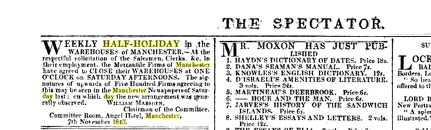
The effect was to give the working people more time for leisure activities on Saturdays, including concerts: 1.24
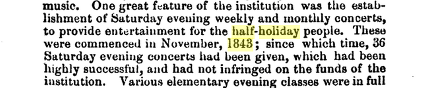
[The above document included a report of the short verbal presentations by each of the self-help organizations present, as to their membership, libraries and lectures given]
“A soirée held in the Town Hall, to celebrate the Saturday half-holiday granted by the merchants, &c., of Manchester, to the persons in their employment.” 1.25
1.24 “Report of the Proceedings Connected with the Grand Soirée of the Manchester Athenæum, Held on Thursday, October 3rd, 1844”: From the Manchester Guardian of Saturday, October 5th, 1844, Printed by Cave & Sever, Manchester, 1844; p. 6.
.25 Axon, William Edward Armytage, “Annals of Manchester”, November 1844, p. 244.
“The first thing, then, which strikes the observer as an essential and fundamental part of the factory system, is the comparative lightness of the actual labour – the comparatively small amount of physical strength required in any of the processes. In truth, the engine is the worker. The operative is the superintendent of the engine’s labours.” 1.26
[This statement was true in 1849, and earlier dates, but not true before 1835]
1.26 Reach, “Letters to the Morning Chronicle”, p. 9.

