THE EXPRESSION “THE HUNGRY FORTIES” WAS NOT USED IN WRITING IN THE NINETEENTH CENTURY. ACCORDING TO THE OXFORD ENGLISH DICTIONARY, THE FIRST USAGE WAS IN 1903; THE FIRST EDITION IN WHICH THE O. E. D. GAVE AN INFORMATION ABOUT THE PHRASE, WAS OF 1930.
THE TERM COMES FROM THE TITLE OF A BOOK PUBLISHED IN 1904.
SEE THE EXTERNAL FILE “THE HUNGRY FORTIES”
Herewith, a list of the types of “operatives” in the cotton industry in the Manchester area in 1833:
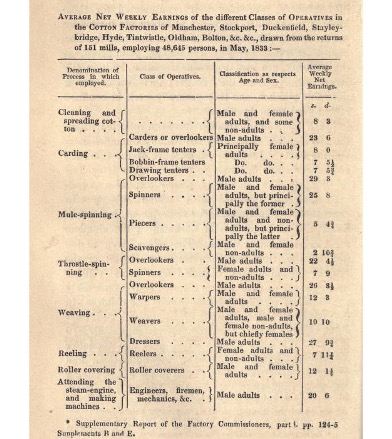
There are no comments by contemporary persons, that the cotton workers had poor wages:
| “The wages obtained by the operatives in the various branches of the cotton manufacture are, in general, such, as with the exercise of that economy without which wealth itself is wasted, would be sufficient to provide them with the decent comforts of life – the average wages of all persons employed (young and old) being from nine to twelve shillings per week. Their means are consumed by vice and improvidence. But the wages of certain classes are exceedingly meagre.”1.03 |
1.03 Kay, Dr., 1832, pp. 26-27
The most complete collection of wage data for our period, in Lancashire, is the following document:
Chadwick, David, On the Rate of Wages in Manchester and Salford, and the Manufacturing Districts of Lancashire, 1839-59 1.04
Mr. Chadwick says that he revised the individual data with representatives of the business owners, and with representatives of the workers, and that the figures were in general accepted.
The document is long, so that here we shall present only some of the most interesting points. We note that the list gives a number of types of employment outside of the cotton industry.
1.04 Chadwick, David, On the Rate of Wages in Manchester and Salford, and the Manufacturing Districts of Lancashire, 1839-59; Journal of the Statistical Society of London, Vol. 23,
No. 1 (Mar., 1860), pp. 1-36.
https://www.jstor.org/stable/2338478
The wages in 1839, 1849, 1859, for a number of tasks in the cotton industry were the following 1.05:
| 1839 | 1849 | 1859 | ||
| s. d. | s. d. | s. d. | ||
| SpinnersSelf-acting mules | Men | 16 0 | 18 0 | 20 0 |
| SpinnersThrostles | Women | 7 0 | 7 6 | 9 0 |
| Warpers | Men | 22 0 | 22 0 | 23 0 |
| Doublers | Women | 7 0 | 7 6 | 9 0 |
| Piecers 14 to 18 yrs. | Boys | 5 6 | 5 6 | 6 0 |
| SpinnersHand-mules | Men | 25 0 | 21 0 | 25 0 |
| WeaversPower-looms(2 looms) | Women | 9 0 | 9 0 | 10 0 |
| WeaversPower-looms(4 looms) | Women | 17 0 | 16 0 | 18 0 |
| Hand-loom weaversFancy fabrics (working at their own house) | Men | 16 0 | 15 0 | 16 0 |
(In all cases, the hours were 69, 60, 60)
1.05 Chadwick, 1860, Tables (N), (O), (P), pp. 23-25
The reduction of the number of hours given for 1849 and for 1859, against 1839, is due to the Ten Hours Act of 1847.
The number of places in a typical cotton mill was as follows (but note the distribution of the sexes) 1.06
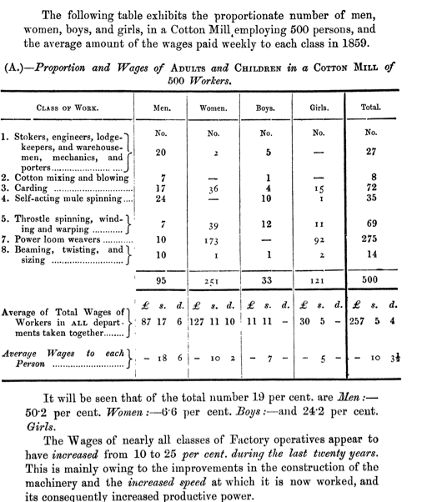
1.06 Chadwick, 1860, Table (A), p. 5
We note that the work of spinning is done by a “self-acting mule” or by a “throstle”, and that the work of weaving is done by “power loom”, such that the workers do not have to expend much physical effort. As Mr. Chadwick says, “it cannot be considered very laborious work for even women or children.”
Here we have a typical list of food and other expenses for a family which has a total income of 30 shillings a week, in 1859, 1849, 1839 1.07
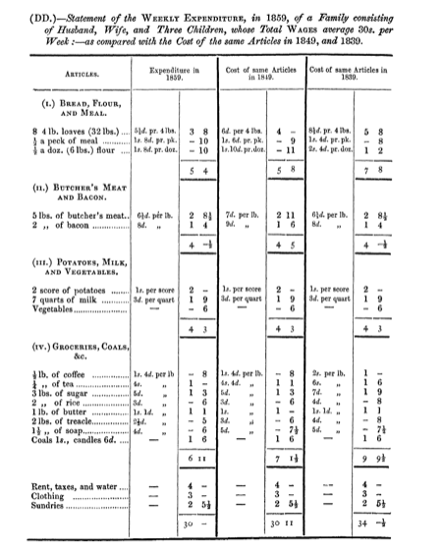
1.07 Chadwick, 1860, Table (DD), p. 24
Herr Kohl, a well-known writer of travel guides, informs us about the highest level of wages for working-class men (highly qualified mechanics):
“I had the pleasure of visiting one of the greatest machine-making establishments in the world; namely, the so-called Atlas-Works of Messrs. Sharp and Roberts. These gentlemen have two manufactories, one for general machine-making, the other for the manufacture of locomotive engines, and of those enormous tools used in the making of machines. …..”
“Mr. Sharp died a short time ago, and his funeral was attended by all his mechanics and work-people, 800 in number. As not one of these workmen had weekly wages less than twenty-five shillings, and many earned four or five pounds, a week, the amount of capital necessary to carry on such a business must be enormous.” 1.08
1.08 Kohl, J. G., “Ireland, Scotland and England”, England and Wales, 1844, p. 125
On the other hand, we see that the persons in the poor-house had enough food to live on:
“I yesterday visited the poor-house, and send some particulars from the last year’s report for your information. There were in the house 233 men, 83 boys, and 77 girls; 9 of the men, and 39 of the women, were between 80 and 90 years of age. The weekly expenses for every person is –
s. d.
Food 2 0 ¾
Clothing 0 5 ½
Total 2 6 ¼
Their breakfast consists of rice and milk, oatmeal porridge; their dinner, two days in the week, of meat and vegetables; and the remaining five days they have soup, or potato soup, with a sufficient quantity of bread.” 1.09
1.09 F. von Raumer, “England in 1835: being a series of letters written to friends in Germany, during a residence in London and excursions into the provinces”, 1835, Vol. 3, p. 225.
In 1841, Mr. Nield, mayor of Manchester, decided to make a comparison of wages and expenses, for 12 families of Manchester and 7 families from Dukinfield, between the year 1836 and the year 1841. The “background” to this was the catastrophic depression in the North of England, which had started in 1838, and would end in 1842. Thus the data for 1836 refer to a “normal” economic situation, and the data for 1841 refer to a “very abnormal” situation. 1.10
The families chosen for the report were as follows (note that they are – almost all – unskilled or semi-skilled occupations).
| Job Description | NumberPersons | IncomeFamily1836(shillings) | ExpenseMeatFamily1836(shillings) | |
| 1 | Machine Printer | 9 | 87 | 9 |
| 2 | Millwright | 10 | 90 | 7 |
| 3 | Watchman | 2 | 15 | 1 |
| 4 | Stoveman | 8 | 57 | 6 |
| 5 | Washer | 2 | 14 | 1 |
| 6 | Overlooker | 6 | 34 | 3 |
| 7 | Labourer | 4 | 22 | 1 |
| 8 | Labourer | 4 | 21 | 3 |
| 9 | Dyer | 10 | 40 | 2 |
| 10 | Blue Dipper | 5 | 20 | 0 |
| 11 | Watchman | 7 | 21 | 0 |
| 12 | Dyer | 9 | 23 | 2 |
| 13 | Power Loom Weaver | 3 | 21 | 1 |
| 14 | Dresser | 6 | 37 | 2 |
| 15 | Labourer | 6 | 28 | 2 |
| 16 | Card Room Hand | 3 | 13 | 1 |
| 17 | Spinner | 5 | 21 | 1 |
| 18 | Warehouseman | 4 | 16 | 1 |
| 19 | Mechanic’s Assistent | 7 | 23 | 1 |
1 TO 12: MANCHESTER, 13 TO 19: DUKINFIELD
See the external file: “Income Expenditure Manchester Dukinfield 1836”
A number of the workers have large families. But they do have good incomes. Generally, they do not eat much meat (1 shilling buys 2 pounds weight). The rent is from 8 % to 16 % of the Total Family Income.
1.10 Nield, William, “Comparative Statement of the Income and Expenditure of certain Families of the Working Classes in Manchester and Dukinfield, in the Years 1836 and 1841«, Journal of the Statistical Society of London, Vol. 4, No. 4, January 1842, pp. 320-334.
To see if the generality of the working-class families had an excess of income over expenses, we can inspect the amounts of the deposits in the Savings Banks.
The Government Savings Banks were institutions under the supervision of the central government. They were only open to deposits by the labouring classes, with maxima of monthly deposits, and maxima of total balance. Husbands and wives could have separate accounts. The interest rate was around 3 % p. a.
The total population in the Manchester Conurbation in 1849 was close to 420,000, thus the number of working-class families was about 55,000. Approximately 45 % of working-class families had an account. The average investment was 25 Pounds per family. 1.11
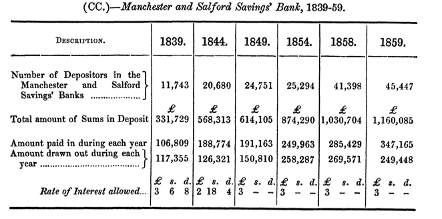
1.11 Chadwick, 1860, Table (CC), p. 34
The number of accounts per type of occupation in 1860, was as follows 1.12
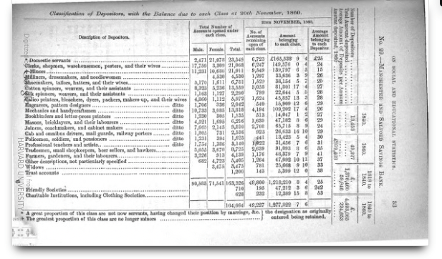
1.12 Chadwick, David; “Social and Educational Statistics of Manchester and Salford, 1860”.
Classification of Depositors, with the Balance due to each Class at 30th November 1860,
Manchester Statistical Society, November 1861, p. 33

