M. Faucher in 1844 mentioned “the poor quarters of the town – Angel Meadow, Garden-Street, Newtown, St. George’s Road, Oldham Roads, Ancoats, and Little Ireland. …” 2.11
Herr Johann Georg Kohl made visits to several parts of Manchester, including the poor parts near the rivers Irk and Irwell. “Sometimes the work-people of each manufactory form a little community by themselves, living together in a neighbourhood in a little town of their own [probably he means Ancoats]; but in general they occupy particular quarters of the town, which contain nothing but long unbroken rows of small low dirty houses, each exactly like the other. These quarters are the most melancholy and disagreeable parts of the town, squalid, filthy and miserable, to a deplorable degree.” 2.12
Mr. Nassau Senior, a politician who was a firm proponent of the New Poor Law, visited Manchester on a fact-finding trip. He was steered in the right direction: “The difference in appearance when you come to the Manchester operatives is striking: they are sallow and thinner. But when I went through their habitations in Irish Town, and Ancoats, in Little Ireland, my only wonder was that tolerable health could be maintained by the inmates of such houses.” 2.13
2.11 Faucher, Léon, “Manchester in 1844, its present condition and future prospects,” 1844, p. 27
2.12 Kohl, J. G., “England, Wales and Scotland”, 1844, p. 133
2.13 Senior, Nassau W., “Letters on the Factory Act, as it affects the Cotton Manufacturer; Addressed to the Right Honourable The President of the Board of Trade”; 1837, p. 16
“Several of the habitations of the Manchester poor are low, damp, ill-ventilated, and surrounded with filth. This is especially the case in Little Ireland, and the neighbouring district, which is chiefly inhabited by Irish. This, however, the most destitute part of the population, does not in general work in factories; but it would be a great improvement in their condition if they did, as the worst room in a factory is a palace of health and comfort in comparison with their miserable dwellings. The factory workmen are usually in a very comfortable condition, many of their houses displaying neatness, and even elegance in their arrangements; and when I visited them at dinner-time, the occupants were generally eating fresh meat and potatoes.” 2.14
The rapporteur for Manchester to the Poor Law Commissioners in 1842, Dr. Howard (Physician to the Ardwick and Ancoats Dispensary), made it clear that, although there were really horrible districts in Manchester, these were confined to a small number of regions.
“That the filthy and disgraceful state of many of the streets in those densely populated and neglected parts of the town where the indigent poor chiefly reside, cannot fail to exercise a most baneful effect on their health, is an inference which has fully proved to be well founded; and no fact is better established than that a large proportion of the cases of fever which occur in Manchester originate in these situations.” 2.15
2.14 Factories Inquiry Commission, Supplementary Reports, Part I, 1834; D2 Lancashire District, Report by Mr. Tufnell, p. 204.
2.15 Poor Law Commissioners, Local Reports, 1842, Lancashire, p. 305
“It appears to me to be unnecessary to lengthen this report by specifying the particular localities in which nuisances, productive of malaria, tending injuriously to affect the health of the inhabitants, and to promote the prevalence of contagious diseases, exist; but it may be well to mention a few of the streets which, either from being unpaved, or without drains, or containing collections of refuse, &c., or being over-crowded and ill ventilated, have been remarked to be particularly unhealthy.” (ibid., p. 312)
“These two districts [Ancoats and Angel Meadow] are very densely populated, principally by hand-loom weavers and the workpeople employed in the factories, a large proportion of whom are Irish, living for the most part in a state of extreme indigence, and without the least attention to cleanliness. Altogether they comprehend by far the worst quarters of the town both as regards the wet and filthy state of the streets, the dirty, damp and dilapidated condition of the houses, and the improvidence, poverty, and destitution of the inhabitants; and, as might be anticipated, they furnish the great bulk of our fever patients.”
(ibid., pp. 313-314)
“Thus in the moral topography of Manchester, Angel Meadow, which comprises a number of streets, New Town, Blakely-street, St. George’s-road, Oldham-road, Great Ancoats-street, and Pollard-street, Deansgate, Little Ireland, Pop Gardens, Gaythorn and Knott Mill, are the districts which may be pointed out, as principally occupied by the criminal portion of society; ….” 2.16
2.16 Neale, William Beaver, “Juvenile Delinquency in Manchester: its causes and history, its consequences, and some suggestions concerning its cure”, 1840, p. 8.
After the Cholera Epidemic of 1848-49, a doctor and a registrar made out a report, which they sent to the Registrar-General of England and Wales. 2.17
They make a number of comments as to the sanitary situation and density of drains in the different part of the Manchester Conurbation. The drainage is better than in 1840, but the small back streets have not been totally improved.
“It can scarcely be said now that Manchester is a badly sewered town, large wide sewers with the necessary regard to the due inclination have been laid in most of the streets, and the Corporation has been most active in carrying out the sewering and paving of all streets requiring it, whether old or new, and nothing is wanting but a sufficiency of water for flushing. It is hoped that on the completion of the water water-works, sufficient water will be obtained for this purpose.
It is in the courts and alleys and in the condition of house-drains that the greatest deficiencies exist; these are usually left to be drained by the landlord, are in a most wretched and unwholesome condition.” 2.17
2.17 John Leigh (M. R. C. S. of England) and Ner Gardiner (Superintendent Registrar of Manchester),“History of the Cholera in Manchester, in 1849; as reported to the Registrar General of Births, Deaths, &c.,”, 1850.
https://wellcomecollection.org/works/bc8tk2tn
Consult the map of Manchester in 1849, showing the districts most affected by the typhus. (p. 7)
“The artificial drainage of Manchester by sewers has of late years been rendered very complete.”
Ibidem, p. 8
“In the examination of the streets and houses of Manchester, it is impossible to avoid the comparison of the wide, airy, clean and dry streets that are found in most parts of Hulme, Chorlton-upon-Medlock, and Ardwick, with the narrow streets, close-winding alleys, and crowded pent-up courts, to be found in many parts of Manchester. The out-townships, again, have the advantage of a dry, gravelly soil, with considerable elevation, whilst Manchester in built on the clay. The houses in the out-townships are of much more recent erection, and built with greater reference or attention to comforts and conveniences.”
Ibidem, p. 8.
“It is in the dirty back streets, the close-crowded, ill-ventilated, damp and badly-drained dwellings that are to be found in every large manufacturing town, that we are to seek them. … Long Millgate …Angel Meadow … Little Ireland … the great mass or block of streets lying between Great Ancoats-street, Oldham-road, Butler-street, and Every-street.»
Ibidem, p. 9,
The following report by the Manchester Statistical Society, about the condition of the working population, refers specifically to the “district inhabited more than any other in the town by the working classes and by those of the poorest description”. Geographically the area includes the Ancoats district, and also the Police District with the largest number of lodging houses. 2.18
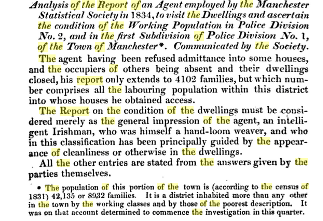
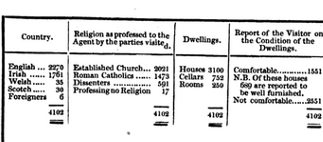
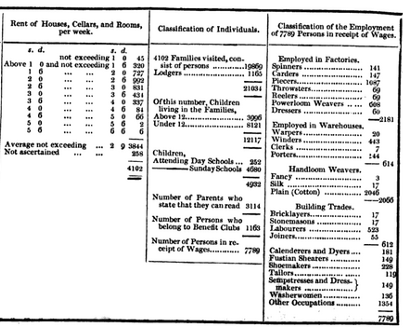
This report shows that the people in these districts had bad housing (60 % not comfortable; 85 % not well furnished), and did not pay much rent. We assume that they did not have good incomes, that is, the average was about 12 shillings for the total family, and a maximum of 16 shillings. However, 30 % paid a monthly charge to a Benefit Club (self- insurance for illness or death), and one child per family attended Sunday School. Only 0.5 persons per family worked in a factory.
2.18 British Association for the Advancement of Science; Report of the Fourth Meeting, held at Edinburgh in 1834, Report by the Manchester Statistical Society; John Murray, London, 1835; pp. 690-691.
This last point is interesting, because all these people lived near the large cotton mills, which employed perhaps 5,000 workers (men, women and children) in Ancoats. The assumption must be that the lower income workers lived near the factories, and in bad housing conditions, and the skilled workers lived in better areas, at a distance from the factories.
But the inhabitants of this area did have a certain cultural level:
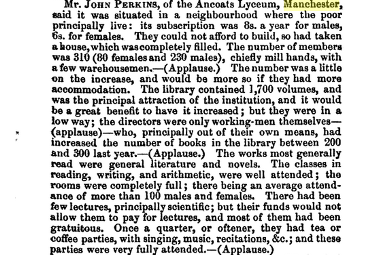
In 1844, a general meeting of the “self-help” organizations in Lancashire was held in the Atheneum, Manchester. The Ancoats Lyceum, situated in one of the poorest areas of Manchester, gave a presentation of their successes in forming a library, and in giving classes.2.19
2.19 Report of the Proceedings … Ancoats Lyceum: From the Manchester Guardian of Saturday, October 5th, 1844, Manchester; p. 7.

