The list of the higher numbers of occupations of adult persons in the conurbation of Manchester in 1851 (Census), is given in the annexed file “Manchester Supplement Occupations 1851”.
From this we see that adult employment in the cotton industry is only 28 % (adult males) and 33 % (adult females) of the total. These are the “workers” in the “Engels” sense, who are employed in large companies, and thus are at a disadvantage against the business owners. The cotton operatives normally had three family members in the mills, and therefore had 30 to 40 shillings total income, in comparison with the often quoted 11 shillings per average person in the mills.
The other groups of occupations are in a free price system, their wage was sufficient to leave a little margin with respect to their food, clothing and rent costs. In some cases, they had also to cover their raw materials costs: meat for butchers, wood for carpenters, leather for shoemakers, etc. The domestic servants were usually paid a small amount in cash, and had bed and food free.
The professional persons, when they proffered an opinion about the workers in general, said that they could be divided in two groups, the “wasters” and the “disciplined” [expressions of this author]. The “wasters” although they earned good wages, they spent everything they had they could on drink, often at the cost of not being to pay for food, rent, and clothing. The “disciplined” did not spend money that they did not have, did deposit moneys in the Government Saving Banks, did spend a little on beer, and went to classes in the Mechanics’ Institutes and the Hall of Industry.
The following comparison is taken from the “Local Report” to the Poor Law Commissioners. It does explain why the better classes had a low opinion of the working classes. 1.02
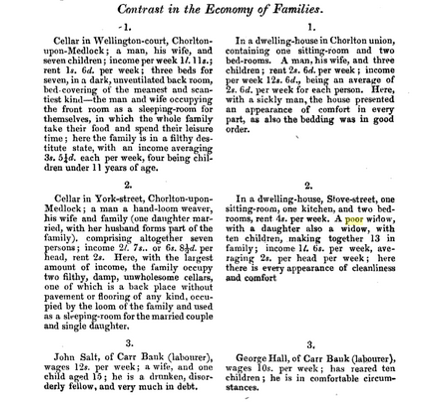
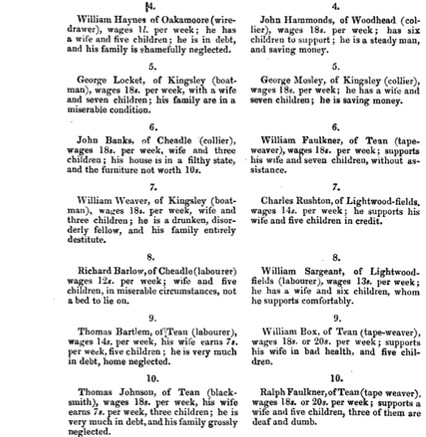
1.02 Poor Law Commissioners, Local Reports on the Sanitary Condition of the Population, 17. Lancashire, Cheshire, Derbyshire and Staffordshire, 1842, pp. 238-239.
The Irish were about 15 % of the population. A large number of them were from the poorest parts of Ireland (the West Coast), and often they did not speak English when they arrived in England. Generally, they were not liked. They worked in informal jobs. Some imported pigs from Ireland that they could slaughter in their backyards, and then sell the pigmeat.

