7.9. Reasons adduced to the Committees in 1834 and 1835

The rapporteur of the “Analysis of the Evidence taken before the Select Committees on Hand-Loom Weavers’ Petitions (1834-1835)” gave a number of possible causes of the bad situation of the weavers, of which the most important were: reduction of wages, over-production of goods, home competition, want of combination, machinery, the power-loom, and twist exportation. As he says, the reduction of wages should more properly be considered as an effect resulting from some operating cause. 

As to the over-production of goods, we have a statement “the more you create an excess of supply of the commodities made up by an over-worked population, in so far you diminish the demand for their labour in producing that article; you diminish their wages and you increase their labour to enable them to purchase a sufficiency of food.” (p. 12).

Also the increase in the amount of yarn given to the weavers, requires them to produce more for the foreign market, which has a very low margin, and then decreases their wages. 

The competition alluded to is that between the individual masters and between the individual wholesalers. These are continuously trying to sell the cloth that have bought, and always have to underbid the other person; this is particularly so in the domestic market. Thus they have to hold down the price that they pay to the weaver.

The want of combination refers to the fact that the hand-loom weavers are not in a good position to make a common front against the masters and wholesalers who are buying the woven cloth.  All the other workers in the chain of production of cotton goods earn around 20 shillings a week, but the weavers only have 5 shillings a week. “The reason why the wages of spinners have not fallen in the same ratio that the weavers’ have, is, the spinners being assembled more under one roof are more capable of combining, and by combination they have opposed a barrier to reduction, inasmuch as the mill-owner having a capital invested he is interested in having his machinery moving, for it suffers from standing, and not being worked. So that in the other case the hand-loom weavers is the machine [sic], and the manufacturer does not suffer in like proportion.” (p. 17).

According to the rapporteur, machinery is the chief cause assigned for the prevailing distress of the hand-loom weavers. There are two variants: firstly, the machinery introduced in the cotton spinning industryhas caused a continuous reduction in prices, and at such a velocity that in many cases the cotton goods can be purchased, even retail, for less than the cost of production (p. 18).Thus the spinning mills have to discharge their best-paid workers, which causes a decrease in the average wages in the mills, and an increase in unemployment. Your author cannot follow this argument, as it is in contrast to the facts: the weekly wages in the spinning mills did not go down, rather the absolute wages went up, because the volume spun per day went up. Further, this does not explain anything to do with the hand-loom weavers.   

The second variant comes from Mr. John Marshall, the most important flax-spinner, who relates the problem to the machinery in the woollen spinning industry. The introduction of mechanical processes in a number of steps in the wool spinning process brought down the total cost of spinning, and made it impossible for the women, children, and old men in the villages in the whole of England to sell their spinning labour, and thus made them considerably poorer. According to Mr. Marshall, this meant that many people had to migrate to the textile manufacturing areas, and thus the enlarged pool of labour had to be content with lower unit wages. This then would cause a decrement in wages for the hand-loom weavers. Your author cannot follow this argumentation, because the decrease in the wages of the hand-loom weavers was not caused by an excess of persons in comparison to the amount of work to be done; there was so much work to be done that the weavers were working 12 hours a day, and the power-looms could not be constructed rapidly enough to take up the difference.

The rapporteur confirms that the power-loom, according to the testimony of a number of witnesses (owners and weavers), has not reduced the wages of the hand-loom weavers. This, because the power-loom does not and cannot work the type of cloth which is manufactured on the hand-looms, but rather is used for large-scale continuous production of simple and harder cloths. The advantage in costs – if there is one – to the power-loom, is not enough to make a changeover useful.     

The persons interviewed agree that the exportation of cotton twist harmed the competitive position of the English hand-loom weavers. Further, the fact that the continental manufacturers were able to use the English yarn, gave them a chance to put on a larger scale their weaving industry.    

7.8. Composition of Costs of the Wholesaler

The question is, why were the masters and the wholesalers so insistent upon pushing the payments to the weavers down to an absolute minimum? The amounts per weaver were very small. What happened arithmetically, was that the costs of weaving, in shillings per piece, were high. The hand-loom weavers were very inefficient in comparison with the spinning machinery, and thus the weekly payment to the weaver was divided by a small quantity of cloth. We see from the following table that the unit costs of the spinning operation were reduced to one-tenth from 1782/85 to 1826/30, in spite of the large increase in the wages of the spinning personnel; the unit weaving costs reduced by only a quarter.

Cost Components (deflated), printing cloth; (shillings per cloth) 

 ClothYarnCottonCloth-YarnYarn–Cotton
1782/8549.042.911.46.131.5
1786/9040.433.610.36.823.3
1791/9534.625.710.69.015.1
1796/180030.920.011.810.98.2
1801/0523.615.07.88.67.1
1806/1015.810.87.35.03.5
1811/1519.59.46.710.12.7
1816/2016.78.85.97.92.9
1821/2514.17.33.96.83.4
1826/309.85.22.84.52.5

(Harley, Prices and Profits, 2010, Table 2, p. 10)

“What proportion do the wages of the weavers of counterpanes and quilts bear to the value of the articles?” “Sometimes half; it depends upon the material of which they are made; upon the average about half.”

(Select Committee on Hand-Loom Weavers’ Petitions, 1834, p. 356, Mr. Thomas Myerscough, Manufacturer with hand-loom weavers, Bolton)

“Do you consider that wages form so small a portion of all the branches of manufacture with which you are connected, that they might be raised, so as to place the weaver in far better circumstances, without in any way injuring the trade?” “Yes, I do think so; for the wages in the branch in which I am engaged form only about three-eighths of the cost of the goods.” 

(Select Committee on Hand-Loom Weavers’ Petitions, 1834, pp. 383, Mr. John Makin, Manufacturer, Bolton)

7.7. Over-Production and Home Competition

“Can you point out any other cause for the distress of the hand-loom weavers to which you think some remedy might be applied?” “Since 1815, when I began to manufacture on my own account, prices have had a continual tendency to fall; there have been temporary reactions, but the uniform tendency has been downwards. This appears to me to arise in a very considerable degree from over-production, itself the effect, I would say, of an intense competition among the manufacturers themselves, which competition I consider has been in a very considerable degree at the expense of the operative, arising from the irresponsible power with which each manufacturer is invested of buying labour as cheap as he supposes he can obtain it, or rather of creating a price of labour himself, which any considerable manufacturer has been able to do.”

(Select Committee on Hand-Loom Weavers’ Petitions, 1834, p. 135, Mr. Thomas Davidson, Manufacturer, Glasgow)

“Have the goodness to explain in what manner what is termed home competition lowers the price of goods and lowers the price of weaving?” “If I and my neighbour have both the same kind of goods to take to market, and we both of us go to the same individual to sell, and I am disposed to sell my goods for less money than my neighbour, then I supplant him in that market, and the operation of it would be when he found it out, as a man of spirit he would go, and most probably, if he could afford, say, “But I will not be outdone in that way; you shall have them at so much less;” and so the thing has been going on shifting up and down, up and down, in that way, till things have got where they are; that is what I call home competition. The same remark applies to the goods when they are sent abroad as when they are sold at home.”

“Is there not a customary rate of profit on capital employed in trade, which customary rate, if the manufacturer does not obtain, he will cease to employ his capital in that way; if two persons are manufacturers, and one competes with the other, selling his goods at a price which will not return him such a customary rate of profit upon his capital, will he not employ his capital in some other way?” “No; we should go to work at this as a man who has his own preservation at stake. In this instance my neighbor has cut me out; I will cut him out, and I think I can nick it in another way, as we express it; I can subtract a little from the width or a little from the quantity; I can put a little coarser material in, or, as a last resort, I will screw down the poor weaver another sixpence, and that will do for me; that is the real and true state of the case.” 

(Select Committee on Hand-Loom Weavers’ Petitions, 1834, pp. 405, Mr. John Makin, Manufacturer, Bolton)

It was also true that the hand-loom weavers were not in a good position to defend themselves against the masters, who were fixing the prices for buying the woven cloth.

“Can you assign a reason why the wages of spinners have not fallen in the same ratio that the weavers’ have?” “The spinners being assembled more under one roof are more capable of combining, and by combination they have opposed a barrier to reduction, inasmuch as the mill owner having a capital invested he is interested in having his machinery moving, for it suffers from standing, and not being worked.”

(Select Committee on Hand-Loom Weavers’ Petitions, 1834, pp. 419, Mr. John Makin, Manufacturer, Bolton)

“Do you consider that wages at present are regulated by the power of starvation on the part of the people, rather than by the degree of profit on the part of the manufacturers?” “Yes.”

(Select Committee on Hand-Loom Weavers’ Petitions, 1834, pp. 385, Mr. John Makin, Manufacturer, Bolton)

7.6. Low Wages and High Volumes around 1830-1834

The main point to be cleared up, is why the hand-loom weavers were receiving such low payments in the years around 1834, when the demand was very high, that is, the workers were forced by the demand to work 12 hours a day.

“The machine-makers of Lancashire are engaged to the full extent of their power in constructing power-looms, so that the number increases almost daily. We should be wrong however if we inferred that hand-looms are lying unemployed. Power looms have not hitherto been found applicable to the production of fine cloths, or what are called fancy goods. …. In the Report of the Select Committee of the House of Commons, appointed in the summer of 1834, ….. we find a statement given in evidence by Mr. Makin, a manufacturer of Bolton, to the following effect: “I know that there is at the present no surplus of weavers. …. But it is a strange fact that, whilst the demand for hand-loom cloth is greater than the production, yet the wages do not rise.””

(Porter, 1836, p. 219)

“At the present time there is no super-abundance of work-people in Manchester; there is an actual scarcity of weavers; I have now about twenty power-looms standing for want of hands, and have a great many unfit hands in the employment for want of better. I could, likewise, at this moment, and for the last two months, have given employment to 300 to 400 hand-loom weavers more than I have been able to get. These are plain calico weavers, and their average wages in a week are about seven or eight shillings; the wages of hand-loom weavers are higher now than they have been for six years.

I consider the insufficient supply of labour in this town one of the chief causes of the employment of children in the factories, and of the high rate of wages that they receive.”

(Commissioners for Enquiring into the Condition of the Poorer Classes in Ireland, Report on the State of the Irish Poor in Great Britain, 1834, Appendix III, Manchester, Lancashire, Cheshire, p. 66, Evidence of John Guest, cotton manufacturer, of Manchester)

“Are the hand-loom weavers in full employment? “Yes.”

“Then it is not from scarcity of work that they are suffering, but from want of adequate wages?” “Yes.”

(Select Committee on Manufactures, Commerce, and Shipping, 1833; evidence of Mr. George Smith, Cotton Spinner, Manchester, p. 565)

“What is the condition of the hand-loom weavers generally in the borough of Bolton, with respect to wages and employment?” “Their wages are lower than ever I have known them at any former period; their employment is complete; I do not suppose there is or needs to be one weaver out of employment, and that has been the case for the last three or four years.”

(Select Committee on Hand-Loom Weavers Petitions, 1834, evidence of Mr. John Makin, Manufacturer, Bolton, p. 388)

“Have you constant employment just now?” “We have had a surplus of work for these six months.”

(Select Committee on Hand-Loom Weavers’ Petitions, 1834, p. 212, evidence of  Mr. Thomas Mallock, Hand-loom weaver, Glasgow)

“Do you not think if we did not get an additional quantity of goods for the manufactures we sent abroad, still there would be additional employment, which would benefit them?” “We have too much employment already, they work till 12 o’clock at night.”

(Select Committee on Hand-Loom Weavers’ Petitions, 1834, p. 355, evidence of Mr. Thomas Myerscough, Manufacture with hand-loom weavers, Bolton)

“The hand-loom is, in fancy goods, more used than the power-loom; yet every year does the number of power-looms increase! Six years ago there were 150,000, and in the empire [Great Britain] now the number probably exceeds 220,000.”

(Whellan, Directory of Manchester & Salford, ….., Booth and Milthorp, London, 1853, p. xxviii) 

This point of the excess of demand over production, can be seen in the following table, which reconstructs very approximately (using a number of estimates from different publications) the weights of woven cotton produced in hand-looms and in power-looms. The column of totals gives figures of the same magnitude as the consumption table some pages above (net of export of yarn, which obviously was not worked in a loom in England). The power-looms, after a long period of continuous improvement, reached a velocity of more than three times that of the hand-looms. The inference is that there is a very large volume of cotton being imported, and that all the available looms – hand-looms plus power-looms – are required. The hand weavers were working full out (until ca. 1838) because their volume was needed. It is not true that the weavers were working very long hours because there was competition between them to produce more cloth, and thus compensate for the low piece rates. The power-looms, which were being built as fast as possible, were giving the possibility of increasing the total production of the country.

Production of woven cotton cloth

Year Hand Looms (*)Lbs. / Loom /YearTotal Prod. ‘000 lbs.Power Looms(*) Lbs. / Loom /YearTotal Prod. ‘000 lbs.
       
179075,00040030,000000
1800160,00040064,000000
1810200,000500100,000 2,0006001,200
1820240,000500120,00014,000120015,600
1830240,000500120,00060,000150090,000
1835210,000500105,000110,0001700187,000
1840120,00040048,000150,0002000300,000
184925,00040010,000240,0002300552,000
Year Total Prod.
Hand Looms
‘000 lbs.
Total Prod. 
Power Looms
‘000 lbs.
Sum of Prod.
Hand and Power
‘000 lbs.
    
179030,000030,000
180064,000064,000
1810100,0001,200101,200
1820120,00015,600135,600
1830120,00090,000210,000
1835105,000187,000 292,000
184048,000300,000 348,000
184910,000552,000 562,000

(*) All Great Britain, not only Lancashire

The Commissioner of the Report on Hand-loom Weavers in 1840 was surprised “at the discovery that notwithstanding the gigantic competition of the power loom the number of hand looms employed in this branch of the trade of weaving is not only considerable, but from almost universal testimony almost as great as at any former period. …. It would seem that the power loom has created for itself a market almost sufficient to carry its own production leaving the demand for cotton cloth nearly as great as before.”

(Knowles, 1922, p. 55)

Year Consumption of
Cotton (lbs.)
Export of Cloth
(Value in Pounds)
   
1835333,043,00052,333,000 
1836363,684,00058,578,000
1837368,445,00051,130,000
1838455,036,00064,812,000
1839352,000,00067,917,000
1840528,142,00073,152,000
1841437,093,00069,798,000
1842473,976,00068,684,000
1843581,303,00082,189,000
1844554,196,00091,039,000
1845679,063,00093,665,000

(Porter, 1851, p. 178)

Hand loom, Yorkshire, mid nineteenth century (this example was used for wool, but the design was similar for cotton); Cliffe Castle Museum, Keighly, West Yorkshire.

Power Loom Weaving 1833 (Swainson, Birley & Co. Cotton Mill); (Baines, 1835, plate, p. 238);

(These people do not live in housing without drainage and with excrement in the streets!)

7.5. Lack of Negative Effects of the Power-Loom

Returning to the question, as to if the introduction of the power-loom had had a negative effect on the wages of the domestic hand-loom weavers, the persons interviewed by Select Committees (owners and workers) were all clear that there had been no – or very little – effect.

“Then you are of the opinion that the distress which now exists is not caused merely by the introduction of the power-loom?” “No; I do not think, generally speaking, that the introduction of power-looms has had so material an effect as many persons might suppose. I stated, as the reason why I formed that opinion, that the cotton trade of this country had increased to a very great extent, within a certain number of years, since the operation of the power-loom had come into effect.”

(Select Committee on Hand-Loom Weavers Petitions, 1834, p. 117, evidence of Mr. William Craig, Coloured trade, handkerchiefs and ginghams)

“Do you attribute the reduction of the wages of the weavers in any degree to the competition of the power-loom?” “I doubt whether the power-loom has tended to bring down wages at all; it is possible that it may have had a small influence, but nothing to the extent to which wages have been reduced.”

“Have the classes upon which the competition of the power-loom has principally fallen been inferior weavers, old people, and persons beginning to weave?” “No; if it has operated at all, it has operated upon weavers competent to weave anything. When power-looms were first introduced, they were employed upon coarser fabrics than they are now employed upon; but generally speaking, the power-loom is now employed upon a distinct species of cloth from what the hand-loom weaver is now employed upon.»

……

Then you think the power-loom has not had the effect of producing, to a very great extent, the evils complained of by the petitioners, but that some other cause is at work, of an evil tendency to hand-loom weavers?” “I think so. I conceive that if the power-loom had not been in existence at all, the same result which has now ensued would have happened, or nearly so.”

(Select Committee on Hand-Loom Weavers’ Petitions, 1834, pp. 380-381, evidence of Mr. John Makin, Manufacturer, Bolton)

“How was it that home competition did not beat down the wages in weaving before the power-loom was introduced?” “It had brought down the weaving at that period of time very low; the great evil had been accomplished before ever the power-loom was introduced; the wages had declined up to that period of time three-fourths whence they set out.”

(Select Committee on Hand-Loom Weavers’ Petitions, 1834, pp. 419, evidence of Mr. John Makin, Manufacturer, Bolton)

It is also not true that the power-loom took away the work from the hand-loom weavers, and thus forced them to offer their cloths at a very low price. For a long time the power-looms could not work the “fancy” weaves.

“Are you enabled to state to the Committee whether it is likely, in your part of the country [Scotland], or any part of the country with which you are personally conversant with the improvements which are taking place in power-loom weaving, that it will be possible for the hand-loom weavers to continue long to be occupied in that branch of the trade?” “I think that a grand mistake exists in supposing the power-loom supplants the hand-loom universally; the power-looms erected in Scotland manufacture a kind of goods in general, which the hand-loom weaver of Scotland was not in the practice of working at all; and therefore they are only partial substitutes for the hand-loom. Before the power-loom weaving was introduced at all in Scotland, about the year 1814 or 1815, the kind of goods generally manufactured by them were not made at all in Scotland, or at least very few of them; and the number of hand-looms in Scotland now, I apprehend to be much more than the number of hand-loom weavers in Scotland at the time that the power-loom was first introduced. I would also say that the hand-loom weaver can work a great many things which it would not be in the interest of any power-loom manufacture to make, especially all the finest goods, fancy goods of all kinds; in addition to this, it is to be recollected that it never can be in the interest of the power-loom manufacturer to make a kind of goods of which he cannot regularly and constantly dispose of a large quantity of the same kind, because changes of any sort are to him extremely inconvenient and troublesome, as well as expensive.”

(Select Committee Shipping Manufacture, 1833, p. 73, evidence of Mr. Kirkman Finlay, General merchant and cotton spinning and weaving manufacturer, Glasgow)   

“Are the hand-loom weavers greatly improved in weaving plain cloth?” “In our part of the country [Manchester] they are; but in other districts they are employed upon finer fabrics, muslins, ginghams and shirtings; they have not yet begun to work on those in the power-loom.”

(Select Committee on Manufactures, Commerce and Shipping, 1833, p. 565, evidence of Mr. George Smith, Cotton-spinner and hand-loom calico manufacturer, Manchester)

“Is there anything in the hand-loom that the power-loom cannot do?” “I should wish to answer that question in this way; I am convinced that the power-loom can do anything that the hand-loom can do; at the same time it will take as much expense to do it, because they can only weave one warp at once. I know that the power-loom can weave a jaconot and a hair-cord, and one man can only attend at one loom.” 

(Select Committee on Hand-Loom Weavers’ Petitions, 1834, pp. 429, evidence of Mr. Richard Needham, Weaver, Bolton)

It was not true, before 1835, that the power-looms could produce more cheaply than the hand-looms. Further, the comparison by unit costs did not cover the whole of the financial calculation, as there were other factors to be taken into account.

“Supposing that you cannot manufacture that particular species of cloth, will not the effect of the power-loom still be that, by causing printed goods to be still cheaper and cheaper, it will throw that species of cloth out of demand?” “I do not think that the power-loom does cause the cloth to be cheaper; the advantage of the power-loom is in being able, and that is a very great advantage, to produce a certain quantity of cloth in a certain time, so that you may with confidence make your contracts complete, and also that you keep a control over the manufacturing materials; these are the two great considerations which have built up the power-loom.”

(Select Committee on Hand-Loom Weavers Petitions, 1834, evidence of Mr. John Makin, Manufacturer, Bolton, p. 407)

“One power-loom is said to do the work of three hand-looms?” “I doubt the fact very much; but I have not sufficient experience whereupon to ground an opinion.” 

“Does it do the work of two hand-loom weavers?” “No, I think not.”

“Does one person do as much work by the power-loom, as three people can do by the hand-loom?” “I should say, without experience, no, decidedly no; as a matter of argument, I think I could prove it.”

“Will you state the grounds of your opinion?” “In the first place there is a mill to be built; there is labour; there is the machine for dressing, which has to be attended by some one, and in the mere fact of weaving the power-loom does execute so much more work in a certain time than what the hand-loom weaver will perform, but the advantage of the power-loom is, in having the yarn already dressed, which the hand-loom weaver is obliged to lose one-fourth of his time to get ready.”

(Select Committee on Hand-Loom Weavers Petitions, 1834, evidence of Mr. John Makin, Manufacturer, Bolton, p. 414)

“Is the distress of the hand-loom weavers attributed to the power-loom by the hand-loom weavers of Preston?” “No, not so much as might be expected. They consider that the power-loom neither is nor ever will be able to manufacture what they do; and when one expense is put to another, they consider it will cost the manufacturer as much to make the manufacture in the power-loom as in the hand-loom.”

(Select Committee on Hand-Loom Weavers Petitions, 1834, evidence of Mr. Robert Crawford, Weaver, Preston, p. 440)

“ …… Then look at the vast capital necessary to be sunk in a power-loom establishment.”

(Select Committee on Hand-Loom Weavers’ Petitions, 1834, p. 150, evidence of Mr. William Buchanan, Hand-loom weaver, Glasgow)

Work in the power-loom halls was not easily accepted:

“In your opinion the power-loom has been an injury rather than a benefit? “I do not think it has been an injury to those employed upon it, for the men on those looms got more wages, and are now getting more wages than they can do by hand.”

“Is not the work much easier, at the same time that they get better wages?” “Comparing one with the other it is easier for the body; but I do not know what effect it may have upon the mind with the eternal clatter there is in those places.”

“The noise in the power-loom manufacturing establishment is such as in your opinion to make it an undesirable state of manufacture?” “Yes.”

(Select Committee on Hand-Loom Weavers Petitions, 1834, evidence of Mr. John Makin, Manufacturer, Bolton, p. 394)

…. “My view of the subject is this, it is not the case with us; all persons working on the power-loom are working there by force, because they cannot exist in any other way; they are generally people that have been distressed in their families and their affairs broken up; they have had a family and they could not continue their employment as hand-loom weavers; they are apt to go as little colonies to colonize these mills; now if those people had the same wages in the hand-looms as in the power-looms, they would leave the power-loom work of their own accord.”

(Select Committee on Hand-Loom Weavers Petitions, 1834, evidence of Mr. Richard Needham, Weaver, Bolton, p. 440)

7.4. Second Depression of Wages 1826

In 1826 the weavers’ wages went down again, from about 9 shillings to about 6 shillings on average. This brought them down from the description of “poor” to that of “suffering”. The reason seems to have been a contraction of the money supply brought about by the Bank of England in response to the failure of banks at the end of 1825 (“The Panic of 1825”). This caused a deflation of wages and costs in the whole country, and a suspension of payments to individuals and to companies. 

“In 1826 the 1 l. notes were suppressed, and less money was of course in circulation in consequence of that suppression. The operations in currency had a material effect on wages; I am sure it had; if the currency was reduced to 40 or 50 millions, which I understand was the case, the same wages could not be paid when there was not money to pay them with; if the circulation amounts to 60 millions, and it is reduced to 30 millions, we should only be paid 10s. in the pound. The operations upon the currency have therefore had a very material effect in reducing weavers to the destitute state they are in. …..”

(Analysis of the Evidence taken before the Select Committee on Hand-Loom Weavers Petitions (1834-1835), Mr. Richard Needham, Weaver, p. 26)

“To what do you attribute this depression of wages?” “To the contraction of the currency.”

“Are you of the opinion that if the currency was placed upon its former affluent footing the same prices would take place again?” “Not the same prices, but improvement would take place.”

(Select Committee on Manufactures, Commerce and Shipping, 1833, evidence of Mr. James Grimshaw, Spinnner and Manufacturer of Cotton, Colne, Lancashire, p. 608)

“Can you suggest anything that would improve the prospects of the trade?” “…… I should however suggest at the same time, that the total amount of taxation should be reduced at least one-half, if the present state of the currency is to continue. ……”  

“Will you explain what you mean by the present state of the currency?” I mean as contrasted with some years back, when we had a large quantity of 1 l. and 2 l. bank notes.”

“Do you think it would be serviceable to substitute 1 l. and 2 l. notes again for a metallic currency?” “I do not think so. I should recommend instead of that a reduction of all the expenses of the country of every description in proportion to the increased value of money; but if no such reduction is to take place, I say let us have as great an issue of paper-money as we had before.”

(Select Committee on Manufactures, Commerce and Shipping, 1833, evidence of Mr. Joshua Milne, Cotton Spinning and Manufacturing by Power, near Oldham, pp. 656-657)

What is not clear at the present time, is why only the hand-loom weavers had a long-term – and considerable – decrease in the wages. There was a downturn in industrial activity and capital investment in the next five years, but the wages of the other occupations recovered.

7.3. The Business Model of the Cotton Industry

A cotton manufacturer in 1835 gave a further reason why the wages of the hand-loom weavers contracted in 1817.     

“You think they [the owners] have not got so good profits from that time [1816]?” “No, I do not think they have.” 

“At what particular juncture was it that this great pressure came upon the hand-loom weavers?” “It came on soon after the peace; began to come upon them soon after the general peace.”

“Was it in consequence of the manufacturers having less profit, that they were disabled from giving such good wages?” “There was not that demand, not generally, for the manufactures as there was before; there was more speculation.”

“Was not there a larger quantity manufactured?” “I do not know there was more manufactured.”

“Were not the exports larger?” “I think they pushed the thing rather too much, thinking we would have such a trade as never was known.  …..”

“You are aware there has been a great nominal increase in exports since the peace?” “Yes.”

“And that the increase in the exports has taken place without a corresponding demand?” “I think there has been a great speculation in exports. …..”

……    

“Then you think this great increase in the exports has taken place without the corresponding profit upon it?” “I do.”

“And you think the absence of profit has again re-acted on the condition of the hand-loom weavers?” “I have no doubt but it has.”

“And do you think that was what commenced the depression among the hand-loom weavers?” “That and some other circumstances with it.”

(Select Committee on Hand-loom Weavers, 1835, evidence from Mr. Jonathan Hitchin, manufacturer of muslins and cotton manufacturer; 13 April 1835, pp. 204-205)

This has a lot to do with the “Business Model” of the Lancashire cotton industry. From 1820, this was a very large volume business with low margins. “The very system of carrying our manufactures to such an enormous extent has been the cause of annihilating the profits of the manufacturer and reducing the wages of the workman.”

(Quote from a Stalybridge mill owner, 1829, Steinberg, Marc William; Fighting Words, Working-class Formation,Collective Action, and Discourse in Early Nineteenth Century England, Cornell University Press, Ithaca, New York State, 1999; p. 200).

“There is little question that it [the cotton trade] has not, upon the average, for years past, afforded those engaged in it a due remuneration for their capital and exertions ….. Ever since the peace, the prices of raw material, and of the manufactured goods, have been coming down; and it is, therefore, impossible that dealers in those articles should have been able to realize those regular profits, which, in a settled state of trade, they might fairly have looked to obtain.”

(Manchester Guardian, 1821, quoted in Collier, p. 11)

“To what circumstances do you attribute the low state of profit in the cotton trade?” “Certainly not to any want of demand, if we compare the demand now with the demand at any former period; but to an extremely extensive production with reference to the demand, arising out of a great competition, doubtless caused by the high rate of profit in former times, which, by attracting a large amount of capital to the business, has necessarily led to the low rate of profit we now see.”

(Select Committee on Manufactures, Commerce and Shipping, 1833, evidence of Mr. Kirkman Finlay, General Merchant and Manufacturer, London, Glasgow and Liverpool, p. 35) 

“State the fall [in profit] since you have been a manufacturer?” “Since I have been acquainted with manufacturing, so as to be able to speak to it, the fall during the last 18 months, in my business, has been from 10 to 3 ½ per cent. But taking a much larger period than that, I will say, for the last seven years the profits in the trade that I am acquainted with have varied from 7 to 15 per cent., but in the muslin branch the average rate of profit is not more than 3 ½.”  

(Select Committee on Hand-Loom Weavers Petitions, 1834, Mr. John Makin, Manufacturer, Bolton, p. 410)

7.2. Reduction of Wages in 1817 and the Export of Twist

So what was the reason that the weavers’ incomes went down, particularly starting in 1817? The principal cause was the large-scale export of “twist” (cotton yarn). This export had been subject to a duty, which was reduced gradually from 1810 to zero in 1820. At the same time (1814), the Wars with France had terminated, so that the whole Continent was now open to English trade. This changed the competitive situation of the English exporter of cotton cloth to the Continent, with respect to the French, German or Swiss producer of cloth. 

Before, the English exporter had spinning costs in base of efficient machinery, and weaving costs in base of manual weavers’ looms; the foreign producer had spinning costs in base of spinning wheels, and weaving costs in base of manual weavers’ looms, the total of the two foreign costs was higher than the English costs. When the “twist” began to be exported in large amounts, to be used by continental weavers, the foreign producers then had spinning costs in base of efficient English machinery, and weaving costs in base of own manual weavers. Thus, in order to export to the Continent, the English manufacturers had to reduce their export prices considerably, which meant “squeezing” the piece payments to the weavers. But the continental weavers had lower incomes and lower living standards than the English weavers. Thus the incomes of the English hand-loom weavers had to be reduced to the nominal levels of those of the foreign weavers. But, unfortunately, they still had to buy their bread at English market prices.            

We have a detailed explanation in 1823 by Richard Guest, cotton manufacturer:

“By these improvements in spinning the price of yarn was so much reduced, that the manufacturers were enabled to undersell their continental rivals, and at the same time could afford to remunerate the weaver with wages of thirty shillings per week. This was the case more particularly in the muslin manufacturers.

The twist and weft spun on the Water Frame and the Jenny are coarse, and are chiefly used for strong goods, for thicksetts, velveteens, fancy cords and calicoes. These goods were also manufactured in France, Saxony and Switzerland, from yarn spun on the hand wheel, the low price of labour in those countries, in some measure counterbalancing the advantages the English derived from their improvements in spinning; but in the manufacture of fine Muslins, the English had not a rival in Europe. The French, Saxons and Swiss, could not spin the yarns for the muslins on the hand wheel, and for some years, the English had the manufacture entirely to themselves. The continental manufacturers, however, soon procured fine yarns from England, and, with the aid of these yarns, they were enabled to rival the English in manufactured goods. By exporting mule yarn, the English have nourished and supported a foreign cotton manufacture, equal in extent to three fifths of their own, and have materially injured the interests of their own weavers. On the Continent, the necessaries of life are cheaper than in England, and the wages of the weavers very low, consequently, while foreign weavers are supplied with the same description of yarns the English manufacturer uses, obtained at the same price at that which he pays for them, he is compelled to reduce the wages of his own weavers to the foreign standard, in order to avoid being undersold in the market. 

The machinery of England, particularly in the instance of the Mule, has thus been auxiliary to the prosperity of foreign, and generally, hostile nations. It has created resources of revenue for their treasuries, and a population to supply their armies, and, at the same time, has proportionally impoverished and injured its own. That this is not an exaggerated position, will be evident from the following extracts from Parliamentary returns of the quantity of twist exported:-

                        In 1816, ……… 16,362,782 lbs. were exported.

                             1818, ………  16,106,000

                             1819, ………  19,652,000

                             1820, ………   23,900,000

                             1821, ………   23,200,000

                             1822 .. …….   28,000,000

The twist and weft spun in Great Britain in the year 1820, may fairly be estimated at                                                                                                             110,000,000 lbs.

The twist exported from Great Britain in the year 1820, according to Parliamentary returns, amounted to           23,900,000                                                                                      

The lace, thread, and stocking manufacture use annually      7,000,000                          

Manufactured into cloth in Great Britain in 1820            79,100,000                               

One half of the seventy-nine millions manufactured in Great Britain, was twist for the warp, the other half was weft. Thus, for the sake of round numbers, we may say, that in 1820, Great Britain manufactured forty millions of lbs. of twist, and exported twenty four millions. The export of twist being as three, and its home consumption as five, it follows, that to every five cotton weavers employed in Great Britain, there are three foreign weavers supplied with twist for their warps by our exports. The foreign manufacturers in general spin their own weft. The number of cotton weavers in Great Britain cannot be less than three hundred and sixty thousand, and with their families, they are probably half a million. The whole number of persons employed in Great Britain in spinning for the foreign weavers in the year 1822, taking the export at 28 millions of lbs., could not exceed thirty-one thousand, of which number twenty thousand were children, and the twenty-eight millions of lbs. of twist, spun by them, furnished twelve months supply of warps for upwards of two hundred and fifty thousand of foreign weavers.

The individuals in Great Britain interested in the export of twist, and benefitted by that export, are as thirty-one, and with their families are as forty-six, the operative weavers in Great Britain, with their families, injured by that export, are as five hundred – what an astounding difference!- the interests of five hundred thousand people sacrificed to those of forty-six thousand! ……

…….

The evil of creating a colony of foreign weavers by the unrestricted exportation of our own fine twist, must have been evident to all, and the bad consequences which it has caused, as well as those which may come, (and from the above details of the exportation of mule twist they are evidently considerable and increasing) are, on the score of neglect, justly chargeable to the Government of this country.

English twist was first exported in small quantities about the year 1790. At that time the continental weavers were chiefly employed in the manufacturing of linen and woollen cloth, and the English, by their improvements in spinning, possessed almost a monopoly of the cotton manufacture. The Continent, if left to itself, would not have attempted to vie with us in the article of cotton, and whatever may be said as to the high price of a manufacture in a particular quarter having a tendency to make the means of producing it emigrate from the soil of its birth, it is plain, that from the want of machine-makers, of trained and experienced workmen, of capital and of fuel, in foreign countries, a restrictive impost in the outset would have preserved to us those advantages which are now enjoyed by foreigners. Improvements in machinery and skill in the operative workmen are progressive, and in 1790 we were in both so far advanced beyond all the continental nations put together, as to leave them scarcely the chance of success if they had attempted to rival us. By means of their agents sent over for the purchasing of twist, they have now acquired a knowledge of our machinery, and have many spinning factories; these are chiefly employed in making weft. The twist for their warps, which requires better machinery, and greater nicety and skill in spinning than weft, is supplied by the English.   

Under the dynasty of Buonaparte, the Continent was shut against us, and the quantity of twist exported from England was but small. When he was sent to Elba, in 1814, the Continent was thrown open, twist was exported without restriction, and, in succeeding years, in increased quantities. What followed? A reduction of the wages of our weavers (*), and its constant attendant, an increase of our Poor Rates.

If the Government of this country had paid proper attention to this subject, when twist was first exported, or in 1814, when the Continent was thrown open, great numbers of Weavers would have been kept off the Poor Rates, and probably much of the misery, tumultuous assemblages and riots, which took place in 1819, would have been prevented.

(*) Prices paid for Weaving 6-4ters, 60 Cambrics, 24 yards, 160 picks in an inch

                                               s. d.                                                    s. d.

1800                                    31 6                1811                            16 0

1801                                     30 0                1812                           18 0

1802                                     32 6                1813    June              21 0

1803    June                        34 6                             November     27 0

             December             28 0                             December     32 6

1804                                      26 0                1814    June             28 0

1805    January                   28 0                             December     20 0

             August                    32 0                1815                           17 0

1806    January                  30 0                1816    January        17 0

             June                        27 0                             June             14 0

             December              26 0                1817                          14 0

1807    April                        22 0                1818                           14 0

December 18 0 1819 12 0

1808                                     18 0                1820                          12 0

1809    February                18 0                1821                          13 6

             June                        20 0                1822                          12 0

1810    March                      25 0                To weave one of these pieces would

             December               19 0                occupy a weaver about a week.

From the above table it will appear, that ever since the years 1815 and 1816, when the Continent was opened for the reception of British Twist, the Wages of the English Weaver have gradually declined.” 

(Richard Guest, A Compendious History of the Cotton-Manufacture, Joseph Pratt, Manchester, 1823; pp. 32-34)

“Do you think that the export of cotton twist to the continent has been the great means of lowering the wages of the weavers since the peace?” “I consider it to have been a great mistake in our commercial policy, to have allowed the exportation of cotton yarn.”

(Select Committee on Hand-Loom Weavers Petitions, 1834, evidence of Mr. John Makin, Manufacturer, Bolton, p. 411)

Other factors which depressed the wages in the cotton weaving industry in the period from 1816 to 1820 were:

  • the return in 1815 of 400,000 men from serving in the Armed Forces, many of whom could not find a job;
  • immigration of Irish workers;
  • the return to legal course of paper money, not just coin, after the Wars (“Mr. Pitt’s Bill”), but on conversion terms which were equivalent to a deflation. 

“Hand-loom weaving, in short, has been, and is, a receptacle for the destitute from all other classes, and the great, the really appalling evil is, that the labour of the parent, once transferred to the child, what is found to be child’s work, comes to be rewarded with child’s wages.” 

(House of Lords, Hand-loom Weavers, 1840, pp. 581-582). 

7.1. Extreme reduction of income and living standards

The grave problem of poverty, in contrast to the generally good situation of the textile workers, was that of the domestic hand-loom weavers, whose incomes fell catastrophically, starting in 1817.

The generally accepted idea is that the decrease in the wages of the hand-loom weavers, was caused by the introduction of the power-looms, which were faster and had lesser costs. But this is not true.

The figures in the following page show the movements in the wages and expenses of weavers from 1797 to 1834. The table refers to the price for a certain type of cloth; one piece of this cloth was woven in about one week. We see that the wage per worker reduced from 26 shillings to 5 shillings 6 pence weekly. At the beginning of the period the worker could buy half a load of flour (i.e. 120 pounds) or 4 pounds of butcher’s meat with this wage. At the end of the period, it was only 40 pounds of flour or 1 ½ pounds of meat. In general, the weavers’ families were 5 or 6 persons, with 3 persons weaving; as the second and third persons were wives or children, the real output of the family was the double of one man.

The very low incomes in the 1820’s and 1830’s in this sector, and the large number of hand-loom weavers, meant that the average income in Lancashire was rather less than it seemed. Possibly there were more children in hand-loom weaver families in horrible living conditions than in the cotton-spinning factories.   

“What proportion of the 200,000 [whole of Great Britain] are engaged in works that yield so small a remuneration [4 shillings 3 pence] to the weavers?” “I have stated 30,000.”

“And the remaining 170,000 are better paid?” “They are better paid, but not beyond 6s. or 7s. a week.”

(Select Committee on Commerce, Manufacture, and Shipping, 1833; evidence of Mr. George Smith, Cotton Spinner, Manchester, p. 567)

“In the early 1830s the cotton hand-loom weavers alone still outnumbered all the men and women in spinning and weaving mills of cotton, wool, and silk combined.” (Hobsbawm, 1963, p. 192)

(Select Committee on Hand-Loom Weavers Petitions, 1834, Mr. John Makin, Manufacturer, Bolton, p. 392)

In the following table we see that the amount that the average family would have available for food, clothing and clothing, went down from 47 shillings a week to a range between 7 and 10 shillings.  

(Select Committee on Commerce, Manufactures and Shipping, 1833, p. 605)

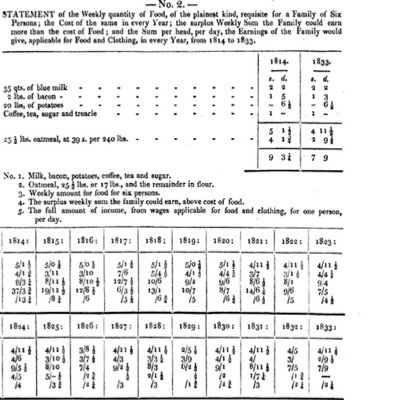
In the next table, we have that the cost of a standard menu of food per week, stayed approximately constant in the range from 8 shillings to 10 shillings. Combining these data of food cost with those of family income from the table above, we have a movement in the real income of the family.

 18141815181618171818181918201821
Income52.034.226.824.228.825.023.328.3
Food9.39.08.812.610.59.39.58.5
Ratio5.63.83.01.92.72.72.53.5
         
 18221823182418251826182718281829
Income22.821.019.119.111.814.614.610.5
Food8.19.39.58.87.38.28.26.2
Ratio2.02.32.02.21.61.81.81.7
1830183118321833
Income13.514.812.012.0
Food9.19.07.47.8
Ratio1.51.61.61.5

(Income and Food in shillings and tenths of shillings)

(Income from Table No. 1 above; Food costs from Table No. 2 below)

Out of the difference between income and food costs, the family had to pay for rent of the house (which contained the looms), rent of the looms, clothing, and fuel.

The relative position of income and food was very good or good in 1814 to 1816, acceptable from 1817 to 1825, and of real poverty from 1826 to 1833:

(Select Committee on Commerce, Manufactures and Shipping, 1833, p. 606)

“Can you tell the Committee what description of food the weavers are generally obliged to put up with?” “The description of food is chiefly oatmeal porridge and potatoes, with occasionally a small quantity of butcher’s meat which they may obtain one in the course of a week.”

“Are there many of them that are not able to procure a sufficient quantity of that coarse food with the wages that they earn?” “I have made a calculation by which I estimate that if a man has to support himself and his wife and five children, with the assistance of two children and his wife labouring with him, they will not be able to earn for food and clothing more than 2 ¾ d. per day. I was not aware of the state of things, until I sat down, and made a calculation for myself, and I must confess that I was startled with the fact.”

“Then the distress of the weavers far exceeded what you had any conception of till you made the inquiry from your own books, and from pursuing the inquiry to other sources, that enabled you to come to those conclusions?” “It did.”

“If they are so distressed for food, how are they off for clothing?” “I cannot recollect an instance but one, where any weaver of mine has bought a new jacket for many years.”

 “Then they are literally clothed in rags?” “Yes, I am only sorry I did not bring one or two jackets to let the Committee see the average state in which they are clothed.”

“Is their bedding and their furniture of the same inadequate description with their food and their clothing?” “I have not been in many of the weavers’ bedrooms, but I have been in some, and they appear to be very bare of clothing; I have known some who have had no blanket at all, merely a coverlid of the value of perhaps half-a-crown when new.”

“What is the nature of their furniture?” “I have observed both on Bolton Moor and at Torkholes, where I go to manufacture, that they are generally without chairs; I have seen many houses with only two or three three-legged stools, and some I have seen without a stool or chair with only a tea chest to put their clothes in, and to sit upon.”  

…….

 “What sort of houses do the weavers reside in, and whereabout are the rents they usually pay?” “The houses are much better than their situation; they are generally dry houses, and such as would be comfortable if they had the means to furnish them; the rents for a two-loom shop will be from five to six pounds, for a four-loom shop from seven to eight pounds, with the addition of poor rates and water rent; the poor rate varies considerably.”

(Select Committee on Hand-Loom Weavers Petitions, 1834, evidence of Mr. John Makin, Manufacturer, Bolton, pp. 388-389)

“At the time you made this survey, had you any idea that there was so much distress in the township you visited as you found there really was?” “I had no idea whatever that there was so much distress as I found, and if I had not seen it myself I could not have believed it, except on very respectable testimony. I was quite surprised. I had heard the subject spoken of and disputed. Some were saying that there was a great deal of distress, and some were saying that there was not, and I determined to see it for myself, and went round the township; and in so wretched and deplorable a condition did I find them, that I am sure no individual could have visited those people, if he was possessed of any of the feelings of humanity, without wishing to relieve it.”

“What took place after you had made those visits to the poor?” “In consequence of finding them so much worse than I expected, I immediately set a subscription on foot for their relief, and it amounted to about 90 l. We bought some blankets and other coarse clothing and distributed to them; ……”

(Select Committee on Manufactures, Commerce and Shipping, 1833, evidence of Mr. Joshua Milne, Cotton Spinning and Manufacturing by Power, near Oldham, p. 663)   

The weaving of cotton by domestic hand-loom workers continued up to 1840, but was accompanied by an extreme reduction of the incomes of the weavers starting from 1817. The power-looms, which were more efficient, started around 1810, but did not take over the majority of the production until about 1835. It is not true that the power-looms caused the lowering of the weavers’ incomes; the incomes decreased from 1817, but the power-looms really started from 1833.

(taken from Wood, 1910, pp. 127-128)

Numbers of looms (thousands)

(Wood, 1910, pp. 127-128; Chadwick, David, 1860, pp. 30-31)

Chapter 7. The Poverty of the Domestic Hand-Loom Cotton Weavers

7.1. Extreme Reduction of Income and Living Standards https://history.pictures/2020/02/07/7-1-extreme-reduction-of-income-and-living-standards/

7.2. Reduction of Wages in 1817 and the Export of Twist https://history.pictures/2020/02/08/7-2-reduction-of-wages-in-1817-and-the-exportation-of-twist/

7.3. The Business Model of the Cotton Industry https://history.pictures/2020/02/08/7-3-the-business-model-of-the-cotton-industry/

7.4. Second Depression of Wages 1826 https://history.pictures/2020/02/08/7-4-second-depression-of-wages-1826/

7.5. Lack of Negative Effects of the Power Loom https://history.pictures/2020/02/08/7-5-lack-of-negative-effects-of-the-power-loom/

7.6. Low Wages and High Volumes around 1830-1834 https://history.pictures/2020/02/08/7-6-low-wages-and-high-volumes-around-1830-1834/

7.7. Over-Production and Home Consumption https://history.pictures/2020/02/08/7-7-over-production-and-home-competition/

7.8. Composition of Costs of the Wholesaler https://history.pictures/2020/02/08/7-8-composition-of-costs-of-the-wholesaler/

7.9. Reasons adduced to the Committees in 1834 and 1835 https://history.pictures/2020/02/08/7-9-reasons-adduced-to-the-committees-in-1834-and-1835/

7.10. Wages and Employment after 1835 https://history.pictures/2020/02/08/7-10-wages-and-employment-after-1835/