Libraries and Institutions 2.36
| Name of Institution or Library | Date of Establishment | 1840 Members | 1840 Books | 1850 Members | 1850 Books |
| Chetman’s Library (free) | 1653 | 16,000 | 19,300 | ||
| Old Subscription Library | 1765 | 20,000 | 30,000 | ||
| Newell’s Buildings, Subscription Library for Promoting General Knowledge | 1771 | 10,000 | 16,000 | ||
| Exchange New Subscription Library | 1800 | 12,000 | 20,000 | ||
| Portico Library and Newsroom | 14,000 | ||||
| Law Library | 1820 | 3,000 | 4,000 | ||
| Foreign Library | 1830 | ||||
| Manchester Mechanics’ Institution | 1825 | 850 | 5,884 | 1,482 | 12,341 |
| Literary and Philosophical Society | 1781 | 180 | |||
| Royal Institution | 1823 | 400 | 420 | ||
| Natural History Society | 1821 | 547 | 200 | 300 | |
| Geological Society | 1838 | 230 | 186 | ||
| Statistical Society | 1834 | ||||
| Phrenological Society | 1829 | 40 | Very few | ||
| School of Design (Art) | 1838 | ||||
| Architectural Society | 1767 | ||||
| Royal Victorial Gallery of Science | 1840 | 198 | |||
| Manchester Atheneum | 1837 | 843 | 5,000 | 1,281 | 10,000 |
| Ancoats Lyceum | 1837 | 715 | 1,700 | 163 | 2,600 |
| Salford Lyceum | 1838 | 365 | 3,000 | 200 | 3,000 |
| + Salford Mechanics’ Royal Institution | |||||
| + Salford Literary and Mechanics’ Institution | |||||
| + Salford Mechanics’ Institution | |||||
| Salford Library (King-street) | 274 | 3,180 | |||
| Pendleton Useful Knowledge Society | 1829 | 142 | 817 | ||
| Pendleton Mechanics’ Institution | 1851 | 140 | 593 | ||
| Christian Institution, Manchester | 1840 | 600 | |||
| 13 small institutions in the Townships | Av. 150 | Av. 800 | |||
| Miles Platting Institution | 1840 | 147 | 1,000 | ||
| Manchester Free Library | 1852 | 21,318 | |||
| Salford Free Library | 1849 | 7,000 | |||
| Chetham Publication Society | 1843 | 350 |
2.36 Chadwick, 1861, Table No. 34, pp. 43-44
Number of Public Institutions in Manchester and Salford 2.37
| Type of Library or Institution | 1840 | 1850 | |
| Commercial Institution | 9 | 6 | |
| Literary, Scientific, and Artistic Institution | 14 | 7 | |
| Libraries | 10 | 6 | |
| Educational Institutions | 35 | 25 | |
| Religious and Benevolent Institutions | 8 | 34 | |
| Medical Institutions | 12 | 16 | |
| Public Charities | 7 | 7 | |
| Miscellaneous Institutions | 12 | 35 | |
| Total | 107 | 156 |
2.37 Chadwick, 1861, Table No. 35, p. 46.
Parks and Places of Amusement 2.38
| Park or Place of Amusement | Date of Establishment | Extent Acres | 1840 Members | 1850 Visitors |
| Zoological Gardens | 1838 | 15 | 600 | |
| Botanical Gardens | 1827 | 16 | 800 | |
| Peel Park | 1846 | 40 | Free | 600,000 |
| Queen’s Park | 1846 | 30 | Free | |
| Philips’ Park | 1846 | 31 | Free | |
| Salford Royal Museum | 1850 | Free | 100,000 | |
| Belle Vue Zoological Gardens | 1842 | |||
| Pomona Gardens | 140 | |||
| Victoria Park |
2.38 Chadwick, 1861, Table No. 36, p. 46.
| MANCHESTER ZOOLOGICAL GARDENS These delightful grounds are upwards of fifteen acres in extent, and are situate at Higher Broughton, about a mile and a half from the Exchange, on the New Bury Road. The Gardens have only been recently formed, but they are rich in animals; and the position of their site, with the tasteful manner in which the land is laid out and adorned with the products of the vegetable kingdom, render them one of the most of the most attractive objects in the neighbourhood. It would be out of place here to give a catalogue of the animals, as a descriptive acoount may be purchased for a trifle on the spot. The following is a list of the principal arrangements about the grounds: – Entrance lodges Bears’ pit Moveable cages Menagerie for carnivorous Eagles’ aviary Winter repository and Animals Refreshment house store rooms Monkey-house Lake Garden curator’s house Aviary for the gallina- Polar bears’ den Keeper’s house ceous birds Pelicans’ pond Geological museum Aviary for foreign birds Dahlia bed Archery ground Elefant’s house Flower garden Rockery Maze, or labyrinth The Gardens are open at an admission fee of one shilling each; children sixpence. There is an interesting spectacle of Herculaneum and Pompeii, as these cities existed prior to the first known eruption, A. D. 77: – On two evenings in the week is represented the eruption of Vesuvius destroying the two towns. Love, 1842, p. 274 |
PICTURE
The Manchester Races were held at Kersal Moor, about two and a half miles from Manchester, in Whitsun Week every year. They were established first in 1730, and continued for one week in each year. In our period, up to 100,000 persons attended the event. Of these 100,000 persons, obviously the great majority were of the working class; so as to be able to take one week off from work, the workers agreed each year with the employers that they would work a number of extra hours in the weeks before the Races.
PICTURE
N. Burton, Leisure in the City: The entertainment sector in the Manchester Central Business District, 1770-1930, 1987, Manchester Geographer, Manchester Geographical Society, Figure 2, p. 22.
The Manchester Central Business District (this is an academic neologism; the phrase was not used in the 19th century) was bounded: on the north-east by Market Street its continuation Piccadilly; on the south-east by the Rochdale Canal; on the south-west by Peter Street and Oxford Street; on the north-west by the River Irwell.
The geographical position was fairly close to the totality of Police Districts 5, 6, 8, and 9.
Public baths, temperance hotels, libraries, billiard rooms were found in many parts of the city. Tea and coffee rooms and clubs were in the centre. There were 45 libraries, of which the half in the central area. Gentlemen’s clubs were concentrated in the centre. The Atheneum was a meeting place for middle class persons with cultural interests. There were four Mechanics Institutes / Lyceums. Two theatres; the Queen’s Theatre and the Theatre Royal. Concert Hall at the junction of Peter Street and Moseley Street (1831). As there are a number of concerts mencioned in the texts as for working class, we may assume that the Concert Hall was used indiscrimately for the better classes and the working classes. The Manchester Choral Society was principally organized by members of the better classes, but there were seasons of public concerts; the singers were active in church and chapel choirs.
In 1842 there were 14 good hotels in the centre of Manchester, generally in Market Street, Picadilly and King Street.
PICTURE
Austin, S.; Lancashire Illustrated, 1832, Market Street after reconstruction, from each end, plate facing p. 29
PICTURE
A depiction of St Peter’s Church and the Theatre Royal on Peter Street, Manchester, around 1855.
(University of Cambridge)
The working classes were very interested in singing, and in going to concerts.
“The first great meeting of the Lancashire and Cheshire Workmen’s Singing Classes was held at the Free Trade Hall, June 10. There were 1,500 performers, led by Mr. John Hullah, the inventor of the system.” 2.39
“The first of a series of concerts for the working classes, conducted by the committee of the Lancashire and Cheshire Philharmonic Institution, was held in the Free Trade Hall”. 2.40
2.39 Axon, “Annals of Manchester”, June 1843, p. 222.
2.40 Axon, “Annals of Manchester”, April 1845, p. 233.
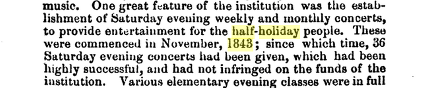
(Report of the Proceedings Connected with the Grand Soirée of the Manchester Athenæum, Held on Thursday, October 3rd, 1844: From the Manchester Guardian of Saturday, October 5th, 1844, Printed by Cave & Sever, Manchester, 1844; p. 6)

