Friedrich Engels writes to Karl Marx about the educational activities in the Manchester Hall of Science:
“While the Church of England lived in luxury, the Socialists did an incredible amount to educate the working classes in England. At first one cannot get over one’s surprise on hearing in the Hall of Science the most ordinary workers speaking with a clear understanding on political, religious and social affairs; but when one comes across the remarkable popular pamphlets and hears the lecturers of the Socialists, for example Watts in Manchester, one ceases to be surprised. The workers now have good, cheap editions of translations of the French philosophical works of the last century, chiefly Rousseau’s Contrat social, the Système de la Nature and various works by Voltaire, and in addition the exposition of communist principles in penny and twopenny pamphlets and in the journals. The workers also have in their hands cheap editions of the writings of Thomas Paine and Shelley. Furthermore, there are also the Sunday lectures, which are very diligently attended; thus during my stay in Manchester I saw the Communist Hall [actually “Manchester Hall of Science”], which holds about 3,000 people, crowded every Sunday, and I heard there speeches which have a direct effect, which are made from the special viewpoint of the people, and in which witty remarks against the clergy occur. It happens frequently that Christianity is directly attacked and Christians are called “our enemies.”” 1.35
1.35 F. Engels, Letters from London, Schweizerischer Republikaner No. 46, Volume 3, June 9, 1843, Letter III; Marx and Engels Collected Works, digital edition Lawrence & Wishart, 2010, p. 387.
There were Mechanics’ Institutes at Manchester Centre (Cooper Street), Salford, and Lyceums etc. at Chorlton, Salford, Ardwick, and Ancoats. From 1845, women could attend special day classes.
The Institute presented exhibitions on scientific and technological themes in 1837, 1838, 1840, 1842-3, 1844-5; these attracted in total 300,000 visitors. 1.36
“The men had frequently learned to write since they were grown up. They were anxious to read well also, that they might avail themselves of the libraries. The lads were in a great proportion of cases members of night schools.” 1.37
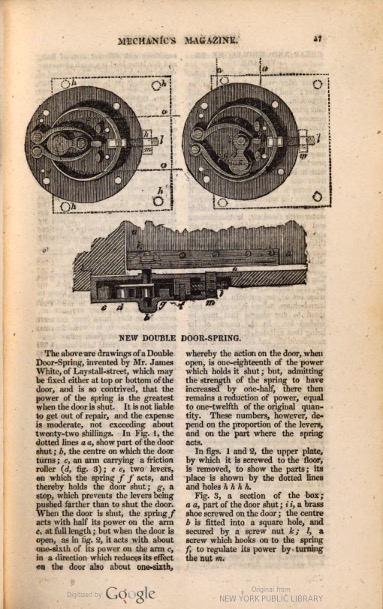
There was a “Mechanics’ Magazine” with a high level of general technical knowledge. It began in 1823, with 32 pages, at 3 pence a week. It had a circulation of 16,000 in 1824, but we can assume that in general, each booklet was read by more than one person.
It is not clear where these 16,000 men obtained the technical education necessary to understand these articles, in the years before 1823; it is also not clear in which industries they worked.
Diagram below from 1.38
1.36 Beauchamp, Dr. Ken, “Exhibiting Electricity”, pp. 40-46.
1.37 Reach, Letters to the Morning Chronicle, p. 59
1.38 “Mechanics’ Magazine”, No. 1, August 30, 1823, p. 47.
“No county buys so many books as Lancashire. Chamber’s Edinburgh Journal, which circulates to the extent of 85,000 per week, is read principally in the manufacturing districts, and Lancashire alone takes 20,000 of them.” 1.39
Evening Schools
In Manchester, according to the 1851 Educational Census, there were 1,478 working-class persons who were taking evening classes. We do not have a detail for Manchester, per occupation, nor per subject. For the total of Lancashire, there were 9,078 such persons of whom Factory Hands were 2,705, Artizans were 3,440, Agricultural Labourers were 565, and 124 were Domestic Servants. As to the subjects given, of 314 schools giving evening classes, 272 had reading, 305 writing, 282 arithmetic, 94 English grammar, 75 geography, 37 mathematics, 29 history, 13 music and singing, and 10 bookkeeping.
Great Britain, Educational Census 1851, Table V p. ccx, Table W p. ccxii.
1.39 Faucher, Léon, Manchester 1844, Its Present Condition and Future Prospects”, 1844, p. 122

